And yeah,
So once we're all ready,
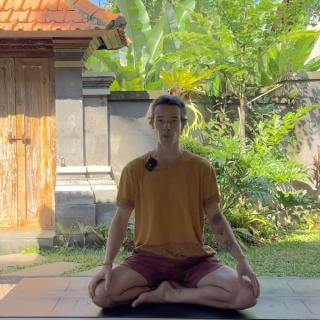
We'll start to settle ourselves into the meditation.
So we can just let our sit bones root into the chair below and we can just feel our eyes
Grow heavy and just blink until they naturally come to a close.
So try to just let go of any thoughts that are running around your head and
Just generate a trust that there's absolutely nothing else that you have to
Do right now.
So just let go of anything that's on your mind,
Release any thoughts
That you have and know that you can deal with anything that comes up after the
Session.
So feel your sit bones rooted in to the chair or to the floor below you.
Feel your spine is straight and self-supporting.
Roll your shoulders up
And back and let your shoulder blades sink down your back to open up your
Chest.
Feel your hands sitting in your lap or on your knees.
Let your chin tuck
Slightly to straighten out the spine.
Invite your jaw to just relax and become loose.
Let your tongue be loose in your
Mouth.
Relax all the tiny muscles around your eyes and relax your eyes from the
Inside to the out.
Relax your forehead and relax the top and back of your head.
And now just take a minute to scan down from the top of your head to the bottom
Of your feet and just make sure there's no last pockets of tension that you're
Holding on to.
If you feel any tension anywhere just breathe into it and feel
It release.
And once we've done that just take a moment to generate a
Positive motivation or intention for your session today.
So you can dedicate
This to someone or to something or to everything.
And now just start to take a
Few deep breaths and feel yourself releasing tension with every out breath.
Let yourself just be fully at ease in your body in this moment.
And know that
By doing these practices we can generate our own happiness from the inside to the
Out and become a source of happiness and peace for other people.
And from here we
Just place our attention on to the ongoing movement of our breath.
So we
Follow it all the way in and all the way out and just become very curious about
The breath.
Observe the cycle and without thinking about it too much just follow
The breath in a natural and easy way.
Try to just keep it in your awareness and
Without thinking of the past or looking in to the future just let your breath
Rest in the present from moment to moment.
And with every in-breath we try
To center the mind and rest the body at ease.
Imagine yourself breathing in peace and light.
With every out-breath we let go of
Any thoughts that may arise and just feel our body relax even more.
And
Whenever you find yourself getting caught up in thought just guide your
Awareness back to the present moment like a small child.
And know that every
Distraction is welcome because everyone gives us a chance to return to the
Present moment and to guide ourselves back to awareness.
Try to notice with
Every breath we're touching life itself.
Every breath is fresh and unique and no
Two breaths are the same.
So try to just notice that in yourself and pay
Attention to the rise and the fall of your abdomen as you gently breathe into
Your abdomen.
Try to just put all of your awareness onto this area for the next
Two to three minutes.
I'll leave you to do this in silence.
And now just keep in
Our full attention on how the breath feels within our bodies in the present.
We're going to start to experiment with the effect of our breath on our
Physiology and on our state of mind.
So first for a minute or two we're going to
Restrict the breath.
So just notice what is your natural breathing rhythm like
Whether it's to a count of four or five on the inhale and on the exhale.
So try
To make a mental note of that and then reduce that by half.
So if your normal
Breathing is to a count of four try to just inhale to two and exhale to two.
So
Your breaths become more shallow and more rapid just for a minute or two.
And
As you're doing this pay attention to what happens within the body and just
Stay curious about how this feels.
You may notice that your heart rate accelerates
Slightly or you become more awake and more alert.
So we're gonna keep going
With this restricted breath for another 30 seconds or so.
And now you can just
Let that go and return to your normal breath.
And again just observe what
Happens in your body as you return to your normal breath and stay curious
About it.
So we feel we've come back to a good baseline with our natural breathing
Rhythm.
We're going to try the opposite.
So now we're going to extend our inhale
And our exhale by about a count of two.
So again if your normal inhale and exhale
Is a count of four then just extend that to a count of six.
So we're breathing
Deeper and try to breathe right down into your diaphragm and slow down the
Exhale.
Again just pay attention to what's happening in your body when you
Do this.
So when we extend the breath you may notice that your mind comes in to a
More calm and relaxed state and you may notice that your heart rate can slow
Slightly and your blood pressure can drop.
So we're gonna keep the breath
Extended breathing deeply for about another minute here.
Again we can just
Let go of the deeper extended breath and let our breathing return to our
Normal rate.
Again notice what happens in your body when you return from the
Deeper breathing to a normal level.
And just let your breath roll in and out
Naturally like the waves on the ocean.
In freediving this natural rhythm of breath
Is known as tidal breathing and it should be slow,
Deep,
Silent and continuous
With no breaks in between the breaths.
So just stay with your own idle breath for
Another minute or so.
And so after another few breaths we're going to do an
Exhale breath hold together.
So for now you don't need to breathe in any special
Way just keep going with this natural tidal breath and let your mind and body
Become completely relaxed.
So we're gonna hold our breath at the bottom of the
Exhale together.
I'll count us down for it and I'll call it the time so no need
To time.
And with this we're just gonna hold our breath until we feel the
Impulse to breathe.
So there's no need to push yourself here and just be honest
With yourself because this is a marker for yourself of your body's efficiency
To use carbon dioxide and oxygen.
And it's not a competition at all.
So once
You're feeling fully relaxed I'm gonna start the timer in 10 seconds.
So try to
Just reach the end of the exhale in 10 seconds with me.
9,
8,
7,
6,
5,
4,
3,
2,
1
And hold at the exhale.
10 seconds
10,
11,
12,
15,
20,
25,
30,
35,
40,
45,
50,
55
And one minute.
Okay so whenever we're ready we can slowly bring ourselves back to the room.
So just take a mental note of how long you were able to hold your exhale before
You got that impulse to breathe.
And as I said this is a test of how efficiently
Your body is using carbon dioxide and oxygen at the moment.
And this is a
Marker that you can use as you continue with your breathing practice to see how
You're progressing.
And so to give you an idea if it was below 10 seconds then
Your ability to retain carbon dioxide is quite low.
If it's 10 to 20 seconds
That's fairly normal these days but it indicates a subtle stressed state.
So it's still not ideal.
If you held between 20 and 30 seconds that's above average.
Really efficient breathers would have a score of 40 seconds or above.
But for today it's
Probably all of our first time trying this so I wouldn't stress too much about
The score you got.
It's more just to use as a marker for yourself if you want to
Progress with a breathing practice.
And you'll notice that the more you do these
Breathing practices the better your body will get at retaining CO2 and the longer
You'll get before you get that urge to breathe.
So yeah take a minute at the end
Of this to reflect,
Jot down what score you got and how that felt for you and
Whether it's something that you would like to do more of.
And yeah next week
Again we're going to be doing a different type of breath hold.
So you're
More than welcome to come and join that.
But yeah that's all for this week and
Thank you very much for joining.
I'll see you again next week hopefully.
Take care.