This is S.
D.
Hudson Magic Jane Eyre Chapter 34 Continued They're coming,
They're coming!
Cried Anna,
Throwing open the parlour door.
And at the same moment,
Old Carlo the dog barked joyfully.
It was now dark,
But a rumbling of wheels was audible.
Anna had a lantern lit,
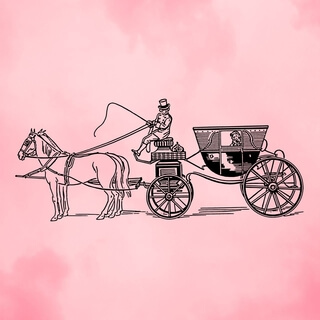
And the vehicle stopped at the wicket.
The driver opened the door,
And first one well-known form,
Then another,
Stepped out.
In a minute,
I had my face under their bonnets,
In contact first with Mary's soft cheek,
Then with Diana's flowing curls.
They laughed,
Kissed me,
Then Diana patted Carlo,
Who was half wild with delight.
They were stiff with their long and jolting drive from Whitcross,
And chilled with the frosty night air,
But their pleasant countenances expanded to the cheerful firelight.
While the driver and Anna brought in the boxes,
They demanded St.
John,
And at this moment he advanced from the parlour.
They both threw their arms around his neck,
And he gave each one a quiet kiss,
And said in a low tone a few words of welcome.
I had lit their candles to go upstairs,
But Diana had first to give hospitable orders respecting the driver.
This done both followed me.
They were delighted with the renovation and decoration of their rooms,
With the new drapery and fresh carpets,
And rich-tinted china vases.
They expressed their gratification ungrudgingly.
I had the pleasure of feeling my arrangements met their wishes exactly,
And that I had added a vivid charm to their joyous return home.
Sweet was that evening.
My cousins,
Full of exhilaration,
Were so eloquent in narrative and comment that their fluency overturned St.
John's taciturnity.
He was sincerely glad to see his sisters,
But in their glow of fervour and flow of joy he could not sympathise.
The return of Diana and Mary pleased him,
But the accompaniments of that event,
The glad tumult,
The garrulous glee of reception,
Irked him.
I saw he wished the calmer morrow was come.
In the very meridian of the night's enjoyment about half an hour after tea,
A rap was heard at the door.
Hannah entered with the intimation that a poor lad was come at that unlikely time to fetch Mr.
Rivers to see his mother who was drawing away.
Where does she live,
Hannah?
Clear up at Wick Cross Brow,
Almost four miles off,
And more a moss all the way.
Tell him I will go.
I'm sure,
Sir,
You better not.
It's the worst road to travel after dark that can be.
There's no track at all over the box.
And then it's such a bitter night,
The keenest wind you ever felt.
You better send word,
Sir,
That you'll be there in the morning.
But St.
John was already in the passage,
Putting on his cloak and without one objection or one murmur,
He departed.
It was then nine o'clock.
He did not return till midnight.
Starved and tired enough he was,
But he looked happier than when he set out.
He had performed an act of duty,
Made an exertion,
Felt his own strength to do and deny,
And was on better terms with himself.
I'm afraid the whole of the ensuing week tried his patience.
It was Christmas week.
We talked to no settled employment,
But spent it in a sort of merry domestic dissipation.
The air of the moors,
The freedom of home,
The dawn of prosperity acted on Diana and Mary's spirits like some life-giving elixir.
They were gay from morning till noon and from noon till night.
They could always talk and their discourse,
Witty,
Pithy,
Original,
Had such charms for me that I preferred listening to and sharing in it to doing anything else.
St.
John did not rebuke our vivacity,
But he escaped from it.
He was seldom in the house.
His parish was large,
The population scattered,
And he found daily business in visiting the sick and poor in its different districts.
One morning at breakfast,
Diana,
After looking a little pensive for some minutes,
Asked him if his plans were yet unchanged.
Unchanged and unchangeable,
Was the reply,
And he proceeded to inform us that his departure from England was now definitely fixed for the ensuing year.
And Rosamund Oliver,
Suggested Mary,
The words seeming to escape her lips involuntarily,
For no sooner had she uttered them than she made a gesture as if wishing to recall them.
St.
John had a book in his hand.
It was his unsocial custom to read at meals.
He closed it and looked up.
Rosamund Oliver,
Said he,
Is about to be married to Mr.
Granby,
One of the best connected and most estimable residents in this shire.
His grandson and heir to Sir Frederick Granby,
I had the intelligence from her father yesterday.
His sisters looked at each other,
And at me.
We all three looked at him.
He was as serene as glass.
The match must have been got up hastily,
Said Diana.
They cannot have known each other long.
But two months,
They met in October at the county ball.
But where there are no obstacles to a union,
As in the present case,
Where the connection is in every point desirable,
Delays are unnecessary.
They will be married as soon as the house Sir Frederick gives to them can be refitted for their reception.
The first time I found Sir John alone after this communication,
I felt tempted to inquire if the event distressed him.
But he seemed to so little need sympathy,
That so far from venturing to offer him more,
I experienced some shame at the recollection of what I'd already hazarded.
Besides,
I was out of practice in talking to him.
His reserve was again frozen over,
And my frankness was congealed by the suddenness of the meeting.
He had not kept his promise of treating me like his sisters.
He continually made little,
Chilling differences between us,
Which did not at all tend to the development of cordiality.
In short,
Now that I was acknowledged his kinswoman,
And lived under the same roof with him,
I felt the distance between two of us to be far greater than when he'd known me only as the village schoolmistress.
When I remembered how far I'd once been admitted to his confidence,
I could hardly comprehend his present fragility.
Such being the case,
I felt not a little surprised when he raised his head suddenly from the desk over which he was stooping,
And said,
You see,
Jane,
The battle is fought and the victory won.
Startled at being thus addressed,
I did not immediately reply.
But after a moment's hesitation,
I answered,
But you are sure you are not in the position of those conquerors whose triumphs have cost them too dear?
Would not such another ruin you?
I think not.
And if it were,
It does not much signify.
I shall never be called upon to contend for such another.
The event of the conflict is decisive.
My way is now clear,
And I thank God for it.
So saying,
He returned to his papers in his silence.
As our usual happiness,
Diana Mary's and mine,
Settled into quiet character,
We resumed our usual habits and regular studies,
And St.
John stayed more at home.
He sat with us in the same room sometimes for hours together.
While Mary drew,
Diana pursued a course of encyclopaedic reading she had.
And I fagged away at German.
He pondered a mystic law of his own,
That of some Eastern tongue,
The acquisition of which he thought necessary to his plans.
Thus engaged he appeared,
Sitting in his own recess,
Quiet and absorbed enough.
But that blue eye of his had a habit of leaving the outlandish-looking grammar,
And wandering over,
And sometimes fixing upon us as fellow-students,
With a curious intensity of observation.
If caught,
It would be instantly withdrawn,
Yet ever and anon it returned searchingly to our table.
I wondered what it meant.
I wondered too at the punctual satisfaction he never failed to exhibit on any occasion that seemed to me of small moment.
Namely,
My weekly visit to Morton School.
And still more was I puzzled when,
If the day was unfavourable,
If there was snow or rain or high wind,
And his sisters urged me not to go.
He would invariably make light of their solicitude,
And encourage me to accomplish the task without regard to the elements.
Jane is not such a weakling as you would make her,
He would say.
She can bear a mountain blast,
Or a shower,
Or a few flakes of snow,
As well as any of us.
Her constitution is both sound and elastic,
Better calculated to endure variations of climate,
Than many more robust.
And when I returned,
Sometimes a good deal tired and not a little weather-beaten,
I never dared complain,
Because I saw that to murmur would be to vex him,
On all occasions fortitude pleased him,
The reverse was a special annoyance.
One afternoon,
However,
I got leave to stay at home because I really had a cold.
His sisters were gone to Morton in my stead.
I sat reading Schiller,
He deciphering his crabbed oriental scrolls.
As I exchanged a translation for an exercise,
I happened to look his way.
There I found myself under the influence of the ever-watchful blue eye.
How long it had been searching me through and through,
And over and over,
I cannot tell,
So keen was it,
And yet so cold.
I felt for the moment superstitious,
As if I was sitting in the room with someone uncanny.
Jane,
What are you doing?
Learning German.
I want you to give up German and learn Hindustani.
You are not in earnest.
In such earnest that I must have it so,
And I will tell you why.
He then went on to explain that Hindustani was the language he was himself at present studying,
That as he advanced he was apt to forget the commencement,
That it would assist him greatly to have a pupil with whom he might again and again go over the elements,
And so fix them thoroughly in his mind.
That his choice had hovered for some time between me and his sisters,
But that he had fixed on me because he saw I could sit at a task the longest of the three.
Would I do him this favour?
I should not perhaps have to make the sacrifice long,
As it wanted now barely three months to his departure.
St John was not a man to be lightly refused.
You felt that every impression made on him,
Either for pain or pleasure,
Was deep-graved and permanent.
I consented.
When Diana and Mary returned,
The former found her scholar transferred from her to her brother.
She laughed and both she and Mary agreed that St John should never have persuaded them to such a step.
I know it,
He answered quietly.
I found him to be a very patient,
Very forbearing,
And yet an exacting master.
He expected me to do a great deal,
And when I fulfilled his expectations in his own way,
He fully testified his approbation.
By degrees he acquired a certain influence over me that took away my liberty of mind.
His praise and notice were more restraining than his indifference.
I could no longer talk or laugh freely when he was by,
Because a tiresomely importunate instinct reminded me that vivacity,
At least in me,
Was distasteful to him.
I was so fully aware that only serious moods and occupations were acceptable,
That in his presence every effort to sustain or follow any other became vain.
I fell under a freezing spell.
When he said go,
I went.
Come,
I came.
Do this,
I did it.
But I did not love my servitude.
I wished many a time he continued to neglect me.
One evening when at bedtime his sisters and I stood round him bidding him good night,
He kissed each of them as was his custom.
And as was equally his custom,
He gave me his hand.
Diana,
Who chanced to be in a frolicsome humour,
Exclaimed,
Saint John,
You used to call Jane your third sister,
But you don't treat her as such.
You should kiss her too.
She pushed me towards him.
I thought Diana very provoking and felt uncomfortably confused,
And while I was thus thinking and feeling,
Saint John bent his head.
His Greek face was brought to a level with mine.
His eyes questioned my eyes piercingly.
He kissed me.
There are no such things as marble kisses or ice kisses,
But my cousin's ecclesiastical salute belonged to one of those classes.
There may be experiment kisses,
And his was an experiment.
When given,
He fued me to learn the result.
It was not striking.
I'm sure I did not blush.
Perhaps I might have turned a little pale,
For I felt as if this kiss were a seal affixed to my fetters.
He never omitted the ceremony afterwards,
And the gravity and quiescence with which I underwent it seemed to invest it for him with a certain charm.
As for me,
I daily wished more to please him,
But to do so,
I felt daily more and more I must disown half my nature,
Stifle half my faculties,
And wrest my taste from their original bent,
Force myself to the adoption of pursuits for which I had no natural vocation.
He wanted to train me to an elevation I could never reach.
It wracked me hourly to aspire to the standard he uplifted.
The thing was as impossible as to mould my irregular features to his correct and classical pattern,
Or to give my changeable green eyes the sea-blue tint and solemn luster of his own.