Hello my friend,
Welcome to humorously dull history for sleep.
My name is Stephen Dalton and it is my hope that that as I tell you lots of different facts about particular periods in history tonight,
You find me so incredibly boring that you fall asleep very quickly.
And maybe.
.
.
Even with a smile upon your face,
It is humorous history after all.
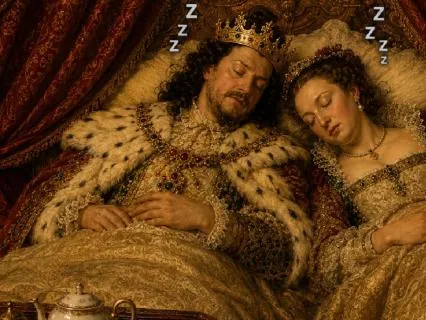
Tonight I'll tell you the humorously dull history of Royal Bedtime Routines.
Yes,
Royal Bedtime Routines.
Ten to draw the curtains,
And two more senior servants to supervise the other seventeen,
All in the service of getting one human being to have a little snooze.
So,
Just before we get started,
Allow yourself to settle into this moment.
Leave the day that was behind.
Feel the support.
Of whatever you lie upon.
If your eyes aren't closed yet.
Allow them to close.
Whatever has been.
Has been.
It's history now.
Whatever will be.
Whoopee.
All you have is this moment.
And my voice.
So allow your curiosity to be a part of this pleasant experience as I tell you the humorously dull history of royal bedtime routines.
To begin any thorough exploration of royal bedtime routines.
One must of course start.
In ancient Egypt.
Where is sleep?
Like everything else in the life of a Pharaoh.
Was less a private activity.
And more a ritualized demonstration.
Of divine order.
While records are incomplete.
Archaeological findings.
And funerary texts.
Give us clues.
Often more about how royals slept in death than in life.
But scholars have long suspected overlap.
The Pharaoh,
Seen not merely as a king,
But as a living God.
Did not simply Go to bed.
He was put to bed.
With a process likely to rival most modern weddings in complexity.
And staffing.
It is generally accepted that the Pharaoh's chambers were scented before his arrival.
Often using imported myrrh.
Frankincense.
Or in some cases,
Blue lotus oil.
These weren't applied freely,
But with precision.
Sometimes using alabaster spoons.
Specifically carved for the purpose.
Each with a shallow scoop.
No larger than the pads of a royal finger.
The application of scent alone could take upwards of 20 minutes.
Not including the preliminary incense offerings.
Made by priests.
Outside the sleeping quarters.
A process necessary to appease the air.
As one scribe put it.
The royal bed itself was not designed for comfort in the modern sense.
Typically raised on wooden legs.
With lying poor feet.
And sometimes sloping downward.
So the Pharaoh's head was higher than his feet.
These beds were usually fitted with a curved headrest made of stone or wood.
And reportedly good for posture.
But terrible for dreams.
The use of linen was ubiquitous.
But only a specific kind.
Woven tightly from flax that had to be harvested during the second lunar month.
Reasons no one has properly explained.
As for company.
The pharaoh was rarely alone.
Depending on the dynasty,
He might be attended by fun-bearers,
Ointment boys,
Scribes to record dreams,
And even a ceremonial harpist,
Whose only role was to strum a few reverent notes.
Before the lights were dimmed.
Although in this case Lights usually meant oil lamps.
Dimmed.
Meant slowly snuffed with a piece of woven reed,
Dipped in damp clay.
The act of extinguishing lamps was itself seen as a symbolic step.
The world entering temporary death.
While the Pharaoh communed with the gods of sleep.
Or at the very least shut his eyes.
And hope for his throne not to be taken in his sleep.
Finally.
There was the matter of the royal amulet.
These were selected each night with a level of fuss.
Normally reserved for foreign diplomacy.
One might be chosen for protection,
Another for fertility in case of late night visits.
And yet another to ward off snakes,
Both real and metaphorical.
These amulets were sometimes tied to the wrist with red string.
Sometimes placed under the headrest.
And in one recorded instance simply held tightly in the right hand.
As if the Pharaoh were going to sleep,
Expecting a duel.
Part two.
In which Alexander the Great probably didn't sleep much.
But when he did.
.
.
Everyone had to know about it.
By the time we reach the classical period.
Royal bedtime begins to shift.
Not necessarily in complexity.
But in tone.
Greek rulers,
Unlike their Egyptian counterparts,
Didn't go in for such overt displays of divinity at bedtime.
Alexander the Great,
For instance.
Wasn't tucked in every night.
With ceremonial harp music.
And seven bowls of scented oils.
But then again.
Alexander didn't sleep like a normal person.
Plutarch tells us.
He often slept very little.
And when he did He slept deeply.
Sometimes fully clothed,
Fully armed and presumably still radiating conquest.
Nevertheless.
It would be incorrect to say there was no ritual.
According to multiple sources.
Alexander had the peculiar habit of sleeping with a dagger under his pillow.
And a copy of the Iliad.
Annotated by Aristotle himself.
On his bedside table.
That's not a metaphor,
By the way.
He literally kept Homer in arm's reach.
Which says something about its priorities.
It's not entirely clear.
Who changed his linens.
But given his fondness for Persian luxuries later in life.
We can assume.
They were crisp.
Scented.
Possibly changed every time someone coughed near them.
The Macedonian camp routine.
Also included the official night tent.
A mobile royal bedroom with elaborate curtains and guards posted at each corner.
No one was to disturb the king's sleep.
Unless.
Absolutely necessary.
Although what qualified as necessary was unclear.
And likely adjusted based on mood.
A thunderstorm.
Probably fine.
Collapsing alliance.
Hold that until breakfast.
Interestingly.
There are records of his physician.
Philip of Agranania.
Preparing sleeping draughts for him during campaigns.
These concoctions were a mixture of herbs Why?
Possibly something that would now be classified under Do not prescribe.
And less under investigation.
Still.
It seems to have worked.
On at least one occasion,
Alexander allegedly slept through a siege.
That had his men digging tunnels under enemy walls.
Either the draughts were effective or his bed was located at a very flattering distance from the noise.
There is no mention of a harpist.
But one assumes if there had been one.
Alexander would have insisted on silence.
Or conquest-themed lullabies only.
The point is,
Even in the field,
The bedtime of a great ruler was not a private affair.
It was an event,
Attended to,
Recorded,
Possibly exaggerated,
And never.
Under any circumstances.
To chance.
Part three.
In which the Romans begin to formalize the art of bedtime fuss.
As the Roman Empire expanded.
So too did the seriousness with which its rulers approached the end of the day.
Sleep was no longer just a matter of finding a flat surface.
It became,
In some quarters,
A carefully managed production.
One involving scribe.
Household Staff.
Fragrance Specialist and occasionally.
A surprising number of marble walls,
Naturally.
Emperor Augustus,
For example,
Had a particular rhythm to his rest.
He believed in short,
Efficient bursts of sleep.
More a series of strategic pauses than a full night off.
He would doze lightly between juices.
Often on a couch in his study.
Wrapped in a linen coverlet.
That had been warmed on a brazier and aired precisely three times.
There was no such thing as a casual nap in the house of Augustus.
Even the act of reclining.
At an air of bureaucratic efficiency.
Later emperors developed more personal bedtime traditions.
The mission for one.
Preferred to sleep in rooms lined with polished stone.
Out for decoration.
But to ensure that nothing in the room could surprise him.
Not a sudden movement.
Not a flickering flame.
Not even the swish of a curtain.
The result was a bedroom that resembled a rather solemn public bath.
Albeit one with fewer towels.
And more security personnel stationed politely in the corners.
Caligula,
An emperor known for his colorful daytime decisions.
Was unusually particular about night-time quiet.
According to Roman historians,
He had certain chambers in the palace sealed off purely because he once had an unsettling dream in them.
Others were redecorated.
Because he claimed the wars were sinking too loudly.
Sleep.
For Caligula was a delicate arrangement.
Subject to mood.
Moonlight.
And how agreeable the pillows had been that evening.
Then we come to Claudius.
Who was said to murmur policies in his sleep?
His household scribes,
Ever dutiful,
Began to record them.
A few were later discovered to be Utterly nonsensical.
A night time decree.
Involving the official classification of lentils,
For example.
But they were noted all the same.
Bruh.
There was even a brief imperial rule that no one was allowed to trim their sandals before breakfast.
That too.
May have been drafted during a nap.
What's clear is that Roman rulers didn't just sleep.
They staged sleep.
There is always a system.
Procedure.
And a story about why the bed had to be exactly there,
And not three feet to the left.
And for the people who served them.
Bedtime was not an ending but a slow,
Careful transition.
Into several hours of not disturbing the emperor.
While still being very nearby.
Just in case he required something at two in the morning,
Like a foot rub or a clarification about barley taxes.
Part four.
In which the early medieval kings bed down.
Sometimes with it dark.
Occasionally with an entire whole.
In early medieval Europe.
Royal bedtime was a slightly more rustic affair.
Gone were the polished stone walls And perfumed linens of Roman refinement.
In their place.
Timbered halls.
Burr blankets.
And a general air of draughtiness.
Yet even in these simpler surroundings.
Kings of the Early Middle Ages.
Managed to turn sleep.
Into a minor ceremony.
One that involved layers of fabric.
Occasional Lassen Mushering the surprising number of onlookers.
Take Charlemagne,
For instance,
The great Frankish king.
Despite ruling over a vast swathe of Europe.
And reinventing half the alphabet.
Reportedly preferred to sleep.
With the windows open.
Even in winter.
He believed fresh air was essential for health.
Which may explain why he often slept wearing a woollen tunic.
Thick Socks and occasionally a small hat.
Tied securely under the chin It is unclear.
Whether this was for warmth or simply personal flair.
But either way.
Is bedtime silhouette.
Would not have looked out of place at a modest barn dance.
Privacy in the modern sense.
Was almost entirely absent.
A royal bedchamber often included not just a bed,
But also various advisors,
Clerics,
Pages.
The occasional pet.
And possibly someone tuning a harp nearby.
In case the king fancied a lullaby.
In many cases,
The king's bed was located in the great hall itself.
On a slightly raised platform.
Separated by a curtain.
Or a thoughtfully positioned wooden screen.
This allowed the monarch to sleep.
While remaining technically available should anything pressing occur.
Such as a messenger arriving from Northumbria.
Or someone misplacing the spoons.
The beds themselves were sturdy wooden frames.
Layered with straw mattresses.
And topped with furs.
Not for luxury but practicality.
Sheep and rabbits were a common theme.
There are a few records of beds stuffed with dried moss or heather,
Presumably by someone feeling experimental.
These arrangements were surprisingly comfortable,
Provided you didn't mind the occasional twig.
Or the sound of a fox rustling somewhere in the beams above you.
It's worth noting that even bedtime prayers were a public activity.
A king might be read to from the psalms before sleep.
Sometimes by a monk.
Sometimes by a slightly nervous clerk with a candle that dripped steadily throughout the performance.
Certain monarchs were known to mumble along.
While others.
.
.
Exhausted from long days of diplomacy,
Unthink.
And moderately successful battle.
Simply nodded off mid-sermon.
Leaving their entourage to quietly extinguish the torches.
And tiptoe away.
Answer.
While these Royal Nights may not have included marble chambers or silk robes.
They were no less ceremonial.
They just happened to be colder.
And smell faintly of roast meat.
Part five,
In which the medieval kings begin to take bedtime very seriously.
With a great deal of help.
By the High Middle Ages,
Royal bedtime had become increasingly elaborate.
Not necessarily more restful.
But certainly more attended.
Monarchs now slept in castles.
And with castles came staff.
And with staff came structure.
The bedtime of a king was no longer just a personal matter.
It was an event.
A procession even.
Carefully schedule.
Occasionally delayed.
Always witness.
Let's begin with the ritual of disrobing.
Which was not,
As one might hope.
A swift or solitary activity.
Is required at least two attendants.
Sometimes more,
Depending on the season.
And how many layers the monarch had insisted on wearing that day.
A good valet de chambre.
Could remove the tunic in under 30 seconds.
Without wrinkling it.
A skill that was both admired and occasionally written about.
In surprisingly glowing terms.
One royal wardrobe account from 1293 includes the note,
You did fold the king's undershirt with dignity and speed.
Praise indeed.
Once the usher garments had been removed and handed over for folding.
Hearing.
Or a life inspection.
Depending on the day.
A light cleansing ritual follows.
This might involve warm water.
Scented herbs.
And a soft class.
On some occasions.
Particularly in the French court.
There was a designated hand-washing bowl.
Made of silver.
Into which the king would dip his fingers before bed.
Whether they needed washing or not.
It was less about hygiene.
More about tradition.
And appearance.
And silver bowls.
Then came the reading.
Not for pleasure.
That came later in history.
But as a devotional exercise.
A monk or chaplain would be called in to read a selected passage.
Sometimes this was done aloud.
Sometimes whisper it.
Depending on the king's mood.
There are accounts of one English monarch requesting the same passage every night for nine months.
Not for religious reasons.
But because he found the rhythm helped him drift off somewhere around the fourth stanza.
Lighting was then dimmed.
By which we mean candles or a snuff.
Usually one at a time,
By a servant with a purpose-built extinguisher that looked like a very solemn pair of tongs.
The final candle was often kept lit.
Until the monarch gave the signal.
Usually a nod.
The one account mentions a small bell that was rung precisely once to mark the transition from still available to please don't.
Finally,
The king would be left with a drink.
This might be warm spiced wine.
Or a posset.
A curious blend of milk,
Ale and occasionally eggs.
The idea was to aid digestion and quiet the humours,
Though it's unclear if it ever actually did.
A few monarchs preferred plain water,
But even that had to be served from a jug.
That had been rinsed three times and glessed lightly by someone in robes.
And with that The room would empty.
Slowly.
Quietly.
With just enough theatrical solemnity.
To make it clear that the day was now at last over.
Properly over.
Part 6,
In which Renaissance monarchs introduce extra steps,
Musical interludes,
And an unusual number of slippers.
The renaissance brought with it.
A renewed interest in structure.
Style.
And making everything.
Even sleep.
A matter of aesthetic.
Monarchs across Europe embraced the idea that bedtime was not simply a routine to be carried out.
But a statement to be performed.
It was a declaration of civility,
Refinement,
And,
In at least one case,
How many people you could summon to help you change into nightwear without ever having to move your arms?
Let's start in France,
Where King Louis XIV raised the act of going to bed to something bordering on theatre.
The couche,
As it was known,
Became an official court ceremony.
Is involved nobles.
Positions.
And various levels of courtiers,
Standing silently in a gilded room,
While the king's attendants helped him into a sleeping shirt.
And adjusted the covers.
Not everyone was allowed to stay for all of it.
That were distinct phases.
High-ranking nobles might witness the initial disrobing.
Lower-ranking ones,
Had to leave before the second stocking came off.
This was not improvised.
It was written down.
Once suitably attired for slumber,
Louis would sometimes offer a few words.
Nothing too taxing.
And sip a digestive.
Well,
Someone read from a devotional text.
Or played a soft melody nearby.
Music at bedtime,
Became briefly fashionable among royals of this era.
Provided it was sufficiently slow.
Contained no abrupt chord changes.
And could be played with an acceptable degree of eyelid drooping.
In England,
Bedtime retained a sense of occasion.
But added layers of domestic concern.
Henry VIII,
For instance.
Required that his nightcap A literal cup.
Be warmed before it touched his head.
This task fell to a designated valet who would rotate two cups over a small brazier,
Alternating them with great care so the heat was even.
There is no recorded punishment for unevenly warmed nightcaps.
But one can assume the pressure was high.
Slippers,
Too,
Became increasingly important.
By the late 16th century,
Royal slipper presentation had been fully formalized.
A designated slipper holder.
Would place the slippers beside the bed,
Heel aligned,
With the toes pointing slightly outward at a 45 degree angle.
In one well-documented mishap in the Spanish court,
The slipper was presented at the wrong angle,
15 degrees off-centre.
And the servant responsible was reassigned to kando counting.
A less prestigious role.
As bedtime neared its final moment.
The courtiers would file out.
Leaving one or two trusted attendants.
To remain just out of sight.
Behind a folding screen.
These attendants would remain on hand throughout the night.
Ready to provide water.
Just blankets.
Or fetch the royal physician in the event of indigestion.
Brought on by a particularly enthusiastic positive.
It was considered the height of trust to be the person quietly hovering behind a velvet curtain while the king snored.
And so.
.
.
In the renaissance court.
Bedtime was less an act of rest.
And more a closing performance.
Gentle.
Labyrinth Choreograph.
And mostly concerned with making sure the monarch was not left unslippered.
Unprayed for.
Or under attended.
At any point.
Part 7 In which the Georgians introduce powder,
Pompom and a curious suspicion of lying down too flat.
By the time we arrive at the Georgian period,
Roughly the 18th century.
Royal bedtime routines had become,
If anything,
Even more ceremonious.
This was an age of wigs waistcoats.
Chamber pots with embroidered lids.
And strong opinions about drugs.
The monarch didn't simply retire for the night.
They withdrew.
Often slowly.
And with at least one footman carrying a candle in each hand.
Let's begin with King George II.
Who reportedly preferred to sleep.
Propped up on several pillows.
Believing,
As many did at the time.
That lying completely flat encouraged the vapours to settle in the lungs.
The number of pillows was adjusted seasonally and,
On one occasion,
According to the alignment of Venus,
Whether or not this was based on medical advice remains unclear.
But his valet was once reprimanded for fluffing them in the wrong order.
Hair was naturally a major concern.
Although wigs were removed at night,
The royal scalp was considered far too delicate to be left unattended.
Most kings and queens of the period.
At their heads lightly dusted with lavender powder before bed.
Not for hygiene.
But for general morale.
One courtier's diary from 1741.
Note that the king appeared unusually composed this evening,
His temples had been excellently dabbed.
Niceware followed strict rules.
A royal nightshirt had to be freshly laundered,
Folded and scented.
But not too scented.
There was a brief scandal in the court of George III.
When an overzealous launderer.
Added a few drops too many of rose oil to the colour.
Which clashed apparently.
With the preferred scent of the king's pillow.
This was not taken lightly.
The Final Act Before Sleep was the presentation of the warming pan.
This was a long-handled device.
Filled with embers.
Slid between the bed linens to make them slightly less rusty.
The process had to be timed precisely.
Too early.
And the bed cooled down again.
Too late.
And the room filled with the faint smell of scorched linen.
One royal warming pan was engraved with the phrase,
Moderation in all things.
A motto that applied equally to temperature.
And to the length of the bedtime psalm.
Reading material was permitted.
But only certain types.
Political treatise were discouraged.
As they led to sighing.
Travel accounts were considered too exciting.
Suitable books included weather diaries,
Greek grammars,
And moral essays that concluded with everyone learning their lesson and having a quiet sit-down.
If none of these were to hand,
The monarch might simply request a servant to describe what happened that day,
But slowly.
And without involving any unresolved conflicts.
With all tasks complete.
The lights were dimmed.
By which we mean several dozen candles were individually pinched out by a gloved hand.
The door was pulled shut behind the final bowing attendant.
The room would now be left to quiet.
To rest,
And to the gentle sound of a monarch shuffling for a more agreeable pillow angle.
Part Eight.
In which the Victorians add a touch of fuss,
A hint of guilt,
And an unreasonably long list of bedside objects.
The Victorian era,
Ever fond of moral structure and tightly scheduled feelings.
Approached royal bedtime with a spirit of earnest dignity and low-level concern.
Sleep was important,
Of course.
It was when the body restored itself.
The soul reflected.
And the domestic staff quietly panicked over a lynch.
For Queen Victoria herself.
Bedtime was a serious matter.
Not dramatic.
Not showy.
Just carried out properly,
With the appropriate gravity.
And a carefully starched nightdress.
The evening would begin with a quiet meal,
No spice,
Nothing saucy.
And absolutely nothing French after 8pm.
Once the royal stomach had been settled with a small helping of rice pudding or a cold mutton.
Her Majesty would retire to her private sitting room.
Here she would complete correspondence.
Reads heavily underlined devotional material.
And occasionally.
If the mood allowed.
Sketch pictures of dogs she loves.
When it came time to prepare for bed.
Two ladies-in-waiting would assist with the evening routine.
This included the removal of several petticoats,
The brushing of hair exactly one hundred times,
More for order than effect,
And the ceremonial placing of slippers beneath the dressing chair.
Toes neatly aligned.
Eels facing Windsor.
One servant was responsible for folding the outer garments with light but decisive hands as described in the Queen's own instructions bedside items were many and strictly arranged.
A bell.
Not too loud.
Was placed within reach.
In case of emergencies.
Or the sudden need for an extra blanket.
A handkerchief embroidered with the royal crest and lightly pressed with lavender water.
Was laid on the pillow.
There is always a small book of evening prayers.
A notepad.
Relate thoughts,
Dreams or the names of underperforming ministers.
And a dish of lozenges.
Ideally in mint or clove.
Though one account mentions a brief but disastrous experiment with lemon.
Queen Victoria in later years.
Often requested her husband Albert's dressing gown be draped over the arm of a nearby chair.
Comforting gesture.
Even decades after his passing.
Sleep,
For her,
Was not just rest.
It was reflection.
Duty.
And the final act of a long controlled day.
Lights were dimmed gradually.
Candlelight replaced by gaslight and later electric lamps.
Which he reportedly did not fully trust.
And the room was left to silence.
Apart from the gentle ticking of the clock.
The faint rustle of linen.
And the slow.
Deliberate winding down.
Of the British Empire for the night.
Part nine.
In which the twentieth century ushers in switches Slippers with rubber soles and corgis who had their own schedule.
With the arrival of the 20th century,
Royal bedtime began to modernize.
Slowly.
Cautiously.
And with occasional complaints.
The introduction of electricity brought new opportunities for convenience.
But also fresh anxieties.
Was the light truly off?
Or simply hiding.
Would the new electric blanket misbehave?
And was it still necessary to have someone stand outside the door,
Holding a candle just in case?
King George V was a traditionalist at heart.
But even he accepted certain upgrades.
He permitted bedside switches,
Though insisted they be labelled in embossed brass.
He also had his bedroom walls lined with modest floral wallpaper.
And kept a framed photograph of a favourite steam engine next to the bed.
A detail noted by visiting diplomats.
Most of whom were too polite to ask.
His bedtime routine was efficient.
Short on fuss and largely focused on foot-related comforts.
The royal slippers were now rubber-soled with silence.
And warmed beside the fireplace before use.
They were handed to him using silver tongs.
Not for ceremony,
But because one doesn't pass slippers directly to the monarch.
A rule that no one could explain,
But everyone followed.
Queen Elizabeth.
The Queen Mother.
Famously enjoyed a small drink before bed.
Usually a Djinn and Dubonnet.
Always prepared to the same ratio.
The glass was to be placed on a particular doily,
Which had been in service for nearly thirty years,
And had faded to a calming,
Forgettable colour.
Her bedtime reading tended to be reliable biographies and long-running mystery novels.
Which were carefully bookmarked each night.
Even if only a page had been read.
One lady in waiting recalled that Her Majesty liked the sound of pages turning.
Is help to settle.
Even if she wasn't following the plot.
And then came the corgis.
From the reign of George VI.
Through to Elizabeth II.
Bedtime increasingly involved the presence of s'mores.
Enthusiastic dogs.
Who had their own well-rehearsed procedures.
The corgis had cushions placed at the foot of the royal bed,
Embroidered,
Cleaned weekly,
And their own late-night snack,
A biscuit,
Placed with quiet reverence on a small silver tray.
There was once an incident involving a misplaced biscuit and a heathed note sent from the Queen's private secretary.
It was never spoken of again.
By mid-century,
The concept of a bedtime caller,
Someone allowed to deliver brief,
Non-urgent updates before lights out,
Was firmly established.
These were usually political in nature.
A minor embassy has changed hands,
Or the Duke of Kent is in Kent.
But occasionally personal.
If nothing required reporting,
The queen would be informed of that,
Too.
There is nothing tonight,
Mom,
Was a sentence rehearsed daily by a young footman learning the ropes.
And so.
Even in a time of airplanes.
Radios.
And rapidly approaching television sets.
Royal bedtime retained its familiar shape.
Ritual Order Comfort.
And just enough gentle management.
To ensure is it nothing.
Not even the turndown of a pillow.
Happened by accident.
Part 10.
In which the modern monarchy winds down with quiet precision.
Filtered lumps.
And the occasional plug adapter.
In the modern era,
Royal bedtime has become quieter,
More streamlined,
And,
In a way,
Slightly more relatable.
The rooms are still large.
The sheets are still monogrammed.
And the staff discreet.
But gone are the days of velvet screens and heated slipper tongues.
What remains.
Is the essence of routine.
A predictable,
Calming end to the day,
With just enough protocol to remind everyone that even sleep in a palace.
Is a shared responsibility.
Queen Elizabeth II by all accounts.
Was fond of routine.
And deeply private about the details of her bedtime.
But a few gentle clues emerged over the years.
She was said to retire at precisely 11pm.
Preceded by a light meal.
Followed by some reading.
Often political biographies,
Crosswords,
Or long-running detective fiction.
If reading didn't appear.
You might listen to the radio at low volume.
Usually the BBC World Service.
Which has lulled monarchs and commoners alike for decades with its curiously reassuring tone.
A bedroom,
It is said,
Contained all the expected elements.
A rising desk.
A telephone.
A neat stack of correspondence.
And a sensible armchair.
Her nightwear was crisp and modest.
A lump filtered through a shade selected years earlier and never replaced.
The room was often scented with a faint hint of beeswax polish.
Not applied by her,
But noticed all the same.
As for the dogs.
.
.
They continued their ritual,
Though in later years they were more inclined to snores and parades.
Technology arrived,
As it always does.
And had to be gently integrated into the bedtime system.
The Queen was not known to use a mobile phone before sleep.
But security staff ensured all devices in her vicinity.
We're fully charged.
Switched to silent.
And positioned,
So as not to create unflattering shadows.
There were no alarms.
No glowing digital clocks.
No harsh ideas.
All lights were adjusted to evening tone.
A setting achieved through a mixture of dimmers,
Lump-shades,
And knowing which bulb to never touch.
The bedtime briefing remained,
Though it became briefer still.
Towards the end of her reign.
Mom,
There is nothing of note.
Became a cherished refrain.
The sound of the world.
If only briefly.
Behaving itself.
It was said she appreciated the quiet of bedtime most of all.
The knowledge that the day had ended.
And let her roll.
Constant,
Watching,
Steady could be paused if only for a few hours.
And so The modern royal bedtime is less theatrical than its predecessors.
But no less deliberate.
It is composed.
Considered.
Politely unchanging.
A tradition in soft cotton.
Carried out with care.
Behind it firmly.
Closed door.