Hello and welcome.
I'm Phyllis.
Today's gentle yoga class will be for nervous system regulation.
We'll use breath.
Gentle movement,
A myofascial release.
And interoception of what we sense within our body.
The only prop that you're going to need is perhaps something for underneath your head and then a rolled up towel.
If you have one of those smaller stability balls,
You could deflate them halfway too,
But I like to use props that people will have at home.
So a rolled up towel or blanket,
Not too big,
Not too small,
Just right.
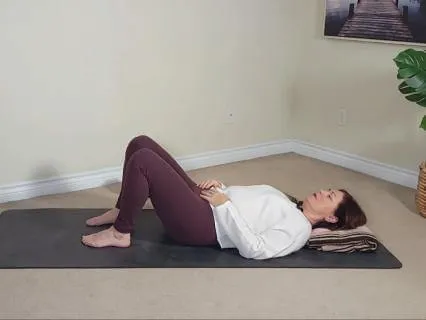
We will lie down the whole time on our mat.
So again,
Having something underneath your head perhaps to support the neck.
You can keep your legs bent here,
Feet flat on the floor,
Or extend them out long,
Maybe having something underneath your thighs.
It could be a nice way to have your legs bent here.
It actually can help to release the psoas muscle.
The femur bone can drop down into the socket.
So feeling that as you settle in here,
If you have your legs bent.
Begin to notice the breath moving in and out of the body.
Notice how this feels for you to land here.
With a compassionate lens on yourself.
How does your mood feel today?
How does your physical body feel?
Notice how the breath feels.
Often if we're stressed,
We might be breathing a little more up into the chest only.
So we want to let the belly rise and fall.
When the belly is rising and falling,
The diaphragm is able to.
.
.
Have its full excursion.
So on the inhale,
The.
.
.
Diaphragm pushes down on the internal organs and the belly rises.
And then on the exhale,
The diaphragm relaxes back up.
So it's like a dome shape fits underneath the ribs.
So on the inhale,
It's flattening out more,
It's contracting.
It is a muscle,
So we want to be able to use that muscle and strengthen that muscle.
The vagus nerve also innervates through the diaphragm.
So when we do this belly breathing,
You can even place your hands on your belly if you like.
You're stimulating the vagus nerve.
And then we'll move through a pursed lip breath.
So take a normal inhale through the nose.
And then imagine that you have a straw in between your lips and you're going to breathe out that straw nice and slow.
So take an inhale through the nose.
And then exhale,
Pursing your lips,
Slowly breathing out through that straw,
Allowing the exhale to be longer.
Gentle inhale through the nose.
Exhale through pursed lips.
Do that two more times,
Inhaling.
This helps to lengthen out our exhale.
Which is one way to help to calm our nervous system in a stressful situation.
Can even be stressful thoughts that we're having.
So we lengthen the exhale.
Slow mindful practice can help to regulate our nervous system.
They do not have to be long practices.
We can do slow practices.
All right,
And then let your breath settle back to normal.
Notice how you feel perhaps.
There's no difference,
That's okay.
And then if your legs are straight,
You're going to bend them.
And then join us as we bring our knees in towards our chest.
If your legs were bent,
You're just going to pick up your knees.
If this causes too much pain on your low back,
You can just pick up one knee at a time or maybe have a strap.
You're just going to slowly start to rock side to side.
So these movements we do are mindful and we slow them down.
That allows for interoception and when we take pauses.
It helps to integrate.
When we're allowed to integrate any changes,
That can help the.
.
.
And then keeping the knees together,
Start to circle the knees around.
So when we circle our knees around,
We're gently massaging the low back.
Helping to produce synovial fluid in the discs in our low back.
Let's go the other way and then see if you can sync movement with breath.
So you would take an inhale as you circle the knees away.
Exhale as the knees come in nice and slow with the breath.
Sinking movement with breath.
It's another way to help regulate the nervous system.
One more here.
All right,
And then pause here,
Take an inhale.
On the exhale,
Just give the knees a gentle little squeeze in towards the chest,
Gently.
And then again,
The vagus nerve,
It goes through the diaphragm.
We're going to do that again.
And also runs down into the stomach.
So when we gently draw our knees in,
We're also stimulating the vagus nerve.
One more that way.
Exhale gently.
And then release the knees,
Let the feet float down onto the floor.
Walk your feet out nice and wide and take your arms and open them out to the side.
Let your knees go one way and head goes the other way.
You can let the knees go.
As small as you want so they don't have to go all the way over.
They do not have to touch the floor.
Notice how this feels around your hip and your spine.
On that side.
Gentle twists can also help to soothe the nervous system.
Let's just pause here now on that next side,
On one side.
So I'm letting my knees go over to the right.
You might choose to have something underneath that bottom knee.
Maybe allow your head to turn away for the knees.
And then you might see what that feels like to take.
The opposite arm.
So if your knees are over to the right,
You're going to take your left arm and just extend it up a little bit.
Always staying without any pain.
And then let that arm come down,
Let the knees come back to center.
And then let the knees gently go over to the other side.
Again,
You might choose to have something underneath that.
Bottom leg,
Maybe even underneath the top.
Slowly turn your head away from the knees if that feels okay for your neck.
And then you're going to take that opposite arm.
Now,
If your knees went over to the left,
You're taking the right arm.
Just keep it still bent,
You're just going to extend it just a little bit so it's still bent.
And then bring your knees back up.
Bring the arm down.
Walk the feet a little closer in,
Keeping the knees facing up.
Imagine that you have a clock placed on your pelvis.
So if your pelvis was to go around each hand of the clock,
You might imagine,
Some people teach this differently,
I like to think of my pubic bone as 12 o'clock.
So if I tip to 12 o'clock,
That's arching my back.
And then my belly button is.
Six o'clock so now I'm flattening my back a little bit.
So you're rolling to 12 o'clock back arches and if you think if you do it in reverse that's fine too.
And then flattening the back.
So that's six o'clock.
Now go to 12 o'clock.
Bring your pelvis back to neutral,
Knees stay facing up,
And then tip over to three o'clock.
That would be your right hip if your pubic bone was 12 o'clock.
Back to center,
Knees stay facing up,
And then tip to nine o'clock.
Just a little tip.
And then back to centre.
Now see if you can add all of those together.
So go to 12 o'clock,
Your back gently arches.
Three o'clock,
That's the right hit.
6 o'clock the back flattens and 9 o'clock.
The left hip.
Keep going through each hand of the clock.
Another way to nourish the Low back,
So we're helping to produce synovial fluid when we gently move.
Again,
Staying without any pain.
And then you might want to go in reverse.
You can always make these small.
They don't have to be big at all.
Keep your breath just smoothly going.
And then come back to center.
Just notice how that feels on your back and your hips just from doing those.
Few gentle movements that we've done.
When we pause,
It allows.
The nervous system to integrate any changes.
And then we're going to take a hold of that rolled up towel that we had.
I'm going to face the camera this way.
So I'm going to have it underneath my left side.
You can choose.
You might want something a little bit bigger underneath your head just to make sure your head is nicely supported.
I can get something a bit bigger.
If you don't need something bigger,
You don't have to,
But you just want to have your neck still more neutral.
So it's not your head's not just hanging down.
All right,
Just take a moment here.
The towel,
Sorry I didn't explain that good.
The towel is right above your hip bone.
And right underneath the ribcage.
So it's right in that side waist.
Often an area that can get tight.
So if you find your breathing is quite shallow,
And if you find you stand on one leg more than the other,
You might.
Have one side of the waist that's a little tighter.
So you can choose to have that top arm just relaxing here.
We're just having that gentle pressure.
If it feels too much,
You can always remove the prop and just lie here.
Another thing to do would maybe be to have that arm and just have it kind of up over by your head if that feels okay for your shoulder.
And then notice as you inhale.
The top rib cage can expand a little more.
And you're gently pushing down into that.
Support the towel that you have rolled underneath Notice there's less room for the bottom ribs to expand than the top ribs.
But we're adding a little bit of compression to all the muscles around the side waist when we lie here.
So that's good.
Called a myofascial release,
Muscles and fascia.
When we compress.
Signals to them to let go.
Take one more breath there.
Notice how this feels.
Feel the top ribs.
Feel the bottom waist.
And then take that top arm back down.
And then we're going to keep the towel right there.
We're going to roll just a little bit onto that side of the back.
So we have the QL muscle.
It goes from the back of our hip,
The top of our hip,
To the bottom ribs.
Often a muscle that can get tight and it's an accessory breathing muscle.
So I'm going to roll just a little bit.
So I'm partly on my back.
You could roll all the way onto your back if you want,
But I find with the towel,
I like to use those other balls then if I'm going to do that.
So I'm going to just roll partway.
Now,
If this doesn't feel good for you at all,
Just adjust.
You can just.
.
.
Move your body around.
So I'm going to shift just a little bit.
So if this again feels too intense.
Just means your body's not quite ready for it.
So please just listen to it.
You can always make the towel smaller.
So this towel I find is just a teeny bit on the big side,
But I'm just gonna stay here just.
It's okay,
I'm not.
Straining at all,
But I would normally have it maybe just a little bit smaller.
And again,
Breathing.
Feel how the part of your low back on that side gently presses into.
The towel.
Feel the ribs expanding left to right,
Front to back.
All right,
And then we're just gonna roll back over onto our side.
Push yourself up just to remove that support,
That towel.
And then I want you to come on to your back without any support underneath.
The back.
Just notice how that feels for you.
Notice how it feels on that side waist.
That side of the back.
Notice how your breathing feels.
Perhaps from one side of the ribcage to the other.
So this is called interoception.
What do we sense from within?
Noticing any changes allowing the brain to integrate.
And then we're going to roll over onto the other side,
Taking that towel with you.
I'll just face the camera here.
So again,
It goes right on the top of the hip.
So I'm going to make mine a little smaller.
So I just got a little bit of.
Extra hanging down there so it just on top of the hip.
And underneath the ribs a little right in that.
Side waist.
And again,
I like to have a bigger support underneath my head.
And then that top arm can rest on that top thigh or top hip.
You might choose to maybe take that arm up over your head.
I'm going to keep for.
Change sake I'm going to keep this top arm resting here on the top hip,
But you feel free,
You can always take it and rest it up over your head if that feels okay for your shoulder.
As you gently breathe here,
Feel the bottom waist.
On the inhale,
It gently pushes into the support.
Exhale,
It softens,
Letting go a little more.
Notice there is more space in the top ribs to breathe.
Ahem.
Notice there's more space in the top ribs to expand.
And then if you had your arm over your head,
Just release the arm down.
And then we'll start to roll back just a little bit.
So you're just going to go a little bit onto that side of your back so the towel is still there.
And now we're targeting that QL muscle.
A very deep low back muscle that can often get tight.
You could also try a little tennis ball,
But that can be a little intense sometimes.
Just going to pause here.
QL muscle is.
A breathing,
Accessory breathing muscle.
So when it's tight,
That can affect our breathing.
Sitting for long periods or standing still for long periods can also make the QL tight.
Notice how this side feels compared to the other side.
Right,
And then roll back onto your side.
You're going to push yourself up,
Remove that prop.
And then lying back down onto your back.
Perhaps taking that larger support,
Having a smaller support underneath your head now.
Legs can be bent or straight.
Just notice how this feels now for the body.
Feel the.
Side waist that we just did.
Notice the rib cage.
And the back.
And now noticing the back as a whole.
Compared to when you first laid down here.
Are there any changes?
Placing your hands again on your belly.
Notice what your breathing feels like compared to the beginning.
Does it feel like there's any more ease?
Belly expands on the inhale.
Softens on the exhale.
Belly expands on the inhale.
Softens on the exhale.
And now take your palms together.
You're going to rub them together.
Just a few times,
Get a little bit of heat in your palms.
And then take your palms and cover them over your eyes.
Take a nice deep inhale here.
And then an exhale out through the mouth.
We'll do that two more times.
This can be a nice way to also calm your nervous system.
Eye palming,
Just taking the palms lightly over your eyes,
Eyes opened or closed,
Inhaling through the nose.
Exhale.
And one more time.
Tapping them over the eyes,
Inhale.
And exhale.
And this time we're going to let our hands rest on our heart.
And as you pause here with your hands on your heart.
Just honoring,
Acknowledging yourself.
You might choose to say to yourself,
I am doing the very best that I can.
And I thank you so much for joining me today.
Until next time.