Hello everyone,
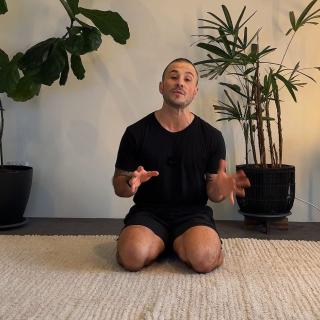
My name is Pedro Avila and in this video I want to chat to you about the differences between static stretches and dynamic stretches.
It's very simple.
As the name says,
You are welcome.
Static,
You're not moving.
And the other one,
You are moving.
Okay,
So what these two look like and why we should be doing both.
Okay so,
Let's start with the static.
If you haven't watched the breathing video about letting your brain know that you're safe,
Watch it,
Okay?
But when it comes to flexibility,
It's all about letting your brain know that you're safe.
Because if you're safe,
Your muscles can relax.
If you can relax,
If your muscles can relax,
You can achieve a deeper stretch.
Make sense?
So this is point number one.
You've got to sink and focus on your breathing when you're trying to stretch,
Regardless of what you're doing.
Okay.
Now that you are breathing,
Your brain thinks it's safe,
You can stay on the stretch for longer,
Okay?
A lot of people,
They stretch for about 30 seconds.
It's good,
Something is always better than nothing,
But it's not enough time to cause significant differences in the muscle itself,
Okay?
So muscle is made by amino acids.
A whole bunch of amino acids chain together,
Creates a bundle,
And then the bundle together creates muscle.
So it's a whole bunch of strings bundled together,
That's a muscle.
Think about an elastic band.
When you pull the elastic band once,
It doesn't really lose its stretch,
Correct?
Now,
If you pull and you maintain that pull for like a minute,
When it comes back,
It won't come back to its original form.
It's stretched now.
It's further.
And your muscles works just the same way.
So static stretches are usually stretches that you can hold on for about 1,
2,
3,
Even 5 minutes.
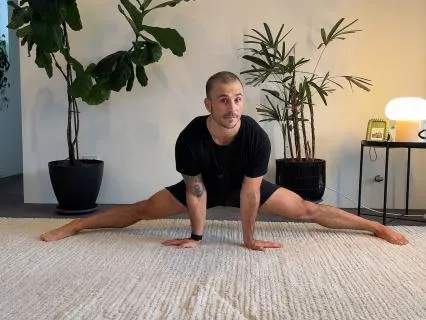
For example,
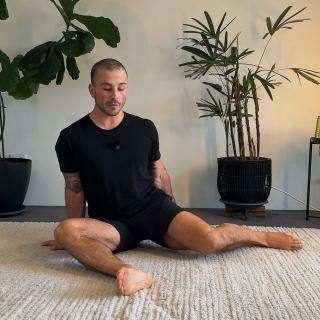
Side splits,
Okay?
I was really stiff.
Not anymore.
Now this is a good example.
Of a static stretch.
I'm gonna hold on to this position for about a minute.
Focusing on my breathing.
Now,
This here,
It will get harder.
Why?
Because I've got gravity working against me.
So,
The more I relax,
The more my muscles stretch.
But because there's a gap between my hips and the floor,
I will keep on getting deeper and deeper and deeper.
Okay?
So this is one way to do it.
Another one is here.
Pancakes.
Alright?
So another example of static stretch here.
You can just sit here on the pancake stretch.
Right now,
I can feel a big stretch,
Like a good eight out of 10.
But if I stay here long enough,
About.
.
.
A minute this eight feeling sensation is going to drop down to a good six seven if I stay a little bit longer it's going to become a five okay This is the static stretch.
You're going to feel the stretch disappearing or dissipating over time,
But you've got to stay there.
So you give your muscle enough time to adjust to the stretch.
That's static stretch.
Dynamic on the opposite For example,
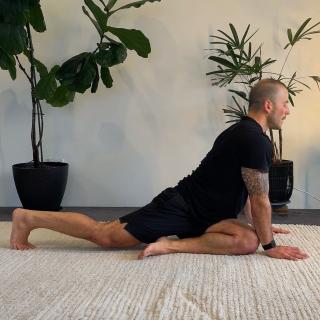
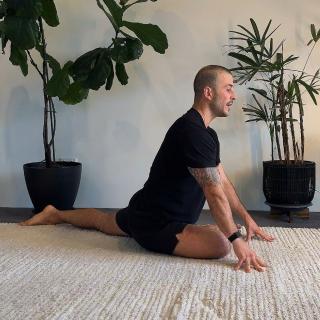
We can do a hip flexor stretch.
You can sink your hips down,
You can feel the stretch,
Get a good eight or nine out of 10.
Out of the stretch.
Inhale.
Exhale so you're achieving the end of the range of motion of your muscle and then you're out of it inhale So you're always pushing a little bit further.
I really like to combine dynamic with statics.
I like to start with dynamics to warm up and the muscles,
And then I stay.
On that one position for about one to two minutes.
That's the stretch done on one side.
I'm gonna move on to the other leg or other arm and I'm gonna repeat the same thing.
What would a dynamic stretch look like on a pancake?
Pancake?
I'm going to walk myself down.
Get a good stretch.
Exhale,
Stay here for a few seconds.
And I'm going to come out.
That's it,
We're gonna go into the stretch.
Understand your limits.
And come out.
So this is the difference between static and dynamic.
And I think you should use both.
If you have any questions,
Please let me know.
Do some of the stretches that I have here and let me know how you feel.
See you later.