Hey there yogis,
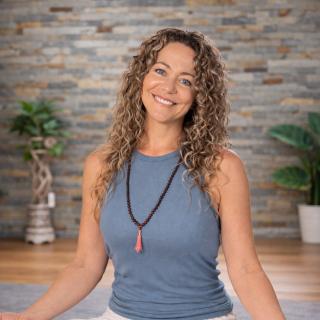
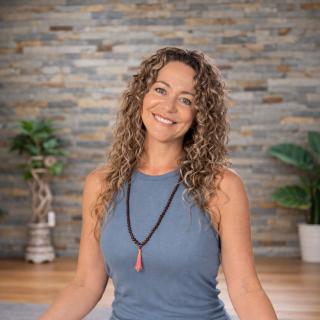
I'm Nicole.
Thanks for joining me today.
Today's yoga class is focusing on the stomach and the spleen meridians.
The element associated with these meridians is the earth element.
As such,
We'll be using the prithvi mudra where we connect the tip of the thumb to the tip of the ring finger.
Our ring finger also represents the earth element.
The postures will be a And I will be using a few props.
I've got a yoga bolster.
If you don't have a bolster,
You can improvise with a blanket that's rolled up nice and tight,
Or two or three firm pillows stacked on top of one another.
I'll be using the two yoga blocks.
If you don't have two,
One will be sufficient.
If you don't have any,
Something solid,
Similar thickness,
Maybe a thick book you could improvise with there.
So as you're aware,
The stomach is the primary digestive organ.
It's the first to receive the food and commence that process of assimilation and distribution.
So as we know,
This goes beyond just the food that we take in,
But also thoughts and emotions as well.
So those usable nutrients are then sent onto the spleen,
Which nourishes all other organs in the body and the unusable nutrients sent onto the small intestine for elimination.
So when our stomach and spleen meridians are in balance,
So too are our cycles.
So harmonious sleep patterns,
Bodily rhythms,
And also clear thinking.
So we're going to also stimulate a couple of acupressure points today before we begin our poses.
There are 45 acupressure or acupuncture points for the stomach meridian,
But today we're going to work with stomach 36,
Which is known as the lower two.
So this one's on the lateral side of the leg.
Now it's four finger width below the bottom of that knee joint,
And then just a little off to the side on the outer edge of the shin bone.
So four fingers down just to the outer edge,
And you should feel a depression or a hollow,
And generally it's quite tender.
So feel free to stimulate both at the same time if you like,
And just applying a comfortable amount of pressure.
You might like to hold it still or move through a circular motion.
So this point is used in acupuncture for nausea,
Vomiting,
Fatigue,
And stress.
It's said to boost our immunity,
Improve digestion,
And also our energy levels.
So if you would like to stay longer here you can always pause the class,
Otherwise we'll move on to our spleen acupressure point.
So there are 21 acupressure or acupuncture points for the spleen meridian.
Today we're working with sp6,
Which is known as the union of the three feminine mysteries.
So this particular point is our four finger widths again on the inner ankle bone,
So just up from that ankle bone.
And again,
Feel free to do both points at the same time,
Can feel a little tender,
A little sensational for most.
So this one is one we don't stimulate during pregnancy.
It's one of the most commonly used points in acupuncture because it not only crosses the spleen meridian,
But also the liver and the kidney meridians as well.
It's therapeutic for digestion,
Menstruation,
And menopause as well.
It's also said to resolve dampness,
Harmonize the liver,
And strengthen the kidneys.
So feel free to pause there if you want to take longer,
Otherwise I'm going to move on to the next pose,
Or the first pose.
First pose we're moving into,
We're only going to be there for a few seconds.
If you've considered doing a little bit of a stretch,
With ankles and knees,
You might like to skip this one,
And you can even stay here and keep massaging that point while I demonstrate the first pose.
If it's not one for you,
You can always skip ahead to the next one.
So sitting in a kneeling position,
You can either take prithvi mudra,
Or you can reach the hands behind you.
We're going to lift up the knees.
So you'll feel a little stretch sensation there through the tops of the feet,
Fronts of the legs.
Let's relax the jaw.
We have a visitor today.
This is Miss Macy.
You've come to join us,
Have you?
And let's release.
So we're going to use our bolster now,
Or your pillows or your blanket,
And just have it placed along the long side of the mat.
We're going to bring the navel down.
And then bend your left knee out to the side.
So at most the knee is at hip height.
You can lower the leg if you need to.
If there is any discomfort in your hips or your low back with this pose,
Feel free to skip it.
Your head can rest either in the centre,
Or you can turn it left or right.
And let's gently place the tip of the tongue where the teeth meet the roof of the mouth.
Keeping the jaw relaxed.
Gently starting to deepen the breath.
Feeling the navel expand and press against the prop as you inhale.
Take a little pause,
Hold the breath for a moment or two before exhaling slowly.
Deepening the pose by deepening the breath.
And let's change sides.
Bring your left knee in,
Taking the right leg out.
If you have the head turned,
Change sides.
You may even begin to feel a pulsing sensation in the navel.
And let's bring that right knee in and press yourself up.
So from this tabletop position,
Just come to sit now with your right hip touching the prop.
Knees can comfortably bend.
There's no right or wrong here with the position of the legs.
If you feel that your hips and knees need support,
You can always position a block in between those thighs.
Coming into a prone twist,
Sit with hands either side of the bowl,
Lengthen the spine as much as you can before you bring your navel down.
And again,
Head can turn left or right.
You might like to turn the palms up and take your mudra,
Connecting tip of the ring finger to the tip of the thumb.
And each time your mind wanders,
Come back to the breath moving the body.
So as you breathe in,
Observing the body expand on the inhalation and gently soften on the exhalation.
I'm going to count your next two exhalations.
We'll exhale to the count of five.
Just let your inhalation do what it likes.
So breathing out together.
Then inhale smoothly,
Deeply.
Take a little pause and exhale for five,
Four,
Three,
Two,
One.
Inhale smoothly,
Deeply.
A little pause and exhale for five,
Four,
Three,
Two,
One.
Follow your next inhalation out of the pose,
Lifting back up.
And you can either come to hands and knees and change sides,
Or you can lift up those hips for a brief downward facing dog,
Before pivoting the feet and changing sides.
And again,
Feel free to take the mudra through your hands,
Checking the position of your tongue and the softness in your jaw.
And I'll count your next two exhalations,
Same as before.
Let's breathe out together.
And then inhale smoothly,
Deeply.
Take a little pause and exhale for five,
Four,
Three,
Two,
One.
Inhale smoothly,
Deeply.
A little pause and exhale for five,
Four,
Three,
Two,
One.
With your next inhalation,
Gently pressing up out of the pose.
So from here,
Yogis,
Let's turn our prop around now,
So that it's running parallel to the short side of the mat.
I'm going to have my two props just in front.
So you could do this next pose flat on the mat without all of the props.
Coming into our sphinx pose.
So we want to rest the lower belly on the prop if you're using it,
Otherwise you can come flat to the floor and just have those forearms on the mat.
If you find that you're fatiguing here through the neck,
You can always take your hands,
Make fists with your hands and take them to the jaw or frame the face.
Otherwise,
Try and keep those shoulders relaxed,
Chin parallel to the floor.
Feeling the body move with the pulse of the breath.
Finding that lingering pause before each exhalation.
So yogis,
You have the option to stay exactly as you are.
If it's comfortable for your body,
We'll take a little quad stretch here.
See if you can reach back for that left foot and just resting your right forearms a bit.
So you could use a strap here if you can't quite reach the foot.
Otherwise,
Just taking a comfortable hold,
No strain.
So we deepen the breath to deepen the pose and if you can't deepen the breath,
You're pushing a little too far.
If we're stretching at our edge,
Then the breath is no longer expansive.
And as we take that expansive inhalation,
We start to feel the breath press on those lines of tension.
Option to stay as you are.
Final variation,
You can gently roll onto your right side,
Continue with that quad stretch and even lower yourself down if you like.
When you're ready,
Return to the navel.
And we'll change sides.
Take a hold of the right leg.
If you did so on the other side,
You can roll over onto your left side.
Continue to hold onto that right foot.
Let's return to the navel.
And from here,
Releasing our sphinx pose,
Pressing up,
Coming off the bolster.
You might like to take a moment just to round the back and gently send the knees away from one another.
And then from here,
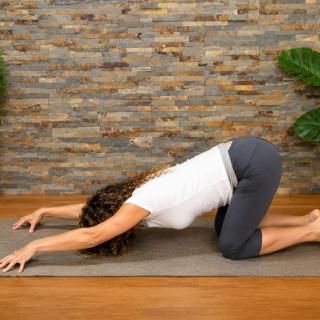
We'll sit back into our child's pose.
So you can use the props if you prefer.
Taking a wide-legged child's pose,
So big toes to touch,
Knees nice and wide.
Option one,
Just resting with the arms in front or you can make a pillow with your hands.
If it's available for you,
We'll take a twist here.
Thread the right arm underneath the left.
Again,
Option to take your mudra.
If you're in your twist,
Let's gently press up and we'll change sides.
Coming all the way up.
Well done,
Yogis.
Our last pose will be our supported fish pose.
I'm going to use the blocks for that,
But you can always use the bolster,
Whichever you prefer.
I'm going to have the blocks running parallel to one another,
One for the head and one directly underneath those shoulder blades.
You can always take the props a little higher if you prefer.
If you need to lighten this pose,
You'll take the block under the head higher than the one under the shoulders.
If you want to deepen the pose,
You can remove the block under the head.
If you feel any niggling sensation in your back,
Then keep those knees bent.
Otherwise,
You can straighten and relax the legs.
We might even like to take a butterfly,
Connecting the soles of the feet,
Letting the knees fall out wide.
So find the position that your body says yes to.
Taking the arms out as high as is comfortable and finding your mudra once again.
And just resting here for a few moments,
Breathing into the heart center.
And when you're ready to release the pose,
You can bend those knees,
Either come halfway up to seated or roll off to your side.
Remove the blocks.
For Shavasana today,
I'm going to place the bolster underneath my knees.
So you can use the bolster or of course you can use your pillow or maybe even a block under each thigh.
So taking up as much space on the mat as is comfortable.
Feel free to connect your thumb and ring finger once again.
And just allowing those legs to fall heavy over the prop.
We'll spend a few minutes here in Shavasana to allow the positive effects of your practice to assimilate in the body.
So take this time to soften the forehead.
Allow the eyes to roll back.
Tongue and jaw relaxed.
Let your thoughts leave no traces in the mind.
Just as birds leave no tracks in the sky.
Allow your thoughts to float off into the distance without a trace.
And just be in this spaciousness,
Quietness.