Nikola Tesla once said,
If you want to find the secrets of the universe,
Think in terms of energy,
Frequency and vibration.
Energy plays a vital role in our lives,
And the story I'm about to tell is for everyone who wants to learn more about energy and to feel a human connection with the science that is continuing to build on our understanding of energy.
Breath is life.
Every breath is an opportunity to be.
We all know this empirically,
Meaning from direct experience.
Breathe in,
1,
2,
3,
4,
And breathe out,
2,
3,
4.
Breathe in,
1,
2,
3,
4,
And breathe out,
2,
3,
4.
Ever since we came out of the womb up until now,
We've all needed to keep breathing.
Every few seconds,
We bring air in,
And we bring air out,
For the simple purpose of transforming energy.
However,
That simple act of bringing in oxygen to keep life flowing,
And to power bodies and our mind,
Has taken on a new significance over the years.
As our research has developed,
I've gained a deeper appreciation of the role of energy in driving health,
Well-being,
And life itself.
Being active is part of who I am and something I've always felt compelled to do.
Ever since my days of after-school hockey practices and long rides as a competitive cyclist,
I've had this drive to push myself.
My motivation from an early age to push boundaries and embrace challenges melded well with my growing curiosity about how our bodies work.
How do complex processes in our bodies and our brains produce the remarkable variability between individuals that we see in health and disease and resilience?
When I was a kid,
My mom juggled the role of chauffeur to hockey practices with her important responsibilities as a home care nurse.
For a few late-night hockey practices,
She picked me up but had to attend to emergency home calls,
So she brought me along.
What I experienced during these patient visits left a lasting impact on me,
An energetic imprint in my developing mind.
Some people recovered remarkably well,
And even appeared to grow from their traumatic experiences.
What I later learned was called post-traumatic growth.
They had an incredible capacity to heal.
But other people did terribly.
They were unable to heal,
Got sicker with time,
And eventually died.
From those real-life stories,
It became clear to me that,
Beyond the genes that we were born with,
So many different factors impact our health.
Emotions,
Human connections,
Our behaviors,
The stress we experience,
Adversity,
And environments all play a role in shaping what we call health.
In college,
Medicine and biology captured my attention.
I wanted to understand how it all worked.
But sitting through lectures as an undergraduate student,
I couldn't escape this nagging feeling that something was missing.
The textbooks I was reading marched us through memorizing detailed descriptions of genes and proteins that hadn't just been sequenced through the Human Genome Project.
I learned of transcription factors and signaling pathways and enzymatic reactions and all sorts of details that form the foundation of metabolism and of life.
But that wasn't telling the whole story.
My experiences on the hockey rink or on the hills with my bicycle and the living rooms of my mom's patients suggested that the human experience was more than molecules randomly colliding and that health was not deterministically driven like a car engine.
Thinking back to the patients I saw with my mom,
I wondered how our emotions,
Experiences,
And the interactions that we have with each other affected our health.
Why did some patients with the same diagnosis get better while others got worse?
Could our experiences help or hinder the healing process?
What was the missing ingredient in this recipe for life?
Those questions fueled my curiosity to learn more.
Trying to find the missing link,
I embarked on a tour of academic disciplines.
On that journey,
I made stops in research labs examining the interactions between the brain and the immune system,
What's called neuroimmunology,
Computational biology,
Which means using computers to understand the complexity of biological processes,
And the psychosocial aspects of the cancer trajectory,
From the beginning of cancer and diagnosis to treatment and survival.
While on that journey across the sciences,
I finally committed to fully studying mitochondria for my PhD.
Why was I so sure that studying mitochondria would be a productive path to follow and that it would yield useful insights into the knowledge gaps that plague medicine?
To be honest,
I wasn't sure.
Reflecting back on the wisdom of Nikola Tesla,
Perhaps the secrets of the universe really could be revealed through a greater understanding of energy,
Frequency,
And vibrations.
At least that was the idea.
Based on what I knew about the role of mitochondria in transforming energy,
It seemed like a good place to start.
As I dug deeper into mitochondrial biology,
What I found was fascinating.
These mysterious little bacteria-derived organelles,
Organs of the cells,
Enabled complex life.
They were implicated in most human diseases,
I realized.
Mitochondria are the reasons we must breathe every few seconds.
Because like a beautiful candle flame,
Oxygen is fuel,
And you are like the flame.
Mitochondria,
Or,
I was learning by studying exercise physiology,
What was allowing me to race on my bike for hours and hours,
And to recover?
According to Albert Einstein,
The important thing is to never stop questioning.
At the same time,
I was still accumulating more questions than answers.
The science was progressing,
But it wasn't looking in the right place.
The integrative,
Transdisciplinary work required to understand health from a first principles perspective also wasn't moving fast enough to help the people who are getting sick and failing to heal properly.
Continuing to explore other fields,
I began to learn more about holistic medicine.
To me,
What was particularly interesting about holistic medicine was the emphasis on the interconnections between physical,
Emotional,
And even spiritual health.
That seemed to be more directly connected to real human experiences,
And to the things I'd seen move my mom's patients from despair to hope and healing.
Or from sick to depressed and dead.
And I was discovering,
In university,
That there was science about this.
The concepts and frameworks I found there brought more variables to the table for this complex and somewhat mysterious equation of human health.
Holistic medicine,
As its name implies,
Involves understanding the whole person,
Not just addressing individual symptoms one at a time.
But how do you do this?
How do you do this systematically,
Rigorously,
And humanly?
This big-picture approach appealed to me and I completed training to become a holistic practitioner.
I spent 5 years with the part-time practice while in graduate school at McGill University.
It was incredibly rewarding and grounding.
Four days a week,
I studied mitochondria.
And on Friday,
It was clinic time.
I was preparing and taking cases of people who'd found no relief for their conditions from general medical care.
People whose dis-ease or the lack of ease in life didn't fit traditional diagnostic boxes.
And there are a lot of those people.
My training and interactions with patients have been instrumental in shaping how I think about health and disease and how energy could be a major part of the problem and potentially an essential part of the solution.
Some experiences have the potential to alter the trajectory of your career or your life and reshape completely how you think about being alive.
For me,
One of these life-changing moments occurred in 2012 in the charming city of Newcastle upon Tyne in England.
As I wrapped up my PhD,
I had the opportunity to work with Sir Doug Turnbull,
A pioneer and one of the most notable researchers of mitochondrial medicine.
One late summer night,
I was working late in the lab and I couldn't be more excited.
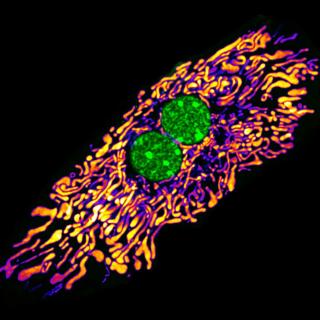
I was running an experiment with living cells you can put in a dish and I added a fluorescent dye that allowed me to see the mitochondria using a microscope.
What I saw that night will forever stay with me.
The mitochondria were alive.
They moved.
These weren't just the perfect little jelly beans frozen in time and cross-sectioned on the page of a textbook or in Google Images.
They were thread-like,
Alive and busy.
I marveled at the mitochondrial network that was surrounding the static circular nucleus full of the 25,
000 genes.
Mitochondria travelled too.
They were spreading,
Diffusing through the rest of the cell.
I didn't want to blink.
It was so beautiful.
And that's when I fell in love with mitochondria.
The mitochondria were interacting and communicating.
That life-changing experience led me to realize,
And not just to understand intellectually,
That mitochondria and the energy they transform really are the basis of life.
The source of all human experiences had to be based on energy transformation.
Without energy,
Without transformation,
There's no experience,
No life.
The science was teaching me that mitochondria play a wide role in a variety of cells,
And they aren't just powerhouses.
As I later realized,
Mitochondria function a bit like an intracellular brain.
We have hundreds,
Thousands of them in each one of our cells.
And together,
They function as the cell's sensory system.
As a communication network,
They strategize and gatekeep information,
Transform that information,
And let the cells know what's happening around them.
Inspired by what I witnessed that night,
I spent the subsequent months pondering how mitochondria share information with each other,
As well as with other aspects of our biology.
So it was time to get to work.
Over time,
My research,
My career,
And my thinking evolved considerably.
As a student,
I started with widely accepted hard science that was focused on mitochondrial structure,
Their morphology,
Their functions,
And their signaling.
And after joining the faculty and launching my research lab at Columbia University in 2015,
I developed an international network of collaborators to start asking questions about the mind and the mitochondria.
We conducted projects that people called overly ambitious and too risky for someone at my early career stage.
I felt like I had to do these projects.
I had to move quickly.
Somehow,
I have always felt compelled to hurry.
Like there's something inside of me that forces me to move quickly.
We desperately need a more accurate,
Holistic model of human health.
So it felt like I had to move fast.
In the next 10 years,
I grew my lab and my research program.
And by academic standards,
I was clearing the career hurdles at a pretty fast pace.
I love what I do.
So it always felt pretty natural to work hard.
A major milestone that brought greater alignment between our work and direction was renaming our lab from the mitochondrial signaling lab to the mitochondrial psychobiology lab.
Somehow,
That decision felt risky,
Potentially undermining our credibility in the eyes of the biomedical community that typically discounts psychological experiences and the domain of the mind more generally as scientifically intractable.
It was like a coming out for me,
But it only brought good things so far.
Under a new name,
I've been able to bring people together to create a more accurate and more comprehensive picture of life,
With mitochondria and energy playing a central role.
Mitochondria are the portal we use to understand the energetic of life,
Stress and aging,
And other health-related processes.
As part of this mission,
I've been incredibly fortunate to bring people together to make discoveries and to have had experiences,
Including some difficult ones,
That have helped me understand the value of what we do.
Has the journey been easy?
Definitely not.
But it's been a good fit for me,
For who I am as a scientist and as a person.
This scientific journey has brought me meaning and incredible purpose.
Taking the time to reflect on your own journey can help you stay grounded and identify what feels meaningful to you and what gives you a sense of purpose.
Think about what energizes you.
Every day I get to live this journey through the science and the experience of energy brings me inspiration.
I am so grateful.
Thank you for taking the time to listen and to connect,
To connect together and to connect with yourself.
If you want to explore the connection between the science of energy and what it's teaching us and your own experience of energy,
Feel free to tune in again.
Until next time.