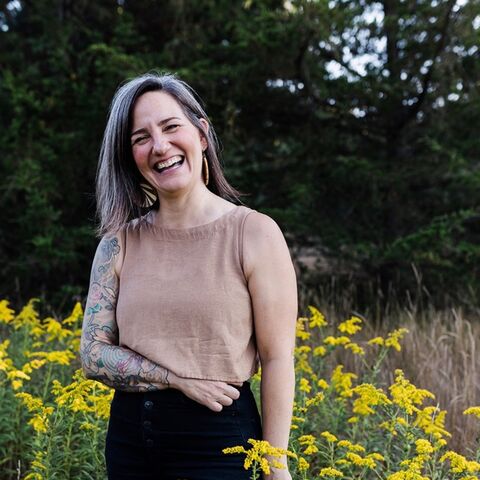
My name is Larissa.
We're going to practice for about 30 minutes today.
And as you're settling in,
Getting situated,
Choosing a posture that feels supportive.
Just going to share a little bit about the Eightfold Noble Path.
You're welcome to close your eyes and just listen if that makes sense for you.
If you're somebody that wants to open your eyes,
You're welcome to.
I'll just share here just this teaching.
Our meditation is often interwoven with some teachings and some stillness.
Just sharing the purpose for this Eightfold Noble Path.
It's something that I use pretty foundationally in my own life and is a very good support for our meditation.
The interesting part about the Eightfold Noble Path is it is a path for living in our waking life.
And it is also something that is in our mind.
Sometimes it's called the pathless path.
And so there can be these dichotomies,
Like joy and grief exist at the same time,
Or how is a path pathless?
But it's this idea that is a path for you specifically.
If you take the exact same steps that somebody else takes,
It doesn't mean it will have the same outcome for you as an individual.
And that's something that the Buddha talked about pretty specifically.
He would say something like,
My finger is pointing to the moon.
Do not mistake my finger for the moon.
And it's this idea that,
You know,
We can understand a concept in our mind,
But to draw it into our life,
To pull it into our heart and to work with it.
There is a transformation that occurs.
And so we can have a transfer of knowledge.
And that knowledge turns into wisdom inside you,
How you interpret it,
How you take that knowledge.
And start to work it into your day-to-day,
To weave it into your life.
And so we share that because.
.
.
Very often when we're talking about the Eightfold Noble Path,
Each step is translated as,
Quote,
Right.
So we're talking about wise perception.
If you look it up,
You'll see often the word right perception,
And then right thinking,
Right speech,
Right action.
And I think it's incredibly important that we look at that word sama.
It can be translated as right,
But that doesn't mean that there's a wrong,
Whereas in English it has to mean there's a wrong.
It can also be translated more specifically as wise.
It can mean benevolent.
It can mean beneficial.
And it's this idea that every step on the path is beneficial.
So even when we make a mistake,
We make a misstep.
I always make the joke,
Someone's like,
Hey,
There's a snake pit up there.
I'm like,
I love snakes.
I want to go visit the snakes and I want to look and I want to explore where someone else might be like,
Hey,
Great,
Thanks.
I do not want to see the snake pit.
So it's really recognizing that we take these wisdom traditions and we walk our own path with them.
We can help illuminate each other when we're feeling difficulty.
When we're listening to a voice in our mind that isn't quite correct,
But we're believing that,
We certainly need each other.
Just remembering too that as I offer these ancient wisdom traditions It is through my lens and I try very hard to make sure that the lens is clear.
Remembering that what you take in,
You transmute it in a way that it makes the best sense for you.
And so as we walk this journey,
Beginning with wise perception or wise view,
I'll say one more thing before we settle into a bit of silence here.
Spending a decent amount of time just the whole month on this first step.
It very much correlates to the second step which is wise thinking or wise intuition,
Wise intention.
But the first step,
Wise view,
Wise perspective.
Wise understanding of the world.
This one is incredibly important because we always go back to it.
If we're trying to take wise action and we're taking missteps and our action isn't quite leading us to where we'd like to head,
We need to go back to our vision.
Am I seeing clearly?
Do I need to put on a new pair of glasses?
Do I need sunglasses?
It's really always going back to this.
How do we see the world?
How do I see myself?
And is there wisdom in it,
Or am I just holding on to old lenses that no longer serve me?
And our brain tends to do that.
It hangs on to things as if things are concrete.
But in truth,
Everything is always changing.
Everything is always changing.
That's one of the foundations in Buddhism,
That everything is impermanent.
And so when our brain tries to cling to something,
It doesn't allow us to see things in a new way.
And with all of that said,
All of that is a concept.
We start to settle into the practice what's helped us bring concept into practice into our day-to-day into creating new neural pathways in the mind,
New thinking processes,
New ways of seeing the world.
Take a couple of moments here,
Maybe.
Make a little wiggle in your torso to settle into your cushion.
Sometimes when I hear information and I'm letting it land,
I'll find my body just sighs naturally or I want to move a little bit.
So if that feels good for you,
Maybe you want to stretch your arms.
Take a couple of deep breaths and sigh them out.
Just the smallest movements can be so supportive for our body,
Our nervous system.
Like letting your lips flutter,
Like taking a deep breath and just letting your lips flutter.
Squeezing your toes a couple of times and releasing them so you can feel that process of tension and then release.
Just letting your body be supported.
Letting each exhale be a reminder to just soften a bit.
Can you let your jaw soften just 1%?
Noticing again your breath.
It just naturally moves through you.
Sometimes when we bring our attention to our breath.
It naturally changes a bit.
Where we place our attention,
Our awareness,
A new energy flows.
So we place our awareness on our breath as not only a focal point,
It is a place of learning.
Our breath teaches us.
This expansion and softness that we need in life.
Our breath teaches us about action and rest being balanced.
Our breath teaches us about abundance and reciprocation,
Always giving and receiving.
And in its simplest form,
Your breath is something you can shift and change.
When you take a longer exhale,
It signals to your brain that you're safe.
We naturally breathe equally on our inhales and exhales when we're concentrating.
Our breath supports us in a million ways,
And we can also change our breath as needed.
These next few breaths,
Notice what it feels like to breathe deeply,
Letting your ribs expand.
Having a nice slow long exhale And this is a tool you have with you all the time.
Again,
It's part of our wise view,
Wise perspective,
This breath.
It's a gift we've been given.
And this gift unfolds in a hundred ways every day.
Just pausing to take a deep breath before you speak.
That's part of wise speech that leads us into wise action.
We always return here,
Wise perception.
Is seeing myself clearly or am I stuck in sudden judgment about myself?
Just watch again as your breath.
Opens you and softens you.
Expansion and softness.
Action and rest.
And the simplicity of breathing and awareness of breathing.
Gives us a moment to drop down into our body,
Into the eye of the heart.
So our mind can rest for a moment.
It's never about trying to stop your mind.
Very often our mind You get pulled up there and that's where we notice.
The anxiety loops,
Turmoil,
Trying to figure something out.
Our brain is also brilliant in its planning and excitement and so many wonderful things.
That's never about.
Trying to stay out of the mind.
The mind is part of the body.
It's remembering that we also have a body.
We also have this brilliant open eye of the heart so we can see the world with our loving awareness.
We can temper the judgment of the mind with an open heart.
And right in the middle of all of this is just breath.
Your breath a continuous gift.
And sometimes when we're walking the path in life.
Or feeling disconnected or in a season of difficulty.
The breath itself doesn't seem like enough.
Seems like our brain is gonna help us figure everything out.
What our breath does is it helps us slow down.
We're not just pulled by all the constructs of mind.
We bring our mind back into the eye of the heart.
By slowing down and noticing a breath.
We get to practice it here when we're not in the moment of stress.
It doesn't mean stress doesn't occur in meditation.
But we've already set aside time.
We already know,
Our brain already knows.
I don't have to do anything for these next several minutes.
It doesn't mean the brain doesn't think about doing,
That's its job.
It's one of its jobs.
We can remind our brain.
Right now we're just focusing,
We're just doing a little gentle concentration.
Concentrating on my breath right now.
Remembering what a gift my breath is.
And when we tell our brain that gently,
Our brain is like,
Oh,
That's right.
I'm just noticing breath.
We start to build a more open conversation within ourselves instead of these looping conversations that we're used to having.
And that helps us with our wise perspective,
Our wise view of the world of ourselves.
Thich Nhat Hanh always talks about letting the mud settle so we can see more clearly.
Very often I find myself marching through life trying to get to the next thing.
I'm churning up all of this mud.
And it's the slowing down.
Oh yeah,
That's right.
I'm just noticing my breath.
The mud can settle and suddenly I can see clearly again.
And not just seeing with the eyes and my brilliant head.
But also seeing.
With this.
Open.
Magnanimous Brilliant.
Benevolent heart.
It's that safe refuge within.
A safe refuge inside you.
And sometimes we need to retreat inside and take a little downtime,
A little alone time.
And that's what we have here,
Just these moments to be still with ourselves.
And to tenderly witness whatever comes up.
And the best of your ability being gentle with yourself.
And when gentleness with yourself feels far away,
Rest in the gentleness of your exhale.
Breathing and aware of breathing.
Just wisely pointing your vision to just.
.
.
Notice your breath,
To witness your breath,
The gift of life moving through you.
It's this gentle concentration.
I'm not trying to force your mind to be quiet.
Just gently guiding your awareness back.
To notice your breath.
The mind,
The brain is technically stable within your body all the time.
It's the awareness within our mind that moves.
Suddenly our awareness is in the future or in the past.
And we just take this eye of awareness and we turn it back.
Just like when you're trying to focus on something with your eyes.
This Eye of Awareness.
Eye of the heart,
The eyes in your physical head.
You're bringing them all together.
And on the Eightfold Noble Path,
These first two steps,
Wise perspective,
Wise thinking,
Or wise intention.
This is part of.
Developing wisdom and intuition.
Not somebody else's knowledge,
But your own wisdom and intuition.
And because it's called a path,
We tend to think of where our physical feet take us.
But more so,
It's where does the awareness in our mind take us?
As we develop this wisdom and intuition,
Eventually we'll move into the other steps,
Wise living.
Wise development,
Sometimes called wise mental acuity.
Although our physical body will take us somewhere today.
It's noticing where is my awareness in my mind taking place?
Can I just?
Continue to come back with this gentle invitation.
Focus.
On my body.
My sensory awareness.
In these teachings on the Eightfold Noble Path.
This was the first teaching of the Buddha after he became enlightened.
He first taught the four noble truths.
In the Last Noble Truth.
Is that there is a path through suffering and that is this,
The Eightfold Noble Path.
And many people want to take it as,
Where do our feet take us?
It's just this reminder.
It's more important,
Especially this first step,
The wise perspective.
Where is my mind taking me?
What is my awareness on?
There's a yogic saying,
Where my attention goes,
My energy flows.
And when we place our attention.
On a thought loop.
That we claim,
I am angry,
I am anxious,
I am this.
That's where energy flows.
And it doesn't mean that you won't feel angry or anxious,
But it's the claimants of the mind,
The mind that wants things to be concrete,
Black and white.
It's our body,
Our mind,
Our heart,
Our soul together that help us remember everything is impermanent.
There is nothing that I need to cling to.
There's nothing I need to push away.
As part of this teaching when the Buddha first taught it said that he spent 49 days after his enlightenment,
Just pure bliss.
49 days walking around this Bodhi tree.
Witnessing.
Lily's growing up.
In the pond.
Just in awe.
And in that 49 days it said that He also recognized This idea of enlightenment.
People will think it's an arriving place.
But what it is is something that already exists within.
In his conundrum.
Was how do I place something that's within into concepts and words?
And these are the best concepts and words that he came up with,
These eight steps.
And I try my best to take these concepts and place them into words we can understand.
And yet everything is already within you.
We're just simply pointing our attention within again and again.
It doesn't mean that we don't learn externally.
I highly recommend taking a walk in the woods and listening to the trees.
The birds and the squirrels and just letting your body's wisdom be enlightened.
Let your mind rest,
Let your body be filled.
And then let your mind learn from your body's wisdom.
That's part of what we do here as well.
And at the same time our mind.
Our brilliant mind with all of its concepts.
It is so helpful for us to learn through.
Words.
Non-verbals,
Different actions that are taken.
Beyond the concepts of the mind.
It wants to place everything in a word form.
Take a moment to feel again the care your body has for you.
As you take a deep breath.
And if your mind didn't have any words left.
What would it feel like to try to describe?
Taking a breath.
And this path,
This Eightfold Noble Path,
Is a little bit like buying a map.
If you buy a map of a mountainous area or you look at your Google Maps.
It will show you where to go.
But it won't tell you what it feels like to stand in mountain air.
Your GPS might take you to the lake.
But that path doesn't show you what it feels like when your toes first touch the cool water.
Let your breath be a reminder of the path.
Your breath is the first step.
What's the first action you take?
When you come out of the womb.
Breath by breath,
Moment by moment,
Present awareness.
Remembering each breath is a gift.
Each breath is a gift that's been given to you that your body receives so freely.
And with so much care.
And when we invite our mind to rest in the eye of the heart,
There is such delight in the ability to take a breath.
It doesn't mean delight pushes away any sorrow or grief.
It supports it.
Notice your breath.
Where do you feel it in your body?
I invite you to bring your hands into any of your closing habits or practices.
Taking a moment.
Let your hands feel your breath moving through your body.
I'll end as we often do with loving-kindness phrases.
Repeating these phrases back as they make sense for you.
May I remember the innate goodness of my breath.
May my eyes be clear and open.
May the eye of my heart Offer me loving awareness.
When action is needed.
May I choose to move with ease and peace.
May the merits of our practice ripple out to benefit all beings.
And may all beings be free.
Take your time.
Go slow if you can.
Find movement when you feel ready.
Take a moment to thank yourself,
As always.
And thank you for being here.
Thanks for supporting each other in our sangha,
Our community.