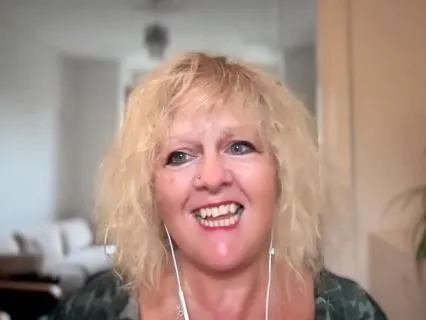
You I'm Heather,
Heather Meyer-Thomas and I'm a holistic voice coach and I teach people to sing but I teach people to sing I mean,
I teach all sorts of people to sing,
But largely I really,
Really enjoy teaching people to sing who've told me that they can't,
Or who don't think they can sing,
Or have had a bad relationship with their voice in the past.
And there are so many people,
As we know,
On this planet who were given a bit of a bad time as a kid when somebody said something,
And it tends to colour our whole experience.
Of singing growing up.
And it's the way that we identify vocally.
I know that sounds a bit highfalutin,
But it is what we do.
We identify as someone who can either sing or not sing.
And we all seem to have a story about our voice.
And quite often,
We have the same thinking around our speaking as we do with our singing.
We get an idea about what it should be like.
We get an idea that we're not how we should be,
As we have probably experienced this to do with the thinking behind it.
And experience and practice all these things are experience and practice but like anything again as i said before if you don't think you're good at something if you're not very likely to practice it um because we tend to think we're just going to make matters worse why would i put myself through this etc but i mean this is why i always say that singing and sport have got quite a lot in common,
That there are techniques to it.
The difference is that if you're not automatically brilliant at sport,
You don't necessarily give yourself a bad time and call yourself names for it.
It's just something that we tend to accept in society.
If we want to get better at tennis,
Then we'll learn to play tennis.
If we want to get better at golf,
We'll get a golf coach and we do the things to make ourselves better.
We don't expect to wake up one morning and suddenly be brilliant at playing golf or tennis.
But with singing,
We tend to have this thing from an early age,
That if there's anything between us and the world,
Our voice,
And it being acceptable and desirable to other people,
It's not worth having.
And to that end,
We tend to not pursue the training or development,
Because why would we?
We're just going to put ourselves in that terrible,
Embarrassing situation again in front of someone that we've paid a few quid to or whatever.
So anyway,
It's a long thing.
But what I wanted to say about that was with singing.
Everybody has.
A completely unique experience of their own instrument.
But I don't think usually we think about it enough.
We don't necessarily try and think about or spend much of our time.
Trying to work out what it is we actually experience with singing,
Because it's that magical instrument.
It's that fantastic instrument.
We don't have to put it in a bag and try and get it on a plane.
We don't have to worry about carrying it down the road.
We've got it.
It's part of us.
It's part of our body.
And yet,
We tend to have very anonymous relationships with our voices.
We tend to assume,
Right,
This is my voice,
And that's how it is,
As if it was some sort of separate thing.
You are a perfect,
Wonderful instrument,
All polished and shiny.
But we tend to not think about ourselves as an instrument until we start looking in to the ins and outs of actually playing it.
We need to learn to play this instrument.
And in order to do that,
It's useful to try and work out how we actually experience it.
What senses are we engaging when we're using that instrument?
And to what extent can we control the outcome of the sound?
Sounds that we're making because it's not the same for everyone.
You know,
I,
For instance,
When I started looking into how I experience my voice,
I realized that,
I mean,
Obviously physically I can feel vibration and I can hear the sound and I can feel,
You know,
Parts of my body being activated when I sing,
But also the way that I experience it is almost,
Almost synesthetically,
I see images I have a lot of sort of metaphorical images going on in my head as those of you who've worked with me before know that sometimes in order to to be able to teach voice and teach singing to people we have to find a way of communicating what it is we're all experiencing and often metaphors and imagery are a really good way of doing it unless you're one of those people in the world who doesn't who isn't able to visualize in which case we go down a different pathway but to you know most most people that tends to be a thing that I could sort of mention an image of a bird.
A boat or a surfboard moving along in a certain way and people can recognize what it is that I'm seeing in my mind,
They can also visualize the same thing and we can do some sort of activity,
A vocal activity that will have the same kind of because we've got the same vision.
Does that make sense?
Yeah,
But we tend not to see our voices.
We tend not to think of our voices as anything other than just things that make a noise somewhere in the body.
And we tend to,
As Julia was saying,
When When you get a little bit tight,
A little bit stressed,
A little bit too up in your head about your voice,
The body takes over and automatically shuts down the sound.
It will tighten the muscle around the throat and stop us.
And the reason for that in many cases is we are very hardwired to not making fools of ourselves or not making,
You know,
Not doing things that are going to end up with embarrassment or terrible things like that.
Not that there's anything wrong with embarrassment.
I highly recommend it.
But it's.
It's identifying what it is that's going on and so for me.
.
.
What I find the most useful thing with teaching people about singing,
Especially people who don't have much of a relationship with their voice to start with,
Is to strip it all back and go for the very bare bones of what the voice is.
How we experience it,
And then find little ways of altering those experiences by going through various exercises with breath,
With sound,
With vibration,
With kind of playful noises,
And just doing all the things.
You have to take a few risks.
You know,
The biggest risk you might take is making a fool of yourself,
But you know,
Let's just get out the way.
Get that out the way first of all,
And then that's it.
Also another thing that I think is really important to mention that I honestly believe that unless somebody has paid lots and lots of money for a ticket to come and listen to you singing and you've promised them that you're going to have a wonderful experience.
Unless they've done that nobody's got any right to have an opinion about your voice at all unless you're insisting on singing in their ear when they're trying to get to sleep or something like that but your voice is your business you know we tend to as a society thank God we've moved on from a lot of things that used to be acceptable nowadays we can't fat shame thank goodness we can't body shame we can't slut shame we don't do all the things people used to do an awful lot of shaming and some people still do it but as a society we've very much switched on to the fact that we are,
You know,
Autonomous and we get to make our choices about how we appear in the world.
But unfortunately,
If you've ever seen any of those TV talent shows,
Voice shaming is still a thing.
Voice shaming is something that people still feel it's perfectly acceptable to do.
You know,
People call each other names,
They tease each other,
And I'm not saying let's all get precious and never,
You know,
No ribbing and poking fun,
But on the other hand,
I work all the time with people who have come out the other side of that kind of shaming and in many cases have lived a whole lifetime with no access to their own voice because of something somebody said or something that happened when they were younger.
And so there are lots of layers going on,
There's that thing where as children you know we're very good people most of us all of us actually and when we're children we believe what we're told and we believe that we want to please people and we yeah if somebody tells us something we believe them and so if your music teacher in you know third year or nursery or something tells you that you are singing out of tune and you have to go and sit over there with the people who sing out of tune.
That's it.
I sing out of tune.
I sit over there.
I don't sing.
And that becomes real.
That becomes the truth in your life.
And so many people that I work with have spent their whole lives thinking that they sit over there because they sing out of tune.
Because somebody who probably had no right to say such a thing at all said something that made a big impact and we carry it for our lifetimes.
So I'm trying to pack so much in this little time.
One of the things that happens is that when people do reunite,
If they do reunite with their voices when they get older and they think,
Hang on a minute,
Let me examine if that was ever true,
It can be a huge catalyst to wonderful things you know there's a lot of emotion there sometimes we grieve over you know lost years where we could have been a singer or or opportunities that we missed or we feel that we might have missed but on the other hand we reunite with our voice and we can take that on through our lives and feel really connected in a way that is more thoughtful perhaps than it would have been if we just always had the voice all along.
What I'd like to do is to go back into the bare bones of what the voice is really and let's do a few things.
Let's do a few things to feel what our voices feel like and just see if we can get any liberation going,
Get any sound going and start to feel,
You know,
A little bit more vocal because we are all singers every single one of us we sing,
We sing every time we speak,
We sing every time we.
.
.
Make a remark.
If you think about how many times in conversation there's music that we don't even notice.
I mean,
If you are agreeing with someone,
For instance,
You're talking to someone,
Standing in the store and you're going,
Hmm.
Mmm or something particularly delicious might go ooh and all these sounds that we make are musical.
We don't necessarily think of them as musical but they're as musical as a song.
Because we're moving through a whole range of motion.
Music can be a fantastic way of helping people learn languages and certainly the way that I I mean,
Anyone who's done anything with me before knows that I'm obsessed with vowels.
Obsessed with vowels,
Particularly Italian pure vowels.
And actually,
Yeah,
Lots of languages have those beautiful pure vowels.
But yeah,
Absolutely,
It's a fantastic way of doing it because it's also,
It helps you to relax when you're singing.
But yeah,
So these noises that we make all the time,
You know,
You'll probably notice now in conversation,
You'll be talking to someone and they'll go,
Ooh,
And you'll think,
Oh,
He just sang a little song and you didn't realize.
We do it all the time.
We do it all the time.
I've grown up in Cornwall.
You know everyone's got very musically voices down there and I used to as a child I used to listen to my aunties sort of talking and then they'd be talking like that and it would all be down there and it would be up here and it was all sort of up and down with the music and I remember when I was a little girl and I first play the recorder.
And I learned the very basics of notation,
Notes work.
And I used to listen to them speak and think,
Gosh,
I wonder how you would write that as musical notes.
I never did find out but I think there is a thing but so we hear conversation in the way that we speak but because we don't put it in the singing box we don't necessarily stress out about it in the same way anyway so the thing about singing it all depends on the Vibration.
The whole of singing is vibration.
Creation is vibration everything's vibration but voices in particular depend on it so the little vocal cords which little bits of muscle that sit in here in the larynx just literally vibrate and they vibrate together and they make a sound so all that needs to happen is we have to send air through and let this vibration occur and then the vibration resonates through the body and we just,
We are these instruments,
We are speakers,
We are amplifiers,
We are this whole package of sound.
And we don't even know it.
But when you start to learn to be able to influence that,
You know,
It's very,
Very exciting.
The B word,
Breathwork.
Now I've got a bit of an issue with that.
It's daft,
Isn't it?
Why is it called breathwork?
Because it's not work.
It's just breath.
But nowadays everybody calls it breathwork and I suppose I should too,
Although I don't necessarily like to do what I should.
So breathing,
I'm going to call it breathing and it's what we're all breathing all the time thank goodness and what we can do with breathing is notice the relationship between breathing and the voice and how we can control the ins and the outs of the breath but not in a sort of way that makes us stressed and tight but just to kind of observe where naturally the breath wants to go and how it wants to move.
Breathing does so many things,
It relaxes the body,
It keeps us alive,
It pumps everything around and also it's the fuel of the voice.
And what we tend to do with singing if we feel nervous or stressed or we literally just forget is we don't breathe before we sing and then we wonder why we can't sing.
And it's like sort of going out on a bicycle and not putting any air in the tires.
You don't really have a particularly comfortable ride with it because there isn't anything keeping you afloat.
So the air keeps the voice afloat.
But what we tend to do as well is we tend to breathe a little bit funny.
We tend to breathe right up in our chests with our shoulders and our necks and all the things.
But actually the only place we really need to be able to breathe is down in our lungs.
Let me just move my camera.
I'm not going to show you my lungs,
Obviously,
Because that would be peculiar.
But so our lungs,
You know,
They're here.
There's part of the body here.
And when I like to breathe,
I like to feel as if the breath is going right into the back here and those ribs are expanding.
So that the breath is quite low.
Okay,
I'm going to move my camera again because that just looks weird.
Okay,
So thinking about breath.
When we're breathing,
Keeping the shoulders nice and settled,
Just let them stay where they are.
Okay,
So we kind of sit here like this.
Nice and relaxed.
And all I want you to do is just take one of your hands and put it on your tummy.
Just there,
Just on your tummy like that.
Okay and another hand if it's safe to do so and you're not driving a car or riding a bicycle take the other hand and put it behind you.
There so you can feel your ribs.
Okay,
So I've got my fingers facing the front,
I've got my thumb pointing behind me,
Just there.
So.
The ladies among us,
It's kind of where the bra strap is.
And all I want you to do is very,
Very naturally just exhale,
Just blow the breath out.
And then just let the breath come back in naturally.
And out,
Just in your own rhythm,
Not my rhythm,
Your rhythm.
Just a few more of these.
So just keep breathing and I'll keep talking.
So as you're breathing,
Just go as far as you can.
Just go as far out as you can with that breath.
You can breathe out through the mouth,
It doesn't matter.
And just feel what is moving naturally.
Feel if you can feel your ribs expand slightly at the back it hasn't got to be anything dramatic But all that's going on is the little balloons that we've got inside us,
The little balloons of our lungs,
They're just inflating and deflating gently with the air coming in and out.
So we're kind of completely bypassing the chest.
Because the chest really doesn't help with breathing very much,
It just tends to make us stressed out if we're breathing too high.
Okay so just,
I mean you don't have to keep your hands though if you don't want to,
But just generally feel that that is where the breathing mechanism is in order to be useful.
Okay so the breath that we're using for singing is a lovely rich breath and this is beautiful to do when you're lying down on the floor as well.
You could get yourself down on a yoga mat and just feel your belly rise and fall when you're breathing.
And all I want you to do now is the same thing,
But as you exhale,
We're just going to make a little sound and it doesn't matter what sound it is.
So I'm going to breathe in and go like this.
Ah.
And then in again.
Ahhhh.
So just notice you're putting sound on the out-breath.
It doesn't matter what kind of sound,
You could be going ooo if you wanted,
Or anything at all,
Or eee any sound,
But we're surfing.
So if that breath is a little metaphorical wave,
Okay?
A little bit of seaside going on here.
The breath is the wave,
The sound is a little surfboard that's coming along.
And just riding out on the brave and just see if you can take it as far as you can on the outbreath.
So we take the breath in.
Ooooooooooooooooooooooooooo and exhale completely and then just let the breath come in naturally.
So we don't actually have to be responsible for the in-breath.
The in-breath happens when we're empty.
But just notice that you're in control of the out-breath and then the in-breath is kind of happening by itself.
So this is what's going on.
Is that making sense to everybody?
So this is the singing mechanism is all about surfing.
It's all about surfing out on the breath.
So letting the breath be natural.
This is also incredibly good for your nervous system.
This kind of lovely concentrated breathing,
The noticing of the breath in the body is so good for you.
The vagus nerve loves it,
The whole of the Was it the something sympathetic nervous system?
How many shrinks have we got on board today?
Quite a few.
So you know what it is.
It's the thingy sympathetic nervous system.
Yeah.
Anyway,
It has many,
Many,
Many good things about it.
Now.
What I would like us to do now we're going to take the sound a little bit further so you can either do the conscious breath or just do this without the conscious breath it doesn't really matter but we're going to make some resonant sound we're going to just if you put one hand here on your chest and then put the other one on the back of your neck.
Okay,
So we're going to feel.
Yourself resonate.
And we're going to do this thing we call sirens,
Because it actually sounds like a siren.
Sounds like a.
.
.
I'll be looking for something.
And we're going NG,
Which is like an NG.
So if you've learnt the word sing and you're left with the NG at the end,
It kind of is in the nose and the back of the mouth.
Has everybody got their NG?
Parasympathetic.
Thank you,
Vicky.
So we're going NG,
NG.
So we've got that sound.
Is everyone cool with that?
If it's too difficult,
Just go with NG.
That's the same sort of thing.
But the word NG is where you're going to feel more resonance in your face.
The back of your neck.
So what I want to do is I'm going to start doing that and go.
Okay.
So just,
We're making those noises.
So who can feel resonance?
Can you feel the resonance in the back of your neck and the chest,
Various places,
And you might want to trace it.
As you start moving the sound,
You can feel it in different parts of your face,
Different parts of your body.
So we're going to move around.
So we're going all over the place.
You haven't got to stick with the same pitch that I'm at.
We've all got completely different voices and this is one of the beautiful things about singing.
Everyone's voice is utterly unique and one of the problems that we have is we try to sound like everybody else and that's where it all starts going wrong.
But just sounding like you,
We're going.
.
.
I get it really itchy in my ears when I do that.
And just see how far you can go in each direction.
So we're just kind of squeaking around.
You can't do any harm to your vocal cords doing this.
It's a very protective thing.
The vocal cords are literally just stretching.
The thinner edges for the upper notes and the edges go thicker for the lower notes.
So we're kind of protecting them by sirening.
It's a really,
Really healthy vocal warm-up.
So is everyone cool with that so far?
Good,
Okay,
So now we're going to take it one step further and we're going to open up to an R vowel when,
Or OO,
Or any vowel you want,
But we're going to stop going NG and halfway through we're going to open.
Let me show you.
So I'm going NG-AH.
Ooh-la-la!
So you're feeling the contrast of sound between the uh and the ah.
As it contrasts,
You'll feel that resonance.
I'll just play with it a bit more.
But we're just surfing out on that uh and that ah,
Making all these sounds.
You've got a massive range of movement in your voice.
You know,
It doesn't matter whether you think you can sing or not.
You have,
Because we've all got vocal cords.
Cords,
Vocal folds that stretch and do marvellous things.
It's just whether or not we're used to using them.
So finding that contrast between the NG and the R.
Okay.
Okay so this is the kind of precursor the warm-up to the voice where we start to feel that we are this instrument you start to really get a physical acceptance of the fact that you are creating sound and that even within that small siren exercise you can do an awful lot of stuff you can go low you can go all over the place and it's not just because i'm a singer i can do that anyone can do that it just is the vocal cords stretching and we can speak up we can speak up here and talk like this and we can speak down here and talk like this and it's just it's vocal cords it's just some of us have the confidence to use it more musically and a bit more control over a bit and a bit more experience.
Everyone good so far?
Yeah?
Okay i'm enjoying this oh my goodness me right okay so this is the thing about singing is is having a decent vocal warm-up is incredibly important because like any other exercise like any sport that we do It's important to keep the muscles in a good limber state.
Because if we sort of just suddenly go into a concert hall and start singing like this after we haven't warmed up,
You know,
After a few nights or whatever,
Concerts,
The voice is going to start getting tired.
So getting into a really lovely,
Healthy routine of vocal care and vocal maintenance from the ground up,
From the first time you ever start singing,
Getting into the warmup routine means that your muscle,
Your vocal cords are going to be looked after.
You're going to be caring for them.
They're going to last longer and they're going to stretch a little bit more,
They're going to give you more range,
More texture.
But remembering that the relationship between the breath and the voice is the key thing,
Whether or not you're going.
Or whether you're just taking a breath and going The breath and the voice are connected,
Absolutely connected.
And,
You know,
When people go off and do karaoke or whatever they're doing sometimes,
You know,
People will stand up,
They get the mic and they'll start singing.
They'll be like,
Oh,
Oh,
They get to the end of the phrase and everybody falls over and it's terrible because we don't get into the habit of very basic housekeeping in terms of singing.
And the very basic housekeeping thing in terms of singing is remembering to take a breath at the beginning of each phrase.
It's really that.
It's taking a breath.
It's filling up with petrol before you make a trip.
Every single time.
Just making sure you've got it in the tank so that you can do what you need to do.
So that,
That is it.
A little reminder always to take a breath.
So if you're ever going to do karaoke,
Make sure if you get a lyric sheet or whatever,
Just put a little tick at the beginning of each phrase and remember to breathe.
Anyway,
Yeah,
We're not doing karaoke today.
Not yet.
But I do want to do a couple more.
More bits and pieces and what I'd like us to do now is to just literally sing sung note okay just a note it doesn't matter what it is it doesn't have to be the same as me it doesn't have to be the same as anybody else but I would like you to take a breath and on the out breath then we're just going to sing a note and you can sing it to a vowel,
To an oo,
Ee,
Ah or la,
Le,
Li or anything you want and I'm just gonna I'm gonna play a little chord on the piano And whoop!
Let's see if my head doesn't fall off because I'm attached to this.
There we go.
Can you all hear that?
It's just a little C major chord.
Nothing exciting.
And I'm just going to take a breath and I'm going to pick one of the notes in that chord.
I think,
Or I might pick a different one.
And I'm just gonna go breathe and sing like this,
Breathe.
Love.
That's it.
So I just held it for a few seconds with the breath beforehand.
Okay,
So let's do that again and you could sing any other note you want.
Let's just do it together.
One,
Two,
Three,
Four.
You How does that feel?
Everyone feel okay yeah good okay now try and pick another note in that chord because this chord is hello cat is a collection of three notes together a triad that harmonize.
So I'm singing that one,
Or you could sing that one,
Or you could sing that one,
Or down there,
Wherever you want,
OK?
And I won't know.
In fact,
We could unmute and do it together,
Which would be even more fun.
No,
Said Leslie.
Yes,
Said Hannah.
Oh,
Okay,
Right.
One,
Two,
Any note you want.
So being like a little choir.
Okay,
We're going to do that again.
Remember you breathe and you connect with the breath.
Ready,
Breathe.
Love.
All right so we've all sung a note How does that feel?
Everyone feel good?
All right so the relationship between the breath and the note is really important is the voice is so much part of you and part of who we are and this whole point that we we don't let ourselves do it for whatever reason is it makes me so cross anyway there we go here's another thing a lot of things that people misunderstand about voices is is there's an awful lot of comparison you know the people hear music they particularly hear music that people like people they enjoy hearing the voices they admire and we try and emulate those voices and sometimes it's like trying to dance in someone else's shoes that we're just not physically built to sing in the same way as that person i remember having um It was kind of the upside down of that actually.
There was a lady that came to me for lessons probably about 20 years ago and she came along because she wanted to sing,
Her favourite singer was Joan Armatrading.
I don't know if everyone is aware of who she is.
She's a British singer-songwriter and she has a low voice and she is marvellous.
So this lady wanted to sing her songs and we were trying all these things and she had no confidence and she said,
Oh I've never been able to sing,
I can't do this,
I can't do that.
And we worked on the voice for a while and we suddenly realised that her voice was naturally so much higher,
That she was a soprano,
That she had an operatic voice.
She had a voice that had all the shiny,
Tinkly stuff that was like little bells.
It was so beautiful.
And once she realized that,
She wasn't gonna be able to sing like Joan on her training because she had a completely different instrument.
It wasn't,
Not that we can't expand and change our instruments and change our ranges,
But not knowing what our voice actually is to start with sometimes just makes us feel like we're wrong all the time.
I can't do that,
Well I'm sorry you know I can't reach that because I'm not tall enough it doesn't mean there's anything wrong with me it's just that that's not the way it is but yeah we can expand the range but anyway so she She still sings.
20 odd years later,
She's been in choirs,
She's sung in all sorts of things,
And singing is such a massive part of her life,
Once she unlocked what it was that she was actually dealing with,
And got real about what was actually the truth for her.
And yeah,
Julia,
I mean,
It may be that you feel comfortable there,
Maybe you need to look at some songs in that kind of range that would feel easy for you to do,
Because it's about being easy and being authentic and finding where your voice sits.
A list of singers.
That you admired or that you liked or you wanted to sing like.
There are so many different sorts.
It's like I always say,
You know,
Someone who was casting for an operatic production probably wouldn't cast Tom Waits.
You know,
Necessarily,
Because he's not got that sort of voice.
But,
You know,
And Placido Domingo probably wouldn't be singing,
You know,
Jazz in a smoky bar.
We've all got different voices and we all do different things.
And yet sometimes people think,
Oh,
Well,
If I can't sing like this person,
Then that means I can't sing.
And actually,
No,
You need to find out what you sound like,
What your voice wants to do.
And that's where the beauty of it comes.
And as soon as we start to learn to use our instrument in a healthy way,
Using the vibration of the body using the breath using that relaxation of the body and all those things and putting them together trying to be a bit playful and maybe not worrying too much about making mistakes and making terrible noises because we all do that you know sometimes in my group things What I ask people to do in the first couple of minutes is just let's make as crap a sound as we possibly can.
Just get it out the way.
Everybody just do bum notes and squeaks and terrible,
Terrible noises.
And then you know what?
We've done that.
So it doesn't matter.
And so we don't set the bar up here because after all it's playful.
It's communication.
Yeah.
We have been the stuffing knocked out of us sometimes when we start comparing ourselves and we start getting stressed out about it should be this and it should be that.
And I'm not this and I'm not that.
And it's making sound out of your body you know it's really silly that's what it is and you know you can make silly noises and all the rest of it but ultimately it's your voice it's nobody else's and like i said before unless someone has paid you a million pounds for a ticket and you've told them you were going to sing you know something from an opera and you didn't then they have no right to complain so let's just get that out the way to start with and making sound is about you and your voice and that's kind of what the whole point is Yeah.
Great!
Oh well,
Thank you so much for coming.
Thank you!