Hi,
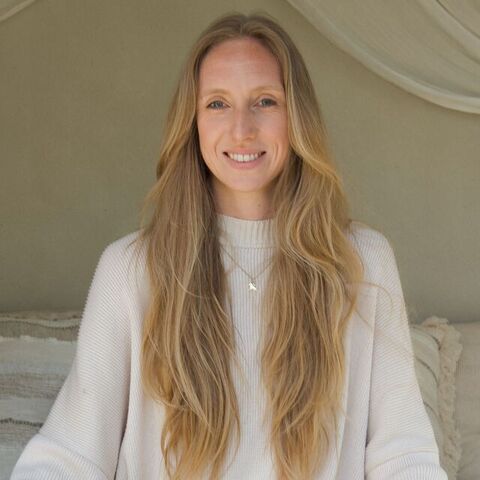
My name is Dieke and welcome to this feminine yoga practice specifically designed to reset your nervous system.
So if you've been feeling overwhelmed,
Overstimulated,
Like you've been sort of stuck in this constant overdrive loop of just going and doing and thinking and analyzing and organizing and keeping all the balls up and you're like,
Okay,
I'm getting to a point where I'm pretty burned out,
Pretty exhausted.
This practice is really perfect to get out of your head,
Back into your body to come back home really to you to that deeper part of you and connect to your feminine energy your feminine essence and so what makes this practice more feminine so why is it called feminine yoga you might be wondering So basically in yoga in general,
We're quite focused on alignment.
So really focused on a more linear way of doing that.
The shapes need to be a certain way and we're trying to get our body into that shape.
However,
In this practice today,
I'm going to be inviting you to sort of let go of it having to look a certain way and just purely start listening to your body,
Letting it become more intuitive and also a little bit more flowy.
Posing.
So that's one thing.
Besides that,
The specific postures that we're using in this practice today,
They are designed to basically target the specific meridians in the body,
Which are energy channels in the body that are connected to the water element.
And the water element is again connected to this deep yin space,
This deep feminine space.
So basically this feminine yoga practice in that sense is a double whammy,
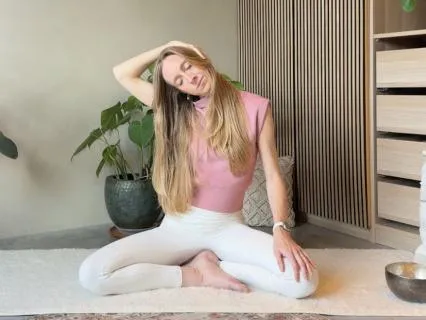
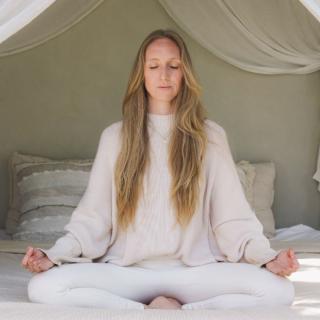
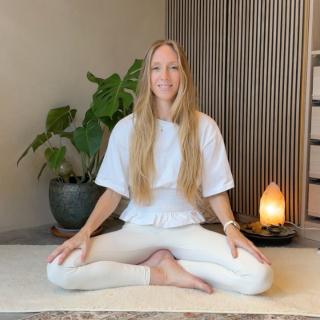
In from different angles and yeah i'm excited for you to try it out one bell marks to start three bells mark the end for now we're going to start off sitting just like i am so in a cross-legged seated position I'm sitting on a little bolster because it helps to create a little tilt,
A little lift in the hips so that my spine can be just naturally straight without me having to do much for it and it feels more effortless.
And so I can really relax my belly.
So it's really important that you can soften and relax your belly also in this practice.
So prop yourself up.
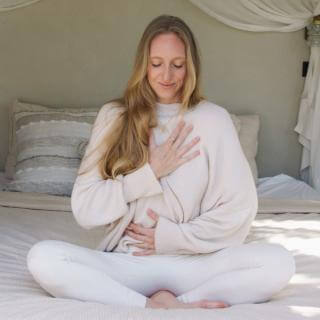
And you can place your hands in front of your chest in a namaste.
Just taking a moment here.
To thank yourself for showing up.
To showing up on the mat.
And then let's begin.
Beautiful.
And then from here,
You can keep your eyes closed for a moment.
Let's take a gentle breath in through your nose filling up your lungs.
And a gentle breath out with an open mouth,
Relaxed jaw.
Let's do that two more times.
Gentle breath in.
And soft breath out relaxing your mouth your jaw And one more time.
Gentle breath in.
And exhale,
Let it go.
And then from here,
We're gonna create a little stretch on the side of the neck.
So you can grab your right or left hand.
It doesn't really matter.
Gently placing that over your head on that other side.
And then gently letting that weight of that hand gently tilt the head creating a side stretch And so the invitation here is not to force yourself,
Not to use too much pressure.
Maybe you feel already a big stretch,
Maybe not so much,
But just being soft and gentle with yourself.
You can also explore a little bit moving the head a little forwards or back seeing like how can you target specifically stretching the side of your neck.
One more breath here.
Slowly coming back to center and doing that also on the other side So creating a gentle side stretch.
It can also help to lower that shoulder down.
To intensify that stretch and just being curious about your body.
How can I really target this?
Part of my body,
The side of my neck,
How does it feel there?
Maybe it's tens,
Maybe already relaxed.
Mainly being curious.
And loving gentle with yourself.
One more breath here.
And then slowly coming back to center.
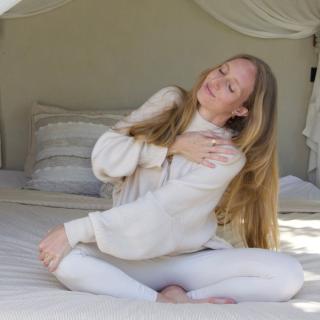
From here,
Let's rotate a few times the shoulder.
So forwards in.
In forwards and up and then back and down.
And you can use your breath at the same time,
Something I highly recommend.
So in breath,
Forwards and up.
Out breath they go back and down maybe even sighing it out And every time you can close your eyes and just allow your awareness,
Your attention to go inwards and be curious,
How do my shoulders feel?
And maybe they want to roll one by one or maybe slowly differently.
Being curious.
How can you stretch and roll out your shoulders?
The best.
And then from here,
Giving your shoulders a little shrug.
Your upper body a little shimmy,
A little shake.
And specifically just shaking out your hands and your arms.
And then from here,
We're going to create a little twist by moving and floating the arms left and right.
And at the same time sort of twisting your spine.
And bring a little bit of playfulness here in while you're shaking,
Moving the arms.
And at the same time,
Staying present with your spine.
How does your spine feel?
And if it needs a pause in that twist,
Feel free.
And also the other side.
So just exploring.
How does your spine feel in this moment?
How can you nurture,
Nourish it with this twist?
And at the same time,
You're playing around a bit and shaking out your arms.
Amazing.
One more good shimmy and good shake.
Sigh.
Beautiful.
And then from here,
We're going to roll forward.
So we're going to come into a cat cow position.
So hands underneath your shoulders,
Knees underneath your hips.
And hands,
Knees about shoulder distance and hip distance apart.
You can spread your fingers.
And then from here,
Just a few rounds of this classical cat cow.
So in breath,
You're arching the spine,
Chest moves forwards.
You're looking up.
Exhale chin to chest stomach in rounding and pressing the mat away So in breath,
You're arching.
Out breath your rounding.
And so once you've got that movement,
I'm going to invite you to close your eyes and allow your attention to go inwards.
And once again,
Bringing it to your spine and being curious,
How does my spine feel today?
And maybe at some point you're noticing like,
Hey,
Actually,
It would be nice.
To move a little bit outside of this shape.
Maybe a little bit towards the left or the right or in a more circular motion.
Or maybe back and forwards.
So see if you can let go.
Of that more linear way of arching and rounding the spine.
And give yourself a little bit of permission to go into this nonlinear space.
Or you're just sort of trusting wherever it is that your body guides you.
And finding a way to sort of stretch out.
Your spine,
But maybe you're noticing come across different parts of your body that feel little tense and you're like,
Oh.
I can hang out there a little bit and stretch it out.
And.
.
.
If there's a moment that you sort of get lost and you're not sure what to do,
You can always come back to this normal cat-cow movement of arching and rounding the spine.
And again,
Bringing the awareness just to what's happening in your spine.
And from that really present aware space,
Maybe.
.
.
You're like,
Okay,
I feel an invitation somewhere else.
Let me flow and explore a little bit outside of that normal cat cow movement.
And so this is really about listening to your body.
And trusting.
That it knows exactly what it needs.
And this can look many different ways.
That's why the invitation is to keep your eyes closed because it will probably.
.
.
Not look the same as what I am doing,
Because your body is unique.
One more minute here of this sort of non-linear movement.
And then slowly.
Coming back to just that normal cat cow.
Let's do two more rounds.
Slowly coming back to that center point.
Of arching and rounding.
Arching and rounding the spine.
And then from here,
Just coming into a neutral spine for a moment.
And just eyes closed.
Being in stillness and just allowing yourself to be a witness.
Of the sensations in your body sensations in your spine Maybe there's lots to feel and maybe there's nothing.
Both are perfectly alright.
Okay,
And then from here,
We're going to come into this ragdoll position.
So gently finding a way to come onto your feet.
Feet are going to be about hip distance apart.
And we're going to just gently lift the hips up.
To the sky and allowing the upper body to relax down.
I invite you to just gently bend your knees as much as you need to so you can relax.
The spine,
And you can really just hang your upper body down.
And then from here,
You're going to grab opposite elbows and just relaxing down.
And you can swing a little bit from left to right.
Or maybe a little forwards and backwards.
Maybe even shaking out your head.
Yes,
Yes.
No,
No.
And.
.
.
Then before we gently come down into a child's pose,
You can also play a little bit here with stretching out the back of those legs.
If you want to straighten one leg or one knee and then the other.
So stretching out those hamstrings.
You can even shake your legs a little bit.
And then from here,
You can gently drop your palms back down.
Very slowly coming onto your knees,
Being aware that there was a lot of blood flow coming into your head,
So take it slow.
Big toes touch,
Knees out wide.
Gently stretching your head.
Hands forwards,
Letting your chest come to the mat.
Forehead rests down.
Just being in stillness here.
Integrating that ragdoll position while at the same time coming into this child's pose.
Which creates a stretch in.
The legs,
The groin area.
You can also come onto your fingertips.
And just kind of like find again a little stretch in the spine.
See if you can allow your.
.
.
Heart your chest come even more down towards the mat Again,
Not by forcing,
Just by being curious.
And you can also just rest here and be in stillness.
Bringing the awareness to your breathing.
And then slowly.
Coming back up.
Finding yourself again in a cross-legged seated position.
And just dropping into stillness here for a moment,
Allowing yourself to become a witness.
Of your body,
Your mind.
Your sensations or emotions.
And just noticing that difference in your body from when you begin.
Until where you got now.
And just holding that with love and acceptance,
Awareness.
And placing your hands in front of your chest and namaste.
Once again,
Thanking yourself for showing up on the mat.