When you feel constantly on alert,
Even being told to relax can become one more thing to accomplish.
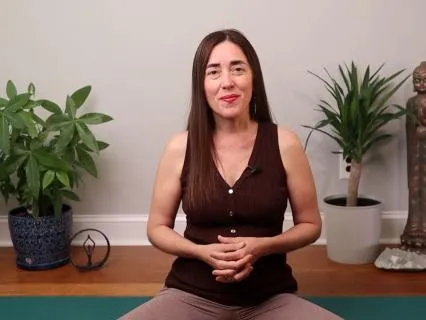
I am Diana,
Felling Grace practitioner and somatic teacher.
In today's practice we will explore a little movement and a little rest and see whether either feels useful today.
Let's begin.
People use the words fight or flight often to describe feeling keyed up and ready to react.
That language can help us talk about stress.
But it doesn't explain every single symptom or tell us exactly what the nervous system is doing.
For now,
Choose a place where you can pause.
Sit with support.
If that is comfortable.
Keep your eyes open or let your gaze rest softly.
If any part of the practice causes pain,
Dizziness or discomfort,
Please stop.
Let your hands rest on your thighs or on a cushion.
Or on the chair.
Notice where the surface meets your hand.
You can keep some attention on the room as well.
Or the sounds.
That you can hear if your eyes are closed.
I will do the practice with you.
Now if it's comfortable.
Slowly slide one hand a short distance forward along the surface under it.
And then bring it back.
Your shoulder can move along with it.
There's no need to hold your shoulder in place.
Let your shoulder move.
With your hand.
And return.
Make the distance small enough that you could stop anywhere along the way.
Repeat this movement a few times.
Make sure to stop between each repetition.
Now let the hand rest.
Notice the difference between moving and being still.
If you don't notice much,
Leave it at that.
Notice any sensation in the side that you just moved,
Perhaps your chest.
Your shoulder and now try the other hand if you would like slide it forward a little,
Then return Do it again as you allow an ordinary breath to happen as you move.
There's no need to match the breath.
To the movement.
Now rest both hands and let them be supported.
If moving felt useful,
Choose the easier hand and repeat the movement once more.
Could you do a little less this time?
A shorter distance perhaps or less effort in your fingers.
If movement felt irritating,
Leave it out.
Stay with a familiar object in the room instead.
Allow the movement to finish completely before deciding whether to do another one.
Now notice the support behind you.
If there's a back rest.
Or a cushion.
You might let yourself meet it a little more fully.
Change position if that would be more comfortable.
If something wants to come out,
A big sigh or a yawn and his sound,
Allow it.
Perhaps your mind is still planning.
Solving or preparing.
You can acknowledge that without answering every thought.
For this moment.
See whether you can let one task wait while you notice your surroundings.
Look around and choose where would you like to place your attention next.
You may notice some ease or simply a clearer idea of what you need.
A dramatic change is not required.
Before you move on,
Consider one demand you could reduce today.
Good task away.
Could you ask for help?
Is there a conversation or a boundary that would make a difference?
A short practice can be one form of support.
Ongoing pressure also deserves practical attention and persistent symptoms deserve care.
Today's practice is a chance to learn about your own experience.
Your response can vary from day to day.
If overwhelm or disconnection is persistent.
Professional support can help you understand it and find approaches that fit.
I thank you so much for taking this time with me.
I look forward to seeing you in my next video and in the meantime,
I send you so much love.