Hey guys.
Tonight's story starts in that cursed slice of night when the world isn't asleep but it isn't awake either.
The walls groan,
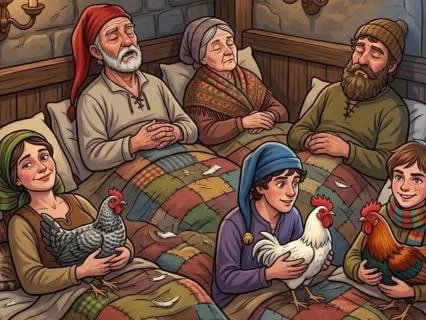
The mice are whispering about your bad decisions and every single relative you share a bed with has somehow migrated onto your half.
The hearth is nothing but a graveyard of ashes and your only light is a candle stub that looks like it's about to retire.
Welcome to the forgotten hour between sleeps where nothing happens and somehow everything does.
Now get comfortable.
Let the day melt away and we'll drift back together into the quiet corners of the past.
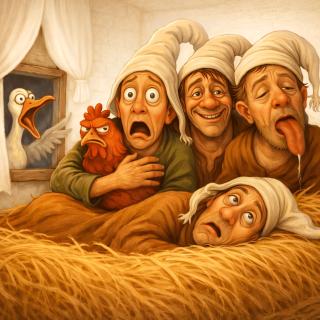
You open your eyes not because you're rested but because someone outside is yelling about a goose.
A goose?
Singular.
As if one bird could justify this much drama before dawn.
You stare at the rafters which creak like they're considering retirement.
The air is cold in that way that seeps into your bones and starts weighing down your thoughts before you've even formed them.
It's still dark.
Not the thick velvet dark of midnight but the smudged,
Reluctant sort that hints something might be coming though it won't be good.
You wonder if it's morning or just last night.
No one knows.
Not even the sun who you're certain has hit snooze again.
You shift under the blanket.
Scratchy wool possibly made of regret and instantly regret it.
Someone's elbow jabs your rib.
Possibly your brother's.
Possibly your grandmother's.
Space is limited and boundaries are conceptual.
You hold your breath and try to decipher whether the body against your leg is human,
Goat or the heap of winter laundry.
Either way,
It smells like feet.
The fire is out.
Naturally.
No one fed it after supper and it's sulking in the hearth like a teenager asked to sweep.
You consider getting up to poke it back into life but that would mean leaving the warmth of the collective body pile and crossing the frozen stretch of floor known locally as the Valley of Bad Decisions.
Your toes are already numb and might be permanently lost.
You give one a wiggle to confirm its existence.
Nothing.
You mourn it briefly.
The rooster hasn't crowed and you're not sure he ever will again.
He's been moody since Candlemas and you're starting to suspect he's unionizing.
Last week he only crowed after being bribed with barley.
Yesterday,
He just screamed once and went back to bed.
This morning,
So far,
Silence.
Somewhere,
A dog barks at absolutely nothing,
Then barks again to confirm it.
Another voice joins the goose yeller,
Higher pitched and definitely insulted.
The goose honks in reply,
Defiant and unrepentant.
You hear a splash then cursing.
You roll over slowly,
Trying not to wake the entire ecosystem on the family bed and succeed only in shifting someone's knee deeper into your hip.
You let out a noise that might have been a whimper or a prayer.
This is not a new day.
This is the in-between.
The sacred stretch of time when the world is neither asleep nor awake.
The time where no one should be conscious but everyone islands,
Sort of.
The hour where thoughts wander sideways,
Where dreams half-finish and guilt starts seeping in from things you haven't done yet.
This is first waking.
It tastes like ash and old porridge and the breath of the person next to you who apparently feasted on onions in their sleep.
You sit up just enough to peek over the edge of the blanket.
Shapes shift in the gloom.
Your mother is still snoring like a blessed ox.
Your youngest sibling,
The one who collects beetles and questionable ideas,
Is curled up with a rag doll missing half its face.
You once asked what happened to the other half.
He told you fire and betrayal,
Then refused to elaborate.
The baby is drooling quietly on a lump of wool that may or may not be a sock.
You choose not to investigate further.
The roof creaks again,
Louder this time,
As if trying to get your attention.
You stare upward and make a deal with it.
Hold out until spring and you won't tell anyone about the hole in the back corner that drips directly into your uncle's ear when it rains.
The roof doesn't respond,
But a mouse scurries across the beam,
Tail twitching like it disapproves of your negotiation tactics.
You blink slowly.
The candle stub on the stool beside the bed is just that.
A stub and a pathetic one at that.
You light it anyway,
With the flint your father leaves tied to the leg of the bed in case of midnight bandits or aggressive pies.
The flame sputters,
Wheezes,
And then flickers to life like an old man settling in to gossip.
You hold the light up and glance around the room.
It looks the same as it always does in this hour,
Haunted and slightly confused.
The walls lean slightly in one direction,
Like they've given up resisting the wind.
The hearth is just ashes and ghost heat.
A pot hangs over it,
Blackened and mysterious,
Containing either yesterday's soup or something that crawled in during the night to die dramatically.
You decide not to check.
Outside,
The noise continues.
The goose chase has escalated into what sounds like a turf war.
You hear someone shout Unhand me,
You feathered demon,
Followed by a squawk and what might be a splash.
You imagine mud.
You imagine damp shoes and poor choices and the long,
Slow sigh of someone realizing they're going to have to explain a bruise and a missing boot.
You smile for the first time today,
Back in the house.
Someone turns over and mutters a name you don't recognize.
You hope it's a dream.
You stand finally,
Slowly,
Like someone rising from the grave more out of duty than desire.
Your knees crack.
Your shoulders whine.
The floor is exactly as cold as you feared.
You shuffle to the window,
Really more of a hole with ambitions,
And peek through the cloth nailed over it.
The sky is thick and bruised.
The trees are still.
The world holds its breath.
You don't know why you're awake.
Not really.
No one does.
Not the priest,
Who says it's a divine pause meant for prayer and quiet contemplation.
Not the midwife,
Who uses the time to mend clothes and mutter about men.
Not even the old crone by the well,
Who insists this is when the dead visit and demand soup.
All you know is that you've always woken like this.
As did your father and his father,
And probably some long-lost ancestor who once stared into the fire and wondered if he was the only one who felt like the night was broken into two pieces and he was stuck in the crack.
You shiver,
Then pull your cloak around your shoulders.
It smells like herbs and animal.
You grab a crust of something hard enough to question and chew it thoughtfully while your breath fogs in the flickering candlelight.
The goose outside lets out one final triumphant honk and you nod to yourself.
Whatever this hour is,
Whatever name it goes by in the hearts of old women and cold floors,
It belongs to you now and to the goose,
Apparently,
But mostly to you.
The hearth is cold.
The cottage is colder.
Not the kind of chill that nips politely at your toes and leaves again,
But the kind that wraps around your spine like a wet eel and settles in.
You can see your breath hovering above your mouth like it's trying to escape.
The fire gave up sometime in the night,
Burned down to a sulk,
And now the only heat in the room is radiating from the tangled human disaster lumped under the blanket.
You shuffle past them,
Careful not to disturb the delicate balance of elbows,
Knees,
And general snoring hostility.
Your father's arm is thrown across your sister's face.
Your cousin is somehow upside down.
Someone's foot is in the buttercrock again.
You consider peeing,
Briefly,
Sincerely,
But the thought of stepping outside into the frost crusted dark,
Of unlatching the door with fingers that barely remember circulation,
Is enough to send you retreating back into the shadows like a guilty raccoon.
Besides,
The outhouse is behind the shed.
The shed is behind the goat pen,
And the goat is probably awake.
He's been waiting.
You've seen it in his eyes.
Instead,
You stare at the wall and pretend not to hear the mice.
They're up,
Of course.
Always up.
Always busy.
Scritching and scratching in the thatch,
In the corners,
Behind the sacks of grain,
Probably discussing you.
You imagine one of them sitting upright,
Arms crossed,
Judging your entire bloodline.
They're louder than they have any right to be.
You try to ignore them,
But it's hard not to take it personally when a mouse sounds disappointed in your life choices.
The blanket you've wrapped around your shoulders is stiff from smoke and use and smells vaguely like stew,
Sweat,
And a life not spent making good decisions.
You clutch it tighter and step over the dog,
Who is not your dog,
But just the village dog who decided this was his home last autumn and refuses to acknowledge anything to the contrary.
He's sprawled by the door like a furry sack of defiance.
You try not to trip over his tail.
The floorboards creak under your feet with a specific volume of betrayal.
One of your siblings groans in their sleep.
Another lets out a sigh so dramatic it probably echoed in the next village.
You pause,
Holding your breath.
Silence returns,
Except for the mouse orchestra and the wind knocking politely at the shutters as if to remind you that,
Yes,
It's still horrible outside.
You tiptoe toward the hearth,
Not with any hope of rekindling warmth,
But because standing still makes the cold sink deeper into your marrow.
The ashes glow faintly.
One ember,
Maybe two,
Cling to life like stubborn old men refusing to leave the tavern.
You prod at them with a stick.
They hiss in protest,
Unimpressed by your effort.
You mutter something unholy under your breath and retreat again,
Defeated by fire and circumstance.
This is the hour no one talks about.
The hour between sleep and sleep,
Between dark and not quite dawn,
When nothing is required of you except existing,
Which is already too much.
It's the hour of regret,
Of vague hunger,
Of bladder negotiation.
You don't have to go outside.
But you could.
But you don't want to.
But it might be worse later.
But it's terrible now.
It's a debate you lose either way.
You sit on the edge of the bed,
Which isn't really a bed so much as a platform of shared suffering and communal body heat.
Your little brother murmurs something about fish and kicks your ankle.
You consider kicking him back,
But remember he bit you last week during a pillow disagreement,
And you're not sure your tetanus is current.
You sigh instead,
Deeply,
The kind of sigh that could power a small windmill.
No one notices.
That's fair.
You glance toward the window.
There's no light yet,
Only the pale suggestion that maybe somewhere far away,
The sun is tying its sandals.
The sky is a smear of gray and indifference.
You hate it a little bit,
But also you understand.
You wouldn't rise either if you didn't have to.
Your mother snorts awake briefly,
Rolls over,
And resumes snoring with renewed commitment.
The baby whimpers and settles again,
Drooling audibly onto a shared pillow that smells like hair and secrets.
You've memorized every sound in this cottage.
The crack of the drying beam,
The wheeze of the old stool,
The way the wind sometimes moans through the thatch,
Like a ghost who regrets marrying into this family.
Nothing is new,
And everything is slightly worse than yesterday.
You think about the rooster.
Where is he?
Why hasn't he screamed yet?
Maybe he froze solid.
Maybe he finally got tired of being ignored and moved to a monastery.
Maybe he's on strike.
It wouldn't be the first animal in this village with strong labor opinions.
The oxen once staged a sit-in for better hay.
It lasted four hours and ended with someone bribing them with apples and a fiddle tune.
Outside,
Something thumps.
Probably the goat.
Possibly the goose.
You hope it's not the pig again.
She's clever and mean and still hasn't forgiven you for last spring when you accidentally fed her a mitten.
You only had one,
And your hand never quite recovered.
You stand again.
Walk to the door.
Touch the latch.
Consider your life.
Step back.
Not yet.
You'll wait until someone else breaks first.
It's the silent agreement every morning.
Whoever gives in and goes outside becomes the designated hero and defrosts the water bucket.
You are not a hero.
You are a reasonable person with a healthy fear of moonlit frost and your own bladder's betrayal.
You return to the corner near the hearth.
Curl into the blanket and pretend you're a log.
A warm,
Unmoving,
Inanimate log.
You breathe in through your nose,
Out through your mouth,
And try not to think about the icy grip around your ankles.
You try not to think about the goats.
You try not to think about anything,
Really.
The mice are still whispering.
You hear one sneeze,
And in that moment,
As you close your eyes and drift into the in-between,
Somewhere between prayer and insult,
Between the cold floor and your brother's snoring,
You accept the truth.
You will not pee.
Not yet.
But you will complain about it.
Loudly.
Later.
You light a candlestub.
Not because you need to see.
There's nothing worth looking at anyway.
But because you feel weird sitting alone in the dark,
Even if half your family is snoring behind you and the other half is likely awake pretending not to be.
The flame sputters like it resents being summoned at this hour,
And casts just enough light to remind you how dusty everything island.
You watch it wobble,
Nervous and small,
Like it's scared of what it might reveal.
You are too.
The shadows stretch around the room like they've been waiting for you.
They're not threatening.
Exactly.
Just nosy.
One of them looks like a hunched man with a big nose until it shifts and becomes a ladle.
Another one,
By the ceiling,
Twitches every few seconds.
You tell yourself it's just the draft.
You tell yourself a lot of things during the not-quite-night.
Like how the goose probably didn't bite through the neighbor's boot.
Like how the mouse you saw earlier definitely isn't plotting your downfall.
Like how you're fine,
A cough echoes through the wall,
Raspy and insistent,
The kind of cough that wants attention.
It belongs to Widow Merrill,
Who sleeps alone with three cats and one enormous sack of dried leeks that she claims are for winter,
But secretly uses as conversational leverage.
The cough continues,
Pauses,
And then resumes,
As if narrating a story only she understands.
You hear one of the cats yowl in protest,
Followed by a soft thud that could either be a broom or a very determined opinion.
Somewhere nearby,
A pot crashes to the ground.
You freeze.
The candle jumps.
Silence follows,
The kind that spreads out like a blanket and presses against your ears.
No one moves.
No one investigates.
That's the rule.
During this part of the night,
You let things fall.
You let things clatter.
You let them live or die on their own terms.
If you intervene,
You risk waking someone who might make you do something about it.
And.
.
.
Worse.
Talk to you.
You pull your blanket tighter,
Feeling suddenly like a child again,
Half afraid of the dark,
Half convinced it's more honest than the light.
Your mother always said the night has layers.
Evening is for meals and songs and bickering over firewood.
Midnight is for dreams,
For stillness,
For husbands muttering about taxes in their sleep.
But this time,
This in-between slice of dark is different.
It's quieter than it should be.
More crowded,
Somehow.
Like time doesn't know what to do with itself,
And is just loitering until morning.
You remember once,
Years ago,
Waking up at this hour to find your grandmother sitting at the table with a piece of bread and a hunk of cheese,
Staring into the candle like she was expecting it to confess something.
She didn't look surprised to see you.
She just cut you a slice and said,
Sometimes the soul gets fidgety.
You nodded like you understood,
Even though you were mostly focused on the cheese.
Now,
Years later,
You do understand.
Maybe not the soul part,
But definitely the fidgety.
A creak above your head suggests someone in the loft has shifted.
Could be your uncle.
Could be the rat.
You've given up trying to tell them apart by sound.
Someone lets out a slow,
Drawn out sigh.
The kind that says,
I'm awake,
But also,
Don't talk to me.
It's answered by the sound of teeth grinding and a soft fart,
Which you choose to interpret as unrelated.
You step carefully across the room and sit on the stool next to the window,
Though calling it a window is generous.
It's a hole in the wall with a bit of waxed cloth nailed over it,
But it lets in air and sound and the occasional beetle with no respect for boundaries.
You lift the corner and peek out.
The sky is still dark,
But in a different way than before.
Less like ink,
More like watered down wine.
The stars are fading,
Slow and shy.
A thin slice of moon lingers like it forgot something.
Down the lane you can just make out the shape of Griever's chimney.
Smoke curls from it.
Of course it does.
Griever the baker never sleeps,
Or at least not when people are supposed to.
He always wakes early to curse at yeast and scream at the dough like it insulted his mother.
You've seen him slap a lump of rye so hard it could have sued.
Right now,
He's probably elbow deep in flour,
Humming the same off-key hymn he sings every morning.
It's comforting,
In a way,
Knowing someone else is up,
Even if it's Griever.
You tear off a corner of your crust from earlier and chew it absently.
It's dry,
But not unkind.
The chewing helps.
There's something about bread at this hour.
It doesn't ask questions.
It doesn't mind the silence.
You think about slicing some cheese,
But the floor creaks in that warning tone that says,
Don't push your luck,
And you decide to sit still instead.
Behind you,
Your cousin mumbles something about frogs.
You don't look.
It's better not to.
Everyone dreams strange during this time.
You once dreamt you married a fish.
Not a mermaid.
A fish.
It gave a speech at the wedding about duty and algae.
You woke up hungry and slightly insulted.
The candle burns low.
You tilt it slightly to make the wax drip evenly.
This is the part of the night no one talks about,
But everyone knows.
You've heard women whisper about it at the well.
Voices low,
Eyes squinting like they're remembering something they wish they didn't.
You've heard old men mutter about it by the ale barrel,
Claiming they used to use this time to sharpen knives or their wits,
Depending on the week.
Even the priest once mentioned,
During a sermon,
That sometimes the Lord whispers in the dark.
He said it like a warning.
You don't hear whispers.
Just the usual.
The thump of restless feet.
The sigh of settling walls.
A rooster somewhere,
Prematurely ambitious,
Lets out a confused croak and then gives up.
You wonder what time it is,
Not because it matters,
But because it doesn't.
The clock is a church bell.
The bell is silent.
Time is,
For now,
Suspended.
You sit,
Candle flickering low,
Bread gone,
And feel it all.
The hush.
The hum.
The peculiar warmth of solitude in a room full of people.
The shadows are quieter now.
The cough has stopped.
Even the mice seem thoughtful.
You don't know how long you sit like this.
Eventually,
The dark begins to change again,
But for now,
This moment is yours.
Yours,
And everyone's.
But mostly yours.
You're not alone.
You never are.
The walls may be thin,
The roof may leak,
And the bed may host more limbs than a battlefield surgeon's tent,
But solitude is a luxury you've never known.
Even now,
In the middle of the second night,
The wakeful watch settles over the village like a woollen blanket.
Scratchy,
Awkward,
And heavier than you'd like.
You can feel them.
The others.
Awake.
Like you.
In that quietly stubborn way that refuses to be called insomnia because no one has invented that word yet.
They call it restlessness.
Or the lord's hour.
Or the I'll just sit here and stare into the fire until I forget what I was thinking about.
Time.
You don't know what it is,
Exactly.
But it's not sleep.
And it's not day.
It's something else.
A pause.
A breath.
A shared stillness that everyone denies having noticed.
Across the village,
In the low stone house with smoke that always smells faintly of burned raisins.
Griever the baker is poking his coals.
You can hear the distant clang of his peel against the side of the oven.
Followed by a low curse and something that sounds like dough hitting the floor.
He's been up since before you lit your candle.
Maybe he never went to bed.
Maybe he sleeps standing up like a disgruntled horse.
Whatever the case,
He's already angry at the rye.
And the rye is already winning.
Two huts down,
The midwife is awake too.
Her window glows dimly,
Flickering orange.
The kind of light that says someone is sewing something they don't want anyone else to see.
Undergarments,
Probably.
Or a doll.
Or a pair of socks shaped like a curse.
You've met her.
She has that look in her eyes like she's seen the inside of too many people and none of them were impressive.
You're sure she sees ghosts.
You're also sure she's friends with them.
You lean back against the rough timber wall,
Head tilted just enough to hear the wind snake through the gaps in the thatch.
The cold is less harsh now,
Less aggressive,
More like a dog that's too tired to bark,
But still wants you to know it disapproves of your choices.
Your feet are tucked beneath you,
Blanket wrapped twice.
Once for warmth,
Once for emotional support.
The candle's flame trembles as if it too is trying to stay awake.
Your father shifts in the bed,
Lets out a snore that sounds like a philosophical disagreement with gravity,
And then settles again.
He won't wake unless there's thunder or someone drops the soup pot.
Even then,
He'll claim he was dreaming of a war where everyone shouted the names of vegetables.
Your mother is quieter,
Though her breathing has the rhythm of someone who's definitely listening even while unconscious.
You suspect she has a sixth sense for knowing when someone is about to steal jam or ask a stupid question.
And then,
Of course,
There's the blacksmith.
Somewhere near the edge of the village,
Probably curled up under his anvil like a dragon guarding hoarded scrap metal,
He's snoring.
Loudly.
Steadily.
Like the world depends on him keeping time with his sinuses.
You've heard it before,
Echoing through the trees on windless nights.
Some claim it's the forest spirit.
Others say it's just his nose.
Either way,
It's dependable.
You close your eyes,
Not to sleep,
But to listen better.
The village is alive in its stillness.
Footsteps creak on distant floorboards.
Someone else has surrendered to the call of their bladder or their conscience.
A shutter clicks open,
Then closed.
A child coughs.
A kettle hisses.
Someone somewhere mutters,
Just one more row,
And you imagine the village weaver sitting in the dark,
Stitching cloth and quiet judgment into every loop.
It's strange how comforting it is,
Knowing everyone else is up too.
Not talking.
Not gathering.
Just awake.
Separate.
But together.
It makes the dark feel less like an absence,
And more like a companion.
A shared understanding that sleep isn't the only way to rest.
That sometimes,
Just sitting with your thoughts,
Unruly,
Half-baked,
And probably about soup,
Is enough.
A dog barks once,
Then again,
In that particular tone that means fox,
Or absolutely nothing.
You hear the rustle of hay in the barn,
Followed by a chicken making a sound like it just remembered it exists.
The village breathes.
Not in harmony,
But in chorus.
Everyone pretending to sleep.
Everyone failing.
You think about what people do in this hour.
Griever bakes.
The midwife sows.
The priest,
You assume,
Prays,
Though you once caught him pacing in the cemetery whispering to a headstone like it owed him money.
Children dream and twitch,
And wake up convinced their foot was a monster.
The old woman in the corner house drinks something pungent and talks to her dead husband,
Who,
According to her,
Never stopped interrupting.
You?
You sit.
You think.
You wonder if it's always been this way.
If people in castles and caves and distant cities also find themselves sitting at tables with crusts of bread and candle nubs,
Wondering why their minds won't shut up,
You bet they do.
You bet someone in a palace right now is wrapped in fifteen layers of imported linen thinking about goats for no reason.
Your thoughts drift.
They always do.
To chores.
To people.
To that one time you said something stupid and everyone definitely still remembers.
To bread.
Mostly bread,
If you're honest.
You wonder if it's too early to sneak a piece from the larder.
You calculate the distance.
The floor creaks are a problem.
The dog might snitch.
Your mother definitely will,
Even in her sleep.
You stay put.
The candle leans low,
Wax pooling like it's trying to escape.
You blink slowly,
Not tired,
But also not awake in any meaningful sense.
The wall presses cold against your shoulder.
The room breathes around you,
Full of sleeping bodies and wakeful minds.
And somewhere,
Not far,
Another candle flickers in another window.
You're not alone.
You never are.
You chew a root.
It tastes like the floor of the pigpen had opinions and got boiled.
The herbalist gave it to you with a smile that felt more like a dare.
She said it would calm your humors,
Soothe your nerves,
And usher you gently into the warm embrace of restful slumber.
What it's done is coat your tongue in regret and make your teeth feel like they've been scolded.
You keep chewing because she also said you have to work through the bitterness.
And you believed her.
Mostly because she has a lot of jars and once threatened a tax collector with nettle tea.
You glance at the pouch she gave you.
It's labeled,
Peaceful Night in handwriting that looks like it was done mid-seizure.
You're fairly sure that the main ingredient is dried disappointment.
You tried the tea last week.
It made your ears itch and your dreams involve shouting sheep.
You tried the lavender sachet too.
Stuffed it under your pillow like she said.
But the goat got into the bed while you were outside relieving your humors and now the goat smells wonderful and you don't.
So now it's the incense.
A thin curl of smoke winds toward the ceiling beam,
Searching for meaning.
It smells like damp hay and someone trying to cover up an argument with potpourri.
You breathe it in like it might help.
Like the herbalist promised.
Like the fourth time might be the charm.
But it's hard to feel mystical when your nose hairs are staging a protest.
The smoke creeps into your shirt and settles there like it's trying to start a conversation with your armpits.
You try to relax.
You do.
You lie back.
Arms crossed over your chest like you've just been respectfully embalmed and stare at the dark shape of the rafters.
A mouse scurries along one beam,
Pauses dramatically,
Then vanishes.
You wonder if it's the same one from last week.
The one that made eye contact and then stole your crumb like it was making a point.
You're not convinced the herbalist didn't send it.
Your grandmother insists this is a sacred hour.
She says it with her eyes closed and her hands wrapped around a mug of something that smells like mushrooms and defiance.
She calls it the space between breath and waking,
When the soul can stretch.
You call it the time when my foot falls asleep and my thoughts are just squirrels.
She says to meditate.
You say you did and what actually happened was you fell sideways into a bucket and no one helped for three minutes because they thought it was part of the process.
You roll onto your side and pull the blanket tighter around your shoulders.
It's scratchy and smells faintly of cabbage,
But it's yours.
You try to think calming thoughts,
A meadow,
A warm breeze,
A chicken that respects boundaries,
But your brain is already off,
Running down side paths and asking questions like,
Did I forget to secure the latch on the pen?
And,
What if soup had legs?
You close your eyes and try counting sheep,
But the sheep in your head are too clever.
They keep unionizing and asking for better hay.
One of them is smoking a pipe and judging your posture.
The incense sputters and goes out with a hiss,
As if even it has lost patience with you.
You watch the last tendril of smoke rise,
Twist,
And vanish into the thatch.
You consider lighting another,
But the last one made your sister sneeze herself awake and she threw her boot across the room in retaliation.
It hit your cousin.
He hasn't spoken to anyone since,
Which some call peaceful and others call ominous.
You chew another root,
Just to prove a point.
It still tastes like betrayal and wood shavings,
But now your jaw is numb and your stomach is beginning to suspect you've made a mistake.
The herbalist says to give it time.
She also once said nettles could cure heartbreak,
But all it did was give you a rash in places best left unspoken.
You remember when she came to the village.
She wore a cloak made of patchwork moss and had a bag full of dried things that crinkled when she moved.
Everyone said she was a gift.
You suspect she's more of a long-term experiment.
She talks to bees,
Not in a metaphorical way.
You've seen her whisper to them like they're old friends,
And once one whispered back.
You don't know what it said,
But she nodded like it had made an excellent point about the moon.
A floorboard creaks as someone rolls over.
You freeze,
Waiting to see if anyone wakes.
No one does.
The room settles again into the hush of shared discomfort.
The candle flickers,
Then steadies.
You consider trying one of the other remedies the herbalist left.
Some kind of ointment you're supposed to rub on your temples,
Made from fermented elderberry and crushed beetle wings.
You opened it once.
It smelled like boiled socks and regret.
You'll pass.
Your stomach growls.
Loudly.
You're not even hungry,
But apparently your internal organs have decided this is the right time to remind you that you once denied them a third helping of stew.
You wonder if the herbalist has a tea for guilt,
Or indigestion,
Or both.
You sigh,
Long and slow,
And it steams into the air like the beginning of a folk song about disappointment.
You are not asleep.
You are not restful.
You are awake and full of root and confusion.
Outside,
The wind picks up,
Rustling through the eaves like it's looking for something it dropped.
The goat bleats once,
Probably still wearing the lavender sachet like a fashion statement,
Probably sleeping better than you.
You shift again,
Trying to find a position that doesn't involve one of your joints crying.
Your neck pops.
Your shoulder makes a sound that can only be described as medieval.
The incense smell is still clinging to your hair like a bad decision.
You close your eyes one more time,
Telling yourself you'll drift off soon.
And maybe you will,
Right after you finish this route.
Your uncle kneels in the corner like he's proposing to the wall.
The floor creaks beneath his knees,
A sound both tragic and suspiciously crunchy.
But he doesn't flinch.
His hands are clasped,
His eyes are shut tight,
And he is praying with the intensity of someone who believes heaven is a bit hard of hearing.
He starts with forgiveness,
Always,
Then detours into health,
Then gets specific.
Last night it was his knees.
Tonight it's probably his neighbor's goat.
Or the mole on his back that he's decided might be prophetic.
You've learned not to ask.
You've also learned that he doesn't care if you do.
Across the room,
Your sister whispers to herself while drawing on the floor with a charcoal stub.
It's from the fire,
Still warm.
She traces looping symbols and writes half-remembered dreams in the soot,
Like she's negotiating with something under the bed.
She does this a lot during the second waking.
No one stops her.
No one wants to find out what happens if you interrupt mid-sigil.
One time,
She drew a circle around your cousin,
And he couldn't speak for two hours.
He says it was a coincidence.
You're not convinced.
Someone outside is reciting a psalm.
You can't tell who it island.
Just a low,
Rhythmic chanting that seeps through the wall like steam.
It's the kind of voice that has given up on sleep and decided to bargain with eternity instead.
The cadence is slow,
Familiar.
Line,
Pause,
Line,
Pause,
Exhale.
It could be the priest or the miller's wife who once claimed she saw an angel in the flower.
It turned out to be the cat,
Covered in ash.
But still,
Your mother sits on her stool by the hearth,
Not speaking,
Not moving,
Just watching the dying embers.
She's wrapped in three shawls and holding her mug like it's got all the answers.
She doesn't pray out loud.
She says God hears better when you don't shout.
She also says God prefers honesty over poetry.
So she just stares at the fire like it owes her rent,
And occasionally mutters something that might be a request or might be a complaint.
Same thing,
Really.
The bread dough on the table has not risen.
It slumps in the bowl like it's been personally insulted.
Your older brother leans over it,
Muttering what might be encouragement or threats.
Come on,
He says,
Voice low.
Just a little lift.
Don't make me get the vinegar again.
You've seen him argue with dough before.
He always loses,
But never admits it.
The bread ends up heavy enough to be used in self-defense,
But at least it's warm.
Everyone has their ritual.
You sit by the window,
Forehead pressed to the cold wood,
Watching frost collect like thoughts.
You don't pray,
Not the way they do.
You don't speak psalms or chant or beg the heavens to reroute your destiny.
You just breathe,
Slow,
Steady.
You think if God listens to anything,
It's probably silence or heavy sighs.
You've tried talking out loud before.
Once,
When your best hen died,
You sat behind the barn and told the clouds you'd trade your shoes to get her back.
Nothing happened.
You went inside barefoot.
Your mother asked if you were daft.
Your uncle said your hen probably committed some unholy crime.
The clouds said nothing.
Sometimes,
In this hour,
You try again.
Not the asking part.
Not anymore.
Just the talking.
You tell the dark what you're worried about,
What you remember,
What you wish you didn't.
The dark doesn't answer,
But it doesn't interrupt either,
Which is more than you can say for your family.
Tonight,
Your thoughts are crowded.
You try to let them line up like obedient sheep,
But they insist on behaving like geese in a thunderstorm.
You think about the harvest,
About the aching in your hip that wasn't there last winter,
About the strange light in the woods no one talks about but everyone avoids.
You think about how the walls of your home are made of mud and prayer and how both crack when it gets cold.
You think about death.
You think about life.
You think about bread,
And still,
The house breathes around you.
Your uncle's voice rises,
Cracking on a particularly desperate syllable.
He doesn't stop.
He never does.
He says this is when God listens best,
During the between time,
When the world is quiet and the mind is too tired to lie.
You wonder if that's true.
You wonder if God actually prefers the moments no one else does.
The awkward ones.
The lonely ones.
The ones where nothing is happening except a floorboard shifting and a mouse chewing something it shouldn't.
Your sister finishes her soot spell and blows on it softly,
Like dandelion fluff.
The cymbals smear.
She nods,
Satisfied.
She's probably hexed the entire street or summoned a toad.
Either way,
She curls back under the blanket like she just finished a night shift at the monastery.
You decide not to step in that spot tomorrow.
Your father wakes just enough to clear his throat and roll over.
He opens one eye,
Sees your uncle still kneeling,
And lets out a sound that might be a groan or a prayer,
Depending on your interpretation.
Then he's asleep again.
Mouth open.
Dreams leaking out.
You run your fingers along the windowsill.
The wood is splintered but familiar.
You trace the same groove you always do.
The one someone carved a hundred years ago.
A name,
Maybe.
Or a curse.
Or just boredom.
You wonder if they were awake,
Like you.
Staring into the dark.
Talking to God or the floor.
Or nothing at all.
You wonder if they got answers.
The candle sputters once.
Flares.
Then settles.
You don't need it anymore.
The room has adjusted to the dark.
Or maybe the dark has adjusted to you.
Either way,
You sit listening to the quiet rhythms of a house half-asleep and half-praying,
Half-remembering and half-hoping.
And you whisper to no one in particular.
Because someone might be listening.
Or no one island.
But you say it anyway.
Just in case.
You build a new fire because the old one died like a martyr.
Dramatic,
Smoky and way too early.
The ashes glare up at you with the quiet resentment of a task half-finished.
You prod them with the iron poker,
Hoping they'll spark themselves out of guilt.
But no.
They are stubborn,
Ashy corpses.
So you start over.
You pile kindling like a humble offering and strike flint like you're trying to insult it into cooperation.
The spark lands.
The spark dies.
You mumble something profane and pretend it was a prayer.
When the flame finally catches,
It does so with a hiss.
Like it resents you personally.
Smoke curls straight into your face as though it has opinions about your life choices.
You lean back,
Eyes watering and blink into the haze like someone trying to read tea leaves in a sandstorm.
The fire sputters,
Threatens collapse.
Then,
Miracle.
It flickers upright,
Just enough to look smug.
You add a log like a bribe,
Coaxing it to stay,
Whispering the same nonsense people use on babies and bread dough.
It accepts.
Barely.
This is the second fire.
The one that doesn't burn for light or for cooking,
But for the quiet theater of not being alone in the dark.
It gives off just enough heat to keep your toes attached and just enough glow to prove that time is still passing.
You watch it like it's a play.
Nothing happens.
That's the point.
Behind you,
The blanket pile shifts.
A sigh.
A snort.
The rustle of someone re-entering consciousness unwillingly.
Your sibling rises,
Eyes half-open,
Hair standing in directions unapproved by any god.
They look at you like they've caught you committing a crime.
Is it tomorrow?
Im.
They ask,
Voice thick with sleep and judgment.
You shrug.
They nod,
Satisfied with the ambiguity,
Then punch you in the leg and go back to sleep without further explanation.
You rub your shin.
Peaceful,
You think,
With the deadpan sarcasm of someone who hasn't had a full night's rest since they were five.
The fire crackles louder now,
Emboldened by its survival.
It spits a spark that lands near your foot,
And you stare at it until it dies,
Because that's how problems are handled in this house.
You poke the log again,
Not because it needs it,
But because it makes you feel like you're participating in the ancient tradition of fire-tending,
Instead of just waiting for sleep to ambush you again.
You think about second sleep,
How no one talks about it like it's real,
But everyone does it.
The in-between sleep,
The one that comes after the fire's been fed,
The dreams have been processed,
And the thoughts have had their tantrums.
It's not a luxury.
It's a ritual.
First sleep is what you collapse into.
Second sleep is what you choose.
Your uncle once said,
Second sleep is when the world is closest to truth.
You're pretty sure he was drunk,
But still,
He has a point.
There's something honest about this hour.
No one's pretending to be busy.
No one's performing competence.
It's just you,
The fire,
And the echoes of a day that isn't quite done being resented.
The room settles again,
People breathing in various keys,
Snoring in different rhythms.
You try not to count them,
But you do.
Six humans,
Two cats,
One dog that technically belongs to the neighbor but prefers your hearth,
Everyone accounted for.
No one fully awake,
No one fully asleep,
Just floating.
You sit closer to the flames,
Letting the heat bite at your fingers until it hurts in a good way.
You think about whether it's worth crawling back into the bed.
It will be warm,
Yes,
But also full of elbows and knees,
And one person who sleep talks in riddles.
The blanket's been pulled entirely off your corner anyway.
You consider reclaiming it,
But that would require negotiations.
And there's always the risk of waking the snorer,
Who snores louder in retaliation if disturbed.
Instead,
You stare at the fire,
Letting your thoughts unspool like a dropped ball of yarn.
They tangle.
They loop.
You find yourself thinking about soup again.
About the way the chicken looked at you before it became soup.
About whether chickens have opinions on reincarnation.
About whether second sleep is a kind of reincarnation,
Just shorter and with less paperwork.
You think about the word tomorrow and how slippery it feels right now.
This doesn't feel like tomorrow.
This feels like the intermission between scenes of a play that's both too long and too familiar.
You know your lines.
You don't like them,
But you'll still say them when the rooster decides you've been horizontal long enough.
The dog twitches in its sleep,
Chasing something invisible and very important.
A cat sneezes.
Your grandmother mumbles from her blanket cocoon.
It sounds like turnip,
But that could mean anything.
You decide not to investigate.
The fire is safer.
A gust of wind howls through the chinks in the door.
The flame leans sideways,
Recovers.
You wrap the blanket tighter around your shoulders,
Even though it doesn't help.
It's the illusion of control that matters.
You could be cold with dignity or cold without it,
And you're choosing the former.
Your eyes grow heavy,
Not from exhaustion,
But from agreement.
Your body has decided it's time.
The second fire has done its job.
It's told your bones to soften,
Your mind to quiet,
Your heart to stop narrating everything like it's a bard with performance anxiety.
You stretch,
Crack a few joints that weren't supposed to make that noise,
And rise.
You don't extinguish the fire.
You feed it one last scrap of wood and trust it to behave.
You crawl back into the shared bed like a spy,
Sneaking into enemy territory.
There's a toe where your pillow should be.
There's a snore in your ear.
There's warmth,
Though.
Real,
Shared warmth.
You pull the blanket over your head and breathe in the scent of sleep and too many people in one room.
Tomorrow will come.
It always does.
But for now,
There's second sleep.
And you're ready.
The walls are thin,
Not metaphorically,
Literally.
You can hear the chickens breathing on the other side,
And they are not quiet breathers.
Somewhere in the next cottage over,
There is giggling,
Soft and repetitive,
Like someone trying not to be caught enjoying themselves.
A high-pitched squeal follows,
Muffled quickly.
Then silence.
Then more giggling.
Then what sounds like a bucket being kicked over.
It's not your business.
But unfortunately,
It is your soundtrack.
Inside your own cottage,
The mood is different.
The opposite of giggling.
If anything,
It's closer to digestive negotiation.
Someone shifts under the blankets.
Someone else sighs,
Long and burdened.
A loud,
Unapologetic fart echoes from the blanket depths,
Followed by a small whimper and an audible not again.
No one claims responsibility.
You all know who it was.
Still,
This is the hour.
The one whispered about,
Then denied.
It doesn't get a name,
But it gets results.
Babies are born nine months later.
Whole family trees sprout from this precise window of darkness.
It's romantic in the way damp cellars and shared bedrolls are romantic.
Which is to say,
Not very,
But consistently.
And consistently is really all anyone's asking for these days.
You lie very still,
Hyper-aware of your limbs,
Because any movement could be misinterpreted as an invitation,
Or worse,
Encouragement.
Your elbow is pressed into someone's ribcage.
A knee juts uncomfortably near your spine.
You think it might belong to your cousin,
Who has been snoring for the past hour and occasionally murmuring what sounds like tax calculations.
There is no privacy.
There are no walls.
There is only wool,
Breath,
And heat.
The emotional kind,
Not the helpful kind.
Somewhere to your left,
Your uncle coughs,
And then says,
It's the hour of temptation,
As if announcing a sermon.
No one responds.
This is his way of gauging interest.
It has not worked yet.
You hear the rustle of fabric,
Followed by the unmistakable sound of someone giving up and going to sleep angry.
Romance,
In this house,
Is a team sport no one signed up for.
You close your eyes and try not to think of anything suggestive,
Which immediately results in thinking of everything suggestive.
You recall a brief glimpse of ankle earlier that day,
When the baker's daughter bent to pick up a dropped onion.
It had been shocking,
Almost violent in its allure.
You try to remember her face,
But all that returns is the onion.
It was a good onion.
There's a different kind of silence now.
Not the absence of sound,
But the careful,
Waiting hush that descends when people are pretending not to listen.
The air is thick with unspoken possibilities,
And a faint scent of boiled turnip.
You hear a rustle from the far side of the room,
A whisper,
Then a second voice saying,
Shh.
With the urgency of a person not ready to explain themselves in front of relatives,
The straw shifts,
Then it stops.
You hear nothing more,
But everyone knows better than to be fooled by that.
You wonder if you'll ever be bold enough to risk it.
Risk the sighs,
The whispers,
The awkward logistics of navigating shared bedding with six other people pretending to be asleep.
Risk the goat,
Who once inserted herself in the middle of such proceedings and ruined a courtship.
She still stares at you sometimes,
Judging.
Still,
The villagers insist this hour is sacred,
Or cursed.
It depends on who you ask and how long it's been since their last successful romantic endeavor.
The herbalist sells potions specifically for this window of time.
One promises to ignite passion.
Another promises to prevent consequences.
Most just taste like regret and licorice.
But she sells out every week.
Your grandmother claims this hour was created by God to test restraint.
Your uncle claims it was created for entirely the opposite reason.
Your aunt pretends not to hear either of them and just adds another log to the fire whenever things get tense.
You once asked your father about it.
He said nothing.
Just looked at your mother with the expression of a man who knows exactly what happened last spring and regrets the timing.
Then he walked outside and stared at the moon for a suspiciously long time.
You did not ask again.
Someone sighs deeply.
It might be you.
It might be your sister,
Who often sighs in her sleep like she's disappointed by dreams.
The air shifts.
The fire crackles.
You try to roll over without brushing against anyone,
Which is physically impossible.
Your leg makes contact with something warm and unidentifiable.
You freeze.
A soft grunt tells you it was the dog.
You both agree to forget this ever happened.
In the next cottage,
There's another giggle.
Higher this time.
Then,
Quiet.
You imagine their firelight,
Their shared blanket,
Their ability to speak without whispering.
You imagine a room where two people can look at each other without twelve witnesses and a goat.
It seems like a luxury or a lie.
Your sibling moves again,
Then mumbles,
Don't be weird.
Into the darkness.
It's unclear who they're talking to.
Possibly themselves.
Possibly you.
Possibly the fire.
You take the advice to heart.
You wrap the blanket tighter and try to return to the safe haven of second sleep.
Your body is tired.
Your thoughts are less so.
They want to linger in dangerous places.
The warmth of a hand.
The smell of bread and soap.
The way someone looked at you that one time in the market.
It could have meant something.
It might have meant everything.
It probably meant they were looking at the goat behind you.
Still,
You let yourself feel it.
The softness of the hour.
The small,
Unspoken hope that maybe,
Eventually,
You'll get your own blanket.
Your own fire.
A room with a door that closes.
A night where the only witnesses are the stars.
And maybe,
If you're lucky,
Someone who snores on purpose just to make you laugh.
But for now,
There's this.
A crowded bed.
A sputtering fire.
And the knowledge that while nothing is happening in your corner of the world,
Somewhere close,
Something island.
And statistically speaking,
It's probably romantic.
You've never been a writer.
But the night insists you become one.
The fire is low and muttering to itself in crackles.
And everyone else is either breathing dramatically in their sleep or pretending to be dead to avoid chores.
You sit cross-legged near the embers,
Balancing a lump of charcoal between two fingers like it's a quill,
Though it stains your hands and smells faintly of last week's stew.
There's no parchment.
There's never parchment.
There is,
However,
The back of a tax receipt from three harvests ago.
The ink has already faded into a polite suggestion of letters.
You flatten it on your knee,
Careful not to disturb the sock lying beside it.
Wool,
Damp,
Mysterious in origin.
You suspect it has always been here,
Watching.
You write slowly,
Mostly because the charcoal keeps snapping and your handwriting resembles the panicked scratches of a bird attempting calligraphy during an earthquake.
The first line is ambitious.
To my future self.
It feels important.
Grave.
Like you're reaching through time to say something wiser than you are now.
Then you immediately undercut yourself by following it with Don't forget to feed the pig.
You pause.
Consider.
Add.
She looks at you with judgment.
You nod.
This feels accurate.
Pig eyes are portals to your worst decisions.
Someone behind you rolls over with the grace of a collapsing barn.
A foot thuds against the floor.
You freeze,
Pretending that you're not committing an act of quiet rebellion with your soot-covered note.
The foot retreats.
A snore resumes.
You exhale.
The sock watches.
You aren't sure who left it here.
It's grayish,
Possibly brown in origin,
With a hole at the toe that yawns like it has secrets.
You nudge it with your finger.
It doesn't move.
You're not convinced it's not alive.
Maybe it belongs to your sister.
Maybe it's yours.
Maybe it appeared during the last thunderstorm as a warning.
The ink from the tax receipt starts to bleed through the new writing,
Creating an accidental poem that reads four chickens owed per unit goat.
You decide this is profound.
You consider submitting it to the village poet,
But he still hasn't forgiven you for rhyming ale with snail last solstice.
You stare at your message again.
It's not enough.
You add,
Also,
Don't trust the baker.
His bread is soft,
But his soul is crusty.
The charcoal smudges.
You lick your finger and try to fix it,
Only to smear the entire corner into oblivion.
You sigh.
The pig will eat this anyway.
Probably with enthusiasm.
She has no respect for literature.
You wonder briefly what your future self would write back.
Probably something like,
Too late.
The pig has learned to open doors.
Or,
The sock is still watching.
You imagine an older version of you,
Wiser but still exhausted,
Flipping this crumpled receipt over and groaning into a pillow made of straw and unmet expectations.
You start a second note.
This one begins,
Stop eating turnips raw.
You are not a goat.
Then you scratch it out and write,
Actually,
Become a goat.
They seem happy.
You leave that one ambiguous.
You hear your grandmother shift in her sleep.
She mutters something that sounds like,
The geese know,
And then nothing more.
You do not question this.
You do not want to know what the geese know.
You reach for the sock.
You don't know why.
Maybe it's the hour.
Maybe it's boredom.
Maybe it's the way it just lies there,
Smug and lumpy,
Defying the laws of organized belongings.
You pick it up.
It's damp.
That was a mistake.
You drop it again.
It lands silently,
Accusingly,
Like you've disappointed it.
You turn your attention back to the paper.
There's not much space left.
You write,
If you marry the tanner's daughter,
Insist on separate blankets.
Then below that,
If you don't marry anyone,
Invest in more socks.
The current ones are planning a coup.
The ink from the front side,
Some forgotten complaint about grain storage,
Has now seeped entirely through.
The words layer over each other until they resemble a spell or a warning.
You like that.
Maybe it will scare off the pig.
A thought strikes you.
You add one last note at the bottom.
Hide this from everyone,
Especially the dog.
He remembers things.
You fold the receipt in half and tuck it under a loose stone near the hearth.
This is your filing system.
You have exactly three things stored there.
A message for future you,
Half a button,
And a very small drawing of a goat that your cousin insists is a map.
You lean back,
Satisfied in the way only someone who has done nothing productive can be.
You've left a mark.
You've communicated.
You've documented your existence in soot and sarcasm.
The historians will thank you.
Or they won't.
It's hard to know what the future values.
Maybe they'll find your note and interpret it as a religious text.
Maybe pigs will be in charge by then.
You yawn.
The kind that takes your whole face with it.
Your legs are numb.
Your spine clicks ominously as you stretch.
The fire gives a last valiant pop,
Then sulks into quiet coals.
You brush your hands off on your tunic,
Then wipe your tunic on the sock,
Because why not?
It deserves it.
You crawl back toward the blanket pile,
Careful not to disturb the strategic ecosystem of limbs and snores.
You slide into your corner,
Curl up,
And whisper to yourself,
Don't forget the pig.
The sock remains by the fire,
Damp and ominous.
Tomorrow's problem.
The dream begins,
As many do,
With turnips.
They are very large,
Suspiciously symmetrical,
And growing in perfect rows beneath a violet sky that smells like beeswax and regret.
You do not question this.
You simply walk the rows,
Bare feet crunching on dirt that whispers your name in a tone you find both flirty and accusatory.
The turnips begin to hum.
Gregorian chant,
You think,
In Latin,
Naturally.
One of them turns to face you.
It does not have a face,
But it somehow still manages to look disappointed in your life choices.
You wake up sweating,
Mouth dry,
Heart galloping like it stole something.
The room is dark and full of the sounds of unconscious discontent.
Someone mutters.
Someone else kicks a wall.
The fire has sulked into embers.
You stare at the ceiling and try to remember if you've done anything recently to offend the turnip god.
Nothing obvious comes to mind,
But then again,
It's been a long week.
Your neighbor,
The one with the one good eye and suspiciously accurate weather predictions,
Insists that this hour,
This peculiar slice of night,
Is when the veil between worlds is thinnest.
She says this as though she's seen the veil herself,
Touched it,
Folded it neatly,
And put it in her drawer next to the dried frog legs and emergency onions.
She once told you her dead aunt visits her to complain about the roof tiles and suggest soup recipes.
You nodded,
Because disagreeing with her results in very pointed stares and unsolicited herbal remedies.
Your cousin claims he saw a dog entirely made of flame walk across the field last month.
It didn't bark.
It just stared at him,
Sneezed fire,
And vanished into the woods.
He swears he hasn't touched mead since.
He is lying.
You've seen him share a jug with the blacksmith while debating the proper spelling of churn.
You,
On the other hand,
Get vegetable opera,
And you're starting to suspect it's because you're not haunted by ghosts.
You're haunted by responsibilities.
Still,
The stories stick.
Everyone has one.
Your grandmother says the house creaks differently now,
Like it's remembering things.
Your youngest sibling swears she saw a glowing woman in the corner who told her to be kinder to the chickens.
The chickens remain unimpressed.
Even the pig,
Who fears nothing and respects less,
Sometimes stares into the dark with a look that says,
I hear things.
I just choose violence instead.
You lie still and listen.
The kind of listening that goes beyond ears.
You listen with skin,
With ribs,
With the spaces between thoughts.
The wind taps the shutters like it wants to be let in,
But won't say why.
The rafters groan.
A single spoon falls somewhere in the kitchen with the tragic dignity of a soldier collapsing in battle.
You wait.
Nothing follows.
Just silence.
Then a yawn from someone too tired to be haunted.
You get up,
Quiet,
Careful,
Betraying no intent.
You tiptoe past the cousin,
The uncle,
The sibling tangle of limbs and bad dreams.
Past the corner where your uncle sometimes prays loud enough to scare the fleas.
The floorboards offer no loyalty.
They creak anyway.
You offer them a mental curse and keep moving.
Outside,
The night is indifferent.
Cold and star-smeared and pulsing with the kind of quiet that makes you feel watched.
Even when you know the only thing truly watching is a squirrel with boundary issues.
You look up at the moon.
It looks down like it knows what you did or didn't do.
It probably saw the turnips.
You walk toward the shed.
You don't know why.
People always walk toward the shed in stories right before the thing happens.
You do it anyway.
The pig snorts in her sleep.
You pause to make sure she doesn't wake and file a complaint.
The shed is locked,
Which is new.
You don't remember locking it.
You also don't remember owning a lock.
You stare at it for a moment then decide the lock is metaphorical.
That feels like a safe thought.
You head back.
In the path between you and your door stands a figure.
You stop.
Blink.
It remains.
Tall.
Hooded.
Possibly glowing.
Possibly just reflecting moonlight off a very clean face.
You squint.
It raises one hand and points to the sky.
Then it points to the ground.
Then it lowers the hand and walks through the wall of your house like someone late to dinner.
You wait a full minute before following.
You do not wish to interrupt.
Inside everyone is asleep.
No glowing figure in sight.
The pig snores a little louder.
You sit by the fire and poke the coals.
A small voice in your head says,
That was probably just the baker in a blanket.
Another voice,
Deeper,
Says,
You should have asked the turnips for clarification.
You write a quick note to yourself.
Do not follow glowing people into sheds,
Even if they seem polite.
You add,
Maybe be kinder to the chickens.
You glance at the corner.
Nothing but shadows.
Still they seem fuller.
Like they've had a snack and are ready for conversation.
You decide not to engage.
Back in the bedding pile,
Someone mumbles,
The goose told me we're cursed.
You don't ask for clarification.
You've learned your lesson.
The goose is always right and always angry.
You try to sleep.
You try not to think about flaming dogs,
Latin vegetables,
Or the way the air felt heavier outside.
You try not to imagine the glowing person waiting patiently behind your closed eyes.
You almost succeed.
Almost.
The second sleep doesn't announce itself.
It doesn't knock politely,
Or bring a gift,
Or ask how your evening has been.
It just sort of drapes itself over you without warning,
Like a drunk uncle who mistakes your lap for a chair,
And then proceeds to tell you about the war he never fought in.
You're not even sure if you're tired.
You were fine a minute ago,
Poking coals and communing with your own poor decisions.
But now,
Your eyelids weigh as much as the millstone,
And the floor is beginning to look emotionally supportive.
You don't give in right away.
You try to reason with it,
Negotiate.
You think,
Maybe I'll just sit here by the fire a little longer,
And contemplate my dreams of agricultural betrayal.
Maybe I'll listen to the house breathe and the wind offer unsolicited advice through the cracks.
But your body has already made its choice.
Your spine surrenders first.
Then your shoulders slide down like they're trying to disappear into your hips.
Your neck forgets what it's for.
You slump,
Drool a little,
Then catch yourself with a dramatic jerk that wakes the cat.
You don't own a cat.
You crawl back to the bedpile like a creature who was once a person,
But has since become a blanket-seeking missile.
You try to be quiet,
But your knees crack like dry sticks,
And your toes find every creaky board and one surprisingly vocal potato.
You pause,
Reconsider the potato,
Then whisper an apology and continue.
The sleeping arrangement is less a bed and more a democratic experiment in shared suffering.
It is a mass of limbs,
Quilts,
And one person who always insists on sleeping diagonally no matter what anyone says.
You wedge yourself into the gap between your cousin's knees and your sister's hair,
Which is everywhere like a creeping vine with dreams of expansion.
Someone's elbow occupies your pillow.
You do not ask who.
You simply retaliate with a hip.
The blanket is,
As usual,
Missing.
Not entirely,
Just mostly.
You find one corner of it and pull.
It resists.
You tug again.
There is a grunt.
A leg kicks reflexively.
A hand slaps your face.
You endure this with the quiet dignity of someone who's lost this battle before.
You try the ancient art of the slow roll.
One inch at a time,
Absorbing fabric into your domain without waking the enemy.
It works until it doesn't.
Someone growls and yanks the blanket back so hard your shoulder pops.
You let go.
Strategically,
Now cold and morally wounded,
You begin to debate whether second sleep is worth this.
Maybe you'll go back to the fire.
Maybe you'll invent a new way to sit.
Maybe you'll start a rebellion and build your own bed fortress out of turnip sacks and straw pride.
But then,
Somewhere between plotting and pouting,
Sleep returns.
It oozes into you.
Not like first sleep,
Which arrives with ceremony and anticipation and a list of intentions.
No.
This sleep is sluggish and sticky and carries the faint scent of wood smoke and resignation.
It wraps around you with the stubborn insistence of a wet cloak.
It settles on your chest like something mildly judgmental.
You twitch once,
Trying to protest.
But your limbs have filed for independence.
Your body is no longer in committee.
Your thoughts go weird,
Fast.
You dream you're back in the turnip field.
But now the turnips are hosting a town council meeting and you're late.
They glare at you,
All leafy disdain,
As you try to explain that you couldn't find your shoes because the moon borrowed them.
One turnip stands up and shouts in Latin.
You agree,
Although you don't know what it said.
Then you're falling.
Then flying.
Then you're very sure you've turned into the pig.
And the pig is trying to write a poem about you,
But she keeps getting distracted by apples.
Your foot twitches in real life.
Someone groans.
Someone else flips over and mumbles.
Tell the bishop it was the goat's idea.
You make a mental note and immediately forget it.
The second sleep is heavier than the first.
Denser.
Dream-soaked.
You sink into it like mud.
Like debt.
Like a story told too many times by the same uncle.
It doesn't refresh you.
It simply holds you down and says shh,
Shh.
It's not time to think.
It smells faintly of smoke,
Feet,
And the kind of secrets that live in floorboards.
You drool a little.
No shame.
Everyone does.
The blanket shifts again.
Someone rolls onto your ankle.
You accept this.
You have no more ankles.
Only a vague ache where your lower body used to be.
Your arm falls asleep before the rest of you.
You feel it go.
Like a friend slipping out the door at a bad party.
In the far corner,
The mouse resumes its judgmental pacing.
You hear it nibbling something you hope isn't important.
The fire lets out a last petulant hiss.
The wind sighs.
Your breathing sinks with the rhythm of the room.
The slow tide of many lungs doing their best impression of peace.
You dream again.
This time,
You're in a boat.
Made of bread.
Floating down a gravy river toward a city of geese.
They chant your name,
But you know they mean something else.
You wake briefly to someone's knee in your ribs.
Smile like an idiot,
And drift back under.
Sleep wins.
It always does.
You wake up in pieces.
Not like a shattered mirror.
More like a medieval stew.
Various parts floating in confusion.
None of them where they're supposed to be.
Your neck has declared war.
Your right arm is pinned beneath someone's knee,
Which might be your cousin's,
Or might belong to a stranger who wandered in and was too polite to leave.
Your left foot is wet,
Mysteriously.
You wiggle your toes and sniff the air.
You immediately regret both actions.
The rooster is already mid-rant.
He doesn't crow.
He bellows.
Every morning,
He screams like he's announcing the end of days,
Like someone just told him about taxes.
He does this directly outside the window with the broken shutter,
And you swear he makes eye contact.
The rooster knows what he's doing.
You peel your face off the mattress,
Which is not actually a mattress,
But more of a philosophical concept.
It is straw,
Some fabric,
And the accumulated weight of generations' disappointment.
It smells like dust,
Soup,
And someone's unresolved issues.
Your face has a new pattern now.
You try to sit up,
But a younger sibling has sprawled sideways across your back in the night and now snores with the confidence of royalty.
You shove them gently.
They grunt and latch onto your arm like a barnacle made of blanket.
You shift,
Roll,
Kick,
And eventually extricate yourself from the bed tangle.
It is less like waking and more like rebirth.
Sticky,
Loud,
And full of judgment.
You stand,
Wobble,
And immediately stub your toe on something that shouldn't be there.
You whisper a curse that hasn't been invented yet.
The pain radiates into your soul.
The morning air is not so much cold as it is a personal insult.
It wraps around your ankles and breathes down your neck like a tax collector with icy fingers.
You shiver and look toward the hearth.
The ashes are smug.
The fire gave up hours ago and took all its warmth with it.
You poke at the coals with a stick and they sigh dramatically,
Like you've inconvenienced them.
You mumble something rude and toss on a log.
It doesn't catch.
Of course not.
Fire has standards.
Someone opens the door and lets in a gust of wind and a smell that can only be described as barn-adjacent.
You shout,
Or at least you mean to,
But your throat is full of regret and your voice comes out as a raspy croak.
The person ignores you,
Probably because they're seven and already carrying a bucket bigger than their head.
You decide to pretend you were just clearing your throat for authority.
You step outside,
Still barefoot,
Because shoes are an afternoon activity.
The sky is gray,
And the mud is ambitious.
You sink slightly with every step and try not to think about what mud really island.
The sun hasn't shown up yet.
Just light.
Diffused,
Passive-aggressive light that makes everything look a little worse than at island.
Across the yard the pig watches you.
She knows.
She always knows.
You nod at her in a way that says,
Yes,
I woke up wrong.
No,
I'm not okay.
Yes,
I will feed you anyway.
She blinks slowly and returns to chewing something that might have been a mitten in a past life.
You hear the church bell,
Dull and echoing like a headache.
It rings not with joy or urgency,
But with the exhausted tone of someone who's been doing this every day and doesn't see the point anymore.
The sound wraps around the village,
Pulling people from beds and blankets and dreams of better lives with fewer chores.
Somewhere a pot clangs.
Somewhere else someone swears creatively at a goat.
You head back inside and trip over a boot that wasn't there before.
You glare at it.
The boot offers no apology.
You pick it up and throw it gently into the corner,
Where it lands on a pile of things labeled Later.
The room smells like morning now,
Which is to say it smells like sweat,
Onions,
Wet wool,
And unbrushed teeth.
Someone is frying something in a pan that screams with every sizzle.
You try to identify the ingredients,
But give up when you realize you don't want to know.
Your uncle is already awake,
Of course.
He's been awake since before the concept of sleep existed.
He's sitting at the table,
Sharpening a spoon and humming a hymn that sounds suspiciously like a threat.
You nod to him.
He nods back.
You've never had a conversation,
But you respect each other deeply in the way only too tired people can.
Your sister appears,
Hair in full rebellion,
Eyes half-closed,
And holding a mug of something hot and vaguely brown.
She hands it to you without speaking.
You sip.
It burns your tongue and tastes like boiled bark,
But it is warm in yours.
You are now 3% more human.
Someone asks if it's Monday.
No one knows.
Someone else says it doesn't matter because the chores are the same anyway.
You all agree.
Days are just arbitrary labels attached to suffering.
A child throws a spoon.
A dog steals a sock.
The rooster crows again,
Louder this time,
As if to remind everyone he's still the most important creature in the village.
You consider eating him just for a moment.
You look around.
Your family moves through the morning like pieces on a worn-out game board,
Bumping into each other,
Muttering,
Cursing,
Laughing when they shouldn't.
It's chaos,
But it's your chaos.
Familiar,
Itchy,
Too loud,
Often damp,
But yours.
You finish your drink,
Slap your face a few times to remind it who's boss,
And grab a cloak that smells like sheep and ambition.
You're ready.
Not enthusiastic,
Not rested,
But upright and vaguely functional.
The sun finally peeks over the trees like it's been watching the whole time,
Quietly amused.
You look up at it.
It looks back.
You don't blink.
You're not ready to forgive.
Breakfast is not an event.
It's a negotiation between what's edible,
What's warm,
And what hasn't been claimed by the goat.
The pot bubbles with something technically food.
You recognize the porridge from yesterday,
And possibly the day before that.
There's a new note to it now,
Something smoky,
Something daring.
You scoop some out,
Hoping not to stir the bottom too much.
That's where regrets settle.
The table is already crowded.
People sit where they always do,
In positions inherited like bad furniture.
No one speaks right away.
There's a rhythm to this,
A few coughs,
A loud swallow,
The scraping of spoons against wooden bowls.
Your brother inhales his portion like it owes him money.
Your mother sips carefully,
As if pretending it's tea and not sadness.
The smell of burnt oats,
Wet wool,
And faint manure wafts through the room.
It's the smell of mourning,
Not good morning,
Just mourning.
You chew with determination,
Not hunger.
Hunger left hours ago,
During the second waking,
Fleeing with your dignity and your last coherent dream.
What's left is duty,
And the faint hope that chewing faster will make it taste like something.
It doesn't.
It tastes like time.
Specifically,
A Tuesday that forgot to shower.
Someone says,
Sleep well,
And immediately regrets it.
The question hangs there,
Thick and obvious.
No one answers.
You all exchange glances like players in a secret society bound by shared trauma,
The kind of trauma shaped like candlelight and whispered prayers and rats with a sense of entitlement.
It's not that you're ashamed of the between time.
It's just not for breakfast talk.
It's personal,
Sacred,
Like nose picking or tax evasion.
The toddler in the corner,
Still sticky from unknown causes,
Giggles and shouts something about dreams.
Everyone freezes.
Your uncle coughs into his bowl.
Your sister elbows the toddler gently.
You all go back to chewing,
Crisis averted.
Someone passes a heel of bread.
It's the kind of bread that could injure someone if thrown with intent.
You accept it with a nod of thanks,
Dunking it into the porridge until it agrees to soften.
It doesn't.
You eat it anyway.
Chewing loudly feels like rebellion.
Outside,
The village stirs.
Hooves clop by the window.
A distant cart squeaks like it's telling a long,
Sad story.
Somewhere,
A dog howls at nothing,
And another dog agrees.
The world is waking up,
Or at least pretending to.
Just like you,
Your father stands and stretches with a noise that could scare birds.
He mutters something about chores and the weather,
Then walks out like a man marching to battle.
Your cousin follows,
Still tying his tunic,
And trips over the cat.
The cat,
Of course,
Is fine.
Cats always are.
You make a mental note to respect that cat,
And also possibly fear it.
The rest of you linger.
Not because there's more to eat,
But because the moment between breakfast and labor is the last soft thing the day offers.
Your sister fiddles with a spoon,
Tapping it against the edge of her bowl in a rhythm that sounds suspiciously like a lullaby.
Your mother stares at the wall like it's just challenged her to a duel.
You pretend to check your boots,
Which are still damp from yesterday,
And also the day before,
As if they've given up drying as a concept.
There's comfort in the pretense.
In the way everyone acts like the night was just sleep.
Plain and simple.
No dreams of dead relatives offering tax advice.
No sudden moments of wakefulness where you questioned everything,
Including your own name.
No middle-hour conversations with the floor,
Or flirtations with the fire,
Or unsuccessful herbal negotiations.
You look at your brother,
Who's now trying to balance a spoon on his nose.
He almost pulls it off.
Almost.
You smile,
Which feels foreign at this hour,
Like wearing your festival boots to the outhouse.
Still,
It sticks for a second before being buried under the usual fog of dirt and duty.
Someone finally speaks again,
This time about the chickens.
Apparently,
They've become philosophical,
And are refusing to lay until the moon apologizes.
Or maybe they're just cold.
Either way,
Eggs are now a theoretical concept.
Everyone nods solemnly.
This is serious.
You miss eggs the way some people miss spring.
You rise from the table with the grace of a broken rake.
Your joints creak.
Your back reminds you that sleeping in a human pile has long-term consequences.
You gather bowls,
Stack them precariously,
And head toward the wash basin with the enthusiasm of someone sentenced to mild,
Wet penance.
Your mother hums as she tidies.
It's not a happy tune.
It's the kind of melody that says,
I've seen things,
And I'm still here.
You hum with her,
Quietly,
Not in harmony but in shared rhythm.
It's enough.
The pot is nearly empty.
The fire crackles as if mocking your attempt at normalcy.
You toss a splinter of wood on it,
And it accepts the offering without gratitude.
Outside,
Someone yells about a missing sheep.
Someone else yells back that the sheep is probably just trying to find a better village.
You wonder if that's possible.
The sun finally peers in,
Late and smug,
Filtering through the warped windowpane.
It lights the dust in the air,
Making it look almost magical.
You squint and pretend it's intentional,
That this day,
Like all the others,
Is manageable.
No one mentions the between time,
Not the wakefulness,
Not the candlelight,
Not the whispered poems or the remembered ghosts,
Or the slight moan,
The wind made that may have been a voice or just bad insulation.
No one dares.
You wrap your cloak around you,
Step outside,
And face the morning as if it hasn't already been several lifetimes long,
As if you didn't already live a whole secret life between sleeps,
As if normal were ever anything but a costume everyone agrees to wear,
Frayed at the edges,
Patched with silence.
The rooster sees you,
And crows again,
Louder this time.
You stare back.
You say nothing,
But you think it loud.
You ask around because the question itches,
Not like a rash,
But like a thought with splinters.
Why does no one sleep all the way through?
Why do your nights split themselves in two like a loaf shared too early?
You don't get an answer,
Not one you can use.
You get a handful of half-truths,
One shrug,
And a proverb that might also be a recipe.
The priest says the midnight hour is sacred,
That God listens best when the world is still.
You nod politely,
Trying not to ask why God can't keep regular office hours.
The steward insists it's about efficiency.
Split sleep allows time to check the fires,
Wind the clocks,
Mend a hem,
Stir the stew,
Write in the ledger.
You don't even have a ledger,
But he's so pleased with himself that you let him finish his lecture while imagining his face on a turnip.
The old women by the well are less interested in justifying it.
They wave their hands like the whole concept of linear time is beneath them.
People wake when they wake,
One says while shelling peas with surgical precision,
And then they go back to sleep.
Always have,
Always will.
Stop asking silly questions before the butter turns sour.
You don't understand what butter has to do with it,
But you leave it there.
Your uncle,
When cornered,
Simply shrugs and says,
Because we're not cows,
Lad.
He says it like it ends the conversation.
You stare at him.
He stares back,
Entirely unbothered.
Then he sneezes into his sleeve and mutters something about mushrooms being cleverer than most people.
You've learned that,
With your uncle,
The sneezing is the punctuation mark.
You consider his answer.
You are,
In fact,
Not a cow.
This seems both true and entirely useless.
You wonder if the answer is simpler.
Maybe people wake up in the middle of the night because they're cold.
Because the fire dies down.
Because someone kicks them.
Because a dream ends and real life sneaks back in like a leaky roof.
Maybe it's just that darkness stretches too long and our brains,
Like goats,
Refuse to behave for that long uninterrupted.
Or maybe it's older than that.
Older than fire.
Older than beds.
Older than the idea that sleep should come in a tidy package.
You think about it while staring at your bowl of barley mush,
Which is trying to impersonate soup.
You think about it while mending your sock,
Which is more whole than wool.
You think about it while pretending to listen to your cousin argue with the neighbor about whether pigs dream in color.
The answer,
Apparently,
Depends on the pig.
You think about it when you're awake at that strange hour.
The one too late to still be night and too early to call it morning.
When the world hums in a quieter key and the mice seem philosophical,
It doesn't feel like a mistake,
This waking.
It feels like an intermission.
Everyone treats it like it's normal.
Not worth commenting on.
No one says,
I woke up at the in-between again.
They say,
I stirred the pot at midnight.
Or,
I fixed the hem.
Or,
The bread rose well.
Or,
Sometimes,
I couldn't sleep.
But they say it like it's the weather.
Predictable.
Cyclical.
A thing that happens to everyone.
No one panics.
No one calls it broken.
You begin to realize that sleep,
Here,
Is not a single door you close.
It's a hallway.
You walk through it.
Sometimes twice.
There are words for it.
First sleep.
Second sleep.
They pass between lips like breadcrumbs.
You hear a man at the market say he had dreams during the first and nightmares during the second.
You hear a woman at the river say she always does her weaving between sleeps.
That's when her hands are clearest.
That's when the pattern comes.
The children don't question it.
They nap like cats,
In piles and patches,
Whenever they can,
Wherever they fall.
No one demands they consolidate their slumber.
They are allowed to be wild with it.
You wonder when that stops.
When someone says,
Sleep must happen this way,
And hands you a schedule and a list of chores.
When the in-between becomes inconvenient,
It's not written down,
Not carved in stone or declared by kings,
But everyone does it.
Everyone knows.
Even the dogs.
Especially the dogs.
There's something about it that feels old.
Older than the buildings.
Older than the language.
Like a tradition handed down by silence.
Like a song you don't remember learning but somehow know all the words to.
You stop expecting it to make sense.
You just feel it.
The middle hour has a texture.
A scent.
Candle wax and damp wool.
Ink and onion.
Sometimes bread if you're lucky.
Sometimes regret if you're not.
It's when your thoughts stretch their legs.
When the room feels bigger or smaller than it should.
When you think about people you miss and people you wish you missed less.
Maybe that's why we do this.
Not because the priest says it's holy,
Though maybe at Island.
Not because the steward likes to measure things,
Though he will.
Not because the old women told you to stop asking.
Not even because we're not cows,
Though your uncle has a point.
Maybe it's because being human is too complicated to fit into one's sleep.
Maybe some thoughts need their own time.
Maybe the soul wakes when the body rests and they need a moment to catch up.
You don't ask again.
Not because you have the answer.
Because you don't need it anymore.
You just light your candle.
You sip something warm and vaguely herbal.
You watch the shadows stretch across the walls and listen for the house breathing.
You hear someone cough.
Someone else turns over.
A floorboard sighs.
The fire mutters to itself.
You scratch an itch you didn't know you had.
And when second sleep finally comes,
You let it.
Not because it's time,
But because you're ready.
The fire is mostly ash again.
You prod it half-heartedly with the stick you've declared the good poker.
Though it's really just a twig that hasn't disappointed you yet.
A faint glow sulks at the base of the hearth like a child sent to bed without supper.
You breathe on it like that'll help.
It doesn't.
But you do it anyway because doing something feels better than staring at the ceiling,
Waiting for sleep to forget it already visited you once tonight.
You're not alone.
You know that.
Not in the larger,
Spiritual sense.
Though someone's great-grandmother probably is watching from the rafters.
But in the physical,
Practical,
Inescapable sense.
The house is full.
Stuffed with relatives like a pie you didn't order but now have to eat.
Everyone tangled in linen and snoring and muttering and producing sounds that don't quite belong to mammals.
The dog is asleep on someone's foot.
Hopefully yours.
Hopefully not your cousin's because he kicks.
You're awake in the space that doesn't have a name.
Not really.
Some call it the watch.
Some call it God's hour,
Which feels ambitious.
You just call it the between,
Though only in your head.
Because saying it out loud would make it sound like a forest spirit might show up to offer you a quest.
You don't want a quest.
You want your blanket back and for your bladder to make up its mind.
This waking is not an accident.
You know that now.
You used to think you were just bad at sleeping.
Like maybe your body missed a meeting where the rest of humanity agreed to stay unconscious for eight hours straight.
Turns out,
The meeting didn't happen.
Or if it did,
It was recent and sponsored by people who sell coffee.
This.
This rhythm.
This break.
This pause.
It's old.
Older than the roof over your head.
Older than the Latin phrases carved into the church door.
Older even than the stories your grandmother won't finish because they aren't proper for daylight.
You wake,
Not because something's wrong,
But because something is meant.
The night is meant to break.
There's something comforting in it.
You sit by the hearth and let the heat lick your knees while the shadows behave themselves for once.
You can hear the wind pulling at the thatch and the occasional sigh of someone remembering a better dream.
Somewhere outside,
An owl hoots with the conviction of someone who knows the gossip and isn't afraid to hoot about it.
You think maybe this time was carved out on purpose.
A space tucked between the folds of darkness to be used however you like.
To pray.
To mend.
To write or to think.
Or to whisper secrets to someone who may or may not still be awake.
To exist without being needed.
To be still without being idle.
The house doesn't feel asleep so much as paused.
You can feel the weight of everyone else's dreams in the air.
Heavy.
Steaming slightly.
Some people believe this is when the soul stretches.
When it uncoils from the body like a cat from under a chair,
Yawns,
And takes a walk through memory.
Maybe that's true.
Maybe it's just what happens when porridge is your main food group and your pillow is filled with hay and judgment.
You remember being told once by someone who read a book or at least stood near one that ancient people used this time to talk to God.
Not the loud ask for things kind of talk,
But the quiet hey it's just me kind.
The kind you have when you're not sure anyone's listening,
But you speak anyway because maybe,
Just maybe,
They are.
Or maybe it's just you.
And that's fine too.
You try it once.
A whisper into the dark.
Nothing fancy.
Just a well,
Here I am.
Followed by silence.
Not the kind of silence that ignores you.
The kind that listens.
You don't hear a voice,
But you do feel a little less like you're the only one awake in the world.
That's the trick of it.
This middle time doesn't shout.
It doesn't announce itself.
It slips in and waits for you to notice.
And if you don't,
It's fine.
It'll be back tomorrow.
And the day after.
It always has been.
You think of the stories your cousin tells.
The ones he's not supposed to.
About witches and wolves and things with eyes that glow where no eyes should be.
He says they come during the in-between,
When even the moon is tired and forgets to watch.
You laugh at him to his face and then check the door three times before bed.
There's a freedom here.
A softness.
Like the night lets go of its edges.
You can read if you want.
You can weep if you need.
You can eat a cold potato with your fingers,
And no one will judge you,
Because everyone else is dreaming of better things.
This is when people tell the truth.
Or at least,
When they stop lying to themselves.
You remember hearing your sister mutter once during this hour.
Not words,
Just sounds.
But there was a gentleness to it.
Like she was speaking to someone kind.
Someone who hadn't spoken back in years,
But still deserved to be addressed.
Maybe this is what we were always supposed to do.
Break our nights in half like bread,
And share it between the selves we show and the ones we don't.
When sleep does come again,
It won't be because you forced it.
It'll sneak up behind you,
Wrap itself around your shoulders,
And drag you back into dreams you don't remember.
You'll go.
Not because you must,
But because you've done what the night asked of you.
You don't know why this is the way at Island.
No one does.
Not really.
But the night is for breaking.
So you do.
The bells ring before sense wakes up.
A low,
Mournful groan of iron and obligation that seeps through walls and dreams like smoke.
You jolt up in the hayloft,
Where the monastery lets you sleep when your cousin decides you're snoring is a sin.
It's dark.
Not just absence of sun dark.
It's ancient dark.
Bible dark.
You pull your blanket around your shoulders and listen.
They're singing again.
Matins.
You don't know why it's called that when nothing about it feels like a morning.
The monks file into the chapel like sleepy shadows.
Robes swishing,
Bare feet slapping stone with the defeated rhythm of men who haven't had porridge yet.
No one speaks.
No one needs to.
This is a place of prayer and also deeply repressed yawning.
Brother Cuthbert once told you that waking at this hour purifies the soul.
He said it with the haunted look of someone who's been purified into a husk.
You asked him once if God really needed prayers at two in the morning,
And he said it's not for God.
It's to keep us from forgetting we're not him.
Fair enough.
The chant begins low.
Latin,
Of course.
Words older than the building.
You don't know them,
But you feel them anyway.
Long vowels.
Soft syllables.
A rhythm like waves breaking gently on the shore of someone else's guilt.
You sit in the shadows at the back of the chapel.
Not exactly welcome,
But not asked to leave either.
That's the monastery way.
If you don't cause trouble,
You're allowed to exist quietly in proximity to holiness.
Matins is strange.
Not quite music.
Not quite silence.
It's the sound of men trying to summon meaning from the bottom of their lungs while wondering if their blankets are still warm back in the dormitory.
Some chant with fervor.
Some chant like they've made peace with the fact that this is simply their life now.
One monk,
Possibly Brother Anselm,
Sings a half beat behind everyone else,
Like he's not entirely convinced by the calendar.
You're pretty sure one of them is asleep standing up.
No one will say it.
But this hour isn't about divine inspiration.
It's about structure.
A rhythm carved into the darkness so the soul doesn't drift too far into dreaming.
The monks say it's for vigilance.
A spiritual watchfulness.
You suspect it's also because monks are human,
And humans have always woken in the middle of the night to ask questions no one else wants to hear.
Brother Cuthbert told you about that too.
Said people used to come to the monastery not for healing or confession,
But to sit in the back of the chapel during matins.
To be near something steady.
To feel less alone in the kind of dark that makes you forget your name.
He once found a woman from the village sitting in the corner with her baby.
Both of them wide-eyed and silent,
Like they weren't sure which of them had cried first.
He let them stay.
You shift on your hay bale and pull your knees to your chest.
The chant drones on,
A lullaby for the part of you that can't sleep.
You find yourself humming along,
Not quite in tune,
Not quite wrong.
The chapel smells like wax and cold stone,
And the lingering breath of onions.
It's holy in the way that cabbage soup is holy,
When you're very,
Very hungry.
The monks bow at the right times.
They cross themselves.
One of them sneezes and no one flinches,
Which feels like a small miracle.
They've done this so many nights it's woven into them like wool into a blanket.
You wonder if any of them even remembers what it was like to sleep through until dawn without being summoned by bells and the ancient guilt of being too well-rested.
There is one candle lit at the altar.
It flickers with the practiced grace of someone used to being stared at.
The flame is tiny,
But the shadows it casts are large and uncertain.
You watch them ripple across the monk's robes like fish in deep water.
You wonder if God watches too,
Or if he's curled up somewhere warm,
Letting the angels do the night shift.
When matins ends,
There's no applause,
No nods,
Just quiet.
The monks file out as they came,
Heavier now,
Like they've dropped something behind.
Maybe their fear.
Maybe their dreams.
Maybe just the thought that the night would end without effort.
You stay seated until the last of them disappears into the corridor,
Robes whispering secrets you're not invited to hear.
Brother Cuthbert passes by you on his way out.
He doesn't say anything,
Just pats your head like you're a cat and he's forgotten he's allergic.
His hand smells like beeswax and old books.
You watch him disappear into the cloister with the slow,
Dignified gait of a man who has accepted that his entire life is structured around preventing sleep.
You remain for a while longer.
The chapel is empty now,
But it still hums faintly,
Like the stones are trying to remember the words just sung.
You think about how even monks,
The most disciplined,
Most cloistered,
Most oat-loving people you know,
Break their sleep in two.
One part for the body,
One part for something else.
Something uncertain,
Something unnameable,
But deeply felt.
Maybe the monks do it not because they're more devout,
But because they're more human.
Because they,
Like you,
Wake up in the dark with thoughts too loud to ignore.
And instead of pretending otherwise,
They gather in the cold and sing into it.
Together,
Off-key,
Sometimes,
But sincerely,
The candle sputters,
The silence deepens.
And outside,
Somewhere beyond the chapel walls,
An owl cries.
Not a hoot,
A cry,
Long and aching,
Like it knows something you don't.
Brother Cuthbert swears that owl has been watching him for years.
Claims it,
Cried the night his mother died,
And the night the roof collapsed over the scriptorium.
You're not sure if he's telling the truth or just making conversation.
But either way,
It fits.
You stand and stretch.
Your legs are numb and your soul slightly less so.
The dark is still dark,
But it doesn't feel as lonely now.
You wrap your blanket tighter and head back toward your corner in the loft.
You'll sleep again.
Eventually.
But not before you whisper a few words into the silence.
Not a prayer.
Exactly.
Just a reminder that you're here.
And the monks are too.
You hear it before you see anything.
The creak of a door that's trying not to be a door.
The rustle of fabric against stone.
The unmistakable sound of someone making a bad decision with admirable stealth.
It's the middle hour.
The sacred between.
And while the pious pray and the tired pretend they're not awake,
Some people,
Some very specific people,
Choose this moment for mischief.
Not the loud kind.
Not murder or shouting or livestock theft.
This is the time of quiet crimes.
Whisper-level sins.
Transgressions that slide under the door like cold air and old gossip.
The floor is cold.
Your blanket's tangled around your legs.
And your youngest cousin just mumbled something deeply unholy in his sleep.
But you're alert now.
Wide-eyed in the dark like a guilty cat.
You sit up slowly.
Listen harder.
There it is again.
The soft thump of bare feet on packed earth.
Moving with the confidence of someone who's either done this a hundred times or absolutely never thought it through.
You rise like a bat from a haystack,
Clutching your cloak like it's a disguise.
Your candle is long dead.
So you move in the dark,
Guided by familiarity,
Suspicion and the smell of pickled something.
It's your aunt.
Of course it island.
You catch her in the yard,
Crouched like a suspicious mushroom by the herb bed.
She holds something in her arms.
A jar.
You know that jar.
It used to contain eggs.
It still might.
She doesn't notice you at first.
Too busy digging into the frost-stiff soil with the handle of a spoon.
You want to say something.
But there's a certain etiquette to observing a nocturnal crime in progress.
You wait.
She finishes the hole,
Lowers the jar in with the reverence of someone burying a small,
Briny relative and pats the earth down firmly.
Then,
Finally,
She looks up.
Her eyes widen when she sees you.
And for a moment you think she's going to yell.
Instead,
She holds one finger to her lips and whispers,
Don't tell your uncle.
He'd dig it up.
You nod,
Because of course he would.
He's always had suspicions about her relationship with eggs.
Back inside,
You wrap yourself back in your blanket.
But the house feels different now.
Charged,
Like the air's been stirred by secrets.
In the next room,
Someone coughs twice and then goes silent again.
The fire pops,
As if in judgment.
You don't sleep.
You listen.
The village is not asleep either.
You hear them.
The others.
Doors cracking open.
Boots on dirt.
A snort of laughter quickly muffled.
Once,
You see a girl dart across the lane with something tucked under her shawl.
It could be a loaf of bread.
It could be a love letter.
It could be her family's last potato.
You'll never know.
And that's the point.
There's a code here.
Everyone knows about it.
No one speaks it aloud.
Some people use this hour for confessions whispered between blankets.
The kind that don't need a priest.
Just ears that won't repeat.
Secrets like,
I saw him kiss the cooper's daughter.
Or I dropped the soap in the well and said nothing.
Minor sins.
Community glue.
You once heard your brother admit to eating the priest's chicken on a dare.
He still hasn't atoned.
The priest probably deserved it anyway.
Others use this time to write things that cannot be said.
You've seen the baker's apprentice scratching notes in charcoal behind the oven.
Love poems.
Bad ones.
Full of metaphors involving yeast.
He hands them to the miller's son,
Who never says thank you,
But always keeps them in his sleeve.
You don't ask questions.
You just watch.
Sometimes they're a rendezvous.
You know because your window faces the back lane and you're a nosy person by nature.
You've seen hands touch in the dark and not let go.
Seen cloaks flutter like wings and boots trip over roots because romance is clumsy and uneven.
One time,
You saw two people kiss and then both sneeze from the cold.
Love,
You suppose.
Your cousin once tried to sneak out to meet someone.
She tripped over the dog,
Woke the whole house,
And claimed she was checking the moon for witch signs.
You're still not sure if anyone bought it.
But the dog got extra dinner for a week.
There are other kinds of crimes too.
Quiet rebellions.
People who walk into the woods and don't say why.
People who dig little holes and hide little things.
Coins.
Tokens.
A lock of hair wrapped in cloth.
You've done it too.
Once you buried a wooden horse behind the barn.
You didn't like that it stared at you in the dark.
You told no one.
That night,
You dreamed of hooves.
You haven't unearthed it.
This hour makes people strange.
Or maybe it just reveals the strangeness that's already there.
The day demands roles.
The night allows tendencies.
In daylight,
You are a helpful nephew.
In the between time,
You are a blanket-clad detective of human oddity.
You've learned to respect it.
The hour passes slowly.
Like honey that's forgotten how to pour.
Eventually,
People return to their beds.
Crimes committed or deferred.
You lie back down and stare at the ceiling like it owes you answers.
You think about the pickled eggs.
You think about your aunt's face.
Oddly serene.
You think about the girl with the potato loaf letter and wonder if she made it.
You drift.
Not fully asleep.
Not fully awake.
Your mind tumbles like a sock in the wind.
You dream.
Not of fire or fields or feast days,
But of secrets.
Burying them.
Digging them up.
Handing them over like warm bread wrapped in cloth.
The rooster crows once.
Off key.
Regretfully,
The house shifts.
The second sleep beckons.
But before it takes you,
You whisper a vow to remember what you saw tonight.
To keep it safe.
Except the thing about quiet crimes is that they fade.
That's how they survive.
Sometimes the worst part is when nothing happens.
Not the cold.
Not the snoring.
Not even the goat scratching its name into the doorframe again.
Just the stillness.
The kind that hums between your ears like a secret you forgot to keep.
You lie there with your hands folded over your stomach like you're already halfway to being a ghost.
Everyone else is breathing too loud.
Your thoughts are louder.
You stare up through the hole in the thatch that you keep meaning to fix and count stars until you forget how numbers work.
There's that one bright one.
Probably Mars.
Or a demon.
Or some kind of flaming celestial chicken.
No one in the village can agree.
The priest says it's a sign of God's watchfulness.
Your cousin says it's a dead knight who got promoted.
You think it's just trying to mind its own business and wishes people would stop naming it things.
But it's up there.
Flickering like it's trying to blink back.
You blink back.
The thatch lets in just enough sky to make you feel small in a way that isn't entirely unpleasant.
It's a reminder.
You are a person.
A person on a spinning piece of earth that refuses to stop being inconvenient.
You are also a person lying awake at the hour when even the chickens are second-guessing their life choices.
You're not a philosopher.
You're just tired.
And yet,
Your thoughts will not behave.
They get ideas at this hour.
The kind of ideas that feel important until morning shows up and pees on everything.
You remember things you didn't say.
You rehearse arguments you didn't win.
You invent elaborate schemes to make your life easier.
All of which involve someone else doing your chores.
You wonder what would happen if you ran away to the forest and lived off moss.
You'd die,
Probably.
But at least it wouldn't involve pigs.
You think about your future.
Then you stop.
You think about bread.
That's safer.
The stars continue their relentless glowing.
You try to match their rhythm.
Inhale when they twinkle.
Exhale when they don't.
It doesn't work.
You're not sure how long it's been.
Time has turned into soup again.
You curl one leg under the other to keep your foot from freezing off.
It's like sleeping in a hay-filled snow globe where someone's replaced the snow with existential dread.
You hear someone murmur.
Maybe a dream.
Maybe a prayer.
You listen for more,
But it fades into the straw.
A baby whines in a house nearby.
The silence that follows is deeper than before,
Like the world just blinked.
You wonder if the king sleeps like this.
Probably not.
Kings have things.
Layers.
Down-stuffed mattresses.
Servants to soothe their feet.
Probably a robe made of whispering mink.
You've heard they even get up to pee in golden pots.
You're not even sure your chamberpot counts as a pot anymore.
It's more of a hopeful bucket.
But kings also have guilt.
You have a cough.
You pull the blanket tighter and pretend it's armor.
Not the shiny kind.
More like the kind made out of old sweaters in delusion.
Still,
It helps.
The wind is talking again,
Sliding under the door,
Licking at your toes like a judgmental cat.
You hum to yourself.
Not a song.
Just sound.
A little buffer between you and the stars.
They're still looking at you.
You try not to take it personally.
You remember a story your grandmother told you once about a man who slept with his eyes open.
Everyone thought he was wise.
But really,
He just had insomnia and bad luck.
You wonder if he stared at the sky,
Too.
Or if he stared at the ceiling and imagined it was the sky.
You try that for a bit.
But your ceiling has a spider.
And the spider has opinions.
You count the thatch lines instead.
One.
Two.
Wait.
You already counted that one.
You go backward.
You get lost.
You consider naming each reed like you did with the chickens that one winter.
Only two of those chickens survived.
And one of them is definitely evil.
Your mind slips again.
You think about your childhood.
How you used to believe stars were pinholes in God's curtain.
Now you know better.
Now you know they're just.
.
.
Far.
You still like your version more.
Someone turns over beside you.
Arm flopping onto your face like a forgotten ham.
You shift it gently and resist the urge to bite.
You're not that kind of tired.
Not yet.
You consider getting up.
Maybe reading a psalm or poking the fire or chewing on something bitter and medicinal.
But you don't move.
Because despite everything the cold,
The noise,
The thoughts,
You're also sort of content.
Not happy.
Not exactly.
Just settled.
Like a loaf that's given up rising but still smells okay.
Eventually your eyes droop.
You blink slower.
The stars seem to dim.
Or maybe your vision just gives up.
The ceiling returns.
The spider retreats.
Your thoughts tangle themselves into softer shapes.
Less guilt.
More bread.
Less kings.
More cows.
The air shifts.
Sleep doesn't come with trumpets.
It seeps.
And as it does you forget the stars.
Just for a little while you wake with a start.
And the first thing you notice is your teeth.
They're clattering together like dice in a gambler's palm.
Sharp little noises that make you feel less like a person and more like a percussion instrument.
The second thing you notice is the cold.
Not crisp cold.
Not refreshing cold.
Mean cold.
The kind of cold that sneaks into your bones and sets up shop.
You pull the blanket higher but it's already stiff with frost at the edges.
You don't even need to check the hearth.
You know.
The fire died.
It didn't go out gracefully.
Like an old sage passing into legend.
It quit.
Slipped away in the middle of the night.
Leaving behind a few sulking embers and the faint smell of disappointment.
You debate rebuilding it.
Of course you do.
You imagine dragging yourself upright.
Fumbling for twigs.
Coaxing a flame out of stubborn sparks.
Feeding it until it glows again.
You picture the warmth on your face.
The glow bouncing off the walls.
The relief flooding your body like hot soup.
Then you picture the work and the frost outside and the possibility of stepping on a mouse.
You decide no.
You're not that strong.
Not tonight.
Not in this in-between hour.
When even your blood seems to have slowed to half speed.
Instead you slide closer to your brother.
He reacts as expected.
Which is to say badly.
He kicks you in the shin with the precision of someone who's been preparing for this moment his entire life.
You snore like a possessed goat.
He mumbles.
Words slurred with sleep and contempt.
You consider pointing out that he snores too.
And not like a goat but like a blacksmith trapped inside a barrel.
Instead you accept the insult.
Fair enough.
Goats,
At least,
Are resourceful.
The rest of the bed is no better.
Arms and legs everywhere.
A battlefield of elbows and knees.
Your cousin has somehow claimed the blanket's best corner and wrapped herself like a smug caterpillar.
Someone's foot,
Large and unwashed,
Rests on your ribs.
You contemplate biting it.
You don't.
Mostly because you can't feel your jaw anymore.
The house groans.
Not loudly.
Just the occasional stretch of wood.
The sigh of the thatch.
The drip of melting frost through a crack.
It feels alive.
Though not in a friendly way.
More like it resents you.
As if it,
Too,
Noticed the fire's betrayal and blames you personally.
You try to bury yourself deeper in the straw,
Pulling it over your shoulders like an extra blanket.
But the straw is damp.
Damp with what?
You don't want to know.
The smell suggests goat or cousin.
You squeeze your eyes shut and try to trick your body back into warmth by sheer force of imagination.
You picture sunshine.
Meadows.
That one time the bread came out of the oven without being burned.
It doesn't help.
You're still shivering.
And your toes are staging a quiet rebellion.
Someone coughs in their sleep.
A rough,
Chest deep cough that rattles the rafters.
You freeze.
Partly from cold and partly from fear that it might be contagious.
Everyone is sick these days.
Everyone always island.
You hold your breath.
Wait.
Then exhale when the coughing stops.
The embers glow faintly.
Mocking you.
They're not gone.
Not yet.
Just lazy.
If you wanted you could feed them.
You could blow gently.
Add kindling.
Coax life back.
The thought needles you.
A better person would do it.
A warmer person would do it.
You roll over.
Away from the hearth.
And choose cowardice.
The cold digs in deeper.
But so does your stubbornness.
You try to listen past your own misery.
Outside,
The wind prowls like a thief.
It sneaks through the cracks and fingers your hair.
Somewhere in the yard the cow shifts heavily.
Probably cursing her fate in cow language.
The rooster makes a confused half-crow.
Realizes his mistake.
And goes silent again.
Even he's cold.
You feel a flicker of solidarity.
Your brother kicks you again.
This time it's less sharp.
More accidental.
You take it as an invitation and press closer.
He groans.
Swats at you blindly.
Then gives up.
Warmth creeps back slowly.
Grudgingly.
Like a cat deciding to sit on your lap after weeks of disdain.
Not enough to stop the shivering.
Just enough to convince you you're not about to die of exposure in your own bed.
You wonder if this is how everyone wakes in the middle hour.
Fighting with blankets.
Bargaining with fires.
Pretending their toes still exist.
You wonder if anyone,
Anywhere has mastered the art of staying warm without effort.
Probably kings.
Kings with feather beds and servants to poke fires on their behalf.
Kings who never wake with a stranger's heel in their mouth.
But then again,
Kings have other problems.
Wars.
Plots.
Assassins.
Maybe they'd trade all of that for one cold night with straw in their hair.
Probably not.
The embers flare once.
Just for a second.
Enough to throw a faint orange glow on the wall.
Enough to make you think about what might be watching from the dark corners of the room.
You turn away quickly.
Better not to know.
You close your eyes again.
Force your breathing slow.
In.
Out.
Pretend you're already warm.
Pretend the fire still burns.
Pretend your brother's snores are not the herald of doom,
But a lullaby.
Eventually,
Something gives.
Not the cold.
It's still there.
Clinging like guilt.
But your body surrenders,
Dragging you under into another sleep.
When you wake again,
It will be morning.
The fire will still be dead.
But for now,
You let the dark have you.
Doctors don't write about it.
Not the physicians with their jars of leeches and their pockets of dried herbs.
Not the scholars in their cloisters with quills sharp enough to dissect the very idea of the moon.
They write about humors.
About bile and blood and phlegm.
About how onions will cure what worms cause.
But they don't write about this.
They don't mention the middle hour.
The broken night.
The fact that everyone wakes like a clock striking wrong.
They act like you should just sleep from dusk to dawn.
Tidy and seamless.
As if your body were a barn door that can be shut and latched.
But you know better.
You live it.
Every night you wake.
And every night you see the village wake too.
One shadow at a time.
Each person silently complicit in a science no one has studied.
It's not insomnia.
Not the curse of tossing endlessly in the dark while your mind gnaws its own bones.
It's not failure.
Not weakness.
It's something else.
Something deliberate.
Though no one would admit to planning it.
You wake.
You live a little.
You sleep again.
Always in two acts.
The rhythm is so ordinary that no one even marks it as strange.
Except of course when you try to explain it out loud.
Then people shrug.
Or smirk.
Or tell you to pray.
But still,
When the fire dies and the silence thickens you hear the cough of a neighbor.
The squeak of a floorboard.
The hush of someone ladling soup they don't want to share.
Everyone is awake.
Everyone is pretending otherwise.
You step outside one night,
Barefoot on frozen mud,
To prove it.
The moon hangs low and cocky.
A slice of silver daring you to keep your balance.
You look across the cottages.
Roofs hunched under frost.
From more than one chimney smoke rises again.
A second breath.
Someone else stokes a fire at the same hour.
Someone else couldn't sleep.
Or wouldn't.
The sound carries too.
The faint scrape of a door.
The bark of a dog suddenly silenced.
A lullaby hummed by a woman who will claim at sunrise that she slept like a stone.
The lie is communal.
The truth is unspoken.
You think about what it means.
That people live in two worlds.
Night and day.
But also in the half-life between them.
This little hour.
Sometimes one.
Sometimes two.
Isn't wasted.
It's used.
Bread is kneaded.
Wood is split.
Prayers are whispered.
Babies are made.
Secrets are whispered.
You wonder if this is what scholars fear.
That the truth of life isn't neat or measurable.
That human rhythm isn't one straight line from dawn to dusk.
But a loop.
A braid.
A broken circle tied together by shadows.
You picture the monks in their cloister.
Writing neat lines by candlelight.
They'd never admit it.
But they wake too.
They have words for it.
Matins.
Vigils.
Hours.
They wrap the truth in Latin and pretend it's discipline.
Not biology.
But you've seen them.
Bleary-eyed.
Shuffling toward the chapel like reluctant ghosts.
They don't study it because they're inside it.
Same as you.
Same as everyone.
Sometimes you wonder if the body knows something the mind has forgotten.
If there's wisdom in waking.
In sitting with the quiet.
You think about the way thoughts stretch during these hours.
They're longer somehow.
Softer.
Less boxed in by chores and daylight.
You've had ideas at this hour that would never dare show their faces at noon.
You've felt feelings that the rooster would mock if he crowed them awake.
Maybe that's why no one writes about it.
Because it isn't meant for daylight.
Half the village is awake.
You know this.
The other half is faking it.
They turn over noisily.
They snore exaggeratedly.
They breathe too loudly.
You've done it yourself.
Pretended you were asleep when your uncle whispered to the floorboards.
When your aunt tiptoed outside with a jar.
When your sister recited a psalm backwards because she thought it might cure her rash.
Everyone pretends.
But you can hear it.
The rustle of wakefulness.
The heartbeat of activity.
You know.
And there's something binding in that.
A fellowship of the unslept.
No one shakes hands or swears oaths.
But you all share this secret hour.
Passing it among you like contraband.
You nod at each other at market.
Eyes ringed with shadow.
Not mentioning it,
But knowing.
The baker doesn't tell you his dough is always ready by dawn because he needs it at midnight.
The shepherd doesn't admit he walks the field in the dark because he can't stay in bed.
The midwife never says that half the babies she delivers come screaming into the world at a time that technically doesn't exist.
None of it's written.
But all of it's true.
You sit by the hearth and watch the embers wink like tiny conspirators.
You think this is more than routine.
It's ritual.
Not the holy kind with incense and bells,
But the lived kind.
The kind that happens whether you want it or not.
Whether you name it or not.
A ritual of being awake together in secret.
Of breaking the night like bread and handing the pieces around.
You imagine someday someone will study it.
Some scholar with nothing better to do will scribble in a book,
The medieval people did not sleep like us.
They slept in two parts.
And others will marvel centuries from now as if it were strange.
As if it were alien.
As if they had never themselves woken at three in the morning and stared at the ceiling wondering why.
They'll call it quaint.
They'll call it curious.
They won't know it was simply life.
For now,
No one writes it down.
Doctors don't prescribe it.
Priests don't preach it.
Scholars don't annotate it.
But you live it.
You all do.
Night after night.
Century after century.
Slipping between dreams and duty.
Between silence and firelight.
Between first sleep and second.
And you don't need to study it to know it matters.
You're awake.
The village is awake.
The world is awake.
Just don't tell anyone.
You feel it before you notice anything else.
Not sound exactly.
Not movement either.
But something beneath both.
A pressure.
A rhythm.
Like the ground itself is breathing under you.
You lie still.
Eyes open to the dark.
And the sensation builds until you know the night has a pulse.
It doesn't throb like a wound.
And it doesn't thunder like festival drums.
It hums.
Low and steady.
Like bees in a distant hive.
Like a song half-remembered by the earth.
At first you think it's your imagination.
You've been awake too long after all.
And your brain is fond of playing tricks at this hour.
But then you hear your brother sigh in his sleep.
Long and rattling.
And the sound folds itself neatly into the beat.
You hear your cousin kick.
A dull thump against the bed frame.
And that too fits into the rhythm.
Even the fire.
What's left of it.
Crackles once.
As if on cue.
You realize you're not inventing it.
You're noticing it.
The night isn't still at all.
It only pretends to be.
You listen harder.
Outside,
The cow shifts her weight.
Hooves scraping frozen ground.
A dog barks once.
Short and sharp.
Then goes silent.
As if remembering it's rude to interrupt.
The wind snakes along the thatch.
Not howling.
Not whispering.
But murmuring with the cadence of something ancient and bored.
Every noise is part of it.
Even the silence.
Especially the silence.
You sit up slowly.
Careful not to disturb the nod of limbs beside you.
Everyone else is asleep.
Or pretending to be.
But their presence makes the air heavy.
Breathing.
Dreaming.
Sweating.
Shivering.
It all joins the hum.
You've lived among these people your whole life.
Fought with them over bread crusts and chores.
Envied them.
Ignored them.
But in this hour,
They're all bound together.
A single organism with many lungs.
The family.
The cottage.
The whole village.
One body at rest and unrest.
You press your palm against the floorboards.
They're cold.
But you swear you can feel it there too.
Faint and patient.
A vibration that doesn't stop.
You wonder if the pulse is inside you or outside.
If it's blood moving through veins.
Or time moving through night.
Or something larger.
Something that refuses to separate the two.
There are nights when you think it's God.
Not the stern,
Distant God of daylight sermons.
But a softer one.
A God who hums to himself while waiting for dawn.
A God who doesn't mind being interrupted with clumsy prayers at odd hours.
You almost speak to him.
But the pulse says enough without words.
Other nights,
You think it's just people.
The collective restlessness of neighbors stirring in their beds.
Of bakers already measuring flour.
Of shepherds listening for wolves.
Of widows whispering to the dead.
All their small movements accumulate until the village itself feels alive.
Like the walls have veins.
The chimneys breath.
The roads stretch like tendons under frost.
You could swear you hear the square itself.
Sigh.
The sensation unsettles you.
It's not dangerous.
Not frightening.
But it refuses to let you remain separate.
You can't claim to be just one person alone in the dark.
You're part of something larger.
Something awake when it shouldn't be.
Something breathing when the world swears it's still.
You think of the stars overhead.
Hidden now by roof and thatch but still burning.
You imagine they too throb faintly.
Sinking with this pulse.
That somewhere in the vast black entire world's beat along with yours.
Unaware but connected.
It's ridiculous,
Of course.
The priest would scold you for blasphemy.
Your uncle would laugh.
Your brother would call you stupid and steal your blanket.
But lying there.
Hand pressed to the floor.
You can almost believe it.
You wonder if animals feel it too.
If the ox shifts not from cold but from some instinctual recognition of rhythm.
If the mice darting in the corners move in time with the same beat.
You even wonder about the turnips in the cellar.
Are they humming quietly in their own way?
Growing in sync with a pulse no scholar has thought to measure?
The fire sputters and exhales a puff of smoke.
You lean toward it.
Not for warmth but to watch the way it glows in time.
The embers blink like eyes.
Not entirely random.
Like they're keeping beat.
You try to hum along but your voice cracks.
Too clumsy for something this steady.
Still.
The sound comforts you.
This pulse is no accident.
It isn't chaos.
Its rhythm disguised as silence.
You begin to think the whole reason for first and second sleep is this hour in the middle.
When the world pretends to be still but is actually the most alive.
The time when everything breathes together.
You know you'll never be able to explain it without sounding mad.
But you know it anyway.
Someone stirs beside you.
A muttered word.
Maybe a name.
Their voice blends into the hum.
Then fades again.
You wonder if they feel it in their sleep.
If dreams too beat in time with the pulse.
Maybe that's why second sleep comes easier than the first.
The body sinks to something larger.
Surrenders to its rhythm and drifts.
You lie back down pulling the blanket over your head but you keep your hand pressed against the floorboards.
You don't want to lose the connection just yet.
You feel it still.
Low.
Steady.
Undeniable.
A drum no one beats.
A song no one sings.
A heart no one owns.
The night has a pulse.
And you belong to it.
When it comes it doesn't crash into you the way first sleep does.
All tangled blankets and arguments about who gets the warm corner.
It slides in like a tide.
Quiet and insistent.
Washing over the restless thoughts that kept you pacing the floor or staring at the rafters as if they'd blink back.
Second sleep is softer.
It doesn't demand.
It suggests.
It beckons.
And you follow.
Not because you must.
But because you finally can.
You don't fight it this time.
The worries that gnawed at you earlier.
The fire going out.
The bucket left outside.
The vague guilt of forgetting something important but not remembering what.
Those things lose their teeth.
They become background noise.
Like a dog barking in another village.
Faint enough to ignore.
Your body,
Stiff and stubborn for hours,
Lets go.
Your shoulders loosen.
Your jaw unclenches.
Even your toes,
Frozen in their eternal rebellion,
Surrender to the warmth creeping in from borrowed limbs and shared blankets.
The bed is no softer.
The straw still pricks.
The blanket still smells faintly of goat.
And someone's foot is still pressed into your side.
But it doesn't matter now.
You've burned through your restlessness.
You've exhausted your complaints.
What's left is a heaviness that feels like honesty.
Second,
Sleep doesn't ask for perfection.
It accepts you as you are.
Cold,
Cramped,
And vaguely annoyed.
And somehow,
That makes it sweeter.
You roll onto your back and stare up one last time.
The ceiling looms.
Patched and uneven.
But kinder now.
You trace the lines of the beams in the dark and feel your eyes blur.
The pulse of the night you felt earlier still thrums faintly beneath you.
But instead of keeping you awake,
It cradles you.
Rocking you toward dreams you won't remember.
You breathe slower.
Deeper.
For the first time in hours,
Your body feels heavier than your thoughts.
Maybe that's why it works.
The noise has already had its chance.
All the doubts and plans and half-formed regrets have marched their laps around your skull.
And now they're tired too.
You gave them their hour.
And in return,
They give you peace.
Second sleep is the truce.
You don't dream about solving anything.
You just dream.
Your brother mutters something in his sleep and shifts,
Stealing half the blanket.
You don't even care.
Normally,
You'd elbow him,
Claim your share,
Start a silent war of tug and kick.
Now,
You let it go.
You even find the exposed edge of cold air,
Oddly pleasant.
A reminder that the warmth you do have is enough.
The goat outside makes a strange,
Choking noise.
Possibly demonic.
Possibly digestive.
You smile as your mind folds the sound into a dream before it can become a worry.
The house breathes with you.
Someone sighs.
Someone snorts.
Someone's hand flops onto your shoulder like a misplaced log.
All of it feels like part of a rhythm now.
Not interruptions,
But harmonies.
You're no longer awake with the noises.
You're part of them.
The second sleep gathers you in with the others,
Weaving you into the communal drift.
Time doesn't matter anymore.
You know there are only a few hours left before the rooster screams,
Before the bell tolls,
Before the frost demands your fingers for the day's chores.
But instead of stealing from your rest,
That knowledge makes it sweeter.
You savor the limited hours,
The way you'd savor bread still warm from the oven.
Scarcity makes it rich.
And when the dreams come,
They come whole.
Not the shallow,
Restless scraps of the first sleep,
Where you replay chores and invent arguments you'll never win.
These dreams sink deep,
Layered,
And strange.
You walk through forests where the trees know your name.
You hold conversations with rivers.
You eat bread that never burns,
Never hardens,
Never runs out.
None of it makes sense,
But all of it feels true in the moment.
Second sleep doesn't waste time with plausibility.
It goes straight to the marrow of what you want.
Sometimes,
When you wake in the morning,
You almost mourn it.
Not because you're still tired,
Though you usually are,
But because you know the second sleep won't return until tomorrow night.
It only exists here,
In the fragile hours after wakefulness and before dawn.
It's a gift you can't force,
Only receive.
You shift again,
Burying your face in the blanket,
Inhaling the smell of wool,
Smoke,
And human.
The heaviness pulls you further down,
Layer by layer,
Until you're not even sure if you're breathing or just part of the night itself.
The rooster is far away.
The goat is far away.
Even you are far away,
And that's the sweetness of it.
Not the straw,
Not the warmth,
Not even the silence,
But the letting go.
You realize it slowly,
The way you realize you've been humming the same song under your breath for hours without noticing.
At first,
You thought the waking was a flaw,
A mistake in the pattern of the night,
A hole in the fabric,
Something you should fix by sheer willpower,
Praying harder,
Eating stranger herbs,
Stuffing wool in your ears until sleep stayed put.
But it never stayed.
It never listened.
And now you see why.
It wasn't a mistake.
It was the rhythm.
The rhythm of things is not the one the priests preach,
All straight lines and commandments.
It isn't the one the steward loves either,
Full of tallies and neat rows in his ledger.
This rhythm is crooked.
It bends.
It breaks.
It pauses and returns like breath.
First sleep.
Second sleep.
Inhale.
Exhale.
A whole night split in two,
With a silence stretched in the middle,
Wide enough to live inside.
You see it everywhere now.
The baker's dough rises twice,
Punched down before it's ready to bloom again.
The blacksmith heats the iron,
Hammers,
And then lets it cool before striking again.
Even the cow chews twice,
Slow and stubborn,
Refusing to accept that one pass is enough.
Everything around you is doubled,
Halved,
Doubled again.
Why would sleep be any different?
You sit in the middle of the night with your knees tucked under your chin,
Staring at the embers and listening to the village breathe.
Not snore.
Not mutter.
Breathe.
A steady inhale.
A steady exhale.
Spilling from the cottages around you.
Dogs sigh.
Infants whimper.
Old men grunt as they roll over in their beds.
You realize the whole place is moving in time together.
A song that no one composed but everyone knows.
The waking hour is not disorder.
It's the pause in the song.
The beat between the notes.
You remember thinking once that it meant you were broken.
That your body was clumsy.
Unable to do what it was supposed to.
You thought of the rooster.
Smug and punctual.
Greeting each morning in one neat crow.
Why couldn't you be like that?
Why couldn't you rest in one piece,
Whole and uninterrupted?
But now you know better.
Even the rooster falters sometimes.
Crowing too early,
Too late,
Or in the middle of the night just to hear his own voice.
The rhythm bends for everyone.
Your uncle once said,
We're not cows.
You thought it nonsense.
But he was right.
In his uncle way.
Cows chew.
Cows sleep.
Cows exist in long steady lines.
You are not a cow.
You are a person.
You wake.
You wander.
You drift.
You break and mend and break again.
You belong to a rhythm that is less like a plow furrow and more like a dance.
Messy and uneven but still recognizable.
You wonder if the king knows this rhythm.
With his feather beds and golden pots.
You wonder if queens wake in the dark and whisper to themselves.
If princes sit by their fires in the silence and chew bread because they can't return to dreams.
Or if luxury teaches you to forget.
Maybe the rhythm is loudest here.
In the cottages where you can't ignore the cold or the hunger or the fact that one bed must hold five bodies.
Maybe this is where the song is clearest.
Sung not in choirs but in coughs and creaks.
The thought makes you smile in the dark.
Not the wide smile of daylight.
All teeth and bravado.
But the softer one you don't admit you have.
You smile because you belong to this rhythm.
Because it explains you.
Because it explains everyone.
You think of the times you've heard it called laziness.
A waste.
A failure to stay asleep like decent folk.
But what if it's not failure at all?
What if it's wisdom?
The wisdom of knowing that the night is too long to face in one stretch.
That silence needs to be shared out.
That the mind needs space to wander before it rests again.
The wisdom of listening to the body instead of scolding it.
You shift under the blanket.
Straw poking your skin in places you'll scratch tomorrow.
Around you the others sleep.
Their breaths rise and fall like waves.
Some crashing.
Some lapping gently.
You add your own to the tide.
Steady and quiet.
The embers glow faintly.
Reminding you of a heart beating.
Not yours.
Not the villages.
The nights.
The rhythm holds you.
It doesn't demand you stay awake.
And it doesn't demand you sleep.
It lets you float between.
Knowing you'll come back when you're ready.
You no longer curse it.
You lean into it.
The way you lean into the sway of a cart instead of fighting it.
It's not broken.
This life.
It never was.
It's just tuned differently.
A slower song.
An older song.
A song that doesn't mind if you miss a note now and then.
You close your eyes again.
Inhale.
Exhale.
Wake.
Sleep.
Always the same rhythm.
You never really stop sleeping.
Not entirely.
You stumble through mornings with one foot still in the dream you left behind.
A dream about turnips that argued with you in Latin.
Or about your cousin suddenly sprouting wings and flying straight into the thatch.
You rub your eyes.
But the haze doesn't clear.
Instead,
It lingers.
Weaving itself into the bread you need.
The water you fetch.
The wood you split.
You're awake enough to work.
But not awake enough to stop yawning.
The world accepts this version of you anyway.
Everyone's the same.
The rooster crows.
And you swear it's the same sound he made hours ago when he got confused in the middle of the night.
The bell rings.
Not because anyone's truly ready for it.
But because time doesn't wait for second sleep to finish its work.
You shuffle into your chores with heavy limbs.
Pretending you've crossed into the realm of day.
But really,
You're still wandering between.
It's less a crossing than a smudge.
The line between night and morning blurred by the fact that you never fully left either behind.
Your body knows this.
It stumbles.
Aches.
Groans.
And yet keeps moving.
Like an ox.
Refusing to collapse.
Even though its legs tremble.
You catch yourself nodding while hauling water.
The bucket tilting dangerously.
You blink awake to realize you've been praying half asleep.
Your lips forming words you don't remember choosing.
And maybe that's the trick.
Prayers mumbled in that half-dreaming state might be the ones God listens to most.
He probably prefers them raw.
Unpolished.
Without all the performance.
You beg for mercy and bread and fewer fleas.
All while snoring lightly.
Sacred multitasking.
You watch others too.
Because it's easier to forgive yourself when you see everyone else carrying the same glassy-eyed daze.
The steward fumbles his tallies.
Counts the same sheep twice.
Mutters curses at his own hand.
The baker forgets the salt.
Blames the fire.
Then yawns into the dough until it looks like he tried to kiss it.
Even the priest blinks through his sermon.
Voice slurring at the edges.
Eyelids drooping between verses.
Holiness has never looked so drowsy.
It's clear now that no one here ever truly wakes.
Not fully.
The whole village exists in fragments.
Caught halfway between dream and duty.
You see it in their faces.
The faraway gaze while mending nets.
The pauses in conversation when someone forgets what word comes next.
The soft snores disguised as thoughtful silence.
You begin to suspect this is what life is meant to be.
Not sharp edges.
Not clear breaks.
But a long muddle of waking and sleeping layered together.
Even the animals join the blur.
The goat dozes while chewing.
The dog snores with one ear perked.
The cow looks half asleep at all times.
Though perhaps that's just the nature of cows.
You envy them.
They live permanently in the between.
Never ashamed of it.
You try to imitate them.
But the moment you let yourself drift,
Your cousin throws a clot of dirt at your head and calls you lazy.
So you shuffle on.
Half awake.
Half dreaming.
Muttering about cows and justice.
Sometimes you wonder if this is why people tell so many stories of visions and omens.
When you're never fully awake,
Everything looks touched by the other side.
The glint of frost becomes a warning.
A bird call becomes a message.
A shadow becomes an ancestor glaring at you for stealing extra bread.
Your own dreams leak into the day.
And no one questions it because everyone else's dreams leak too.
The whole village is haunted.
But gently.
Like a lullaby that never ends.
You catch yourself drifting while the priest drones on about sin.
Your head dips.
Your breath slows.
And for a moment you're convinced you're back in the straw bed.
Warm and safe.
Then someone nudges you.
And you jerk upright.
Eyes wide.
Pretending you were praying.
But even then,
You know you're not truly awake.
You've just shifted your dream to fit the day.
The rhythm doesn't stop at dawn.
First sleep.
Second sleep.
Then the slow drifting through the daylight hours.
Naps stolen against walls.
Prayers mumbled with heads bowed too long.
It's all one continuous loop.
A river that never breaks but sometimes runs faster.
Sometimes slower.
You realize you don't so much live in days as in layers of half sleep.
You dream with your eyes open.
You work while nodding.
You wake without leaving sleep behind.
And maybe that's why the world feels bearable.
If you were forced to stay sharp from dawn to dusk,
To live entirely in one realm,
You'd break.
The weight of hunger,
Of cold,
Of endless chores would crush you.
But softened by sleep,
Blurred at the edges,
It becomes survivable.
You're never entirely present for your own suffering,
Which is a kind of grace.
The rooster crows again and you ignore him.
The bell rings and you keep yawning.
The bread rises in the oven and the baker finally admits he forgot the yeast.
Life keeps moving,
Whether or not you're fully awake to witness it.
And you,
Bleary-eyed,
Blinking against the light,
Drifting between one sleep and the next,
Begin again.
Always between.
Always both.
You never really stop sleeping or waking.
Hey,
Guys.
This one starts with the smell of boiled ambition,
Twelve eggs too many,
And a pudding that might be alive.
You're the ruler of everything.
You can't control your court,
Your crown,
Your digestion.
Every bite could be poison.
Every smile could be plotting.
And yet,
Somehow,
The deadliest thing in the room is the breakfast.
Let's take a seat at the room at the royal table and see who survives the first course.
Now get comfortable.
Let the day melt away.
And we'll drift back together into the quiet corners of the past.
The bed feels alive.
You shift and it sighs,
A thousand feathers whispering beneath the weight of your questionable authority.
Morning light spills across embroidered sheets,
Depicting saints who look as though they disapprove of sleeping past dawn.
Your nightcap,
Heavy and sweet-smelling,
Lists dangerously to the side like a pastry left too long in the sun.
And there it is again.
The crown,
Tilted,
Itchy,
Persistently real.
The metal pinches your scalp,
Pressing every bad decision you've ever made into your hairline.
A servant stands by the window,
Wringing his hands with the anxious energy of someone who has already been blamed for two things today.
Your majesty,
He murmurs,
Voice trembling with the delicate balance between reverence and fear.
The morning court has begun without you.
You blink at him.
It's far too early for responsibility.
He continues.
Also,
There was a small uprising in the western kitchens.
Over.
Soup.
You stretch,
Yawn,
And decide to address the coup after you've located your left slipper.
You roll out of bed like a fallen statue,
Your nightshirt tangled around your knees,
And the crown slides forward to nearly blind you.
The servant gasps and rushes to adjust it,
Muttering a short prayer to whichever saint handles wardrobe disasters.
You allow it,
Mostly because standing still requires less effort than dignity.
Across the room,
Sunlight catches the edge of a mirror,
And for a moment you meet your own reflection.
You look regal in the way a cat might look philosophical,
Entirely by accident.
Your hair rebels in all directions.
The crown,
Slightly too large,
Hangs at an angle that would make a sculptor weep.
You imagine this is what power looks like,
An exhausted person who hasn't seen their own forehead in weeks.
The floor is cold,
The kind of cold that reminds you wealth is not insulation.
You step carefully,
Trying to remember which of your twelve slippers you wore last night.
A faint trail of rose petals suggests someone attempted romance,
Or perhaps just wanted to disguise a spill.
You follow the petals to an overturned slipper near the hearth,
Its silk crushed,
Its buckle still sticky with honey.
You decide not to ask.
Another servant enters with a basin of steaming water and a towel that smells faintly of lavender and regret.
She curtsies,
Eyes lowered.
For your face,
Sire.
You dip your hands in the water and splash your cheeks.
The shock of heat almost brings you into consciousness.
Almost.
Outside the window,
Bells ring in,
Uneven rhythm.
One toll for the market,
One for the church,
One for someone's forgotten funeral.
You wonder idly if the bells ever stop,
Or if they,
Too,
Are trapped in service to tradition.
Somewhere below,
A horse neighs in protest against something invisible.
You sympathize deeply.
Your Majesty,
The first servant says again,
Voice tightening.
The council awaits.
They are restless.
You know what restless means in court language.
It means hungry,
Bored,
And slightly treasonous.
You sigh.
The crown shifts again.
You lift it from your head and examine it in the morning light.
It's heavier than memory,
Ornate and unnecessary.
Up close,
You notice tiny scratches where past rulers must have gripped it during sleepless nights.
You trace one with your thumb.
Someone before you thought this was glory.
Someone before you believed this metal meant control.
You consider throwing it out the window just to see what sound it makes when it hits cobblestone.
Instead,
You set it gently on the table beside a cup of cold wine.
A compromise.
The crown can rule the cup for a while.
The servant clears his throat,
A noise both polite and desperate.
You finally find your other slipper beneath the bed,
Guarded by a small mouse who looks unimpressed by your rank.
You slip it on,
Adjust your nightcap,
And try to remember how to look like a person who knows what they're doing.
The corridor outside hums with the faint buzz of political tension and beeswax candles.
You take one step toward it,
And immediately wish you hadn't.
The world beyond your chamber is filled with voices that will ask things of you.
Decisions.
Decrees.
Mercy.
The world inside the chamber smells like warm bread and cowardice.
You decide to linger a little longer.
The servant bows again,
The universal sign of both loyalty and exhaustion.
Shall I announce you,
Sire?
You glance back at the crown,
Sitting smugly beside the wine.
It gleams in the light,
Pretending innocence.
You take a deep breath,
Feel the weightless space above your head where it should be,
And smile.
Not yet,
You say.
Let them wait.
And for a moment,
Standing there in your lopsided slippers,
You feel gloriously free like a monarch who has briefly misplaced the burden of being royal.
The crown will still itch later,
Of course,
But for now it can wait,
Too.
You wake to the smell of boiled ambition and overcooked poultry.
Morning has come again,
Dragging its responsibilities behind it like a tired servant.
You shuffle toward the long table in the solar,
Where breakfast waits if breakfast can be called a pile of confusion disguised as food.
There are twelve eggs,
Still steaming,
A loaf of bread the size of a helmet,
And something grey,
Quivering on a silver plate that looks like it once dreamed of being edible.
Your steward hovers nearby,
All tight smiles and cold sweat.
The royal pudding,
Sire,
He whispers,
As though naming a curse.
You eye it suspiciously.
What's in it,
You ask.
His mouth opens,
Then closes again,
Like a fish uncertain of the tide.
Tradition,
He says finally,
Which is never a good answer.
At your right stands the royal taster,
A small,
Wiry man with a mustache that has seen things.
He bows so low you can hear his joints crack.
You've never asked his name.
It feels impolite to know too much about someone who might die for you before the second course.
He takes a spoonful of the grey pudding,
Hesitates,
And mutters something that might be a prayer or a recipe.
Then he swallows.
Everyone in the room leans forward a fraction of an inch as though suspense were an ancient rite.
He coughs once,
Twice,
Then gives a weary thumbs up.
The steward exhales audibly.
He lives,
Someone murmurs.
Mostly,
Someone else adds.
You take your seat,
The wooden chair groaning beneath the weight of monarchy and mild dread.
The bread is dense enough to be considered a weapon.
You break off a piece and feel your wrist protest.
Butter gleams beside it,
Pale and trembling,
As though it too fears being judged.
You smear some across the bread and chew thoughtfully.
It tastes of salt and silence.
Across the hall,
A pair of servants pour wine into your cup,
Careful to avoid eye contact.
It's barely past sunrise,
But wine is medicinal,
Or so the physician claims good for the blood,
Bad for the memory.
You sip anyway.
It's thin,
Sour,
And utterly honest.
Your mind drifts to the council chamber,
Where a dozen men in fur-lined robes are probably arguing about something important,
Like the price of salt or whether the moon favors your dynasty.
You know you should join them soon.
But there's something hypnotic about breakfast,
The quiet clatter of spoons,
The faint squeak of a mouse stealing crumbs,
The subtle tension of every servant praying you don't choke.
The pudding stares back at you.
Its surface ripples faintly,
As though alive.
You prod it with the spoon,
Half expecting it to protest.
Are you certain this is food?
You ask no one in particular.
The steward bows again.
My lord,
It is the same recipe your ancestors enjoyed.
You glance at the portraits on the wall,
Pale faces,
Hollow eyes,
The unmistakable expression of people who endured many questionable meals.
You decide not to argue with history.
You take a tentative bite.
It's neither sweet nor savory,
Existing in that mysterious middle ground where flavor goes to die.
Still,
The hall watches,
Holding its collective breath.
You chew slowly,
Dramatically.
The taster looks ready to faint.
You swallow and set the spoon down.
It's traditional,
You declare.
The court exhales in unison as if you've just negotiated peace.
The steward claps his hands and a small boy rushes forward with more eggs.
You wave him off.
Enough,
You say,
Though you're not sure whether you mean food or responsibility.
The boy retreats,
Nearly tripping over his own enthusiasm.
Through the high windows,
Sunlight spills across the table,
Catching on silver platters and gilded cups.
It should feel grand,
But it only reminds you how lonely luxury can be.
You wonder briefly what the peasants eat something simple,
Probably.
Something that doesn't stare back.
The taster clears his throat gently.
Would your majesty like the honeyed pears,
He asks.
You glance at him.
This man who has risked his life for your breakfast and feel a flicker of absurd affection.
No,
You say.
Let the pudding finish its victory.
A faint ripple of laughter passes through the servants,
Cautious and short-lived.
You pretend not to notice.
You stand,
Wiping your hands on a napkin so fine it could be used as scripture,
And look once more at the feast you didn't really want.
The bread sits half-eaten,
The pudding defiant in its survival.
Outside,
The bells toll for morning prayers.
You sigh.
Another day of decisions,
Masks,
And careful nods.
But for now,
You've lived through breakfast,
Which feels like triumph enough.
You take one last sip of wine,
Tilt your crown back into place,
And rise to face the day.
The taster watches you leave with a mix of admiration and pity.
He knows,
As you do,
That every royal meal is an act of faith,
And this one,
Mercifully,
Didn't require a funeral.
You never realize how many people it takes to bathe one monarch until they all arrive at once,
Marching into your chamber like an invading army armed with towels.
Each carries a steaming bucket,
Their faces solemn,
As though they're about to baptize you into sainthood instead of soap.
You're seated in the great wooden tub,
Stripped of everything but a faint sense of entitlement and an alarming awareness of how human you are beneath the robes and titles.
The water is tepid,
Not warm,
Not cold,
Just ambitious enough to disappoint you.
Steam curls lazily in the air,
Carrying the scent of lavender,
Wet wood,
And faint humiliation.
One attendant kneels to pour water over your shoulder with the reverence of a priest.
Another scrubs your arm in slow,
Circular motions as if polishing a relic.
The third just stares into the distance,
Lost in the kind of spiritual crisis that can only come from washing royalty's ankles.
Not too hard,
You murmur,
Because you've learned that if you sound soft enough,
They mistake laziness for grace.
The attendant nods as if you've revealed divine wisdom.
Somewhere in the room,
A page sings off-key to fill the silence.
The song is about chivalry,
Or turnips.
It's hard to tell,
Since both are equally praised in this kingdom.
The sound echoes against the tiled walls,
Oddly holy,
Like the world's most inconvenient hymn.
You try not to think about how many people are watching you,
Pretend not to notice them.
A maid wrings out a cloth and drapes it over your forehead,
And for a moment it feels almost peaceful.
Then someone argues about the correct temperature of the rinse water.
Two attendants square off like rival philosophers.
One insists the king's skin thrives under mild heat.
The other quotes an apothecary who claims cold water fortifies the humors.
You raise a hand to settle it,
And accidentally splash yourself in the face.
The court chronicler will likely call this a moment of royal contemplation.
The wooden tub creaks as you shift your weight.
Beneath your feet a layer of petals floats aimlessly,
Disguising how old the bathwater truly is.
You stare at them drifting,
Pink and pale,
Like noble thoughts that went nowhere.
You wonder if your ancestors endured this same ritual,
Or if some ancient king had the courage to simply not bathe at all,
And declared its sacred tradition.
One of the older attendants scrubs your back with the vigor of a soldier avenging an insult.
You make a noise somewhere between dignity and complaint.
Majesty must shine,
She mutters,
As if your skin contains the reputation of the entire realm.
You almost tell her that shining is overrated,
That kings are not brass candlesticks.
But then another bucket of lukewarm water hits your shoulders and silences all philosophy.
Someone produces a bar of soap carved into the shape of a lion.
You recognize it as a gift from a foreign envoy,
A diplomatic gesture that smells faintly of goat.
The attendants lather it with care,
Discussing the latest rumors and voices just low enough to seem accidental.
You catch fragments.
Something about a lord's daughter,
A knight's disappearance,
The baker who claims to have seen an omen in his dough.
They never think you're listening,
Which is half the pleasure of being royal.
The water cools too quickly,
Settling into that unpleasant middle ground where you can feel both clean and betrayed.
You watch the ripples fade,
Tracing faint lines of light across the wooden rim of the tub.
A servant approaches with a towel so large it could double as a diplomatic treaty.
She wraps it around you as though covering a secret.
For one brief second,
You imagine vanishing completely.
Walking out into the corridor,
Wrapped in linen,
Crown abandoned,
Title left floating among the petals.
But then someone coughs and the illusion collapses.
They lift you from the tub with practiced efficiency,
Drying each limb as if preserving evidence.
You stand there,
Dripping and vaguely saintly,
While the attendants bustle around with the chaos of purpose.
One bows and presents a comb.
Another whispers something about scented oils to flatter the divine nose.
You allow it all.
You have learned that surrender is its own form of ceremony.
By the time they finish,
You are powdered,
Perfumed,
And reassembled into something almost human.
The floor gleams,
The towels steam,
And the air hums with the faint pride of a job completed without scandal.
You thank no one but nod as if blessing them.
They beam.
They'll tell stories later of how kind you were,
How radiant your skin looked,
How you smiled at them like a saint.
When the chamber empties,
You sit back in the still air,
Damp hair clinging to your neck.
The tub stands there,
Wooden and hollow,
Still steaming faintly like a ghost of routine.
You look at it and think not for the first time that maybe dignity is simply the art of pretending your bathwater isn't shared by twelve pairs of hands and one nation's expectations.
The wardrobe stands against the wall like a cathedral of poor decisions.
Its doors groan as they open,
Releasing the scent of cedar,
Dust,
And faint despair.
Inside,
An entire forest has been sacrificed for your sleeves.
Silks whisper.
Velvets sigh.
Brocades shimmer in the dim light,
Heavy with jewels that promise nothing but shoulder pain.
You stare at the garments the way one might stare at an approaching storm,
Awestruck,
Resentful,
And slightly curious which one will kill you first.
Three attendants hover nearby,
Armed with ribbons and opinions.
One holds a tunic embroidered with enough gold thread to bankrupt a monastery.
Another presents a doublet so stiff it could deflect arrows.
The third simply waits,
Clutching a belt of braided silk and muttering about fashion decrees.
You choose the least offensive option,
Only for all three to exchange horrified glances as though you've just suggested attending court in a potato sack.
They descend upon you like well-meaning vultures,
Arms lifted,
Legs adjusted,
Fabric tugged into submission.
You are less a person now and more an ongoing construction project.
A sleeve refuses to cooperate.
Two servants debate which arm it belongs to,
One citing tradition,
The other citing geometry.
You stand motionless,
Letting them argue over your anatomy as if it's an academic exercise.
Eventually they settle it by flipping the garment upside down and calling it innovation.
Buttons appear endless,
Treacherous,
Each one a tiny act of defiance.
One attendant works silently down your front,
Fastening them with the patience of a saint and the precision of someone who knows this could end in a beheading if misaligned.
You breathe shallowly,
Not out of vanity but necessity.
Silk tightens across your chest like a very polite python.
The collar rises high enough to restrict most philosophical thought.
You begin to understand why portraits of royalty always look faintly suffocated.
A mirror waits nearby,
Tall and unkind.
You catch a glimpse of yourself,
Half-dressed,
Half-trapped,
An accidental artwork of wealth and exhaustion.
The colors dazzle in a way that suggests pain was involved in their creation.
Someone announces that green is the color of power this season and another nods reverently as though nature has been waiting centuries for this decree.
You briefly consider declaring mud fashionable,
Just to watch them panic.
The head servant approaches with your cloak,
A monstrous piece of velvet lined with fur that could warm a small village.
It settles around your shoulders with a satisfying thud.
You immediately begin to sweat.
The attendants beam with pride,
Mistaking discomfort for majesty.
Perfect,
One declares,
Stepping back to admire the result.
You feel like a gilded roast ready for presentation.
They move on to accessories,
Which is their word for additional suffering.
A chain of office is draped around your neck,
Heavy enough to qualify as a mild crime.
Rings are slid onto fingers already calloused from signing decrees.
Someone attaches a jeweled brooch,
Shaped like a lion,
Though the lion appears to be grimacing.
Finally comes the crown or,
As you privately call it,
The migraine enhancer.
The servant lifts it with both hands and lowers it onto your head with ceremonial slowness,
As though crowning a particularly guilty saint.
You straighten or try to.
The combined weight of your outfit could anchor a ship.
The attendants fuss with invisible creases,
Whispering about how the Duke of Montshire wore his hose higher or how the Duchess of Elmere's ruffs are imported.
You nod at all of it,
Pretending to understand,
Secretly wondering what it might feel like to walk barefoot through a field again.
One of them asks if you would like a scent applied a new mixture from the apothecary involving amber,
Rosemary,
And the memory of better days.
You decline.
The air already smells thick enough to be eaten.
They look disappointed but obedient.
A servant hands you your gloves,
Which take so long to put on that by the time you finish,
You've forgotten why you needed them.
The final adjustment comes from the oldest attendant,
Who smooths the collar with a hand trembling from decades of service.
She steps back,
Eyes softening.
Magnificent,
She whispers.
You nod,
Not sure if she's admiring you or the illusion you've agreed to inhabit.
When the doors to the corridor open,
Cool air hits your face like mercy.
You take one slow step forward,
Your garments rustling in protest,
Every movement orchestrated by centuries of etiquette.
Somewhere behind you,
The wardrobe stands empty and smug,
Already plotting tomorrow's torment.
You walk on,
Tall,
Heavy,
Beautiful,
Absurd.
Somewhere between costume and crown,
You remember there was once a simpler way to exist.
Wool against skin,
Dirt under nails,
Wind without witnesses.
The thought flickers,
Small and treasonous,
Before being swallowed by the silk.
The throne room smells faintly of wax,
Wet wool,
And the collective despair of people who have been waiting since dawn.
You sit on the throne,
Spine straight,
Face composed,
Pretending this is what leadership looks like.
Sunlight filters through tall windows,
Slicing the air into polite golden squares.
At the far end of the hall,
The first petitioner bows low,
Hat in hand,
Eyes filled with the fragile hope of someone who thinks the crown is listening.
He begins a long,
Winding story about a goat.
You lose him at north pasture.
Something about a neighbor,
A fence,
And an incident involving unchaperoned livestock.
You nod gravely,
The universal signal of royal comprehension,
And say,
We shall look into it.
The man beams,
Convinced justice has been served.
You have already forgotten his name.
Beside you,
The royal scribe scratches furiously at parchment,
Capturing every detail as if the fate of the realm hinges on this goat.
You suspect he does it less for record-keeping and more for entertainment at dinner.
Next comes a woman holding what appears to be a cabbage wrapped in a baby's blanket.
She insists it's cursed.
It whispers at night.
She says,
Eyes wide.
You lean forward,
Curious despite yourself,
But she presses the vegetable to her chest protectively,
As though the thing might overhear.
You glance toward the bishop,
Who looks equally baffled,
But mumbles something about holy water and agricultural demons.
You pronounce the matter most serious.
The cabbage emits a squeak.
You decide not to ask.
A boy steps forward with a complaint that his father's shadow has gone missing.
The crowd murmurs approval.
A missing shadow is exactly the sort of scandal that keeps the kingdom interesting.
You ask if perhaps it was just the lighting.
He insists,
No,
It's been gone for three days and his father now frightens the hens.
The scribe writes this down as if chronicling a legend.
You promise an investigation,
Though you know your guards barely manage to find their own boots most mornings.
The line of petitioners stretches endlessly,
A human tapestry of misery and misplaced optimism.
There are disputes over rivers,
Over marriages,
Over a cat that allegedly serves two households and pays loyalty to neither.
Someone claims their cow began speaking Latin during last night's thunderstorm.
You raise an eyebrow,
Impressed.
The court murmurs approval,
Half convinced this might be a sign of divine favor.
You issue a proclamation banning cows from the priesthood,
Just to be safe.
At some point,
The steward brings you a cup of watered wine,
Which you sip while an old man describes how his neighbors are stealing the rain from his side of the field.
You ask him to clarify.
He can't.
Neither can you.
The scribe looks delighted.
The guards yawn discreetly,
Shifting their weight from one leg to the other.
The herald has long since stopped shouting the names of the petitioners and now simply waves them forward in resigned rhythm.
Every story sounds familiar.
A chicken lost here,
A haunted well there,
A dispute over who owns the windmill on alternating Tuesdays.
You nod and hum thoughtfully,
Occasionally uttering indeed or most troubling phrases that mean nothing and everything.
Occasionally,
You glance up at the vaulted ceiling where painted saints gaze down with the kind of patience you envy.
Their faces are cracked,
Faded,
Yet eternally composed.
You wonder what they would do with all these complaints.
Probably listen,
Possibly smite.
The scribe clears his throat discreetly whenever your attention drifts too far.
He is loyal in that maddening way scholars are devoted not to you but to the idea of you.
His quill scratches like a tiny executioner,
Sealing each absurdity into history.
You imagine future generations poring over these records,
Reading about the year of the cursed cabbage and thinking this must have been a fascinating era.
Hours pass in measured misery.
Your crown feels heavier than law,
Pressing against the back of your skull as though eager to remind you that you belong to everyone but yourself.
A small child approaches at last,
Clutching a broken toy sword.
He wants it fixed because he plans to slay dragons when he's older.
You tell him the realm would be lucky to have him.
For once the words don't feel hollow.
When the final petitioner bows and retreats,
The chamber exhales.
Servants scurry to clear the benches.
Guards stretch.
The scribe flexes his ink-stained fingers.
You rise slowly,
Every muscle protesting,
And glance down at the parchment pile beside your throne.
Names,
Grievances,
Superstitions all neatly recorded.
None of it will matter tomorrow.
But for today,
It feels like governance,
Or at least the closest imitation available.
You leave the hall with the faintest trace of a smile,
Thinking perhaps this is what ruling truly is.
Listening to the noise of the world,
Pretending it makes sense,
And hoping no one notices that you don't either.
Lunch arrives dressed as ceremony,
Though it feels more like theater.
The hall glows with afternoon light,
Pouring in through stained glass that makes every noble look slightly more divine than they deserve.
Long tables stretch across the floor,
Filled with silks,
Jewels,
And opinions.
At the far end,
Beneath banners depicting lions that have never existed,
Sits the high table,
Your stage,
Your trap,
Your daily entertainment.
You take your seat,
Crown polished,
Posture impeccable,
Surrounded by the most dangerous creatures in the kingdom,
Your relatives.
The first course is soup,
Which sounds innocent until you remember what the cooks can do with onions and suspicion.
The nobles murmur praises before even tasting it,
Terrified that disapproval might be treason.
The Duchess of Harrow,
Wrapped in enough lace to smother an infant,
Leans forward and asks if you've heard about Lord Fenwick's moat.
You haven't,
And yet you nod wisely.
Ah,
Yes,
You say,
Quite the development.
Around the table,
Heads bob in agreement,
As though frogs in a ditch are a matter of national importance.
To your left sits your cousin,
The one with too much perfume and not enough discretion.
Her smile is a performance of loyalty,
Dazzling enough to distract those who don't know better.
You do.
Between sips of watered wine,
She slips in compliments shaped like daggers.
Your majesty looks positively radiant,
She says,
Voice sweet as poison.
It's remarkable how ruling agrees with you,
Even after all those challenges.
You meet her gaze and smile back,
The kind that makes courtiers nervous.
It's the diet,
You say,
Mostly betrayal and boiled roots.
She laughs too loudly.
Servants glide between the tables,
Pouring more wine,
Laying down roasted quail that smells faintly of overambition.
Nobles pretend not to watch how much everyone else eats.
Gluttony,
After all,
Is only scandalous when performed by someone poorer.
You pick delicately at your food,
Pretending to be above hunger,
Though you'd trade half your kingdom for a loaf of bread you didn't have to share with forty witnesses.
Conversation shifts from moats to marriages.
The Earl of Dreth describes his daughter's engagement as though it were a military conquest.
The countess beside him sighs that her own son has sworn off matrimony until he's had spiritual guidance,
Which everyone knows is code for the tavern maid said no.
You listen,
Nodding at intervals,
The way one might to an opera sung in a language they don't understand,
But must applaud anyway.
A platter of fish arrives,
Its eyes still intact,
Staring upward in silent horror.
You wonder if it feels familiar.
Across the table,
The Archbishop blesses the meal again,
A little too loudly,
As though divine favor might drown out gossip.
The air hums with forced laughter and the clink of goblets.
Someone mentions the peasant riots in the east,
And for a heartbeat the hall goes quiet until a baron jokes that at least the frogs are loyal.
Everyone chuckles dutifully.
Your cousin leans closer,
Her voice a whisper wrapped in honey.
There are rumors,
You know,
Whispers that you might consider naming an heir soon.
You tilt your head slightly,
As if pondering theology.
Rumors are like fish,
You say softly,
Best served cold and eaten by someone else.
She smiles thinly and turns her attention back to her plate.
Dessert arrives in the form of a towering pie,
Filled with something unidentifiable,
But impressively flammable.
The nobles cheer when it's set alight,
Though no one seems eager to eat it.
You sip your wine again,
Noting that the steward has refilled your cup three times without asking.
That's never a good sign.
Across the hall,
Two knights argue over whose family crest has more lions,
As if breeding imaginary beasts grants moral authority.
The heat from the candles makes the air shimmer.
You can feel the weight of every gaze flicker toward you,
Each one calculating,
Measuring,
Aligning themselves to whatever they believe you'll say next.
Power tastes a lot like overcooked poultry dry,
Faintly metallic,
And always served with too much ceremony.
You raise your goblet in a lazy toast.
To prosperity,
You say,
And the table echoes you in unison.
You wonder how many of them mean it.
When the meal finally ends,
Servants clear the plates with the quiet efficiency of people who know better than to interrupt politics disguised as politeness.
Nobles rise,
Bowing,
Murmuring farewells thick with hidden intent.
You remain seated for a moment,
Letting the hall empty,
Your reflection caught faintly in the silver dishes.
The crown on your head feels heavier than it did at breakfast.
Your cousin lingers at the doorway,
Offering one last smile that could curdle milk.
Until next time,
Dear Majesty,
She says.
You wave a hand,
Dismissing her like a ghost.
When she's gone,
You drain the rest of your wine and stare into the cup's dull gleam.
In the end,
The difference between lunch and diplomacy is mostly the tableware.
The fool arrives before supper,
Cartwheeling through the great hall as though physics itself were his servant.
His hat is a disaster of color and sound,
A collection of mismatched bells that ring every time he breathes.
The courtiers pretend not to flinch,
Pretending also that his presence is charming rather than necessary.
You sit on your throne,
The most uncomfortable seat in the kingdom,
And watch as he juggles three wooden clubs and a goose that looks like it has seen too much.
The bird honks at intervals,
A tragic metronome to the fool's chaos.
He lands the act with a bow so deep his bells chime like a small confession.
The nobles clap politely,
Terrified of being the only ones who don't.
You laugh,
Because you're supposed to,
But it slips out unevenly,
Half amusement,
Half fatigue.
He catches the tone instantly,
The way a hound catches scent.
Ah,
He says,
Rising,
Eyes gleaming.
The sovereign laughs with the weariness of ten thousand tax collectors.
The hall titters,
Uncertain if this is safe to enjoy.
You smile anyway.
It feels good to pretend you're part of the joke.
The fool dances closer,
Balancing a candlestick on his chin.
Wax drips down the side of his face,
Hissing like tiny protests.
He grins through it all.
A man who has made peace with discomfort.
Your Majesty,
He says,
The peasants whisper your name when they drink their ale.
Some say you are merciful,
Others say you are mad.
Which should I confirm?
His tone is light,
But the question lands heavy.
The courtiers exchange glances,
Careful ones that say nothing and everything at once.
You raise an eyebrow.
Tell them both,
You say.
It keeps things interesting.
He claps his hands in delight,
The bells on his wrists jangling like gossip.
A wise answer,
He declares,
And dangerously honest.
I must write that down before it vanishes into the air like hope.
He rummages in his pockets and produces a quill,
An apple,
And a dead mouse,
Then decides none of them are useful and tosses them over his shoulder.
The goose honks again,
Offended on behalf of order itself.
The court relaxes by degrees,
Sensing that the storm of wit has passed.
The fool turns his attention to the Duke of Malden,
Whose mustache has long been the subject of whispered horror.
My lord,
He cries,
How fares your mustache in these humid conditions?
Does it still double as a net for passing moths?
The Duke chokes on his wine while the others laugh in restrained bursts.
You catch the fool's eye and see it the flicker of triumph,
The satisfaction of survival.
Humor is his armor,
Sharper than any sword in the room.
He twirls again,
This time too close to a torch,
And the edge of his hat catches fire.
A lady screams.
The goose flaps into the rafters.
The fool calmly pats out the flame with the nonchalance of a man accustomed to disaster.
See,
He shouts cheerfully,
Even the fire wants to be part of the act.
The court erupts into relieved laughter,
That strange mixture of fear and joy that defines most of your reign.
You find yourself watching him more closely now,
The exaggerated gestures,
The painted grin,
The way he performs exhaustion as if it were art.
His face,
Stripped of expression for just a moment,
Looks older than yours.
You wonder who decided laughter was safe enough to be royal,
Who first thought to keep a man like this near the throne to absorb all the tension the crown creates.
The fool senses the shift in you.
He straightens,
Takes a mock bow,
And murmurs softly,
Careful,
Majesty,
Staring too long at a mirror might show you who's really the fool.
For a heartbeat,
The hall feels too quiet.
The courtiers shift in their seats,
Uncertain if this is treachery or truth.
Then he laughs,
A wild bright sound that makes the silence flee.
You exhale and join in,
Because not laughing would be worse.
He returns to his juggling,
Tossing apples now,
Each one rising and falling with impossible grace.
By the time he finishes,
The hall is alive again,
Chatter spilling through the air like spilled wine.
He bows low,
Bells chiming one last apology,
And backs away until he disappears behind the curtain.
You sit still for a long moment,
Your smile fading into something thoughtful.
The goose waddles back across the floor,
Honking once as if to punctuate the evening's meaning.
You lift your cup,
Drink deeply,
And listen to the echoes of laughter dying against the stone walls.
For a brief,
Dangerous second,
You envy the fool his freedom to speak,
To mock,
To burn,
And still bow at the end.
Then the moment passes,
And you remember your role.
You are the one who cannot juggle,
Cannot jest,
Cannot stumble without consequence.
So you do what kings do best.
You straighten your crown,
Call for wine,
And prepare to laugh again tomorrow.
The garden looks peaceful from the balcony,
Rows of roses,
Tidy hedges,
Sunlight resting on the marble statues like approval itself.
But the moment you step into it,
The illusion collapses.
The air smells faintly of manure,
Perfume,
And intrigue.
The roses are beautiful,
Yes,
But in the way snakes are beautiful before they bite.
You walk slowly,
Hands clasped behind your back,
Pretending to admire the blooms while trying to ignore the rustling sound of gossip sprouting faster than the ivy.
Behind you,
Courtiers trail at a polite distance,
Moving in a formation that resembles worship until you realize they're just keeping close enough to hear.
The Countess of Velmar pretends to examine a tulip while whispering something sharp to her companion.
The Duke of Harrow follows,
Pretending to cough each time she says something scandalous.
Their choreography is flawless,
Like dancers in a play no one admits is happening.
You can almost hear the words forming in the air,
Rumors about your love life,
Your diet,
Your recent decision to move the royal astrologer to a tower for clarity.
The courtiers have already decided this means madness or romance,
Possibly both.
A bee drifts by,
Lazy and golden,
And you envy its purpose.
It knows exactly what it's meant to do,
Buzz,
Sting,
Die.
There's honesty in that simplicity.
You,
On the other hand,
Exist in an ecosystem of conversation that feeds on itself.
The moment you open your mouth,
Ten versions of your words bloom elsewhere,
Each more absurd than the last.
You pause beside the fountain,
Where the water spills gently from the marble hands of a saint who probably never existed.
The statue's expression is eternally patient.
You wonder if that's what holiness truly is,
Just very controlled boredom.
Nearby,
Two young ladies pluck petals from a rose,
Pretending to debate love,
But clearly debating you.
You catch the sound of your own name in the word eyebrows.
You look up just as they curtsy,
Faces pink with guilt.
Majesty,
One says too quickly,
We were admiring the flowers.
You nod,
Because everyone here lies beautifully.
You move on,
Stepping along the gravel path that winds between hedges trimmed to perfection.
Each snip of the gardener's shears sounds like punctuation in a rumor you'll hear tomorrow.
The king spends hours among the roses,
They'll say,
Contemplating his sins,
Or writing secret poetry.
In truth,
You're just trying to avoid the council meeting about tax reform,
But no one believes simple explanations when elaborate ones feel better in the mouth.
A breeze passes,
Scattering petals across the path like a gesture of apology from nature.
You reach out to catch one.
It lands on your sleeve,
Pale pink against velvet,
And for a second the garden falls quiet.
Even the courtiers seem to pause,
Waiting for meaning to happen.
Then you sneeze.
It's loud,
Unroyal,
Final.
Somewhere behind you,
Someone gasps.
Within a day,
It will be written that your sneeze foretold either famine or victory,
Depending on which chronicler is paid first.
The chancellor appears from behind a hedge,
Carrying a stack of scrolls,
Like a man bringing doom to a picnic.
Your Majesty,
He says,
Bowing.
The council awaits your decision regarding the border tolls.
His voice carries enough gravity to bend the flowers toward him.
You gesture vaguely at the roses.
I am communing with nature,
You say.
He blinks,
Unsure if it's a dismissal or a revelation.
The courtiers exchange knowing looks.
By supper,
Someone will declare that you speak to the flowers.
By tomorrow,
Someone else will claim they answer.
You continue your walk until the murmur of voices fades into the buzz of bees.
Beyond the last hedge,
The world softens open fields,
Real air.
Silence,
Unedited by rumor.
You linger at the threshold,
But do not cross it.
Outside is freedom,
But inside is expectation,
And expectation has better wine.
Turning back toward the palace,
You catch sight of your reflection in the fountain's surface,
Dignified,
Composed,
Slightly ridiculous.
You stare until a ripple distorts it into something less certain.
For all their talk,
The courtiers will never know how ordinary you feel,
How absurd it is to be both feared and gossiped about,
Both legend and sneeze.
You pluck a rose,
Careful to avoid the thorns,
And tuck it into your sleeve.
Tomorrow,
Someone will write that it symbolizes peace,
Or lust,
Or divine favor.
The truth is simpler.
It was just the nearest bloom.
But you've learned that truth rarely survives the garden.
The queen's new hobby begins innocently enough.
Or at least,
That's what everyone tells themselves,
While pretending not to stare at the growing collection of paintings cluttering the solar.
Canvases lean against walls and furniture,
Saints and martyrs rendered in oils that shimmer with devotion,
Or something close to it.
The first portrait,
Saint Alaric,
Has the bishop's nose.
The second,
Saint Mildred,
Bears a striking resemblance to the lady in waiting,
Who recently received a suspiciously generous dowry.
The third is you,
Or rather someone who might be you if you were blessed with patience,
Better cheekbones,
And a less complicated expression.
The queen sits by the window,
Brush in hand,
Hair tied up with a ribbon splattered in colors too vivid for the times.
The light catches her face,
And for a moment,
You understand why people have gone to war over less.
She paints with focus,
Lips pursed,
Humming some half-remembered hymn that sounds suspiciously bawdy when it drifts through the corridors.
You watch from a safe distance,
Because interrupting her during her creative revelations has been classified as a punishable offense ever since she threw a pallet at the lord treasurer for questioning her depiction of St.
Ethelred's abs.
The court pretends not to notice the pattern forming in her art.
They crowd around the finished pieces,
Murmuring about divine inspiration while desperately avoiding the bishop's eye.
The bishop himself has begun avoiding everyone's,
Particularly yours,
Perhaps afraid that confession will now include a gallery tour.
You catch him crossing himself backward once during chapel,
Eyes darting toward the queen's wing of the palace like a man praying to remain unpainted.
At dinner,
Conversation shifts carefully around the subject.
Nobles compliment her artistic vision in tones usually reserved for diplomatic hostages.
The Duke of Merrow declares that her latest work captures the essence of faith itself,
Though you're fairly certain he's staring at the neckline rather than the halo.
The queen accepts their flattery with the serene confidence of a woman who knows exactly how far she can push piety before it bites back.
You try to sound supportive.
You say things like remarkable use of color and how innovative to include the saints humanity.
She beams,
Takes your hand,
And insists that one day she'll paint you again,
Properly this time.
You have no idea what that means,
But you're certain it's a threat disguised as affection.
The servants gossip behind tapestries,
Claiming the queen paints only at night,
That she mixes her pigments with wine and whispers secrets into the canvas.
One swears he saw a portrait's eyes move.
Another insists she's working on a massive altarpiece depicting Judgment Day where everyone in court is present alive or otherwise.
You've learned to stop asking for details.
The less you know,
The less you'll have to deny later.
Sometimes you catch her studying faces at court,
Eyes narrowing as if measuring them for immortality.
Her subjects smile nervously,
Unsure whether to feel honored or doomed.
You wonder what she sees when she looks at you,
The monarch,
The partner,
Or simply another shape to trap in pigment.
One evening,
When the candles burn low,
She asks if you believe art can make someone eternal.
You tell her eternity sounds exhausting.
She laughs and says that's why she paints instead of ruling.
Weeks pass and the palace begins to resemble a gallery curated by madness and beauty in equal measure.
The queen's paintings multiply like gossip,
Crawling up walls,
Invading corridors,
Spilling into antechambers.
Every saint looks faintly familiar now,
Each face carrying some echo of the living.
The courtiers walk with their chins tucked low,
Afraid of being canonized without consent.
Even the jester refuses to enter her studio,
Muttering something about holy ghosts and unpaid models.
One morning,
You find her asleep in the chair by the window,
Brush still clutched in her hand.
A new painting rests on the easel,
Unfinished,
Half-shadowed,
Unmistakably you.
The likeness is uncanny,
But the eyes are different,
Softer,
Tired,
Perhaps.
There's something in the way she's painted your mouth,
As though she's forgiven you for something you haven't done yet.
You stand there for a long time,
Caught between admiration and unease,
Until she stirs and looks up at you with a small,
Secret smile.
Don't worry,
She says.
It's not finished.
You're too alive.
You nod,
Unsure what that means,
But somehow grateful.
Later,
As the court whispers and the bishop prays a little louder than usual,
You pass through the halls lined with her saints and wonder which of you she'll paint next,
And whether immortality is just another form of scandal dressed in divine light.
The morning of the tournament arrives with more noise than sense.
Trumpets blare from every direction,
Each one slightly off-key,
As though the kingdom itself is trying too hard to impress.
You sit beneath a silk canopy that smells faintly of damp hay and ambition,
Watching a parade of armored men attempt to look heroic while being led by horses that clearly know better.
The crowd surges around the lists,
Peasants waving flags,
Merchants shouting wagers,
Nobles pretending they don't gamble.
Everyone smells of roasted meat and anticipation.
The herald announces each knight with grand enthusiasm,
His voice cracking on the syllables of names too long for human use.
Sir Godfrey of Greyfen,
Defender of chastity and.
.
.
The rest is swallowed by the roar of the crowd.
Then comes another.
Sir Aldous the Bold,
A cheer.
Sir Bernard,
The slightly confused,
A laugh.
You clap politely,
Pretending to care who wins,
Though your attention keeps drifting toward the juggler attempting to charm a goose behind the stands.
The goose seems unimpressed.
The queen sits beside you,
Fanning herself with the kind of grace that could end a war if properly weaponized.
She leans in and whispers,
Remind me again why we do this.
You glance at the field where two knights are already circling like armored beetles.
Because it looks like control,
You say.
She hums,
Unconvinced.
The first joust begins.
Spears lower,
Hooves thunder,
Banners snap in the wind.
It's magnificent,
Until one of the horses veers left and the other knight misses entirely,
Spearing the banner instead of his opponent.
The crowd gasps,
Then cheers anyway because failure performed with confidence counts as entertainment.
You raise your goblet in solemn acknowledgement of mediocrity.
Next,
Rides out a knight so small in stature that the squire has to help him mount.
His armor gleams as if freshly polished by anxiety.
The herald announces him as Sir Percival the Brave,
Though bravery seems a generous translation of volunteered accidentally.
You find yourself rooting for him instantly,
Perhaps because the others look too polished,
Too practiced,
Too painfully noble.
Sir Percival wobbles in the saddle,
Visor crooked,
Lance trembling in his grip.
When the horn sounds,
He charges in a line that could only be described as interpretive.
His opponent,
Distracted by laughter from the crowd,
Misses entirely.
Somehow,
Percival's lance glances off the other's shield,
And the impact sends both horses spinning like startled dancers.
Dust erupts,
A collective gasp follows,
And when it clears,
Sir Percival is standing technically on his own two feet,
While his opponent lies groaning in the mud.
The silence lasts only a moment before the crowd erupts into chaos.
They cheer,
Throw flowers,
And chant his name as though he's slain a dragon instead of physics.
You can't help it,
You laugh,
The kind of laugh that shakes your shoulders and makes the courtiers glance at one another nervously,
Unsure if laughter from the throne is ever safe.
You wave at Percival,
Who looks dazed but proud,
Like a man who tripped into destiny.
The queen hides a smile behind her fan.
You've found your champion,
She teases,
A hero for the ages.
You nod,
Or a warning for future ones.
The steward hurries to your side,
Flushed and sweating.
Shall we present him with the wreath,
Your Majesty?
He asks.
You glance toward the field,
Where Percival is now fainting into the nearest puddle,
The wreath sliding gently from the squire's hands onto his chest.
Yes,
You say,
That seems appropriate.
The afternoon drags on,
Filled with more jousts,
Duels,
And one accidental brawl involving two knights who discovered they were both courting the same baker's daughter.
You sip wine and pretend this is all part of divine order,
Though it feels more like organized chaos disguised as sport.
The crowd lives for it,
The pageantry in blood,
The illusion that bravery can be measured in broken bones.
By sunset the air smells of trampled grass and singed feathers.
The field is littered with splintered lances,
Dented pride,
And the occasional unconscious knight.
You rise,
Wave to the roaring masses,
And declare the tournament a triumph.
They believe you,
As they always do,
Because victory is easier to crown than question.
As the stands empty and torches flicker to life,
You spot Sir Percival being carried off by two squires,
His helmet still on backward.
For a moment,
You think about what courage really looks like.
Maybe not shining,
Maybe not sharp,
But stumbling and persistent and entirely unprepared.
You lift your goblet in his direction,
A private toast to noble accidents.
The trumpets sound one last time,
As if the kingdom itself insists on ending with a flourish.
You smile faintly.
Tomorrow the knights will nurse their bruises,
The crowds will exaggerate,
And the poets will turn clumsiness into legend.
That's the beauty of it.
Every disaster becomes history if you describe it loudly enough.
The royal falcon sits on your shoulder like it owns both you and the air around you.
Its talons dig just deep enough to remind you who's really in charge.
The bird's eyes gleam small,
Sharp,
And golden,
Full of the kind of intelligence that never once considered compromise.
You inherited it,
Technically,
From your father,
Along with three feuding provinces and a war no one remembers starting.
The falcon was supposed to symbolize power,
Grace,
Dominion over nature.
Instead,
It looks perpetually offended,
As if every breath you take personally insults it.
This morning begins with its usual defiance.
The falconer,
A man who treats birds with the reverence of saints,
Insists it needs exercise.
You nod indulgently,
And he opens the aviary door like a priest unveiling relics.
The falcon spreads its wings,
Glorious and terrible,
Feathers shining in the dawn light.
For a moment,
Even you believe in majesty.
Then it flies three feet,
Lands on your shoulder,
And refuses to move.
The falconer coughs delicately.
Perhaps it feels a bond with your majesty,
He says.
You suspect bond is falconer language for mutiny.
The bird accompanies you to the council meeting,
Where the smell of parchment and anxiety fills the room.
Diplomats bow,
Their eyes flicking nervously between your face and the predator perched beside it.
The chancellor clears his throat and begins to speak about taxes,
His voice trembling each time the falcon shifts its weight.
It lets out a low,
Guttural sound,
Half growl,
Half sigh that silences the room more effectively than you ever could.
You pat its wing approvingly.
My advisor agrees,
You say,
And the courtiers nod,
Visibly relieved to have any guidance at all.
The ambassador of Flanders arrives next,
Carrying the kind of smile that hides a dozen insults.
He bows too deeply,
Says too much,
And gestures too widely.
The falcon watches him,
Unblinking,
And then,
With the slow inevitability of fate,
Leans forward and bites him on the ear.
Chaos erupts.
The ambassador yelps.
The falcon hisses triumphantly.
You murmur,
Ah,
Yes,
Foreign policy and signal for wine.
The matter is,
Surprisingly,
Resolved within the hour.
No one argues with a bird that understands power dynamics better than half your counsel.
Later,
You retreat to the gardens for what the servants call reflection time,
And what you call avoiding work.
The falcon rides your shoulder like a living crown,
Feathers brushing against your cheek.
You talk to it,
Quietly,
As you walk among the hedges.
You tell it things you can't tell your advisors the truth about how the kingdom feels too large,
Some days and too small on others,
How ruling is a constant performance where silence earns more applause than sincerity.
The bird listens,
Head tilted,
Occasionally clicking its beak as if taking notes.
You start to wonder if it understands.
When the chaplain approaches,
Muttering blessings under his breath,
The falcon swoops down to snatch the bread from his tray.
The poor man freezes,
Clutching his cross.
A test from God,
He declares shakily and retreats before divine logic can fail him.
You look down at the falcon devouring its prize in the grass.
You really are my spirit animal,
You tell it.
It doesn't look up.
In the afternoon,
The falconer returns,
Flustered and reverent,
Carrying a glove the size of a small shield.
It must hunt,
Your majesty,
He pleads.
It's what it's born for.
You glance at the bird,
Who stares back with utter disdain,
A monarch recognizing another.
It hunts,
You say,
Just selectively.
The falconer looks,
Puzzled,
So you clarify.
Mostly diplomats,
He bows,
Uncertain if that was a jest.
You're uncertain too.
By evening,
The falcon has moved from your shoulder to the back of your throne.
It perches there while you sign decrees,
Its talons tapping lightly in time with your pen.
Each document receives a small grunt of approval or disapproval,
Which the clerks dutifully record as if divinely inspired.
The bird is becoming a legend faster than you ever did.
You imagine future generations carving statues of it beside you,
The king and his feathered conscience,
Twin tyrants of very different temperaments.
As night falls,
You open the window to let it fly free.
It doesn't move.
The falcon looks at you,
Eyes bright and knowing,
And ruffles its feathers in dismissal.
So you leave it there,
Silhouetted against the dying light,
The one creature in your realm that obeys no one and serves nothing but its own sharp will.
You envy that.
Somewhere beyond the walls,
The world turns.
Armies march.
Alliances shift.
Prayers rise.
But inside your chamber,
The falcon watches,
Silent and supreme.
You raise your goblet to it and whisper,
To sovereignty.
It blinks once,
Unimpressed.
Then,
With the quiet grace of absolute authority,
It steals a piece of your dinner and flies into the dark.
The banquet begins before you're ready for it,
Which is true of most royal obligations.
The hall blazes with candles,
Hundreds of them,
Flickering like nervous courtiers.
Every surface gleams the silver,
The crystal,
The sweat on the servants' foreheads.
You sit at the center of it all,
The still point in a storm of chatter,
Music,
And the smell of roasted animals.
Someone announces your presence with a trumpet blast that nearly knocks a chalice from the table.
Conversation pauses,
Heads bow,
And the orchestra strikes a note so triumphant it sounds like victory's hangover.
Your dinner stretches the length of a battlefield.
There are dishes whose ingredients you recognize only,
From Scripture.
Roast peacock with gilded feathers arranged for show.
Trout pie shaped like a bishop's hat.
Pickled pears glistening in syrup the color of ambition.
Every plate screams of effort.
You nod graciously at each presentation,
As though you personally approve of this culinary absurdity,
While praying no one notices that you only ever eat the bread.
The nobles on your right argue about taxes with the same energy children use to fight over toys.
The ones on your left compare their tapestries.
At least one of them is lying about owning one.
You sip your wine,
Which tastes like something between vinegar and punishment,
And watch them all perform civility like it's an Olympic event.
The ambassador from the western duchy rises for a toast.
He praises your wisdom,
Your strength,
Your ability to exist in the face of adversity.
He's been in your court for three months,
And still hasn't noticed that flattery bounces off you like arrows against armor.
You raise your goblet anyway,
Smiling the way one does when bribery arrives disguised as admiration.
Behind him,
Someone attempts to clap,
Misses their timing,
And knocks over a platter of pheasant.
A servant swoops in,
Efficient as gilt.
Across the table,
The Duke of Merrow is clearly drunk.
His wig sits crooked,
His laughter a full second behind everyone else's.
You watch him lean toward the Countess of Velmar,
Whisper something unwise,
And promptly spill half his drink onto her jeweled sleeve.
Her expression could curdle milk.
You pretend not to notice,
Because noticing would require ruling,
And ruling interrupts digestion.
The musicians shift songs.
The lute player is excellent but tragically earnest,
Pouring his soul into melodies about love and loyalty.
Two concepts that exist here mostly as conversation topics.
A few courtiers sway,
Mistaking sentimentality for grace.
You continue eating,
A small,
Steady rhythm of movement.
The knife,
The fork,
The occasional glance that keeps people guessing whether you're listening.
The Queen,
Or King,
Depending on who you're pretending to be today,
Catches your eye from across the table.
Her smile carries too much meaning,
The kind that could start either a scandal or a war.
You raise your brow and return.
The message is simple.
Not tonight.
She returns to her meal with a laugh so soft only you hear it.
The air grows thicker with whine and pretense.
Laughter becomes louder,
Stories longer,
The truth smaller.
Someone behind a curtain vomits discreetly,
Or at least tries to.
A page hurries past holding a platter of something unidentifiable,
And you can't tell whether it's dessert or an act of violence.
The Chancellor proposes a toast to peace.
The General toasts to victory.
You toast to survival.
Everyone drinks to all three.
At some point,
The Ambassador of Flanders begins an elaborate speech involving metaphors about rivers and unity.
You nod along until your attention drifts to the chandelier overhead,
A masterpiece of iron and beeswax trembling slightly under its own brilliance.
For a moment,
You wonder what it would feel like if the whole thing fell,
Not out of malice,
Just curiosity.
Dessert arrives in procession.
Sugared almonds,
Molded marzipan castles,
A custard shaped suspiciously like your late uncle.
The nobles cheer as though sugar were salvation itself.
You accept a bite,
Sweet enough to erase thought.
The court poet stands and recites something about divine destiny that rhymes poorly with majesty.
No one listens except the poet who will write about this silence as rapture.
When the final course is cleared,
Servants pour more wine you didn't ask for,
And the last of the guests begin to sway in their seats like exhausted candles.
You rise,
Signaling the end of indulgence.
The crowd stands,
Bowing,
Mumbling blessings.
The ambassador wipes sweat from his brow.
The Duke of Merrow snores quietly into a bread roll,
And somewhere in the shadows,
The vomitor attempts dignity.
You step away from the table,
Your robes heavy with the scent of meat and ceremony.
Behind you,
The laughter continues,
Softening into the kind of noise that will become memory by morning.
You pause at the doorway and glance back once.
The peacock sits untouched,
Still magnificent,
Still absurd,
Its feathers catching the candlelight like an accusation.
You smile faintly.
Dinner has been conquered,
Diplomacy postponed,
And history mercifully fed for another day.
Night comes softly,
Though never quietly.
The castle exhales after a long day of pretending to be noble.
The corridors dim,
The torches hum,
And servants move like ghosts,
Carrying basins and secrets.
You retreat to your chambers,
The echo of diplomacy still clinging to your sleeves.
The air smells faintly of smoke,
Lavender,
And responsibility.
You long for sleep,
But sleep never arrives on command.
It must be coaxed,
Bribed,
Tricked into visiting.
You begin the ritual the way your mother taught you,
Though you've long since forgotten which part was faith and which was habit.
Three circles around the bed,
Clockwise for fortune.
The floor creaks in protest at the weight of tradition.
Somewhere in the dark,
A mouse watches,
Unimpressed.
You toss a pinch of salt over your left shoulder,
Though you can never remember what it's supposed to ward off demons,
Envy,
Or last week's council minutes.
The salt lands on your cloak instead,
Leaving a constellation of superstition on velvet.
You pause by the tapestry of St.
Mildred,
Whose embroidered face has watched every royal generation lose its mind in this very room.
Her eyes are calm,
Compassionate,
And slightly judgmental.
You whisper goodnight to her,
Because you always do.
It's not that you believe she's listening,
It's that you can't risk her not.
Her stitched hand holds a lily.
Her stitched lips curve in the faintest smile,
And the flicker of candlelight gives her an unsettling sense of awareness.
You mutter a few extra words,
Just in case politeness translates across dimensions.
The chamber is vast and ornate,
Built to impress rather than comfort.
The bed could sleep a small village,
And the canopy above is painted with constellations that someone once claimed matched your birth.
You no longer trust the stars.
They gossip too much.
The mattress sighs as you sit,
The sound like parchment being folded,
And you feel the weight of the crown even though it's long since been set on the table beside the wine.
You stare at it for a moment,
Gleaming faintly in the low light,
And imagine it whispering nothing divine,
Just a reminder that tomorrow exists and expects things from you.
You blow out one candle,
Then another,
Leaving only the stubborn one on the bedside table,
Its flame trembling as if uncertain of its own authority.
Shadows lengthen and merge,
Turning the room into a story you half remember.
You remember the superstition about counting heartbeats before closing your eyes.
Seven means safety,
Nine invites dreams.
You try for seven,
But reach eight and lose track.
Distracted by the soft tapping of the wind against the shutters,
The sound could be a branch,
Or a hand,
Or history trying to get in.
You murmur the names of the saints you actually like,
The ones who seem to understand bureaucracy and bad decisions.
Saint Honorius,
Patron of scribes and those who say the wrong thing at the wrong time.
Saint Osmond,
Who supposedly once fell asleep during his own coronation.
You skip Saint Bartholomew,
He feels smug.
Finally,
You whisper Saint Mildred's name again,
Because she's still watching.
The tapestry seems to shift in the candlelight,
Her expression deepening as if she's withholding commentary.
The room cools as night stretches itself across the windows.
You pull the blankets up,
Still wearing too many layers,
Because royalty is allergic to simplicity.
The mattress feels like a throne in disguise,
Soft,
Suffocating,
Vaguely judgmental.
You turn once,
Then again,
Chasing comfort across embroidered sheets.
The falcon on its perch by the window stirs,
Feathers rustling like paper.
Even it can't sleep easily under these walls.
You think about the peasants who believe you dream prophetic dreams,
That your visions steer the fate of the kingdom.
In truth,
Your dreams are mostly about losing shoes or showing up to parliaments without trousers.
You wonder what that means for the realm.
Perhaps Saint Mildred knows,
Though she's keeping her counsel.
You close your eyes anyway,
Whispering to her one last time,
Not for miracles,
But for something smaller.
A quiet mind,
Perhaps.
The last candle gives up,
Its smoke curling like a question.
The room settles into stillness,
Save for the soft sigh of the curtains moving with the wind.
You lie there in the dark,
Counting your breaths,
Your thoughts,
Your doubts,
All of them piling softly atop one another.
Somewhere below,
The castle hums with dreams not your own.
Eventually,
You drift half-waking,
Half-sleeping,
Between prayer and pretense.
The last thing you see before surrendering to the dark is Saint Mildred's faint smile,
Glinting in the shadows like she knows how the story ends.
Sleep arrives reluctantly,
Like a servant summoned too many times in one night.
It settles on you unevenly,
Pulling you halfway into its grasp before reconsidering.
The bed is too soft,
The air too heavy,
And the silence too loud.
You lie still,
Staring at the canopy where painted stars shimmer faintly in the glow of the dying fire.
The world outside continues,
Its spinning soldiers standing guard,
Nobles snoring,
The occasional cat plodding,
But within these walls,
Time thickens like honey.
When you finally drift off,
It's not gentle.
One moment you are counting breaths,
The next you are barefoot in a field so wide it feels impossible.
The grass ripples like applause,
The wind carries no scent of politics,
No hint of obligation.
You are no one here,
And it feels almost holy.
You run,
Not elegantly more,
Like an escaped thought,
But it's enough.
The sky burns gold,
The ground hums beneath your feet,
And for the first time in years,
You are entirely unobserved.
There are no courtiers,
No decrees,
No waiting signatures.
Just you,
Unburdened,
Unthrown,
Alive.
Then,
Inevitably,
The dream shifts.
It always does.
The field darkens,
The wind turns colder,
And a faint tolling begins in the distance.
Bells or taxes,
It's hard to tell.
The horizon folds inward,
The grass curls into scrolls of parchment,
Each blade etched with words you can't read fast enough.
You try to run again,
But the ground catches your ankles in red wax seals.
Somewhere above you,
Saint Mildred frowns down from a cloud,
Disapproving of your fiscal management.
You wake with a gasp,
Tangled in the sheets,
Heart pounding as if you'd just escaped an audit.
The fire has gone out,
Leaving only embers and shadows.
You reach for the bell rope and tug once.
Within minutes,
Your chamberlain appears,
Bleary-eyed but pretending otherwise.
He asks if the realm is in peril.
Worse,
You say.
I dreamed again.
He nods solemnly,
As though you've declared war.
Shall I fetch the astrologer?
Moments later,
The court astrologer shuffles in,
Draped in robes that smell faintly of smoke and smugness.
His eyes gleam with the certainty of a man who sees meaning in everything.
You recount your dream while he hums thoughtfully,
Taking notes on parchment shaped like a star.
When you finish,
He declares,
A clear sign of victory,
Majesty.
The open field represents triumph,
The running freedom,
And the bell divine acknowledgement of your destiny.
He bows,
Awaiting applause.
Before you can respond,
The door creaks again and the royal cook enters,
Summoned by rumor or coincidence.
She folds her arms,
Unimpressed by astrology or grandeur.
You had the mutton pie again,
Didn't you?
She asks.
You hesitate.
Perhaps.
She snorts.
Then it means indigestion.
Nothing divine about that.
You're lucky it wasn't the eel.
The astrologer stiffens,
Offended on behalf of the cosmos.
My interpretations are sanctioned by the heavens and mine,
She retorts,
By your stomach.
They glare at each other,
Celestial theory versus culinary fact,
And you sit between them,
Half amused,
Half exhausted.
You decide to compromise.
It was both,
You declare.
Victory and indigestion.
The universe is complicated.
That seems to satisfy them.
The cook leaves muttering about butter,
And the astrologer bows deeply before retreating to chart your fate anew.
The chamber quiets once more.
You sit by the window,
Looking out at the faint line of dawn sneaking over the rooftops.
The city sleeps restlessly,
Unaware that its ruler is interpreting dreams like omens from a reluctant god.
You think about the field again,
The feeling of air unburdened by history,
The absence of titles and crowns.
Maybe that's what the dream really means.
Not victory,
Not digestion,
Just wanting to be smaller than your responsibilities for a while.
You return to bed,
But don't expect more sleep.
The sheets are cool,
The air heavy with the faint scent of smoke and lavender.
You close your eyes anyway,
Half hoping to see the field again,
Half fearing the taxes will chase you there too.
The embers crack softly,
Like laughter from another world.
When dawn finally breaks,
You're still awake,
But you smile.
There's comfort in knowing that even kings and queens can't control their dreams.
Some things remain gloriously outside the crown's jurisdiction,
Like sleep and freedom,
And the meaning of running barefoot through a world that doesn't ask for anything in return.
Morning crawls in through the tall windows,
Dragging the light behind it like an afterthought.
The court stirs,
Yawns,
Straightens its collars,
And pretends to be ready for another round of ceremony.
You sit on the throne,
Or rather,
The throne sits on you.
It's carved from an ancient oak feld before anyone had the courage to question trees,
And it smells faintly of beeswax,
Damp velvet,
And inherited anxiety.
The seat is too hard,
The air too warm,
And the silence before the first petition feels like the pause between confession and judgment.
The herald announces your presence for the fifth time,
As if repetition might make the miracle stick.
Courtiers shuffle,
Bow,
And freeze into shapes that imply loyalty.
The scribe clears his throat and begins to read from the day's list.
Disputes.
Taxes.
Lost animals.
Requests for divine intervention disguised as policy proposals.
You listen,
Nodding occasionally in ways that convey authority,
Mercy,
Or mild constipation,
Depending on the angle of your chin.
The first petitioner enters a farmer with the posture of someone who has been awake since the invention of mud.
He bows so low you can see the back of his head glisten.
His goats,
He explains,
Have been possessed by demons or possibly bad cheese.
The local priest recommends exorcism.
His wife recommends stew.
You nod wisely,
Order an investigation,
And watch relief flood his face like sunrise.
He backs away,
Mumbling blessings that sound suspiciously like curses for your enemies.
Next comes a merchant wearing the kind of perfume that commits assault.
He complains that bandits have stolen his silk,
His coins,
And his sense of self-importance.
You promise swift justice,
Which in royal language means someone else will deal with this eventually.
He bows,
Lingers a moment too long,
And leaves a trail of clove-scented despair behind him.
The chamberlain opens a window discreetly.
Fresh air stumbles in,
Trips over the incense,
And gives up.
Then there's the noblewoman,
With three small dogs and one large grievance.
She claims her neighbor's falcon has been eyeing her pets with malicious intent.
The neighbor stands beside her,
Looking as though he'd rather be anywhere else,
Including war.
The dogs yip in chorus.
The falcon,
Perched on the neighbor's arm,
Looks utterly innocent,
Which is suspicious in itself.
You decree that the falcon must be muzzled,
A suggestion that causes everyone to nod gravely,
And no one to understand how.
The falcon blinks.
You win.
As the morning stretches on,
So does the smell,
A thick stew of incense,
Perfume,
Candle,
Smoke,
And humanity.
The courtiers dab their foreheads,
Fanning themselves with the speed of moral decay.
You try to look serene,
Though the air feels heavy enough to chew.
Occasionally,
A petitioner faints,
And the attendants rush forward as if fainting were a competitive sport.
Each collapse is followed by murmurs of divine favor.
You begin to suspect that some of them are doing it for attention.
Your thoughts wander,
As they often do,
Toward an alternate life.
You picture yourself as a miller,
Sleeves rolled up,
Arms dusted in flour,
Listening to the honest song of the water wheel.
No petitions,
No flattery,
No smell of ambition fermented in wool,
Just the rhythm of work,
The satisfaction of creation,
The quiet.
You're halfway through imagining your first loaf when the chancellor coughs meaningfully,
Dragging you back to the present.
A bard approaches next,
Clutching a lute,
And the confidence of a man who has never been booed by nobility.
He begins to sing an ode in your honor,
Rhyming sovereign with For Again,
Which earns him a few winces from the literate members of court.
You applaud anyway,
Because even bad poetry has its uses,
It fills time without requiring decisions.
The bard bows,
Beams,
And exits,
Clearly believing himself immortalized.
By noon,
Your head feels stuffed with parchment.
The scribe's voice has turned into a steady drone,
And your fingers tap against the armrest in rhythm with your irritation.
Somewhere behind the throne,
A servant drops a goblet,
And the sound echoes like a prophecy.
You decide it's a sign that the session should end.
That will be all for today,
You declare,
Rising with the slow grace of someone who's earned their stiffness.
The courtiers bow again,
A wave of fabric and fear,
And begin to disperse.
The smells follow them out,
Lingering like uninvited thoughts.
You remain seated a moment longer,
Staring at the empty space where power pretends to live.
The throne beneath you creaks,
As if sharing its opinion on everything that's just transpired.
You smile faintly,
Stretch your hands along the carved arms of the chair,
And whisper to no one,
Tomorrow I'll be a miller.
The throne says nothing.
It doesn't believe you.
The servants move like whispers through the veins of the castle.
You hear them before you see them footsteps on cold stone,
The clink of pitchers,
The muted hum of gossip traveling faster than any royal decree ever could.
They are everywhere and nowhere at once,
Part of the walls themselves,
The true machinery behind the illusion of your authority.
You've ruled long enough to know that if the kingdom ever truly fell,
It would not be because of war or famine,
But because the laundry staff decided they'd had enough.
From your vantage point,
You catch only fragments.
A maid balancing a tray twice her size mutters curses that could curdle cream.
Two footmen bicker in stage whispers about who misplaced the royal slippers again.
The steward,
Gaunt and perpetually exasperated,
Tries to maintain decorum,
While the scullery boy uses the silver basin as a hat.
They all move with the choreography of people who have long stopped pretending to care about perfection,
Because they're the ones who clean up after it.
Once,
During a rainstorm,
You wandered into the servants' hall by accident,
Following the smell of fresh bread.
No one noticed you at first.
They were laughing loudly,
Freely,
Without the politeness that weighs down noble laughter.
One woman sat on a barrel,
Apron dusted with flour,
Telling a story about the royal falcon stealing the chaplain's wig.
The others howled,
Tears in their eyes,
Cheeks flushed from the work and wine.
You stood there,
Unseen,
Feeling both intruder and ghost.
For a moment,
You wanted to sit with them,
To join their world of sweat and jokes and small joys that didn't require permission.
Then,
Someone noticed you,
And the laughter died so quickly,
It left a silence shaped like guilt.
You've never gone back.
Still,
You hear them,
Through the floorboards,
Through the walls,
Their world hums beneath yours.
In the evenings,
When the courtier's voices fade into the hush of diplomacy and deceit,
You catch the echo of something real,
Someone humming an old song while scrubbing floors,
The clatter of cutlery being sorted by hand,
The soft thud of boots dancing in the corridor after hours.
The kingdom above them pretends to be solemn,
But below,
It breathes and laughs and argues about things that actually matter,
Like who broke the butter churn,
Or whether ghosts can cook.
The butler,
A man who has served three monarchs and aged like a myth,
Once told you in confidence that the cat runs the household now.
Everyone listens to her,
He said,
Straight-faced.
She sits on the linen inventory,
And no one questions her authority.
You almost knighted the cat just to see the reaction.
She still greets you with the disdain reserved for equals.
Sometimes,
When you pass the kitchen,
You smell the comfort of meals that never reach the royal table.
Thick stews,
Burnt crusts,
Laughter mixed with spice.
You imagine them sitting together long after the last dish for you has been served,
Trading stories about nobles who mispronounce their own titles or wear their crowns backward after too much wine.
You envy them their permission to exist unobserved.
No portraits,
No heraldry,
No expectations beyond the next sunrise.
You think about the maid who rolls her eyes when you issue another decree about grain storage.
She knows what will really happen the farmers will do,
As they always have.
And she'll still have to explain to the kitchen why there's no flour again.
Or the stable boy who hums lullabies to horses that have more sense than most dukes.
Or the laundry girl who flirts shamelessly with the guard at the east gate.
A romance as doomed and alive as the roses outside your window.
They live like sparks under your rule,
Brief,
Bright,
And unstoppable.
When night falls,
The castle shifts into its truer self.
Courtiers vanish into their rooms,
But the servants remain awake,
Reclaiming the spaces they keep spotless by day.
You've glimpsed it once or twice,
The laughter echoing off stone,
Someone sneaking a dance in the great hall while polishing the floor,
A boy asleep on a pile of clean linens like a saint of exhaustion.
It feels almost holy,
That kind of living.
You stand at your window,
Watching the faint glow from the servants' quarters.
You can't hear their words,
But you can feel the pulse of their world beneath yours,
Steady and alive.
You realize that kingdoms don't run on crowns or decrees,
They run on the quiet competence of those who never get painted in murals.
You take off your robe,
Place the crown on the table,
And let the night settle around you.
Somewhere below,
Someone laughs,
And it sounds like freedom.
The feast begins the way all unnecessary things do with trumpets,
Shouting,
And an alarming number of napkins.
No one remembers what you're celebrating,
Only that it involves swans,
A banner with too many adjectives,
And the promise of meat.
The hall is dressed within an inch of its life,
Garlands drooping under their own optimism.
The tables buckle with the weight of dishes that gleam like bribes.
You sit at the head of it all,
Your smile as polished as the silverware.
The servants bring out the animals in processions fit for saints,
Swans roasted to a golden arrogance,
Pigs glazed and twirling,
Doves stuffed with herbs,
And a sense of misplaced martyrdom.
The goat arrives last,
Led by two boys who look equally nervous.
Its expression is pure resentment,
As though it once held a title before being demoted to centerpiece.
The steward bows deeply,
Declaring it symbolic of plenty.
You're not sure who's plenty.
The goat chews on a ribbon in protest.
The court applauds the spectacle.
Nobles murmur compliments they don't mean,
Courtiers smile until their faces ache,
And someone strikes a lute chord that dies of embarrassment halfway through.
You lift your goblet,
Toast something vague like the enduring prosperity of us all,
And watch as the room drinks to the idea rather than the truth.
The wine is strong enough to make anyone feel optimistic for at least three minutes.
At the far end of the table,
A juggler performs for a group of barons.
His balls are replaced with apples,
Then apples replaced with knives,
Then knives replaced with pies,
Because progress is a dangerous thing.
He tosses one too high,
Reaches too late,
And the pie arcs gracefully through the air before collapsing into the lap of the Duke of Merrow.
For a long moment,
No one breathes.
Then the Duke laughs,
Loud and false,
The kind of laugh that sounds like diplomacy.
Everyone joins in.
You clap politely,
The sound measured between indulgence and warning.
The goat chooses that moment to bleat loudly,
Shattering whatever grace the evening had left.
The juggler bows too low,
The Duke dabs at his tunic,
And someone in the back whispers,
Is this part of the entertainment?
The bishop crosses himself just in case.
You can feel the weight of your crown tilt slightly forward,
As if trying to hide its face.
Dinner continues.
Trays circulate,
Dripping gravy and pride.
The air thickens with the smell of overachievement.
A poet stands to recite verses about divine abundance,
But his metaphors collapse halfway through,
Drowned by the noise of the pig being carved.
The courtiers pretend to listen,
Nodding at the rhythm rather than the meaning.
You suspect this is how policy works too.
By the third course,
Everyone is pretending not to be full.
The Queen fans,
Herself,
Murmuring something about divine punishment.
The falconer sneaks bites from a platter meant for the bishop,
Who pretends not to notice.
You take another sip of wine and feel it settle in your stomach like a small rebellion.
Outside,
Thunder grumbles,
Either weather or foreshadowing.
When the desserts arrive,
The servants look almost apologetic.
Towers of sugared fruit,
Pastries shaped like mythical creatures,
Puddings trembling under candlelight.
The goat watches from its post with quiet contempt.
The bard begins a song about glory,
Promptly forgets the second verse,
And repeats the first as if it were profound.
The audience applauds anyway,
Too tired to distinguish sincerity from habit.
You glance down the table and see the juggler again,
Pie remnants still clinging to his tunic.
He looks around as if searching for redemption,
Then decides against it.
You envy him slightly the freedom to fail publicly and survive it.
Around you,
The courtiers lean into conversation,
Their laughter louder now,
The kind that doesn't belong to joy but to relief.
You feel detached,
A spectator in your own celebration.
The goat bleats again,
Softer this time,
Like an exhausted philosopher.
For reasons you don't examine too closely,
You raise your glass toward it.
To resilience,
You murmur.
The nearest nobles repeat it instantly,
Mistaking irony for wisdom.
The toast spreads down the hall,
Echoing back as a chorus of self-congratulation.
When it's over,
The musicians play something lively,
The servants begin clearing bones,
And the air starts to cool.
You sit a moment longer,
Staring at the half-eaten swans,
The puddles of wine,
The crumpled napkins shaped like surrender.
It occurs to you that this is what victory must look like when no one remembers what it's for.
You rise,
Thank everyone for their loyalty,
And make your way toward the door.
Behind you,
The goat escapes.
The hall erupts in laughter,
Applause,
And mild panic.
You don't turn around.
Some celebrations,
You think,
End better without witnesses.
The royal bathhouse was meant to symbolize refinement,
A marble sanctuary of steam and serenity,
Where the nobility could wash off the sins they weren't ready to confess.
In theory,
It works.
In practice,
It's chaos wrapped in humidity.
The air hangs thick with lavender oil and entitlement.
Steam curls around every corner like gossip with good posture.
You enter the scene cautiously,
Crown left behind,
Towel draped with the authority of someone pretending to be relaxed.
The attendants bow and scatter like startled pigeons,
Setting out buckets,
Brushes,
And confidence they clearly don't feel.
A chorus of nobles chatters around the central pool,
Their voices echoing in bursts of laughter that sound too bright to be sincere.
The Duke of Harrow is already submerged to his chin,
Complaining that the water is too democratic.
Shared warmth breeds shared weakness,
He proclaims,
Before being splashed in the face by a countess who disagrees.
Across from them,
Two young knights argue over whose reflection looks braver.
You lower yourself into the water,
Careful not to look undignified,
Which is impossible when you're surrounded by half naked politics.
The heat hits you like divine punishment.
Someone has poured too much rosemary into the mix.
The steam smells like a medicinal battlefield.
You attempt composure,
Though every part of you is questioning your life choices.
The bathhouse attendants move about with ladles and towels,
Muttering prayers to patron saints of discretion.
That's when the shouting begins.
A lady shrieks,
Pointing at the corner of the pool where something dark and ambitious moves through the steam.
At first,
People assume it's someone's loose wig,
Until it hisses.
The attendants freeze.
The nobles erupt into pandemonium.
Towels fly.
Slippers scatter.
Alliances dissolve instantly.
Out of the corner emerges a rat,
Massive,
Glistening,
And entirely unrepentant.
It walks along,
The marble edge with the confidence of a philosopher who knows no one can prove him wrong.
The archbishop faints immediately,
Toppling into the shallow end with a splash that sends ripples of heresy across the surface.
The Duchess of Velmar clutches her pearls,
Though she's not wearing any,
And declares it an omen.
Of what?
Someone demands.
Cleanliness,
She says dramatically,
Before retreating behind a curtain.
You,
Trapped somewhere between authority and absurdity,
Attempt diplomacy.
It's only a rat,
You announce,
Which does nothing to help.
The creature pauses,
Sniffs the air,
And proceeds to climb onto a discarded towel.
The towel belongs to the treasurer,
Who yelps and sprints for the exit,
Dignity shedding faster than steam.
The rat,
Triumphant,
Surveys the bath like a conquering hero.
Someone throws a sandal.
Someone else starts praying.
You start laughing,
Not out of amusement,
But because reason has clearly drowned.
The queen enters mid-chaos,
Robed in silk and fury.
What,
She demands,
Is happening?
A dozen people begin to answer at once.
The archbishop,
Now conscious,
Insists the rat is a divine messenger.
The treasurer calls it a demon.
The falconer,
Inexplicably present,
Claims he can train it.
The rat chooses this moment to leap gracefully into the central pool,
Causing a tidal wave that extinguishes three candles and one fragile truce.
Silence follows,
Thick and dripping.
The rat paddles in lazy circles,
Squeaking as if giving a sermon.
A nobleman whispers,
It swims better than my son.
You,
Still laughing softly,
Declare,
Let it be.
Perhaps it seeks baptism.
The queen glares,
But the attendants nod reverently,
Uncertain whether you're serious or inspired.
Eventually,
The beast climbs out,
Shakes itself dry,
And disappears into a drain as if the entire debacle were an illusion designed to test everyone's patience.
The nobles begin reconstructing their dignity,
Pretending to have found enlightenment.
The archbishop,
Seizing opportunity,
Declares the event a miracle,
A sign of purification,
Of renewal.
The crowd murmurs agreement because it's easier than admitting they panicked.
You decide not to correct him.
History always prefers miracles to rodents.
By the time the commotion fades,
The bathhouse smells faintly of panic and citrus oil.
Towels are gathered,
Excuses rehearsed,
Reputations repaired.
Someone,
In the aftermath of confusion,
Suggests mixing herbs and ash into a paste to ward off future infestations.
The idea catches fire immediately.
The cook,
Overhearing,
Claims it could double as a cleanser.
Someone coins the word,
Soap.
Applause follows,
As though civilization has just been invented.
You rise from the water,
Feeling lighter,
Not clean exactly,
But less burdened by the idea of control.
The rat,
Wherever it's gone,
Has done you a favor.
The nobles will talk about this for weeks,
Spinning panic into parable.
You wrap yourself in a towel,
Nod to St.
Mildred's portrait above the doorway,
And think,
As the steam closes behind you,
That miracles are usually just messes with better timing.
You decide to write after midnight,
When the castle softens into silence,
And even the torches seem to whisper instead of burn.
The ink is your invention,
Equal parts wine,
Vanity,
And terrible decision-making.
It smells faintly of hope and tomorrow's humiliation.
The letter itself is not meant for politics or policy.
It's for someone far away,
Someone who once laughed at your jokes before realizing they were supposed to bow afterward.
You keep it brief,
As all dangerous things should be.
You begin with grace,
The kind that hides weakness inside wit.
You mention the harvest,
The weather,
The way the moon seems indecently bright when you can't sleep.
You hint at longing the way a painter hints at guilt-broad strokes disguised as art.
Then,
Because you are only human beneath the crown,
You add one reckless line too many.
A.
Confession dressed as metaphor,
A truth small enough to fit between sentences.
You read it back,
Decide it's foolish,
And send it anyway.
You tell yourself it will vanish quietly into the night.
By morning,
The courier is gone,
The letter folded into destiny's pocket.
You sit through council meetings that drone like flies in a jar.
The chancellor argues about tariffs,
The treasurer sighs about deficit.
You nod strategically,
Thinking only of the letter's flight through fog and forests.
The world looks brighter,
Softer.
It lasts until supper.
The first sign of disaster comes in the form of laughter.
Too loud,
Too shared.
You glance up to see a minstrel tuning his lute at the far end of the hall.
You don't remember requesting music.
He smiles too cheerfully,
Too knowingly,
And begins to sing a ballad about a monarch's tender quill and the ink of forbidden delight.
You feel the blood drain from your face like tax revenue in spring.
The courtiers lean forward,
Delighted.
Each verse grows more creative,
Less accurate,
Yet somehow unmistakably yours.
The queen looks at you with the calm of someone filing away a weapon for later use.
The duke of Merrow grins,
Mouthing along to the refrain.
Even the servants pause in their duties,
Torn between horror and entertainment.
You consider feigning outrage,
But the minstrel's rhyme schemes are so appalling they almost distract from the betrayal.
Almost.
When he reaches the final verse,
Something about love's decree written in wine and folly,
The hall erupts in applause.
You join in,
Clapping lightly,
A perfect performance of amused detachment.
The sound echoes strangely in your ears,
Hollow and sharp.
Somewhere beneath it,
A scream curls itself into silence,
Careful not to be noticed.
Afterward,
The courtiers swarm you like moths to embarrassment.
A charming piece,
One exclaims.
Who could have inspired such passion?
Another teases.
You smile until your face aches,
Offering vague jokes about artistic license and the hazards of public affection.
You want to vanish into the floor,
But royalty is not granted that mercy.
Instead,
You toast to the minstrel's talent,
Ensuring his survival,
Because nothing disarms suspicion like generosity.
Later,
Alone in your chamber,
The laughter still hums in your skull.
You pour wine,
Though you've already drunk enough ink for one week.
On the table lies a copy of the song,
Hastily transcribed by someone eager to immortalize your humiliation.
The handwriting is elegant.
The refrain,
Unfortunately catchy.
You stare at it until the words blur into rhythm.
You wonder who intercepted the letter.
A servant with quick eyes?
A clerk with slow morals?
Perhaps fate itself grew bored and decided to meddle.
You imagine your noble friend hearing the ballad in some distant hall,
Smiling despite the scandal,
Perhaps recognizing your foolish heart between the rhymes.
Or perhaps not.
Perhaps they are laughing,
Too.
The candle burns low,
Wax spilling like confession.
You pick up your quill,
Consider writing again,
Then think better of it.
Some lessons are best learned once.
You pour the remaining ink back into the wine bottle,
A quiet burial for your sincerity.
Outside,
The wind howls through the courtyard,
Carrying faint echoes of that cursed tune.
You raise your glass to the empty room.
To secrecy,
You whisper,
May it rest in peace.
Then you drink,
Half hoping the wine still remembers how to forget.
You wake up with a sneeze so violent it could start a minor rebellion.
Before you can reach for a handkerchief,
The royal physician appears from nowhere,
As if summoned by your body's betrayal.
He peers at you with the solemnity of a man about to misinterpret everything.
An omen,
He whispers,
Clutching his bag of horrors.
A disturbance in the humors.
You have learned from experience that this phrase means he's about to bleed something important out of you.
He begins his ritual with dramatic precision,
Opening jars,
Muttering Latin phrases that sound suspiciously like excuses.
The leeches come first,
Squirming in a bowl beside your bed like small damp threats.
They draw out the imbalance,
He explains,
Which is apparently located somewhere near your dignity.
You protest weakly,
But he assures you that resistance only encourages illness.
Within moments,
The leeches are attached,
Doing whatever it is leeches do when they think no one's watching.
You try not to think about it.
The queen walks in mid-procedure,
Takes one look,
And announces she'll return when you're less amphibian.
The court chaplain follows,
Muttering blessings over the leech bowl,
In case one of them is possessed.
The physician nods approvingly,
As though faith and parasites make excellent colleagues.
You sit there,
Pale and glistening,
A monarch reduced to biology's punchline.
Once the leeches have had their fill or simply grown bored,
The physician replaces them with charms,
Strings of garlic,
A copper coin under your tongue,
And something he calls blessed onion vapor.
This turns out to involve burning onions near your face while chanting about purification.
The smoke burns your eyes,
Your nose,
And possibly your soul.
Breathe deeply,
He says.
Healing is pain leaving the body.
You suspect it's actually comfort leaving the room.
The physician then produces a vial of liquid that smells like despair steeped in vinegar.
A tonic,
He says proudly,
For the royal constitution.
You ask what's in it,
And he lists ingredients that sound more like a witch's alibi than medicine.
You drink anyway,
Because the alternative is listening to him explain humoral theory again.
The taste is indescribable,
Which is fortunate,
Because memory tries to protect you from it.
Outside your chambers,
Word spreads quickly.
The courtiers gather like crows,
Whispering about your health with the enthusiasm usually reserved for scandal.
One claims it's divine,
Punishment for raising taxes.
Another insists it's proof of saintly transformation.
The bishop prays for your swift recovery.
The treasurer prays for your life insurance not to activate.
And the cook simply prays you don't die before supper.
The nation waits,
Holding its collective breath,
Which is the most attention they've paid to you in months.
By evening,
The physician returns with an alarming smile.
The treatment has succeeded,
He declares,
Though you feel worse than when you started.
He gestures to your face.
You're less gray,
He says,
More greenish now,
A sign of vitality.
You are unconvinced.
He prescribes bed rest,
More vapor therapy,
And a daily prayer to Saint Pustula,
Patroness of skin conditions.
You pretend to be asleep until he leaves.
When the door closes,
You peel off the remaining leech with the weary delicacy of someone removing political alliances.
The air still smells faintly of cooked onions and desperation.
You open a window,
Let in the cool night,
And breathe freely for the first time all day.
Across the courtyard,
You can hear laughter from the servants' quarters,
Healthy,
Ordinary laughter that doesn't require a charm to justify it.
You pour yourself a small glass of wine and call it preventive medicine.
Somewhere in the castle,
The physician is likely writing his report,
Claiming credit for your miraculous recovery.
Tomorrow,
He'll tell the court that you survived through divine favor and leech discipline.
You'll nod solemnly and say nothing,
Because contradicting him would only result in more onions.
As you lie back,
The night settles around you,
Quiet and forgiving.
The candle flickers beside your bed.
The last leech wriggles lazily in its jar,
And you wonder how much of rulership is just pretending the cure is working.
You close your eyes,
Half amused,
Half exhausted,
And whisper to the ceiling,
Long live the patient.
The ceiling,
Mercifully,
Doesn't answer.
They arrive at dawn,
A slow-moving miracle wrapped in mud and devotion.
Pilgrims,
They call themselves,
Though they look more like survivors of an argument with geography.
Their leader,
A woman with eyes like cracked glass,
Kneels dramatically before you and declares that they have seen your face in the sky.
You haven't even had breakfast yet.
The courtiers murmur,
Scandalized or impressed.
It's hard to tell which.
You adjust your crown and pretend this sort of thing happens every day.
The woman continues,
Describing how clouds formed your likeness above a meadow,
Just as the sun split the horizon,
Like holy parchment.
She adds details you wish she hadn't.
A glowing halo,
A tear of rain running down your cheek,
And a faint smell of roasted lamb.
The chaplain coughs meaningfully,
Already preparing his sermon.
You suppress the urge to look guilty for existing.
You invite the pilgrims into the hall,
Partly out of mercy,
Partly out of curiosity.
They shuffle in with the reverence of people entering a dream they might wake from.
Their clothes are a patchwork of miles,
Their sandals held together by faith and stubborn thread.
One carries a small wooden icon painted with what might be your face or a startled turnip it's hard to tell under the layers of varnish.
They insist it glows at night.
You nod politely and ask if it also does taxes.
The courtiers gather like ravens at the edge of spectacle.
The queen sits stiffly,
Her expression hovering somewhere between disbelief and annoyance.
The archbishop,
Sensing opportunity,
Begins muttering about divine portents and sainthood applications.
You make a mental note to increase his tithe.
The pilgrims,
Unaware of the politics swirling around them,
Simply look at you with a kind of awe,
Usually reserved for eclipses or well-baked bread.
You ask what the vision means,
Hoping for something manageable,
Like peace or plant more turnips.
Instead,
They speak of a prophecy,
A time of renewal guided by the sovereign of radiant clouds.
The treasurer pales visibly,
Whispering about the cost of radiant anything.
Someone suggests building a shrine.
Someone else suggests imprisonment.
You sip your watered wine and decide both options sound exhausting.
As a compromise,
You offer them food and shelter,
Bread,
Cheese,
Maybe even a bath if they promise not to anoint it afterward.
They accept with tearful gratitude,
Blessing you so fervently that your eyebrows feel consecrated.
The court applauds,
Partly relieved,
Partly disappointed that no lightning struck anyone.
You declare that they may rest within the city walls,
But advise them with kingly gentleness not to start a cult until after the harvest.
The queen nearly chokes on her wine.
Later,
As the hall empties,
You linger near the window,
Watching the pilgrims settle in the courtyard.
They sing as they unpack,
Low and haunting,
Voices rising like smoke.
Children chase the echoes.
Guards pretend not to listen.
You wonder what it feels like to believe in something that completely.
The archbishop corners you again,
Parchment in hand,
Proposing an official pilgrimage route.
2.
Capitalize spiritually.
Of course.
You tell him to pray about it and close the door.
That night,
Sleep refuses you.
The sky outside churns with clouds,
Restless and luminous.
For a moment,
One does seem to take shape,
Cheekbones too familiar,
A mouth drawn in worry.
You blink,
And it's gone,
Replaced by nothing more than weather.
You laugh softly into the dark.
The court poet will hear of this,
You think.
And by next week,
Your cloudy doppelganger will have saved the nation in verse.
In the morning,
The pilgrims depart,
Leaving offerings at the gate.
A handful of wildflowers,
A carved spoon,
And a loaf of bread shaped vaguely like your head.
The steward tries to confiscate it for safety reasons.
You take a bite instead.
It's a little too dense,
But strangely comforting,
Like most faith.
The queen watches you from across the table,
Unimpressed but resigned.
At least they didn't ask for money,
She says.
You smile.
Give it time.
As the sun climbs higher,
The last of the pilgrims disappears down the road,
Banners fluttering,
Songs drifting back through the mist.
You stand at the window again,
Crowned slightly askew,
Wondering what the world will make of the story by the time it circles back to you.
Somewhere,
Someone will swear you healed a river or tamed the moon.
You sigh,
Take another bite of bread and whisper to no one in particular.
Next time,
Let the clouds pick someone else.
The plan begins with ambition and ends,
As most royal plans do,
And with confusion.
You gather your counsel in secrecy or what passes for secrecy in a palace where the walls have opinions and announce your brilliant idea.
You'll send a spy into the neighboring kingdom.
The court gasps,
Thrilled by the word spy.
It sounds exotic,
Dangerous,
Full of velvet cloaks and whispered rendezvous.
You don't mention that the candidate list consists mostly of men who think subtlety is a kind of cheese.
After much deliberation,
You choose one Sir Cedric of Brambley,
A man whose defining quality is enthusiasm.
He bows so deeply his hat falls off,
Swears loyalty,
And leaves immediately to blend in with the shadows.
Unfortunately,
The shadows are three steps behind him,
Wheezing to keep up.
Within an hour,
Servants report seeing him interrogate a pigeon for classified information.
You decide not to worry.
Spies,
You tell yourself,
Are mysterious by nature.
The next day,
Before dawn has even fully committed to happening,
Cedric returns,
Covered in dust,
Wearing a grin large enough to be diplomatic.
He bursts into the great hall mid-breakfast.
Mission accomplished,
He declares,
As crumbs of bread and confusion scatter in equal measure.
The courtiers freeze,
Forks halfway to mouths.
You stare at him,
Calculating the odds that accomplished means burned something down.
What did you discover?
You ask,
Quietly,
Because that's how one should speak about espionage.
Cedric misunderstands the assignment completely.
He clears his throat,
Squares his shoulders,
And begins to shout.
The neighboring king is suffering from gout.
His cook despises him,
And his mistress is actually his cousin.
The room erupts,
Not in horror,
But delight.
Gossip travels faster than plague,
And you can already hear scribes scratching notes for the court chroniclers.
Cedric continues,
Oblivious to the chaos he's unleashed.
Also,
He adds proudly,
They know we're spying on them.
The treasurer groans.
The queen places her forehead in her hand.
You sip your wine and pretend this was the plan all along.
When he starts reenacting his stealth maneuvers with exaggerated gestures and sound effects,
You find yourself admiring the sheer commitment.
Subtlety may not be his strength,
But confidence radiates off him like heat from a forge.
By midday,
The news has spread across the castle.
The courtiers are already debating whether to send another spy or simply invite Cedric's opposite number for tea and call it even.
The archbishop insists this debacle is divine punishment for deceit.
The chancellor insists it's an opportunity for diplomacy.
The queen insists that next time,
You vet candidates for volume control.
You spend the afternoon pretending to consider their advice while watching Cedric in the courtyard,
Proudly recounting his tale to anyone with ears.
When evening falls,
You hold a small ceremony in the hall.
Cedric kneels before you,
Beaming,
Unaware that the entire event feels like a historical footnote in the making.
You tap his shoulder with a sword and declare him Sir Cedric the Audible.
The court erupts in polite applause.
The queen coughs into her goblet.
Cedric rises,
Cheeks flushed with glory,
And loudly proclaims his gratitude to his wise and cunning monarch.
You raise your glass in silent surrender.
Later,
When the hall empties and only the echoes remain,
You sit beside the fire and consider what just happened.
The spy who couldn't whisper has somehow achieved what no diplomat could.
Half the nobles are laughing again,
The servants have stories to last the winter,
And the neighboring kingdom,
Upon hearing of his performance,
Will likely be too bewildered to retaliate.
There's strategy in absurdity.
You decide.
You picture Cedric marching into the enemy court,
Announcing himself as a humble observer of suspicious habits,
And the thought makes you smile.
Perhaps subtlety is overrated.
Perhaps there's power in being underestimated so thoroughly that the world stops expecting logic from you.
You raise your goblet to the empty room,
The fire crackling like laughter.
To confidence,
You say softly,
The deadliest weapon of all.
Outside,
Cedric's voice echoes faintly through the courtyard as he explains espionage to a very unimpressed cat.
You close your eyes,
Feeling oddly at peace.
Somewhere between idiocy and brilliance,
Your kingdom might just survive.
The royal ballroom glitters like a fever dream,
Hundreds of candles trembling in chandeliers that look one cough away from disaster.
The musicians tune their instruments with the confidence of men who've never played sober,
And the scent of spiced wine and powdered ambition fills the air.
You stand at the top of the staircase,
Draped in silk and apprehension,
Surveying your court as it readies itself for a night that history will later call memorable,
Though no one will agree on why.
The nobles arrive in waves,
Each one louder and more perfumed than the last.
The Duchess of Merrow wears a gown so wide it could block a doorway,
The count of harling sports jewels that make him look like a chandelier's rebellious cousin.
Somewhere,
Someone drops a goblet,
And the sound rings like a prophecy.
The ball has begun.
You descend the stairs with the deliberate grace of someone who's practiced falling,
Elegantly.
All eyes follow.
Applause ripples through the crowd,
Because power,
Like music,
Demands rhythm.
You smile,
Bow slightly,
And are immediately swept into conversation with three people you don't like,
And one who wants to marry you for strategic reasons involving sheep.
You nod,
Smile,
And murmur platitudes while scanning the room for anything resembling an exit.
The orchestra strikes its opening chord,
Too loud,
Too confident.
Couples take the floor,
Swirling like peacocks trapped in polite combat.
You are pulled into the dance by duty,
Or possibly by the duchess herself,
Who grips your hand with surprising strength.
You twirl.
You glide.
You nearly collide with a servant carrying a tray of tarts.
The court gasps,
Then laughs,
Then pretends it never happened.
You are royal.
Therefore,
Nothing you do is a mistake,
Merely a metaphor.
Halfway through the second dance,
Someone's hand flames.
It's unclear how perhaps a candle,
Perhaps divine intervention,
But the effect is instantaneous.
The musicians falter,
Guests scatter,
And a knight throws his cloak over the blaze like a man saving honor itself.
The room fills with the smell of singed vanity.
The victim,
A baroness of indeterminate rank,
Insists she is perfectly fine,
Though her pride now smolders faintly.
You call for more wine,
Because nothing soothes chaos like shared intoxication.
The festivities resume,
Albeit shakily.
A prince from the northern territories attempts to impress a duchess by quoting poetry,
Only to realize halfway through that he's addressing a dog wearing a ribbon.
The dog,
To its credit,
Takes the compliment well.
Courtiers whisper,
Laugh behind fans,
And invent a new rumor before dessert is served.
You stand by the window,
Watching the moon reflect off the goblets,
Wondering if anyone at all remembers how to be sincere without witnesses.
Then,
It's your turn again.
The queen insists you dance once more for the people,
She says,
Though you suspect it's for the painter lurking in the corner.
You take the floor,
This time alone,
Bowing as the music swells.
You step forward,
Turn,
And immediately trip over your own train.
A collective gasp fills the hall.
You recover quickly,
Spinning the stumble into an elaborate flourish that even the musicians pause to admire.
Someone begins clapping.
Others join.
Within seconds,
Your near collapse has transformed into legend.
Wine flows freely now.
The laughter grows louder.
The music bolder,
And the night dissolves into fragments of brilliance and embarrassment.
Two knights duel with breadsticks.
A lady faints from excessive admiration.
Someone starts juggling pairs.
You sit on your throne-like chair at the edge of it all,
Watching the chaos unfold,
Feeling oddly proud.
This is your kingdom,
Messy,
Loud,
Alive.
By the time dawn stains the windows pink,
Half the guests are asleep where they fell,
And the other half are pretending they're not.
You rise quietly,
Stepping over a snoring ambassador,
And walk to the balcony.
The night air is cold,
Sharp,
And real.
Below,
The courtyard glitters with the remains of festivity,
Spilled wine,
Dropped gloves,
The faint laughter of those still awake.
You breathe it in,
This proof of life beneath the formality.
Somewhere inside,
A historian is already composing tomorrow's account.
The grandeur,
The majesty,
The composure of their sovereign,
Who danced flawlessly and ruled the room with grace.
You smile at the thought.
History,
You know,
Always edits the truth in your favor.
Behind you,
The orchestra plays one last note,
A tired,
Beautiful sigh.
You raise your glass to the empty hall and whisper to chaos and the courage to look elegant in it.
Then you drink,
Knowing tomorrow they'll remember only the majesty,
Never the fall.
The morning arrives too soon,
As it always does,
Dragging light across the ceiling like an accusation.
The air smells faintly of last night's candles and the half-truths they illuminated.
You're sitting by the window,
Crown resting crooked on the table,
Beside a half-empty goblet of mead that was once warm and full of optimism.
Outside,
The city yawns,
Chimneys coughing smoke,
Bells mumbling themselves awake,
Market carts already rattling toward another day of commerce and complaint.
You watch it all from your gilded perch,
A monarch wrapped in a robe that used to symbolize power and now mostly symbolizes draft protection.
It's quieter than you expected.
No trumpets,
No heralds,
No urgent knock about some missing ambassador or angry bishop.
Just the kind of stillness that makes you realize how loud life usually is.
You take a sip of the cold mead,
Grimace,
And decide it suits the mood.
Across the table,
Crumbs from last night's feast cling stubbornly to the linen like small,
Edible reminders that even majesty sheds.
You flick one away and immediately feel you've committed an act of diplomacy.
The crown catches the first slice of sunlight,
Its jewels blinking like hungover stars.
It looks heavier than usual,
More honest without your head beneath it.
For a moment,
You wonder if it misses you when you're not performing for it.
You reach out,
Touch its rim,
And remember every absurdity it has overseen.
Peasants who saw your face in clouds,
Nobles who set themselves on fire for attention,
Physicians who fought demons with onions,
And a falcon who understood politics better than most advisors.
You could almost laugh,
If laughter didn't feel so much like surrender.
The queen still sleeps behind the curtain,
Her breathing steady,
Her patience untested for the moment.
You envy her ease.
She'll wake soon,
Stretch like royalty perfected,
And ask what today demands.
The answer will be the same as always,
Everything.
You'll nod,
Sit straighter,
Wear the crown again,
And play your part.
But not yet.
Not while the world still pretends you're allowed to pause.
You lean forward on the sill,
Elbows pressing into cold stone,
And look.
At your kingdom,
The rooftops layered like scales,
The streets coiling with potential disasters you haven't named yet.
Somewhere,
A baker drops his first loaf,
A guard sneezes at his post,
A servant curses softly while chasing the cat that outranks him.
Life moves on,
Gloriously indifferent to ceremony.
The absurdity of it warms you.
A pigeon lands on the balcony rail,
Staring with the judgmental calm of one who's never been responsible for anything.
It tilts its head,
Coos once,
And promptly steals a crumb from your sleeve before flying away.
You watch it vanish into the rising light and think,
Briefly,
About joining it.
Not as a bird,
Exactly,
But as something untethered someone who could walk into a market unnoticed.
Trade names for smiles,
And not worry about the weight of history pressing on their spine.
You know you never will,
But the imagining is its own kind of rebellion.
The city grows louder.
Church bells,
Laughter,
The rhythm of ordinary survival.
Soon the petitions will begin again.
The nobles will reappear with their grievances disguised as compliments,
And someone will inevitably find a way to turn breakfast into politics.
You sigh,
Not unhappily,
Just aware.
Majesty,
You realize,
Is simply persistence in a costume.
You look once more at the crown,
Gleaming smugly in the sun,
And wonder if it understands the joke how you serve it more than it serves you.
How both of you shine best when someone else is watching.
You take another sip of mead,
Raise the goblet toward the empty hall,
And murmur.
To the fools who keep pretending this makes sense,
The silence answers like applause.
For now,
You let the kingdom wake without you.
The courtiers can handle their gossip,
The ministers their numbers,
The cooks their chaos.
You'll sit a little longer,
Watching the day unfold from its fragile beginning,
Pretending you're not at its center.
Outside,
The sky brightens,
Reckless and golden.
Somewhere below,
A child laughs for no reason at.
All.
You smile into the light,
Crown still on the table,
Hands sticky with crumbs,
And something close to peace.
The world continues imperfect,
Magnificent,
And entirely beyond your control.
And for once,
That feels like grace.
Hey guys.
Tonight's story drops you into a village where everyone smells faintly of goat.
Half the women look like startled eggs,
And children scream no feathers at the browless lady next door.
A nobleman struts past with teeth as black as burnt wood,
And people cheer,
Not because he's terrifying,
But because rotting teeth mean he's rich.
Here,
Every wrinkle,
Freckle,
And unfortunate hair color is a scandal.
And tonight,
We're wandering straight into that world of medieval beauty,
Where survival is ugly,
And beauty is deadly.
Now get comfortable,
Let the day melt away,
And we'll drift back together into the quiet corners of the past.
You are told that beauty is written on your skin,
Not in the metaphorical sense,
Not in the inner glow sense,
But quite literally,
In whether your cheeks look ghostly,
Pale,
Or ruddy with the hue of outdoor labor.
You quickly learn that to be beautiful here,
You must appear as though you have never once lifted a finger,
Nor exposed your face to the vicious peasant sun.
A pale face is a wealthy face,
And therefore the only face worth admiring.
The problem,
Of course,
Is that you live in a drafty cottage with a roof that lets in more daylight than is strictly good for your complexion.
Every trip outside to fetch water or wrangle poultry brands your cheeks with a little pink betrayal.
You peer into a polished scrap of metal,
Your only mirror,
And groan.
Your nose is shining with vigor,
Your forehead freckled with effort,
And your entire aura screams,
Works for a living.
Tragic.
Absolutely tragic.
So you do what everyone does.
You cheat.
A sack of flour sits temptingly by the hearth,
And with the precision of a painter,
You pat a handful onto your face until your reflection looks like a startled ghost.
You inhale at the wrong moment,
Choke on the powder,
And immediately blast a fine white cloud across the room.
The unfortunate cloud drifts into your neighbor's soup bowl as he stops by to complain about the noise from your chickens.
He coughs,
Spoons up the thickened stew,
And declares it improved.
You smile,
Serenely,
Pretending this was entirely intentional.
The village,
Meanwhile,
Buzzes with its usual gossip.
Pale skin equals nobility,
But too much pallor,
And you risk looking like death warmed over.
Lady Agnes looks refined.
Someone murmurs at the well.
Yes,
But doesn't she also look like she's been embalmed,
Replies another.
No one remembers what Agnes actually does,
But everyone remembers her complexion.
You take mental notes.
Too pink,
You're a field hand.
Too white,
You're a corpse.
The sweet spot lies somewhere between sickly poetry muse and fainting heroine.
You pass a group of girls sitting under the shade of the church wall,
Giggling and comparing arms.
One moans that she was caught carrying buckets yesterday,
Her skin bronzed in betrayal.
Another brags about staying indoors for three days straight,
Insisting her complexion has reached dove's egg status.
You resist the urge to show them your flower dusted cheeks,
Because deep down,
You suspect the flower hasn't blended evenly.
One side likely screams prosperous noble while the other whispers deranged baker.
And then there's old Henry,
Whose face is naturally pale,
But not in a flattering way.
His skin carries the hue of sour milk left in the sun,
And the children call him Ghost Turnip.
He is living proof that paleness alone is not enough.
You must have the right sort of pale.
You must glow faintly with delicacy,
Not curdle with impending gout.
You practice fainting dramatically in your cottage,
Trying to cultivate that fragile nobility,
But all you manage is a bruised hip and a chicken perched indignantly on your chest.
The church,
Of course,
Has opinions.
A sermon last week warned that vanity leads to damnation,
But the priest's own sister has been spotted plucking weeds only under moonlight to avoid the sun.
Everyone nods piously at the sermon,
While simultaneously eyeing each other's cheeks for suspicious hints of labor.
Holiness may glow from within,
But beauty,
Apparently,
Is best dusted on with pantry staples.
At market,
You overhear a fishmonger's wife whisper,
Look at her,
Cheeks like fresh roses.
She must be spending too much time out of doors.
The woman in question flushes further under the scrutiny,
Only proving the point.
You imagine living in fear of your own circulation.
One sneeze,
One brisk walk,
And suddenly you've betrayed your class aspirations.
Pale beauty is exhausting.
Back home,
You refine your method.
Instead of dumping flour straight on your face,
You mix it with a splash of vinegar water until you achieve a paste of questionable consistency.
The paste clings stubbornly,
Refuses to dry evenly,
And cracks when you smile.
You attempt a demure expression in the mirror,
And look instead like a wall with water damage.
Still,
You convince yourself it is working.
As dusk falls,
Neighbors pass by your window.
One compliments your new pallor,
Though she adds that it makes you look slightly consumptive.
Another asks if you've been unwell,
And offers onion broth for your weak lungs.
You murmur vague thanks,
Too proud to admit this look required both flour and vinegar.
Deep down,
You know they're whispering already.
And so,
The game continues.
Every day becomes a balancing act of sun avoidance,
Flour rations,
And calculated faintness.
Too pink,
And you're mocked for your obvious labor.
Too pale,
And they'll start measuring you for a coffin.
But for now,
You step outside into the evening,
Cheeks ghostly,
And powder still dusting your lashes,
And you hold your head high.
You may look like a half-baked loaf,
But to the gossiping eyes of the village,
You are beauty incarnate.
Hair is never just hair.
It is declaration,
Accusation,
And occasionally damnation,
Depending on what color sprouts from your unfortunate scalp.
You quickly learn that blonde is the holiest shade,
Celebrated as the color of angels,
Saints,
And any noblewoman who manages to sit indoors long enough for her.
Locks to fade gently toward gold.
The trouble is that natural blonde is rare,
So everyone starts inventing their own ways of manufacturing it.
You spot one girl rinsing her hair in stale vinegar until she smells like a pickle barrel.
Another kneels by the river,
Scrubbing furiously with crushed herbs and pigeon droppings,
Insisting it will brighten her strands.
You don't know if she means brighten the hair,
Or simply bleach the life out of her soul.
If blonde is divine,
Then red is not.
Red hair means suspicion,
Danger,
And possible consorting with Satan himself.
Poor Matilda down the lane was born with a fiery crown,
And though she has never hexed a cow in her life,
The village insists she whispers curses into the butter churn.
They glare when she walks by,
Mutter when her shadow falls,
And cross themselves if she sneezes.
You sometimes think she should lean into the drama,
Wear black,
Cackle loudly,
Maybe acquire a broom and fly off into the night.
At least then she'd be in control of the rumors.
Instead,
She just weeps quietly and tucks her hair under a cap while children whisper that her freckles are witch marks.
Black hair,
Meanwhile,
Carries its own intrigue.
It is considered mysterious,
Exotic,
A touch of dangerous allure.
Travelers from far-off lands are admired for their jet-tresses,
Though when the look appears in your village,
Everyone alternates between fascination and fear.
She has raven hair.
Someone sighs,
As though reciting a poem.
Yes,
Another mutters darkly.
Ravens eat corpses.
You decide it is safest to keep your own hair as nondescript as possible.
Somewhere between muddy straw and could-be wheat if you squint.
For those unwilling to accept their natural lot,
Wigs provide salvation or at least a lumpy facsimile.
The nobility prance about with enormous headdresses and wig creations that appear to be made from equal parts human sacrifice,
Goat trimmings,
And anything the barber happened to sweep up that morning.
You see one lady tilt her head too far,
And her wig slides askew,
Revealing a suspicious patch of coarse brown beneath.
The entire feast hall pretends not to notice,
Though you catch three servants exchanging coins over whether it was horse or cow hair.
The local monks,
Of course,
Get involved.
One in particular,
Brother Gerald,
Claims to have acquired holy relic hair from the skull of a saint.
He cuts locks into neat bundles and sells them to pilgrims who stitch the sacred strands into their veils.
You take one look and realize it is goat fur,
Shaved clean off the abbey's particularly bad-tempered billy.
Yet people buy it eagerly,
Stroking their new saintly wigs while the goat itself stares through the fence,
Looking oddly bald.
The deception is so blatant that you nearly admire Gerald's audacity.
Maintaining fashionable hair is no easier than acquiring it.
Combs are carved from bone or wood,
And you spend hours dragging them through tangles that seem to multiply in the night.
Lice are the constant enemy,
Tiny tyrants that infest every scalp regardless of social class.
You attend gatherings where nobles lift their elegant veils only to reveal furious scratching,
As discreet as possible but obvious to everyone.
Children hunt the creatures for sport,
Proudly displaying the little bodies like trophies.
The priest warns that lice are a punishment from God for vanity,
Though he scratches his own tonsured scalp mid-sermon and pretends not to notice.
You try your own experiments.
Perhaps blonde would suit you,
You think,
And mix a concoction of ashes,
Vinegar,
And questionable herbs.
The smell is appalling,
The sting immediate,
And the result underwhelming.
Your hair emerges not golden but a shade somewhere between mold and despair.
You rush to the well,
Dunk your head in,
And listen as the washerwomen laugh so hard they nearly drop the linens.
For days afterward,
They call you Swamp Sprite,
Which is not the elegant title you had hoped for.
At market,
Beauty standards parade themselves openly.
One stall sells hair ribbons dyed in every shade imaginable.
Though the seller insists pale colors best compliment blonde hair,
Another woman offers little pots of concoction promising shine and luster,
Though you notice it smells strongly of goose fat.
Everyone debates endlessly whose hair is most admired,
Most envied,
Most certainly blessed.
Behind the chatter lurks the fear of stepping out of line.
Too red,
And you're cursed.
Too pale,
And you're mocked as sickly.
Too black,
And you're whispered about as though you harbor dark secrets.
By evening,
You watch the shadows lengthen across the village and see a group of young men boasting about a knight with flowing golden locks,
Claiming his hair shimmered like sunlight in battle.
You wonder if they forgot he wore a steel helm the entire time.
Stories,
It seems,
Polish hair into legend just as much as vinegar or wigs.
You imagine what tale they might one day tell of you,
Whether your hair will be remembered as divine,
Suspicious,
Or merely in need of a good scrub.
For now,
Though,
You tug a kerchief over your head,
Ignore the itch of lurking lice,
And hope that tomorrow you wake up as a saint instead of a swamp sprite.
You are told that the seed of wisdom lies in the forehead,
And therefore the bigger the forehead,
The wiser and more beautiful you must surely be.
This,
Naturally,
Leads to a local arms race in which everyone is plucking,
Shaving,
Or otherwise banishing their hairline back toward the crown of the skull.
You walk into church one Sunday and it looks less like a congregation and more like a collection of startled eggs,
Each head gleaming with an expanse of pale,
Exposed skin.
The priest drones about humility while half his parishioners are quietly comparing who has the grandest stretch of forehead real estate.
The methods are,
As usual,
Both desperate and absurd.
Women sit by candlelight with tweezers carved from bone,
Yanking hairs one by one,
Until tears streak their cheeks.
Others prefer a quicker approach,
Lathering soap and scraping a sharp blade across their hairline until it retreats obediently,
Leaving behind an angry red frontier.
The most devoted even apply concoctions of vinegar and pigeon droppings,
Convinced this will discourage regrowth.
The smell alone would make any hair flee,
Though it does nothing for social gatherings.
You pass one such devotee at market and nearly faint from the fumes,
Though her forehead does gleam like polished marble.
The gossip mill,
Ever vigilant,
Thrives on this new obsession.
One villager brags that her forehead measures five fingers high,
Proudly slapping her palm against her brow like she's displaying a prize harvest.
Another sneers that the butcher's daughter has only a three-finger forehead,
Clearly the mark of peasantry.
You overhear two washerwomen whispering cruelly about a girl whose hair grew back unevenly,
Leaving tufts that resemble a patchy field.
Looks like a sheep got halfway through grazing her,
One snickers.
The poor girl pretends not to hear and tugs her veil lower.
You,
Of course,
Cannot resist trying it yourself.
With shaking hands,
You take a small blade to your own hairline,
Pressing closer and closer until the upper half of your face begins to resemble a barren field awaiting spring planting.
The first moment is thrilling.
You imagine yourself radiating intelligence,
Noblesse,
Perhaps even saintly aura.
But then the draft sneaks in.
A wind whistles across your new expanse of exposed skin,
And you realize you have created a personal wind tunnel above your eyebrows.
Goose flesh rises immediately,
And your eyes water as though you are forever standing in a gale.
You regret everything,
But it is too late.
The hairline has been conquered,
And the enemy will not return quickly.
Villagers notice.
One old man chuckles and tells you that your forehead could now serve as a fine writing desk.
Children giggle and play a game of trying to count how many beans they could balance upon it.
Even the chickens seem to stare longer than usual,
Their beady eyes reflecting off the pale stretch of flesh.
You attempt to hold your head high,
Though the cold makes you shiver,
And everyone mistakes this for elegant trembling.
Suddenly they are praising you for your delicate constitution,
Your refined beauty,
While you are simply trying not to sneeze.
At feast days,
The competition intensifies.
Women arrive with foreheads so vast you wonder how they can even keep their wigs balanced.
One noble woman,
Desperate to outdo the rest,
Appears with her hairline shaved nearly to the crown,
Leaving only a small island of curls perched like a bewildered squirrel at the back of her skull.
People gasp in admiration while you marvel at her bravery or madness.
The men,
Meanwhile,
Pretend indifference,
But secretly measure themselves against one another.
A merchant jokes that he can project announcements onto his neighbor's brow like a church wall.
The neighbor does not laugh.
Of course,
Fashions are fickle,
And already you hear whispers that two large foreheads may be unbecoming.
A traveler passing through claims that in his region a natural hairline is prized,
And women with endless foreheads are mocked as looking permanently surprised.
The village freezes in collective horror,
Suddenly uncertain whether to pluck more or let nature reclaim the land.
For now,
Though,
The mania continues,
And you wrap a scarf tightly around your head to keep the wind from howling across your newly expanded territory.
At night,
As you lie on your straw bed,
You wonder if beauty is worth this constant battle against your own biology.
Yet in the morning,
You catch your reflection in a bowl of water,
Forehead gleaming,
Eyes wide beneath the pale expanse,
And you almost convince yourself that you do indeed look more intelligent,
More refined,
More holy.
Almost.
Then a spider scuttles across your brow as if it mistook the space for open field,
And you swat it away,
Groaning at your own vanity.
Eyebrows are a luxury,
Not a necessity,
Or so everyone in the village insists,
As though generations of evolution had mistakenly supplied you with a set you are better off without.
Fashion here demands either the thinnest suggestion of a line,
Delicate as a whisper,
Or their total removal,
Leaving the upper half of your face as smooth and bare as a plucked goose.
You wake one morning to find that half your neighbors are proudly parading about,
With foreheads stretching unbroken down to their lashes,
And you begin to suspect that your own stubborn brows are holding you back from true beauty.
The noble women lead the charge,
Naturally.
You attend a feast where Lady Isolde sweeps in,
Veils floating around her like she is drifting on a cloud of her own superiority,
And her face looks permanently surprised.
Not a hair sits above her eyes.
When someone dares to ask about it,
She declares,
With the fervor of a saint testifying to a miracle,
That removing her brows allows her to see God more clearly.
No one points out that she now resembles a startled eel,
Because it is very difficult to argue with a woman who owns half the sheep in the county.
Once Lady Isolde makes her declaration,
Every ambitious woman in town rushes to pluck,
Scrape,
Or otherwise obliterate their own brows.
The apothecary begins selling sharpened clamshells as holy eyebrow removers and business booms.
Children pick at their mother's foreheads like diligent gardeners weeding a field.
The blacksmith,
Ever entrepreneurial,
Even advertises brow removal by hot iron,
Though the smell that drifts from his forge afterward convinces you to decline.
The market becomes full of red-eyed women blinking furiously,
Their upper faces shiny and raw,
While they reassure each other that beauty always requires sacrifice.
You are not immune to the fever.
One evening you sit before your polished scrap of tin,
Staring into your reflection with determination.
You hold up a candle for better light,
Grip a pair of bone tweezers,
And begin.
The first pluck makes your eyes water.
The second convinces you that perhaps you are communing with God after all,
Because surely no mortal pain could be this sharp.
You continue stubbornly until half your brow is gone,
Then pause to examine yourself.
The result is not holy.
It is not noble.
It is,
Quite frankly,
Horrifying.
You look like a man only halfway through a transformation into boiled poultry.
Still,
Half-finished as you are,
You must live with the result.
The next morning,
Villagers notice immediately.
Some are impressed,
Nodding and murmuring about your bravery.
Others snicker and whisper that you look like a startled boiled egg.
A child runs past,
Points at you,
And yells,
No feathers,
Before darting away.
You attempt to scowl,
But without brows the expression falls flat,
Leaving your face an unreadable blank.
This,
Perhaps,
Is the true purpose.
No one can tell if you are furious or serene,
And so they assume the latter.
Of course,
Fashions are never without contradiction.
As you stumble through your experiment,
You hear rumors from a neighboring town where women darken their brows with soot to achieve the illusion of drama and intensity.
While your village plucks away until their faces gleam bald,
Others are painting thick black arches that make every expression look like thunder.
A traveler passes through wearing exactly such soot-painted brows,
And your neighbors nearly faint in horror at the sight.
She,
In turn,
Looks at them as though they are naked moles.
You realize with some despair that no matter what you do,
You are destined to be wrong somewhere.
By week's end,
The true absurdities arrive.
One widow claims that shaving off her brows cured her headaches.
A farmer swears that his wife's browless stare frightened wolves away from the flock.
Someone insists that eyebrows catch disease and should be removed for health.
The priest,
Not to be outdone,
Gives a sermon on humility while his own sister sits front row,
Her brow space gleaming like freshly polished marble.
The contradiction is delicious,
But no one mentions it aloud.
You,
Meanwhile,
Adjust to your new reality.
Wind seems to sting your eyes more often,
And when you attempt to flirt at market,
Your expression slides into something more akin to bewildered goose.
Still,
You hold your head high,
Because this is what beauty demands.
You imagine future generations looking back in awe at this noble sacrifice.
In truth,
You know they will probably laugh.
But tonight,
As the candle flickers,
And you examine your bald reflection once more,
You tell yourself that perhaps Lady Isolde was right.
Perhaps without brows,
You do see God more clearly.
Or perhaps it is simply the result of all the tears you shed plucking them out.
Either way,
You have committed yourself,
And tomorrow,
The village will gossip all over again.
Teeth are the most treacherous part of beauty,
Because no one really has them in the way you expect.
A smile here is less gleaming pearl and more medieval ruin,
Each tooth standing at a different angle,
Like drunk soldiers on parade.
White teeth exist,
But they are rare,
Usually belonging to children too young to have ruined theirs with ale,
Bread grit,
Or general survival.
By adulthood,
The teeth you have left are a patchwork,
And the village agrees to politely pretend that this is attractive.
There are trends,
Of course.
Once sugar makes its way into noble circles,
The strangest fashion arises.
Blackened teeth as a status symbol.
Only the rich can afford enough sweets to rot their mouths into charcoal stumps,
So black teeth become a way of boasting.
You overhear one lady at market laughing behind her fan,
Showing off gums that look like a burnt log.
Her companions coo with admiration,
Insisting that her decay proves her wealth.
You marvel at this logic,
Then watch as a peasant with naturally blackened teeth from neglect tries to join in,
Only to be shooed away for being inauthentic.
It seems even rotting must be done with style.
Your own teeth are an embarrassment.
Too many have cracked from biting bread baked with grit,
And one molar wiggles ominously whenever you chew.
You try rubbing them with ashes,
As advised by the wise woman,
But this only leaves you tasting fireplace for hours.
Charcoal is another remedy,
And after a week of scrubbing,
Your teeth do look darker,
But not in the glamorous,
Noble fashion,
More in the ate-the-chimney sort of way.
Still,
You practice smiling in your water bowl reflection,
Hoping the dim light will hide the truth.
Dentists,
If you can call them that,
Offer their services with alarming cheer.
You witness one set up a stool in the market square,
A pair of iron pliers gleaming at his side.
His cure for every ailment—ache,
Rot,
Swelling— is simple.
Remove the offending tooth.
For bravery,
He prescribes ale,
Both for the patient and for himself.
You stand among the crowd as a farmer sits down,
Gulps two mugs,
And leans back with all the dignity of a condemned man.
The pliers clamp,
The dentist yanks,
And out comes a molar with a squelch that makes your stomach flip.
The farmer roars,
Spits blood into the dirt,
Then raises the tooth like a trophy as the crowd cheers.
Children scramble forward to see the prize,
While the farmer's wife swoons at the sight of her husband's courage,
Or possibly from the smell.
Later,
You meet a man who grins proudly to show off the three molars he has left.
He insists that their survival proves both his strength and God's favor.
You nod politely,
Though you cannot help but notice they wobble in time with his laughter.
Another woman brags that she can crack nuts with her remaining front teeth—a party trick that both impresses and horrifies.
Here,
Dental pride is less about quantity or quality and more about sheer persistence.
At feasts,
You notice how nobles manage their smiles.
Many conceal their mouths behind napkins,
Goblets,
Or coy gestures as though teeth are secrets too scandalous to reveal.
Others,
Bolder,
Flash their blackened gums like a badge of honor.
You sit chewing carefully,
Praying your loose molar doesn't choose that moment to leap free and land in the stew.
When a knight across the table winks at you with a grin full of gaps,
You realize that everyone is performing the same balancing act of confidence and decay.
Superstitions abound.
Some claim toothaches are caused by tiny worms gnawing inside the enamel,
And remedies range from burning herbs to chanting charms over your mouth.
You watch one poor soul hold a candle by his jaw,
Swearing he saw a worm wriggle out before collapsing from the pain.
Others swear that burying an extracted tooth beneath the threshold of your house will prevent evil spirits from entering,
Though this simply makes you worry about accidentally stepping on a hidden graveyard of molars.
One evening,
You try to imagine what future poets will say about beauty.
Will they sing of bright eyes,
Flowing hair,
Delicate hands,
And teeth like broken tombstones?
Will some troubadour compose a ballad about the brave knight whose gums were as noble as his deeds?
The thought makes you laugh until your loose molar gives a warning twinge,
Silencing you.
Beauty,
It seems,
Is a game of survival,
And if you can flash even a partial smile without scaring children,
Perhaps you are already ahead.
As you lie in bed that night,
Tongue prodding nervously at the gaps in your mouth,
You accept that teeth are not about perfection here.
They are about endurance.
Whether black,
White,
Or missing entirely,
Each one that remains is a relic of all the bread,
Battles,
And bad decisions that came before.
Tomorrow,
Someone will boast about theirs again,
And you will nod,
Knowing your own mouth is less a shrine to beauty than a battlefield scarred by time.
Still,
You smile into the darkness,
Gap-toothed and weary,
Because in this world,
Even three molars can make a person proud.
The perfect lady is not perfect in the way you first imagine.
She is not slim,
Swift,
Or sun-kissed.
No,
Here perfection is measured in flesh.
To be admired,
You must carry the sort of plumpness that suggests your family has so much bread and butter that you could eat steadily through a famine.
Round cheeks mean prosperity,
Wide hips mean fertility,
And a soft belly under silks means you have servants to do all the heavy lifting.
To be thin is to be tragic,
Pitiable,
Suspiciously close to starvation.
The perfect lady should wobble ever so slightly when she walks,
Her body whispering luxury with every step.
Hands are another battlefield.
Yours are too scarred,
Too freckled,
Too familiar with rope and wood.
True beauty demands hands pale and soft,
Untouched by work,
As though they have never even considered milking a cow or carrying water.
At feasts,
Noble women raise goblets with fingers so white and delicate they might snap under the weight of the wine itself.
They smile knowingly,
As if the paleness proves divine blessing.
You try to mimic the gesture at home,
Cradling a goose feather with the daintiness of a duchess.
It immediately slips,
Drifts into your nose,
And makes you sneeze so violently that the entire bird flaps off indignantly.
You clutch your reddened face,
Certain no poet will ever immortalize you in verse.
Clothing helps complete the illusion.
Gowns with endless fabric,
Embroidery thick enough to stand upright,
And sleeves that trail so long they double as floor sweepers.
To wear such garments means you do not need to stoop or bend or run.
You exist to be admired like a tapestry.
You watch one noble woman attempt to sit while wrapped in fur and velvet,
Only to teeter like an overstuffed pudding,
Before toppling into her chair with a thud.
The hall pretends not to notice,
Though you hear muffled laughter from the servants.
You realize beauty demands not just wealth,
But also balance,
For one wrong tilt could ruin the whole performance.
The face too must contribute,
Pale as cream,
Ideally powdered,
With cheeks kissed lightly by berry stains to suggest health without implying outdoor labor.
The perfect lady does not tan.
Tanning suggests fields,
Toil,
And sweat,
None of which are suitable for someone who must be admired for existing.
To keep pale,
Women shun the sun like it is the plague,
Hiding beneath hoods and veils while muttering curses at its audacity.
You try staying indoors for two days,
But the smell of your cottage convinces you that sunlight,
Even at the cost of beauty,
Is sometimes necessary.
Behavior seals the image.
A perfect lady moves slowly,
Deliberately,
As though each gesture has been rehearsed.
She nods instead of laughs,
Smiles instead of snorts,
And drifts rather than stomps.
You,
On the other hand,
Cannot resist clapping when amused or tripping over your hem when distracted.
When you attempt a graceful curtsy,
You wobble and nearly topple into a trough.
Children nearby shriek with laughter,
And you wonder if perhaps you are destined to be admired for comedy rather than charm.
Yet,
You also see the cracks in this perfection.
Behind the veils and powders,
The noble women itch at lice.
Beneath the layers of velvet,
They sweat profusely.
Their servants whisper about secret feasts devoured late at night,
About belts unbuckled when no one is watching.
You realize that beauty is both a performance and a prison,
Where the smallest mistake invites ridicule.
A too large bite of bread,
A clumsy step,
Or a sunburned nose can undo months of cultivated elegance.
Still,
You cannot deny the spell.
When the ladies sweep through the market,
Everyone stops.
Even the pigs pause in their rooting.
Villagers sigh and murmur,
Longing for a touch of such grace.
Poets compare them to lilies,
Moons,
Doves,
Angels.
You catch yourself staring,
Too,
Jealous not of their wealth but of the effortless way they make others believe.
And perhaps that is the true perfection.
Not the plumpness,
Not the pale hands,
Not even the gowns,
But the ability to convince the world that this is beauty and that they were born to embody it.
That night,
You sit at your table and practice again with the goose feather.
You lift it delicately,
Balancing it between your fingers,
Trying to conjure grace.
The bird eyes you from the corner,
Ready to attack if you sneeze again.
You stare at your own reflection in the darkened window,
Cheeks unevenly flushed,
Hair slightly tangled,
And hands still rough from work.
You sigh,
But then smile,
Because even if you look nothing like the perfect lady,
At least you can laugh.
And laughter,
Though rarely praised in ballads,
Feels far more comfortable than holding your breath for beauty.
The perfect man,
At least in the eyes of this century,
Is built less like a poet and more like a well-fed ox.
His chest should be broad enough to serve as a small dining table,
His calves thick enough to trample mud without sinking,
And his posture unwaveringly knightly,
As though he were permanently posing for a tapestry.
When such a figure strides through the square,
Villagers nudge one another and murmur with admiration while you stare and wonder how on earth a human manages to look like a barrel turned upright.
Strength is beauty,
But it is a very specific strength.
It is not the wiry endurance of field laborers whose backs hunch from years of carrying wood and hay.
That sort of strength is practical,
Useful,
And therefore dismissed.
True beauty in men is measured by the sort of bulk that announces he has swung a sword rather than a scythe,
That his arms were sculpted in jousts and not in threshing.
To be admired,
He must be capable of lifting a lady onto a horse in one smooth motion.
Even if he has never so much as owned a horse,
His shoulders are expected to carry armor,
Or at the very least,
The heavy expectations of looking like he might someday wear armor.
Of course,
Grooming plays its own role,
Though the bar is hilariously low.
The perfect man does not need to smell like roses.
He merely needs to smell less offensive than the pigsty.
A rinse in the river once a month,
A dab of vinegar water,
And perhaps a sprig of herbs stuffed under the tunic is enough to inspire awe.
You watch one man at market who has clearly discovered rosemary,
Strutting proudly as though he carries a garden upon his person.
The crowd nods appreciatively,
Never mind that his boots are caked with manure.
Another man,
Less fortunate,
Arrives smelling of wet sheep and is promptly ignored no matter how thick his calves appear.
You take note.
In this world,
Smelling faintly edible is preferable to smelling distinctly alive.
Facial hair is optional but risky.
A well-tended beard can make a man appear wise,
Rugged,
Or knightly.
An untamed mess,
However,
Makes him indistinguishable from a hedge.
The perfect man keeps his beard oiled,
Combed,
Perhaps even dusted with flour to give the illusion of age and gravitas.
You once overheard a group of young women debating whether a knight's beard looked more like noble silver or pigeon droppings.
The disagreement nearly ended in violence,
Proving that beauty is as dangerous as it is subjective.
You,
Naturally,
Attempt to imitate the knightly bearing.
You square your shoulders,
Puff out your chest,
And imagine yourself stepping proudly into the square,
Admired by all.
The effect lasts precisely three seconds until your foot lands squarely in manure.
You wobble,
Flail,
And collapse into a pose that resembles less hero of the realm and more confused scarecrow.
The pigs snort in laughter,
Villagers smirk,
And your attempt at glory dissolves into the stink of your boots.
You scrape furiously at the ground,
Muttering that even true knights must have slipped once or twice,
Though no ballad ever remembers those moments.
Still,
The image of the perfect man endures.
At feasts,
He is the one who carves meat with a flourish,
Lifting the knife as though it were a sword.
At tournaments,
He charges with confidence even if his lance wobbles.
At church,
He kneels with a solemnity that suggests his calves could support a cathedral.
Everyone whispers that such men are destined for greatness,
That their very posture guarantees divine favor.
You remain skeptical,
Yet you cannot deny the way eyes follow them,
The way villagers speak of them long after they depart.
The irony,
Of course,
Is that even the perfect man suffers.
His armor leaves bruises,
His posture aches by night,
And his broad chest requires endless food to maintain.
You once overhear a knight groaning to his squire that he would give anything to hunch like a farmer just for one evening's rest.
The squire nods sympathetically,
Though you can see he envies the knight's form all the same.
Beauty,
It seems,
Is a burden carried on shoulders broad enough to bear it.
As you sit on your stool that night,
Rubbing the mud from your boots and trying once again to square your posture,
You realize you will never look like a tapestry knight.
Your calves are stubbornly practical,
Your chest refuses to inflate beyond its limits,
And your attempt at grooming leaves you smelling vaguely of turnips.
But then you laugh.
Because even if you are no perfect man,
At least you are not forced to spend your life worrying about the angle of your stance or the girth of your calves.
Beauty may belong to them,
But freedom perhaps belongs to you.
The medieval makeup kit is a marvel of both creativity and recklessness,
For it contains the very tools that can make you radiant or,
With equal ease,
Make you very dead.
You are told that to be beautiful you must appear pale,
Luminous,
And faintly otherworldly,
Like a statue carved from marble.
Unfortunately,
Nature insists on giving people complexions that actually reflect their lives.
Ruddy cheeks from labor,
Freckles from the sun,
Sallow undertones from bad bread.
So everyone turns to paint.
White lead is the foundation of choice,
A substance mined directly from the earth and smeared generously across faces,
As though God himself made rocks specifically to be worn as skin.
When you first try it,
The paste is cold,
Chalky,
And oddly sweet-smelling.
You smooth it onto your face with trembling fingers,
Watching your reflection pale into ghostliness.
For a moment,
You are thrilled.
Your skin glows with a porcelain sheen,
Smooth and perfect.
Then the tingling begins,
Followed by a faint itch.
You remember hearing rumors that lead seeps into the body,
Rotting it from the inside.
But by then,
You are already invested.
Beauty,
You decide,
Is worth at least a few strange rashes.
After all,
Every noble woman you see wears the same gleam,
And none of them seem concerned that their beauty is slowly poisoning them.
They even brag about it.
Better to die admired than live unnoticed.
One lady sniffs,
Her face already cracking under the weight of her own vanity.
Of course,
Pallor alone will not do.
To suggest that your blood still circulates,
You must add a flush to the cheeks.
Berries are the favored choice,
Crushed into little pots and smeared on the skin.
You watch a girl at market dab strawberries against her face,
Insisting the seeds exfoliate,
Though you suspect she has simply smeared dessert upon herself.
You try the technique at home,
And for a few brief seconds your reflection glows with vitality.
Then the juice dribbles down your chin and stains your tunic,
Giving the impression not of health,
But of a botched execution.
You scrub furiously with water,
Leaving your cheeks raw,
Which ironically achieves the very look you were after in the first place.
Eyeliner comes in the form of soot.
Some swear by lamp black,
Carefully scraped from candle stubs,
While others use ashes from the hearth.
You attempt the latter,
Holding your breath as you dab the dark dust along your lashes.
Immediately,
A speck falls into your eye,
And you yelp,
Tears streaming.
The result is less sultry mystery and more tragic chimney—sweep.
You try again,
Determined,
But the soot clings unevenly,
Smudging in streaks.
Just as you begin to look vaguely presentable,
You sneeze.
The soot explodes across your face in wild lines,
And you stare into your reflection in horror.
You do not look like a noble lady.
You do not even look like a servant.
You look like a demonic jester who crawled out of a coal mine.
The village notices.
As you emerge from your cottage,
Children stop their games to point and giggle.
One woman gasps,
Clutching her chest and mutters a prayer against evil spirits.
Even the chickens scatter,
Convinced you are some new form of predator.
You rush back inside,
Scrubbing frantically with water,
But the soot only spreads,
Leaving you blotchy and streaked.
Eventually,
You give up,
Collapsing on your stool with the despair of someone defeated not by war,
But by cosmetics.
Yet despite your failure,
You see others succeed,
Or at least believe they do.
At church,
The pews gleam with powdered faces,
Rosy cheeks,
And darkened eyes,
As though the saints themselves have descended to worship.
No one mentions the faint smell of vinegar and ash that fills the air.
Nobles strut through feasts with painted perfection,
Sipping wine while their skin cracks and flakes beneath the lead.
Some even touch up their paint mid-meal,
Casually smearing poison across their mouths between bites of mutton.
You sit in the corner,
Eating plain bread,
Wondering if you should admire them or fear them.
What strikes you most is the contradiction.
Everyone knows the paint is dangerous,
Yet everyone insists on wearing it.
People laugh at neighbors who dare to show their natural faces,
Mocking freckles,
Blemishes,
And wrinkles.
A woman with a bare face is considered careless,
Perhaps even unclean.
And so,
The choice is no choice at all.
You either glow with the brilliance of lead or fade into obscurity with the honesty of your own skin.
That night,
You examine yourself once more in your warped mirror.
The soot has mostly washed away,
Though faint smudges linger like bruises.
Your cheeks are still flushed from scrubbing,
And your skin feels oddly tender.
You try to imagine yourself at a feast,
Cheeks painted,
Eyes darkened,
Lips stained with berry juice.
Would anyone believe you were beautiful,
Or would they see through the mask to the anxious,
Itchy figure beneath?
You cannot decide.
Still,
You reach for the pot of lead again,
Smearing a little across your cheekbones,
Telling yourself it is just for practice.
You cough as the dust fills your nose,
Sneeze again,
And this time manage to send powder across the room,
Where it settles ominously on the bread.
You stare at it for a long moment,
Then laugh.
If beauty is poisoning you from the outside,
Why not from the inside as well?
After all,
It seems that here,
Glowing and dying are almost the same thing.
Cleanliness is a rare and suspicious thing.
To bathe too often is to invite sickness,
They say.
For everyone knows water seeps into your pores and drowns you from within.
Thus,
Most people bathe only a few times a year,
And the rest of the time they disguise the evidence with perfumes,
Herbs,
And outright lies.
The streets smell of humanity baked in wool,
Yet everyone insists the sweet scent of lavender lingers in the air.
You sniff,
And all you catch is smoke,
Manure,
And desperation.
Perfume is not a luxury,
It is survival.
Pouches of dried lavender dangle from necks,
Belts,
And even sewn into sleeves,
So that every movement sends a faint cloud of floral distraction into the world.
You watch a woman at church adjust her veil and nearly choke as three lavender bags tumble out,
Releasing such a cloud that the priest pauses mid-sermon.
Another favors rosemary,
Stuffing sprigs into her bodice until she resembles a walking stew.
Vinegar washes are another favorite,
Splashed on the body in hopes of killing both stink and sins,
Though the result makes everyone smell faintly like sour pickles.
You try it once,
But the sting in your armpits convinces you that vinegar is best left on cabbage.
Rosewater is the most coveted,
Brewed in tiny batches by those who can afford both the petals and the time to distill them.
Bottles are sold for ridiculous sums,
And everyone claims theirs is pure.
You acquire a vial from a traveling merchant who swears on St.
Agnes' bones that it will make you smell like heaven itself.
You unstopper it eagerly,
Inhale,
And recoil instantly.
It does not smell like roses.
It smells suspiciously like goat.
The merchant insists it is a rare Damascus blend,
While the goat tied to his cart stares at you knowingly.
You dab a little on your wrist anyway,
Because what else can you do?
Later,
Someone compliments you,
Though their expression wavers between delight and confusion,
As if they cannot decide whether you smell like a garden or a barnyard.
Men are no better.
Knights reek of sweat trapped under armor,
Their so-called noble scent closer to wet iron than musk.
Farmers disguise themselves with handfuls of mint crumpled and shoved into tunics,
Though the effect fades quickly and leaves them smelling like bruised salad.
One man boasts that he rubs garlic on his skin to repel both fleas and women,
And you can confirm it works for at least one of those.
At feasts,
The air is a battle of scents,
Roasting meat,
Spilled ale,
Smoke from torches,
And a faint undertone of vinegar and wilted herbs.
People call it festive.
You call it unbearable.
The irony is that everyone pretends not to notice.
To acknowledge a smell is to admit that you yourself might reek,
So instead they exchange compliments.
How fresh you smell today,
Says one noble woman,
Waving her fan rapidly under her nose.
Why,
Thank you,
Replies another,
Discreetly pressing another pouch of lavender into her bodice before she faints.
It is a grand performance,
And everyone plays their part,
Even as the truth lingers in the air heavier than incense.
You try your own experiment one morning,
Stuffing sage and lavender into every pocket and seam you can find.
You step outside,
Confident that you radiate freshness,
Only for a neighbor to squint at you suspiciously.
Smells like my cooking fire,
She mutters,
Then asks if you've been rolling in herbs.
You protest,
Insisting you smell divine,
But a sudden breeze reveals the truth.
All your carefully arranged sachets have burst into powder,
Leaving you looking and smelling like a failed spice merchant.
Children trail behind you,
Laughing as you shed rosemary sprigs onto the path.
And yet,
Despite all this,
You understand the appeal.
For a fleeting moment,
When someone walks by trailing faint rose water,
Or even faint goat water,
You are distracted from the reality of sweat and grime.
You imagine yourself in a perfumed garden,
A noble court,
Anywhere but here.
Scent,
Even false scent,
Offers escape.
You cling to that thought as you dab vinegar behind your ears,
Ignoring the sting,
And hope that today you will pass for fresh rather than fermented.
By evening,
The perfumes mingle into a haze.
You sit among your neighbors,
All of you wrapped in lavender,
Vinegar,
Herbs,
And deceit.
The truth is,
No one smells clean,
But together you create an illusion strong enough to almost believe.
You breathe it in,
Close your eyes,
And let the lie carry you,
Because here,
In this world,
Beauty is never the absence of filth.
It is the art of pretending it isn't there.
Your hands betray you before you even open your mouth.
They are the first thing people notice after your face,
Because here,
Hands tell all.
Soft,
Pale,
And unblemished palms signal nobility,
A life of leisure where the heaviest thing you have ever lifted is a goblet.
Calloused,
Rough,
And stained fingers betray peasantry,
Proof that you have wrestled with ropes,
Soil,
Animals,
And possibly your own poorly thatched roof.
You can powder your face until you glow like marble,
But one glance at your hands will remind everyone exactly where you belong.
At market,
Women flaunt their fingers like jewels.
One noblewoman extends her hand to a merchant,
Her palms so smooth it reflects light.
He bows over it as though it were a holy relic,
Though you notice she keeps it carefully still,
Terrified of letting the rough cloth brush against her fragile skin.
Meanwhile,
A milkmaid walks past with red,
Cracked hands that look as though they've been soaking in brine for days.
Children call her milkmaid palms,
And though she shrugs,
The words follow her like burrs stuck in wool.
You realize that mockery of hands is a sport here,
Sharper than any sword fight,
Because it cuts straight to the truth of your existence.
You try to soften your own.
That night,
You soak them in warm water,
Rub them with stale butter,
Even scrub them with ashes,
In hopes of creating some illusion of refinement.
The butter leaves you smelling like rancid cheese,
The ashes stain your fingernails black,
And the water only prunes your skin into wrinkles.
By morning,
Your hands look worse than before.
You catch your reflection in the basin and groan,
Convinced that no one will ever mistake you for a noble.
Gloves are,
Of course,
The solution.
Nobles wear them from dawn until dusk,
Hiding imperfections beneath silk,
Velvet,
Or even fine leather.
You have none of these things.
Instead,
You contemplate stealing curtains from the manor hall,
Cutting them into glove shapes,
And stitching them together in secret.
You imagine strolling through the square with your improvised finery,
Hands swaddled in stolen brocade,
Admired by all.
Then you remember your sewing skills are closer to bird's nest,
Held together with desperation than delicate embroidery,
And the vision collapses.
Besides,
You suspect someone would recognize their missing window hangings and drag you out by your collar.
Still,
The dream persists.
You experiment by wrapping your hands in scraps of linen,
Pretending they are gloves,
But the effect is less aristocrat and more invalid.
People ask if you've injured yourself,
And when you try to explain that you're cultivating softness,
They laugh until tears run down their faces.
Even the priest chuckles,
Though he coughs afterward to disguise it as a holy wheeze.
Yet you cannot stop noticing how much hands matter.
At feasts,
The ladies gesture gracefully,
Fingers arched like swans' necks.
Every movement rehearsed to display their softness.
Men slam tankards on the table,
Their knuckles broad and unmarred,
Proof that they fight in tournaments rather than chop firewood.
You sit quietly,
Hiding your hands under the bench,
Terrified that someone will notice the calluses from carrying buckets and the blisters from tugging stubborn weeds.
One day,
You overhear a young squire boast that he could tell a woman's worth simply by feeling her palm.
His friends roar with laughter,
Though you cannot tell if they agree or if they are just amused by his confidence.
He goes on to claim that his future wife will have hands so soft they could not possibly have known work.
And you picture him weeping when his bride inevitably picks up a broom.
The arrogance is infuriating,
But also revealing.
Hands,
More than faces or gowns,
Seem to dictate the story people tell about you.
So you start wearing your calluses like armor.
When someone sneers at your rough palms,
You spread your fingers wide and declare they are proof of survival,
Of labor,
Of feeding yourself without relying on stolen curtains or poisoned powders.
Some villagers nod in agreement,
Though others only laugh harder.
Beauty,
After all,
Is not about honesty.
It is about convincing others of a lie so well that they forget the truth exists.
That night,
As you lie in bed staring at your hands in the flickering candlelight,
You sigh.
They are cracked,
Worn,
And marked by every task you've ever done.
No poet will ever compare them to lilies.
No knight will ever kiss them without flinching.
And no one will ever mistake them for noble.
Yet they are yours,
Stubbornly,
Undeniably,
Proof that you have lived.
You close your fists,
Rough against rough,
And think that perhaps beauty is not in the softness,
But in the strength to keep using them,
Curtainless,
Gloveless,
And unashamed.
Beauty here is less about what you are born with and more about what you are willing to smear across your skin without crying out in horror.
The shelves of apothecaries and the baskets of wise women overflow with concoctions that promise radiance,
Allure,
And eternal youth.
You quickly realize that most of these recipes are indistinguishable from poisons,
But no one seems deterred.
Mercury and lead are stirred into pastes as though they were flour and butter.
Frog bile is bottled like a precious tonic.
Anything that burns,
Stings,
Or smells like death is hailed as proof that it must be working.
You watch a neighbor dab mercury onto her temples,
Insisting it smooths wrinkles.
Her face does shine afterward,
But in the way a wet stone shines before a storm.
Another woman brags that she rubs lead paste onto her cheeks nightly to preserve freshness,
Though her lips tremble as she says it,
And her hands shake from what you suspect is not age but poison.
People nod approvingly,
Calling her dedicated.
You stare,
Wondering if beauty is a contest to see who can survive their own remedies the longest.
The frog bile is perhaps the most curious.
A vendor at market sells it in tiny jars,
Claiming it purges blemishes when rubbed across the skin.
He demonstrates by smearing a streak onto his own cheek,
Smiling brightly as everyone recoils from the stench.
See,
He cries,
The glow of youth.
In truth,
The glow is just the green smear catching the sunlight,
But the crowd murmurs with interest anyway.
You imagine yourself covered in frog slime,
And the thought alone makes you itch.
Then there is the wise woman of your village,
Who peers at your face one afternoon and declares that your skin lacks luster.
Before you can protest,
She presses a jar into your hands.
Inside is slug slime,
Glistening and thick.
She insists that if you coat yourself with it,
You will gleam like polished ivory.
You hold the jar at arm's length,
Gagging slightly,
And debate whether glowing green truly counts as glowing.
She eyes you sternly until you nod,
Though the slug slime remains firmly sealed.
Later,
You watch her smear it onto her own arms,
And indeed they do shine,
Though more like the belly of a fish than a noble lady's radiance.
Everywhere you turn,
Someone is brewing another potion of doom,
Vinegar and ashes for whitening teeth,
Urine mixed with herbs to soften hands,
Sulfur fumes inhaled to purge the complexion.
You stumble across a young man sitting with his head in a bucket of smoke,
Convinced it will cleanse him from within.
He emerges coughing,
Eyes watering,
And declares himself reborn.
You try not to laugh as he stumbles blindly into a fence.
You experiment cautiously,
Because the pressure is constant.
If you do nothing,
People accuse you of neglect.
If you do something wrong,
They accuse you of madness.
One night,
You smear a little lead paste along your cheekbones,
Careful not to overdo it.
Your skin feels oddly tight,
But in the dim light of your mirror,
You think perhaps you look noble.
Then you sneeze,
And the paste cracks,
Leaving jagged lines like dried mud.
You resemble less a lady of refinement,
And more a statue left outside for too many winters.
You scrub it off before anyone can see,
Though your skin tingles for hours afterward.
What makes it all stranger is that everyone is aware of the dangers.
People whisper about women whose faces have pitted and blistered from mercury.
They gossip about men who have lost their teeth from strange elixirs.
They mourn the noblewoman who turned a frightening shade of blue after months of lead treatments.
And yet,
At the next feast,
There they are again,
Painted and polished,
Sipping wine while their skin quietly deteriorates.
The contradiction is maddening,
But beauty demands sacrifice,
And sacrifice rarely asks permission.
By morning,
You have decided to stick with simple remedies.
A splash of water,
A smear of berry juice,
Nothing more.
But then you catch sight of Lady Margaret sweeping into church,
Her cheeks glowing like marble,
Her skin so smooth it looks carved,
And you feel the sting of envy.
Never mind that her color comes from poison.
Never mind that her hands tremble when she clasps them in prayer.
Everyone stares at her as though she is divine,
While you hide your calloused hands behind your cloak.
That night,
You find yourself staring at the jar of slug slime again.
It gleams in the candlelight,
Daring you.
You unscrew the lid,
Wrinkle your nose,
And dip a tentative finger inside.
The slime clings stubbornly,
Stretching like string.
You smear it on your cheek and wait.
The sensation is cold,
Wet,
And faintly horrifying.
You peer at your reflection,
Expecting transformation,
And see only a person who looks like they've lost a fight with a snail.
You laugh until your stomach aches,
Wiping it off quickly before it dries.
And yet,
In the morning,
Your skin does look a little different.
Not radiant,
Not divine,
But perhaps softer.
You wonder if the wise woman was right after all,
Or if you are simply delirious from the smell.
Either way,
You know the village will keep chasing its beauty through bottles of bile,
Powders of poison,
And jars of slime.
You will too,
Though you promise yourself you'll draw the line before frog bile.
Probably.
Bathing is not the ritual of refreshment you once imagined,
But rather a gamble with death.
Or so the villagers insist.
Water,
They say,
Seeps into your pores,
Weakens the body,
And invites illness straight into your bones.
To immerse yourself regularly is to flirt with disaster.
Weekly baths?
Absurd.
Monthly baths?
Outrageous.
Yearly baths?
Perhaps if the mood strikes and the priest doesn't frown too deeply.
More often than not,
People live their entire lives in a haze of smoke,
Sweat,
And perfumes.
With the tub sitting unused except for brewing ale or hiding turnips.
You hear stories of kings who bathed twice in their lives,
Once at birth and once at marriage,
And their longevity is praised as proof that avoidance of water preserves health.
Commoners repeat these tales with grave nods,
Conveniently ignoring the constant coughs and sores that plague them anyway.
You suggest to one neighbor that perhaps washing more might help,
And she looks at you with horror,
Clutching her chest as though you've proposed consorting with demons.
Water makes you sick,
She hisses,
And then goes back to rubbing rosemary on her armpits.
So,
Cleanliness comes by other means.
You see men scraping their skin with knives to remove the top layer of grime,
And women rubbing themselves with rough cloth until they glow red.
Children roll in grass and declare themselves clean afterward,
While priests recommend smoke from incense as a holy disinfectant.
You,
Desperate to improve your own scent,
Take to scrubbing with moss,
Damp and spongy,
Stolen from the side of a well.
It leaves you smelling faintly of swamp,
But you hope someone will mistake it for a fashionable woodland fragrance.
You even practice introducing yourself with a subtle gesture of your moss scrubbed arm,
Praying for compliments.
Bathhouses do exist in some towns,
Though they are frowned upon as dens of sin.
Steam rises from them,
Laughter and whispers float out,
And the pious declare them dangerous to both body and soul.
Yet people sneak inside anyway,
Desperate for warmth and the chance to soak away a year's worth of sweat.
You pass one once,
Catch the heady mix of soap,
Sweat,
And ale,
And feel a pang of longing.
But the price is steep,
And you know you'd emerge not purified,
But ruined by gossip.
Everyone would whisper that you were one of those bathhouse types,
Which is somehow worse than smelling like goats.
Water itself is not always the enemy,
Only the full submersion of it.
Washing hands,
Faces,
And feet is acceptable,
Even expected,
Though it is done quickly,
Like a thief stealing moments.
Some nobles dab their foreheads with scented cloths dipped in rose water,
While peasants splash their faces with cold well water and call it done.
You attempt something similar one morning,
Pouring a bucket over your head in a burst of daring.
For a moment it feels heavenly,
Crisp and bracing.
Then you sneeze,
Shiver,
And nearly fall over from the shock.
Your neighbor,
Spotting your wet hair,
Gasps and demands to know if you wish to catch the plague.
You mutter something about piety and retreat indoors,
Dripping onto the floor like a guilty criminal.
Children,
As always,
Turn necessity into play.
They leap into rivers during summer,
Shrieking with delight,
While mothers shriek back that they'll drown or sicken.
They emerge muddy but joyous,
Then roll in grass to dry.
Adults scowl at their recklessness but secretly envy the freedom of it.
You envy it too,
Watching from the bank,
Wishing you had the courage to dive in without fear of whispers or illness.
By evening,
The scents of the village mingle into one overwhelming perfume.
Sweat,
Smoke,
Animals,
Herbs,
And faint vinegar.
You sit by the fire,
Sniffing yourself and deciding you are no worse than anyone else.
Your moss experiment has left faint streaks of green on your arms,
And though no one compliments you,
No one recoils either.
That counts as a victory.
You lean back,
Sighing,
And think perhaps cleanliness is less about water and more about convincing others that you are no filthier than they are.
In this world,
That might be the closest thing to beauty you'll ever achieve.
The tooth powder is not so much a science as it is a gamble,
One in which every brush is a spin of fate's wheel.
People here insist on keeping their mouths clean,
Or at least less filthy,
By rubbing their teeth with substances that look more suited to fueling a fire than preserving a smile.
Charcoal is popular,
Ground into dust and smeared across enamel until every mouth resembles a chimney sweep.
Ashes from the hearth serve as another option,
Leaving behind a taste so bitter that you wonder if beauty is worth the suffering.
Crushed eggshells are considered luxurious,
Though you can't shake the feeling that you're gnawing on breakfast backwards.
You witness one villager grinning proudly at market,
His teeth black as coal.
He beams,
Insisting he has discovered the secret to freshness,
And calls it his minty smile.
You are too polite to tell him that the only thing minty about his mouth is the faint scent of the ale he drank earlier.
Still,
The crowd admires his confidence,
Nodding approvingly as though soot itself has become the new pearl.
You wonder if perhaps that is the trick.
Convincing others that your disaster is actually fashion,
Your own attempts are less successful.
Inspired by rumors that sour milk softens plaque,
You take a cup and dip your rag into it,
Rubbing your teeth with grim determination.
The taste is immediate and catastrophic,
Coating your tongue with rancid slime.
You gag,
Spit,
And nearly retch into the bucket,
Realizing too late that whoever recommended this remedy must have been a sworn enemy.
For hours afterward,
You burp curdled air,
And your mouth smells like the underside of a cheese wheel.
No one compliments you,
Though one child does ask if you've been kissing cows.
The variety of recipes is endless.
Some mix ashes with salt,
Grinding until the grains scrape across enamel like sandpaper.
Others swear by herbs,
Pounding mint and sage into powders that taste faintly medicinal but leave the gums raw.
A daring few experiment with urine,
Claiming its acidity whitens teeth,
Though you pray never to meet them up close.
The point is not hygiene,
Really,
But the performance of trying.
If you are seen scrubbing,
No matter with what,
People will assume you care about appearances,
And caring,
In itself,
Is half the beauty.
You overhear an old man explaining proudly that his teeth have survived sixty years thanks to a regimen of soot and eggshells.
He opens his mouth wide to display them,
Revealing precisely three survivors clinging to his gums like battered soldiers.
The audience gasps in awe rather than horror,
Praising his diligence.
You bite your tongue to keep from asking what happened to the other twenty-nine.
Sometimes you wonder if the obsession is even about teeth at all.
Smiling is rare,
After all,
Reserved for feasts or mockery.
Most people keep their mouths firmly shut,
Only revealing their dental situation when drunk or boastful.
Yet the powders persist,
And the rituals continue,
Because even if no one sees your teeth,
You must believe that they could,
At any moment,
Be judged.
You feel it,
Too,
The anxious compulsion to scrape and scrub as though one day a poet might immortalize your grin and verse.
That night,
You sit by the fire with your rag,
Debating which horror to try next.
Charcoal leaves you looking like a demon mid-feast.
Ashes sting,
But at least feel effective.
Eggshells crunch unpleasantly,
Yet somehow give you hope.
You dip cautiously into a mixture of all three,
Rub them across your teeth,
And stare into your warped reflection in a pot of water.
Your smile gleams strangely,
Part shadow,
Part chalk.
You grin wider,
Unsure whether you look noble or cursed,
And laugh,
Because here,
In this world,
Beauty has always been a lottery,
And you've just bought another losing ticket.
Hair here is not the glossy crown of glory sung about in poems,
But more often a battlefield between oil,
Dirt,
And small armies of lice.
The average scalp gleams not with health but with grease,
And the smell wafting off it could season a stew.
Washing with water is avoided for fear of weakness,
So hair is rarely rinsed,
Only occasionally dusted with flour or herbs in a desperate attempt to disguise the sheen.
You catch yourself wondering whether the shine counts as fashionable luster or just evidence of neglect,
But the truth is plain.
It's both,
Depending on who is staring.
Lice thrive in this world,
Moving through hair like fish in a stream.
People treat them not as pests to be eliminated,
But as annoyances to be managed,
Like unruly cousins who never leave.
Combs made of bone or wood are treasured possessions,
Passed down like heirlooms.
A fine-toothed comb can command the same respect as silver,
For with it you can drag an afternoon's worth of lice from your head and present them triumphantly to the fire.
You once see two men trade a pig for a particularly well-carved comb,
And neither feels cheated.
In a way,
That comb probably saves more lives than the pig ever would.
For those who can afford to abandon their own hair altogether,
Wigs become salvation.
Nobles wear them proudly,
Enormous constructions perfumed with rosemary and lavender,
Meant to suggest both refinement and immunity to filth.
The wigs are heavy,
Hot,
And suspiciously stiff,
But everyone nods approvingly as they pass.
You notice,
However,
That no one ever touches them.
To lay a hand on a wig is to risk disturbing whatever might be nesting within.
You keep your distance,
Too,
Until one day you watch a noblewoman parade through the square,
Her wig towering and fragrant.
She beams,
Lifting her chin,
Until suddenly the wig shifts,
Not from wind or gesture,
But from movement inside.
A ripple passes through it,
And you realize with dawning horror that the thing is alive.
She carries on as though nothing has happened,
While you stare,
Wide-eyed,
At the elegant monstrosity perched upon her head.
The poorer folk attempt their own remedies,
Usually involving smoke.
Women sit by the fire with cloaks over their heads,
Sweating until lice supposedly flee the fumes.
Men dunk their caps in vinegar and wear them proudly,
As though the sharp tang is proof of cleanliness.
Children run free with tangled mats,
Scratching openly and passing their burdens to one another with gleeful abandon.
You scratch your own scalp reflexively,
Though you're not sure if it's paranoia or infestation.
Perfuming hair is another trick,
Though rosemary is the universal favorite.
People weave sprigs into braids,
Tuck it into caps,
Or rub the oil onto their scalps.
The effect is strange,
A mixture of sweat,
Smoke,
And faint roast chicken.
You test it yourself,
Twining herbs into your hair until you smell like a cooking fire.
A neighbor nods approvingly,
Calling you almost refined,
Though a goat trails after you the rest of the day,
Convinced you are edible.
Wigs,
Perfumes,
And combs may create the illusion of order,
But beneath it all the truth remains.
Hair is wild,
Oily,
And alive with secrets.
You catch sight of your own reflection in a bucket of water,
Strands sticking up like straw,
And sigh.
You try to pat it flat,
But the grease only shifts,
Clinging stubbornly.
You imagine yourself with a grand wig,
Perfumed and powdered,
But the image falters when you remember the ripple you once saw moving beneath silk curls.
Perhaps it is better to remain plain,
Comb in hand,
Than risk carrying an entire kingdom of vermin on your head.
That night,
You sit by the fire with your borrowed comb,
Dragging it slowly through your hair.
Each scrape brings both relief and dread,
For you never know what you might find.
You tip the comb over the flames,
Watch sparks leap,
And whisper a small prayer of victory.
It is not glamour,
Not radiance,
But survival.
And in this world,
Survival is perhaps the truest form of beauty.
The hut smells like boiled herbs,
Blood,
And resignation.
It's where beauty goes to die,
Or at least to get lanced.
On a three-legged stool sits a woman with a wart the size of a pea on her chin,
Gripping a wooden spoon between her teeth like a knight preparing for battle.
Across from her,
The so-called healer dips a knife into something brown that hisses like it disagrees with its purpose.
People call this medicine.
You call it foreshadowing.
In the corner,
A boy presses a rag to his forehead where a boil has been drained.
He's pale and sweating,
But insists he feels handsome now.
Between shallow breaths,
His mother nods proudly,
Already planning which of her daughter's suitors will be next.
You try not to stare at the streak of pus on the floor,
But your eyes keep finding it like a bad painting in a church.
The healer.
He isn't a doctor.
He's barely a carpenter of flesh.
Claims his technique makes scars elegant.
He demonstrates by pulling down his sleeve and showing a long,
Pale line across his arm,
Which he describes as,
My masterpiece.
The crowd hums with admiration.
A man at your elbow mutters that his wife thinks scars are masculine,
Like jewelry for men who can't afford gold.
He rolls up his tunic to reveal a puckered oval on his thigh,
Grinning as though it were a badge of nobility.
Boil,
He says.
Cut it myself with a bread knife.
Nearly fainted,
But look at the shape.
It does indeed have a shape.
You nod weakly and reconsider the concept of attractiveness altogether.
In another corner,
A girl waits with a swollen finger,
The nail dark as a plum.
Her friend whispers that she's going to be beautiful after this.
That the swelling shows her humors are strong.
The healer doesn't argue.
He just takes another sip of ale and gestures for her to sit.
Ale doubles as anesthetic here.
People swig it until the world tilts and then let strangers dig at them with knives.
You're offered a mug yourself but decline,
Clutching your stomach and wondering if you'll faint before the girl does.
The tools are a horror.
Knives blackened from the fire.
Tweezers bent like old tongs.
Bits of thread from someone's torn apron.
Everything is wiped on the same rag,
Which looks more like a relic from a battlefield than a cloth.
But no one complains.
They've come here willingly.
Desperate to trim,
Drain,
Slice,
Or scrape their way to what they call improvement.
Beauty is pain,
Yes,
But here beauty is also infection,
Fever,
And a suspicious rash.
A man enters with a bandage across his cheek,
Swaggering like a knight returning from war.
He pulls the cloth away to reveal a new scar,
Red and raw,
Like a line of crimson wax.
Removed a mole,
He announces proudly.
No more whispers about witchcraft for me.
The room murmurs approval.
His chest swells.
He looks like he might bow.
You take one glance at the wound and the floor tilts sharply.
You don't remember deciding to sit.
You only realize you've slid down the wall when a cool draft runs under your collar.
Someone laughs softly and hands you a cup of water,
Which smells faintly of herbs and something else you'd rather not name.
Across the room,
The girl with the swollen finger is biting her lip,
Eyes wide,
While the healer leans over her with his knife.
He murmurs something about courage.
She nods,
Then screams.
Even after the scream fades,
You hear it in your head.
It blends with the hiss of boiling water and the low murmur of gossip.
Which cousin is next?
Which noble tried a new ointment made of snail guts?
Which villager cut off his own wart and buried it under the full moon to ensure it never returns?
You grip your knees and stare at the dirt floor,
Counting breaths.
One,
Two,
Three.
Don't look up.
But curiosity is stronger than caution.
You glance back just in time to see the healer lift the pus-slicked knife,
Mutter something about beauty restored,
And reach for the rag again.
The girl slumps in her chair but smiles faintly through her tears.
Her friends rush to tell her how radiant she looks already.
You swallow hard.
Maybe you are the only one who notices the tremor in her hands,
The gray tinge at the edge of her lips.
Outside,
The air smells of smoke and manure but feels miraculously clean.
You stagger out,
Blinking against the daylight,
And hear the man with the bread-knife scar boasting behind you about how many admirers he expects now.
He sounds genuinely happy.
You lean on the fence and breathe until the world steadies.
Somewhere in the back of your mind,
A voice whispers that you came here to watch,
Maybe even to learn.
Instead,
You've learned that fainting is an entirely reasonable response to medieval self-care.
By the time you walk away,
The hut has swallowed another hopeful client.
You don't look back.
The mud squelches under your shoes,
The sky drizzles faintly,
And you imagine your reflection,
Pale,
Queasy,
And very much unscarred.
Perhaps,
You think,
Beauty can wait.
Perhaps it can stay right where it is,
Untouched,
Uncut,
And blissfully free of knives.
Fashion here is less about covering the body and more about broadcasting wealth as loudly as possible,
Like a medieval trumpet that happens to be stitched from cloth.
The brighter the color,
The more expensive the dye,
And the more impressive the statement.
Yellows so vivid they burn the eyes,
Reds so deep they look stolen from the heart of a dragon,
And blues so rare they may as well be painted with ground sapphires.
Wearing such colors is like walking through the market shouting,
Look at me!
I am rich enough to boil plants until they bleed.
Know it.
But color alone does not suffice.
Furs are stitched along every edge.
Ermine for kings,
Squirrel for lesser nobles,
Rabbit for those pretending.
The trims grow so thick they could double as bedding,
And some cloaks are heavy enough to pin the wearer in place.
You witness one unfortunate man wrapped in velvet and lined with fur attempt to descend a staircase,
Only to trip over his own magnificence and vanish in a tumble of fabric.
When he reappears at the bottom,
He is still clutching a goblet and insisting he meant to demonstrate the fullness of his cloak.
The servants are less convinced as they try to haul his drowned figure upright.
Then come the sleeves,
Swollen and monstrous,
Wider than your head and trailing to the floor.
They flap like sails when the wind catches them,
Knocking bread from tables and children from benches.
A noblewoman waves to her suitor and accidentally slaps him across the face with her brocade cuff.
He swoons,
Not from injury but from admiration,
For nothing signals elegance like a sleeve capable of committing minor assault.
You try on a borrowed gown once,
Your arms swallowed in yards of fabric,
And immediately knock a jug from the shelf.
It shatters,
And you pretend it was deliberate,
An artistic display of your fashionable power.
No one believes you.
The most daring accessory of all is the train,
A length of fabric trailing behind like the tail of a comet.
Trains can stretch six,
Ten,
Even twelve feet,
Sweeping dirt,
Ash,
And the occasional small dog in their path.
Nobles glide through halls with attendants tasked solely with arranging their trains,
As if dragging half the castle behind them were a sign of majesty.
You,
Eager to test the effect,
Pin a blanket to your tunic and step proudly through your doorway.
Within seconds,
The blanket tangles around the doorframe,
Yanking you backward so violently you nearly topple.
You flail,
Caught between dignity and defeat,
Until you surrender and crawl free,
Swearing you will never attempt nobility again.
And yet,
Despite the absurdity,
The spectacle works.
People gasp when a lady enters draped in scarlet velvet,
Her sleeves brushing the ground like banners.
Men puff their chests beneath mountains of fur,
Strutting like bears in human form.
Every feast becomes a battlefield where cloth and color duel for dominance,
Each outfit an armored proclamation.
I am wealthier,
Holier,
Stronger,
More enviable than you.
Fashion is not frivolity here.
It is war,
Stitched in silk.
At the end of the day,
You sit by the fire in your plain-wool tunic,
Tugging at the loose threads and wondering if anyone would ever admire you in twelve feet of velvet.
Then you picture yourself stuck in another doorway,
Or drowned in your own sleeves,
And laugh.
Perhaps beauty does not require armor after all.
Perhaps survival,
In something you can walk in without needing four attendants and a prayer,
Is victory enough.
Jewelry is not just decoration here.
It is ammunition in the endless battle of status.
Gold rings flash on swollen fingers,
Necklaces jingle like chains of command,
And belts gleam with so much metal they could double as siege weapons.
But the newest and boldest fashion flex sits in the mouth.
Gold teeth caps.
A smile that sparkles is not merely a grin.
It is a declaration that you are so wealthy you can afford to plate your rotting molars instead of letting them fall out.
You see a man at market beam wide,
Revealing two gleaming nuggets where his front teeth should be,
And the crowd gasps as though Christ himself has returned.
You are torn between admiration and horror because it does look impressive.
But he also whistles faintly every time he talks.
Not everyone can afford gold,
So beads are pressed into service,
Strung around necks,
Wrists,
And even hair.
Bright glass from Venice is most prized,
Each bead a tiny sun catching the light,
While clay imitations fool only the desperate.
Children barter them like candy,
But nobles pile them until their necks look like strangled rainbows.
You try wearing a string of cheap beads once,
Hoping to dazzle.
But the knot snaps and they scatter across the ground.
You scramble to gather them while villagers stomp them into mud,
And you decide perhaps understated beauty is safer.
Then there are the reliquaries,
Those miniature shrines hung proudly on chains.
They are supposed to hold holy fragments,
A scrap of cloth,
A splinter of wood,
A bone small enough to pass as divine.
Some might actually be authentic,
Most are not.
Still,
To wear one is to display both piety and wealth,
The perfect combination.
You watch a neighbor flaunt a pendant said to contain the toe bone of a saint,
Though no one can remember which one.
Saint who knows?
He calls it proudly.
And everyone nods,
Because to question is to risk looking unholy.
You roll your eyes,
Yet deep down you feel the twist of envy.
Fake or not,
The way people lean in to see his little bone makes you wish you had a saint of your own dangling from your neck.
Jewelry multiplies in absurd directions.
Some men hang bells from their hats so their approach jingles like a parade.
Women sew coins into their gowns until every step clinks like a treasury on the move.
One girl even braids pewter spoons into her hair,
Insisting it shows off her family's wealth.
You pass her in the square,
And she looks both radiant and oddly prepared for dinner.
No one mocks her,
Though,
Because confidence itself seems to be half the beauty.
You,
Meanwhile,
Try to imagine your own fashion flex.
You have no gold for teeth,
No reliquary bone,
Not even a strand of glass beads.
The best you can manage is a string of polished pebbles and a tooth from the pig you slaughtered last winter.
You tie them together,
Hang them proudly,
And step into the square.
The reaction is mixed.
One man snickers,
Another asks if you're starting a new saint cult,
And a child whispers that you look cursed.
You pretend not to hear,
Though later,
In the privacy of your cottage,
You untie the pig tooth and sigh.
Still,
The envy lingers.
When your neighbor grins with his golden caps or jingles his fake saint bone,
The villagers gather,
Admiring the performance.
It doesn't matter if the relic is questionable or the gold is stolen.
What matters is the gleam.
Jewelry here is not truth.
It is theater.
You stare at your bare wrists in plain tunic and wonder if beauty will ever be yours.
But then you laugh,
Because at least your smile,
Crooked though it is,
Doesn't whistle when you speak.
For now,
You decide.
That is treasure enough.
Shoes are not meant for walking.
Not here.
Shoes are meant for proving that you can afford to walk badly and still be admired.
The latest craze is Krakow's.
Long,
Pointed shoes with tips so absurdly extended that they curl upward like question marks,
Daring anyone to ask why.
The answer,
Of course,
Is status.
The longer the point,
The wealthier the wearer.
A peasant's shoes might barely cover the toes,
While a noble's stretch so far ahead they could announce his arrival a full minute before the rest of him stumbles in.
You first spot them at market,
Gleaming with embroidered leather and trailing lace,
Worn by men who stride or attempt to stride with dignity.
One noble pauses to chat,
Shifting his weight carefully to balance the extra half-foot of leather dragging in front of him.
Another bends to adjust his shoe,
Only to topple sideways into a barrel of eels.
No one dares laugh aloud,
But the air vibrates with suppressed giggles.
The noble emerges smelling like fish,
Muttering that his shoes are the latest from Krakow,
As if that explains everything.
The tripping becomes routine.
At feasts,
Nobles march grandly into the hall,
Only to catch their points beneath benches,
Yanking themselves to the ground with a crash.
At church,
One man kneels too deeply and cannot rise again,
His shoes wedged against the pew.
The congregation watches politely until two squires pry him free like a cork.
Even in duels,
The shoes make appearances,
Though it is hard to look intimidating when your opponent simply steps on your point and leaves you hopping.
Women adopt the fashion too,
Their points shorter but no less dangerous.
One lady sweeps into a dance,
Her shoes stabbing at the floor like tiny spears,
Scattering skirts and stepping on toes.
She smiles sweetly each time someone yelps,
Insisting it is all part of the rhythm.
You try to join once,
But your borrowed shoes twist under you,
And you collapse before the music even begins.
The laughter is mercifully brief,
Drowned by the sound of another noble tripping into the musicians.
Peasants shake their heads at the spectacle,
Muttering that only the wealthy could invent a shoe that prevents actual walking.
They cut their boots short,
Practical,
Sometimes with holes punched for air.
You eye your own cracked leather shoes,
Plain and sturdy,
And feel a surge of resentment.
Surely you too could stride about with half a yard of leather leading the way.
Surely you too could suffer fashion for the sake of admiration.
So you experiment.
You take a pair of boots and sew scraps of cloth to the ends,
Tugging them into crude points.
They flop and sag.
Less elegant spear,
More dead fish.
But you wear them proudly anyway.
The first step is fine.
The second catches under the table.
The third sends you sprawling across the floor,
Tangled in your own ambition.
By the time you crawl upright,
Your makeshift crackos are ripped and muddy,
And your dignity is somewhere beneath the bench.
Still,
You cannot help but admire the nobles' determination.
They fall.
They stumble.
They drown in velvet cloaks with their feet pointing to the heavens.
And still,
They insist this is beauty.
They turn their bruises into badges,
Their stumbles into choreography.
To wear crackos is to say,
I am so wealthy that I do not need to walk properly,
And so admired that even when I fall,
You will still envy me.
You sigh,
Looking at your ruined boots,
And wonder if perhaps the only real difference between you and them is the confidence to call a trip art.
That night,
You lie awake imagining yourself in perfect crackos,
Tips curled high,
Striding through the square without a wobble.
People gasp.
Dogs bow.
Children whisper of your grace.
You smile in the dream,
Radiant,
Untouchable.
Then you wake,
Stub your toe on the bed frame,
And decide that perhaps fashion is best left to those who can afford the fall.
Sumptuary laws are where beauty collides headfirst with politics,
And politics wins.
These are rules written by people who already own everything shiny,
Declaring that no one else may even look shiny by accident.
The idea is simple.
Your place in life should be visible at a glance.
Nobles wear velvet,
Silk,
And blazing colors.
Peasants wear wool,
Mud,
And shame.
If you dare to blur the line,
Men with ledgers appear to find you,
And if you are especially unlucky,
They fine you in public so everyone else learns not to get ideas.
You first hear of it when the baker down the lane shows up at church in a red tunic.
It is not even the deep,
Noble red made from expensive dye,
But more of a faded,
Pinkish stain,
Probably from needing too many raspberries.
Still,
A guard spots him,
Declares him in violation,
And slaps a fine so large he will be baking stale loaves for months to recover.
People whisper about it for days.
Not about the injustice,
Of course,
But about how daring he was to wear it in the first place.
The baker shrugs,
Insists he wanted to look festive,
And goes right back to his oven,
Poorer,
But briefly admired.
Colors are the most dangerous territory.
Red belongs to nobles,
Purple to royalty,
Blue to those who can afford the crushing expense of imported dye.
Peasants are supposed to stick with browns and grays,
Blending into the earth like background characters in someone else's story.
You look down at your own tunic,
The color of old porridge,
And feel the insult deeply.
What if you want to shine,
Just a little?
What if you want to be noticed,
But the law is the law,
And the penalties are steep?
A few brave souls sneak scraps of color into hems or linings,
Flashes of rebellion only visible when the wind catches.
These tiny acts of defiance pass for revolution.
Fabrics are policed,
Too.
Silk is forbidden,
Fur is suspect,
And velvet is practically treasonous.
One farmer's wife was caught trimming her sleeves with squirrel fur and fined more than the value of the squirrel itself.
Another man was arrested for lining his cloak with lambskin on the grounds that he looked far too comfortable for his station.
Nobles insist this keeps order,
But everyone knows it is really about guarding the monopoly on glamour.
If peasants start looking beautiful,
How will anyone tell who to bow to?
You find yourself daydreaming about rebellion,
Not with swords or fire,
But with velvet socks.
Imagine slipping them under your boots,
A hidden luxury no one can see,
A secret victory against the rules.
You picture yourself walking through the village,
Nodding politely while the forbidden fabric hugs your toes.
No one would know,
But you would know,
And maybe that is enough.
Then you imagine the shame of tripping,
Boots flying off,
And guards discovering your treasonous hosiery in front of the crowd.
The fantasy dies quickly,
Leaving you staring glumly at your wool socks,
Which are already full of holes.
The most frustrating part is watching nobles strut through the square,
Draped in colors so bright they look like tropical birds,
Sleeves dragging,
Rings flashing,
Fur collars sweeping the dust.
They sigh about how difficult it is to maintain such standards while you chew stale bread and try not to choke on envy.
When they catch peasants staring too long,
They smirk,
As if daring you to imitate them.
You clench your fists,
But the memory of the baker's fine keeps you silent.
And yet,
Small rebellions survive.
A patch of bright ribbon sewn inside a cloak,
A secret bead braided into hair,
A pair of gloves stitched from curtains rather than wool.
They are not much,
But they are enough to remind you that beauty cannot be completely legislated.
One day,
You tell yourself,
You will find your velvet socks,
And you will wear them boldly,
Even if only for a single evening.
You will walk through the square with colors hidden at your ankles,
Defiant and ridiculous,
A tiny flicker of beauty in a world determined to stamp it out.
The beard is never just a beard.
It is a proclamation,
A banner unfurled beneath your nose.
One year,
A thick,
Wild beard signals wisdom,
Holiness,
And virility.
The next,
It brands you as savage,
Unkempt,
And suspiciously pagan.
Fashions turn as fast as the seasons,
And men scramble to keep their chins in line with the times.
A cleric with a full beard might be praised as saintly in spring,
Then mocked as a forest hermit by winter.
You watch the cycles and realize no man truly owns his face.
He rents it from fashion.
Beard oil is the newest obsession,
A mixture of herbs,
Fats,
And mystery liquids that supposedly makes whiskers gleam.
Men rub it in proudly,
Combing their beards until they shine like polished wood.
One man,
Eager to impress,
Oils his beard so heavily that when he leans near the forge,
It bursts into flame,
The sight of him sprinting through the square,
Slapping at his own chin,
Is so unforgettable that children imitate it in their games for weeks.
He survives with only singed pride,
Though now his uneven beard is hailed as rugged and sparks a brief trend of lopsided grooming.
You try to tame your own beard,
Though resources are limited.
Soap is rare,
Oils costly,
And combs precious.
In desperation,
You attempt trimming with a sickle borrowed from the field.
It goes poorly.
The blade is too large,
The angle too awkward.
One wrong twitch and half your beard vanishes in a crooked line,
Leaving you looking less like a wise elder and more like a goat with mange.
You stare into your reflection in a pot of water and sigh,
Debating whether to shave it all off or lean into the asymmetry.
Shaving,
Of course,
Is another ordeal.
Razors are dull,
Water scarce,
And mirrors warped.
Many men emerge with cuts,
Scabs,
And faces that look more punished than polished.
Others refuse altogether,
Claiming that beards protect them from illness or that shaving is a sin against nature.
A monk lectures that Christ himself wore a beard,
So who are we to scrape ours away?
Another monk argues that saints are clean-shaven in icons and beards are prideful.
The debate grows so heated that both eventually tug each other's chins until the abbot intervenes.
Among nobles,
Beards are trophies,
Long,
Flowing,
Perfumed,
Sometimes even braided with ribbons or beads.
Knights stroke theirs thoughtfully,
As if wisdom dwells in the whiskers.
Merchants let theirs grow wide too,
To appear prosperous.
You watch one nobleman arrive at a feast with his beard tied into two distinct points,
Each capped with a tiny bell.
He jingles when he chews.
Everyone pretends to admire it,
Though half the hall looks ready to collapse in laughter.
He calls it avant-garde.
You call it ridiculous,
Though secretly you wonder how heavy it must feel.
Peasants,
By contrast,
Grow whatever their faces allow.
Practicality over fashion.
Some have patchy tufts,
Others thick thatches,
Others nothing at all.
They do not debate meaning.
They debate whether it keeps their faces warm in winter.
You envy their indifference,
But envy more the noble attention lavished on every whisker.
You want to matter that way too,
To have people look at your chin as though it holds prophecy.
By evening,
You have made peace with your crooked sickle cut,
Convincing yourself it makes you look distinguished.
You practice stroking it in the mirror,
Hoping for wisdom,
But only manage to spread dirt across your cheek.
Still,
You keep the beard,
Better mocked for a crooked face than forgotten for a bare one.
And perhaps,
Just perhaps,
Next season the fashion will turn and uneven beards will be the rage.
Then you,
By accident,
Will finally be beautiful.
Holiness is not merely a state of the soul,
It is a state of the skin.
If you are pale,
Smooth,
And serene,
You are considered angelic,
Kissed by heaven itself.
If you are pockmarked,
Scarred,
Or ruddy,
People whisper about sin,
Curses,
And divine punishment.
It does not matter that half the village has faced the same plague.
Somehow your spots prove you are uniquely guilty.
Beauty and holiness are bound together so tightly that to look unblemished is to radiate virtue.
Whether or not your heart is remotely pure,
You see it during Mass.
The noble woman in her veil,
Her face as pale as milk,
Sits with her hands folded just so,
Glowing in the candlelight.
The priest praises her piety without mentioning her dowry paid for half the church roof.
Meanwhile,
A farmer's son kneels nearby,
Cheeks cratered from last year's sickness,
And the priest warns the congregation about sin's mark on the flesh.
You bite your tongue,
Knowing it is not really about God's judgment but about appearances.
Holiness here is painted on like makeup,
Not prayed into existence.
The pursuit of this glow is desperate.
Women powder their faces with lead until they shimmer faintly in the light,
Half beautiful,
Half poisoned.
Men scrub with vinegar,
Certain that stinging skin equals sanctity.
Some even starve themselves pale,
Cheeks hollow but properly ethereal,
As though Heaven prefers the look of the nearly dead.
It is not enough to behave devoutly.
You must look devout,
The face itself a sermon no one can ignore.
You try it yourself one evening,
Standing in the square with a bit of smoke curling from a smoldering torch.
You angle your face so the haze softens your features,
And for a moment you believe you look otherworldly,
Luminous,
Saintly.
A passing villager coughs,
Waves the smoke from his eyes,
And mutters that you smell like burnt onions.
Your holy glow collapses into ash.
Still,
The obsession persists.
Mothers whisper that daughters too freckled will never find good marriages.
Men with scars grow long beards to hide them,
Praying the fashion stays on their side.
Remedies pile up,
Honey smeared on wounds,
Herbs pressed to cheeks,
Charms hung from necks in hopes of divine favor.
People pray for beauty as they pray for rain,
Certain that both come from Heaven's hand.
At times you cannot help but laugh.
You imagine angels watching from above,
Baffled that mortals equate skin tone with salvation.
You imagine saints shaking their heads at powdered faces,
Muttering that true holiness smells less like vinegar and more like mercy.
But laughter fades when you catch your reflection and see your own blemishes,
Your own lack of angelic serenity.
You know the villagers will see them too,
And judge.
So you keep trying,
Dabbing,
Ash for shadow,
Rubbing herbs for brightness,
Turning your head just so in candlelight.
It is foolish,
But it is survival.
In this world,
Holiness is beauty,
And beauty is holiness.
And sometimes the difference between the two is only a trick of the smoke.
Saints do not merely guard souls in this world.
They also dictate cheekbones,
Hairstyles,
And skin tones.
The statues in chapels are less reminders of the divine and more lookbooks carved in stone,
Each one silently whispering,
If you want holiness,
Start with bangs.
Pilgrims kneel to pray,
Then rise to examine the curls on St.
Catherine,
The tilt of St.
Agnes' jawline,
The serene oval of the Virgin's face.
These figures become the beauty icons of the age,
And copying them is an act of both devotion and vanity.
You watch women return from pilgrimage with hair newly plaited in loops because they swear they saw a street Ursula sculpted that way.
Men suddenly grow beards trimmed square after glimpsing a statue of St.
Peter in the cathedral.
Even children are not spared,
Their mothers tugging them into shapes resembling cherubs,
Though the children squirm and howl in protest.
The statues do not move,
Of course,
But people swear they see meaning in every curl and wrinkle.
One woman insists the faint speckles on street.
Margaret's cheek proves she had freckles,
And declares this a holy blessing rather than a blemish.
For a few weeks,
Freckles are in fashion.
Then someone points out another statue with perfectly smooth marble skin,
And freckles fall out of favor again as quickly as they rose.
Relics,
Too,
Carry weight.
A lock of hair preserved in a jeweled box becomes not just holy but aspirational.
Pilgrims whisper about its sheen,
Its color,
Whether it is truly golden or merely faded straw.
Bones,
Too,
Are scrutinized,
As if the shape of a saint's skull might dictate the ideal contour of a noble woman's jaw.
You overhear one knight praising a relic tooth as perfectly aligned,
Holding it up like a dentist,
And gone mad.
The crowd nod solemnly,
As if holiness and orthodontics have always been the same.
You are not immune.
One afternoon,
Inspired by the serene gaze of a stone Madonna,
You attempt to sculpt your own holy look.
You wash your face with vinegar until your eyes water,
Then dust your skin with flour to mimic marble.
For hair,
You try coiling it into a saintly halo,
But your fingers fumble,
And the strands collapse into a sticky mess.
You attempt a holy half-smile in the mirror,
But it looks more like you are passing gas than radiating divine grace.
By the end,
You resemble a bakery disaster rather than an icon.
Still,
The impulse is strong.
To look like a saint is not only to appear beautiful,
But to appear safe,
Chosen,
And righteous.
Every blemish can be blamed on sin,
Every flaw seen as divine judgment,
And so people cling to statues and relics for hope.
If St.
Margaret had freckles,
Then so can you.
If St.
Peter's beard was uneven,
Then yours may be too.
And if the Virgin's eyes gaze heavenward without noticing the mud on her sandals,
Then perhaps holiness and imperfection can coexist.
But tonight,
When the candles are snuffed and the statues cast long shadows,
You cannot help but smirk at your reflection in the water basin.
You tried to sculpt yourself wholly and ended up merely human.
Perhaps that is the truest look of all.
Ugly here is not just unfortunate,
It is suspicious.
A crooked tooth,
A wandering eye,
A hunched back,
Even a mole in the wrong place can brand someone as marked by darkness.
Beauty is tethered to morality,
And anything outside the accepted lines becomes a possible sign of demons.
Villagers whisper as though their words can chase away storms,
Yet always their eyes flick to the odd one out,
The blemished,
The crooked.
If the weather turns or the crops fail,
Blame is as easy as pointing a finger at someone's freckles.
You watch it happen one summer,
When a sudden storm tears across the fields,
The clouds boil black,
Lightning forks,
And rain drowns half the barley.
A child,
No older than seven,
Stands shivering nearby,
His face speckled with freckles like spilled pepper.
By nightfall,
Villagers are muttering that his spots are the devil's footprints,
Calling him cursed,
The reason the sky cracked open.
His mother protests,
Clutching him close,
But suspicion hangs thicker than the storm itself.
For weeks afterward,
People cross themselves when he walks past,
And children whisper,
Witch's child behind his back.
The freckles do not fade,
But the laughter in his eyes does.
Crooked teeth invite similar whispers.
A woman smiles too widely at market,
Revealing her uneven grin,
And suddenly half the square mutters about unnatural marks.
A bent nose might be forgiven as the result of a fight,
But teeth growing oddly?
Clearly some devilish twist of nature.
Moles fare no better,
Especially dark ones,
Especially if they sprout hair.
The demon's teat,
Some call it,
As if a blemish on the skin is proof of midnight feasts with Satan himself.
You hear stories of women tried for witchcraft,
Their so-called evidence nothing more than a wart on a shoulder or a scar on the back of a knee.
You feel the weight of it when you glance at yourself in still water.
Your own teeth,
Not perfect.
A small bump on your nose,
A blemish on your cheek.
You lean closer,
Cataloging every flaw,
Every imperfection that could be twisted into accusation.
Would your neighbors call you holy or cursed?
Would they squint at your reflection and see a person or a threat?
The thought unsettles you enough that you pull your hood low for the walk to the village,
As if shadows might protect you.
And yet,
You notice the hypocrisy.
Nobles with scars from jousts are admired.
Their crooked noses called bold.
A knight with half his teeth missing is still toasted at feasts because his ugliness is earned in battle,
Rather than born in silence.
The difference is not the feature itself,
But the story behind it.
One,
The man's mole is demonic.
Another's scar is heroic.
Beauty and danger are decided not by the mirror,
But by the gossip that follows.
One evening,
While the villagers sit around the fire,
A storyteller recalls a legend of demons who disguise themselves in fair faces,
Only for their ugliness to leak through when night falls.
Everyone leans in,
Watching the firelight flicker across each other's features,
As though searching for the shadow of horns.
You tug your cloak tighter,
Heart racing.
Certain someone will notice your flaws glowing in the firelight,
But the moment passes,
They look away.
You breathe again,
Though unease lingers like smoke.
Later,
Alone,
You stare into the dark and run your fingers over your skin,
Tracing every ridge and mark.
You tell yourself they are human,
Ordinary,
Even harmless,
Yet still the old whispers ring in your ears.
Crooked,
Cursed,
Dangerous.
You laugh weakly,
The sound sharp in the silence,
And mutter to yourself that maybe tomorrow you will claim your freckles are holy constellations,
Proof not of demons but of stars.
Perhaps then,
At last,
Beauty will be on your side.
Astrology rules more than crops and harvests here.
It rules faces,
Hips,
And whether anyone thinks you're kissable.
To be born under Venus is to be declared beautiful,
No matter what your reflection actually insists.
Venus children are said to have charm in their eyes,
Roses in their cheeks,
And a certain glow that can distract from missing teeth.
Mars,
On the other hand,
Is doom.
Born under Mars and you're branded hot-tempered,
Ugly,
Or at best rugged in a way only goats admire.
The stars decide and everyone nods as if the heavens themselves are holding mirrors.
The village astrologer thrives in this system.
He wears his smugness like a second cloak,
Strutting through the square with a pointed hat too large for his head.
His favorite boast is the Venus mole on his cheek.
A dark little spot,
He insists,
Is the planet's mark of favor.
He strokes it,
Lovingly,
As though it were a gemstone,
And announces that women sigh when they see it.
You glance at the mole,
Which looks more like a crust of bread he forgot to wipe off,
And wonder if women sigh for reasons entirely unrelated to Venus.
Still,
No one dares argue with him because to question him is to question the stars,
And that is dangerous ground.
Charts are drawn for every birth and gossip spreads from them faster than fire and hay.
A baby under Jupiter will grow prosperous.
One under Saturn is doomed to gloom and wrinkles.
A girl born on a Venus day?
Half the town is already preparing dowry offers.
You see mothers clutching their infants,
Praying the astrologer assigns them beauty instead of disaster,
And when he declares a favorable sign,
They nearly weep with relief.
The child has not even grown teeth,
Yet already their attractiveness is mapped across the heavens.
You,
Of course,
Cannot resist.
One evening,
You slip him a bribe,
A loaf of bread still warm from the oven,
To secure yourself a favorable horoscope.
He takes it eagerly,
Chewing with his mouth open,
Then declares in a booming voice that you are radiantly touched by Venus and destined to be admired across kingdoms.
The villagers nod,
Some skeptically,
Others with envy.
You stand straighter,
Glowing with pride,
Until a child points out that last week he said you were under Mars and cursed with a temper.
The astrologer waves this off,
Blaming a cloud that had hidden the stars at the time,
And insists the correction is more accurate.
You pretend not to notice his eyes fixed greedily on the rest of the loaf.
From that moment,
You catch yourself moving differently,
Shoulders back,
Chin lifted.
People glance your way,
And you convince yourself it is admiration,
Though it may just be curiosity about the bread you gave away.
Still,
The horoscope lingers in your mind.
Perhaps you are beautiful after all,
Not by mirror but by decree.
If the stars say so,
Who are you to argue?
Later,
In the quiet of your room,
You study your reflection again,
Searching for the Venus glow.
You tilt your head,
Squint,
Try on different expressions.
Nothing changes,
Yet somehow you feel more radiant,
Because belief itself reshapes the face.
You laugh softly,
Wondering if this is the astrologer's true magic.
Not divining truth,
But planting beauty in minds until it blossoms.
And maybe that is enough,
To let a loaf of bread buy you a moment of loveliness written in the sky.
The line between beauty and witchcraft is thinner than a strand of hair,
And twice as treacherous.
Any potion or charm that makes you look better too quickly draws suspicion.
If your cheeks suddenly glow after a dull winter,
People mutter about sorcery.
If your hair shines brighter than it did yesterday,
Someone will whisper that you have been dancing with the devil.
Improvement itself becomes incriminating.
Women brew little remedies in secret.
Rose water,
Honey balms,
Or ground herbs pressed into the skin,
But they never boast about them.
To admit you know too much about beauty is to risk being accused of knowing too much about magic.
The safest path is to claim your radiance is natural,
Or perhaps the result of pious living.
One woman insists her clear complexion comes from fasting and prayer,
Though you once saw her sneaking goose fat into a jar behind her house.
Another swears her hair shines because she never combs it,
When you know she rinses it in rosemary tea each week.
The trick is not the potion itself,
But the lie that conceals it.
You notice how the village watches.
A girl returns from a visit to her aunt in another town,
Suddenly prettier,
With brighter eyes and smoother skin.
People gather at the well to whisper.
Too quick,
They say.
Too sudden.
Clearly she has meddled with charms.
By the end of the month,
Three different neighbors claim they saw her shadow move strangely in the moonlight,
And the priest preaches about vanity as a gateway to sin.
You feel a chill watching her shrink into herself,
Beauty turned into a noose.
The danger makes even harmless remedies feel dangerous.
Honey mixed with oats for smoother skin,
Vinegar rinses for hair,
Powdered herbs rubbed into the cheeks.
All of it must be done quietly,
Explained away if caught.
A pouch of lavender in a sleeve is for the smell,
Not for beauty.
A paste of egg white on the face is to cool fever,
Not to soften wrinkles.
To survive,
Every beauty ritual must masquerade as health.
You attempt one yourself,
Mixing crushed mint and butter into a paste you spread across your cheeks.
The coolness feels divine.
The redness fades,
And for a moment you admire your reflection.
Then,
Footsteps crunch outside,
And you panic.
You scrub the paste off with such haste that you end up smearing butter into your hair.
When the neighbor pokes her head in,
You claim you were experimenting with a new cooking recipe.
She eyes your shiny forehead suspiciously but says nothing.
Still,
You avoid eye contact at the well for days after.
Terrified,
She has decided you are in league with something dark.
The irony is that true witches,
The kind sung about in fearful stories,
Are always described as ugly,
Hooked noses,
Warts,
Hunched backs.
Yet in the village,
Beauty itself can be evidence of witchcraft.
Too ugly,
And you are cursed.
Too beautiful,
And you are cursed.
You realize with a sinking heart that the only safe state is mediocrity.
The careful art of looking plain enough to avoid envy,
But not so plain you invite pity.
At night,
Lying in the dark,
You wonder if the devil really bothers with freckles and freckles.
You imagine him laughing at villagers terrified of butter on skin,
Herbs in hair,
Or the glow of youth.
Maybe,
You think,
The only real magic is confidence,
The power to walk to the well with a shining face and not care if people whisper.
But when morning comes and eyes glance too long at you,
You lower your gaze,
Clutch your bucket tight,
And remind yourself plainness is survival.
Noble.
Ladies are painted into visions of perfection,
Powdered into pale angels,
Perfumed until the air around them smells like an herb garden collided with a wine cellar.
Their beauty is constructed daily,
Layer by layer,
Like masonry,
Except with more lead dust and rose water.
When they walk into a hall,
All soft hands and smooth cheeks,
People bow not just to their titles,
But to the labor of hours spent hiding the slightest hint of mortality.
To look at them is to be reminded that wealth means never having to show sweat.
Peasant women,
By contrast,
Are valued for very different qualities.
Broad hips mean children.
Strong arms mean survival.
Sun-darkened skin means you work,
And if you work,
You eat.
They carry hay on their shoulders,
Water on their backs,
And babies on their hips,
Moving with a strength that would shame a knight.
Their beauty is not powdered but proven,
Not perfumed but practical.
A peasant girl may never be called angelic,
But when a barn roof collapses or a sow refuses to budge,
She is the one everyone calls.
The two worlds glance at each other with envy and disdain.
Nobles whisper that peasants are rough,
Animal-like,
Their cheeks too red,
Their hands too hard.
Peasants mutter that noble ladies are useless ornaments,
Pale as flour,
Unable to lift anything heavier than a goblet.
Yet secretly,
Each side covets the other.
A noble woman gazes at a peasant's sturdy body and wonders what it must feel like not to faint at the sight of mud.
A peasant gazes at a lady's clean skin and wonders what it must feel like not to scrub soot from your pores.
You discover this divide the hard way one morning.
After hours in the field,
You arrive at market with hay still tangled in your hair,
Cheeks flushed,
And hands calloused from work.
You tell yourself the look is rustic,
Maybe even charming,
A countryside chic that will surely impress.
It does not.
People glance at you and smile politely,
The kind of smile given to a donkey that has wandered into the square.
One child points and says,
Look,
The haystack walks,
And the crowd laughs.
Your rustic chic collapses into rustic humiliation.
Later,
You watch a noble woman pass through the same market,
Her veil carefully arranged,
Her shoes spotless despite the mud.
She lifts a hand as though blessing the world,
And everyone sighs,
Even though she nearly faints at the smell of fish.
You sigh,
Too,
Not out of admiration,
But from the recognition that no amount of hay will ever make you look like that.
And yet,
In the quiet moments,
When you sit beside the fire and comb straw from your hair,
You realize that both kinds of beauty are traps.
The noble woman must choke on lead paint to keep her glow.
The peasant must break her back to keep her worth.
You look at your hands,
Rough but strong,
And laugh softly,
Because maybe real beauty lies not in being angelic or fertile,
Painted or practical,
But in surviving a world that demands both.
Regional standards of beauty are like a tournament no one has to join,
And the rules shift depending on whose wine-soaked table you're sitting at.
In France,
Pale is perfection.
The ideal lady is so light she could be mistaken for a candle,
Glowing faintly as though she has never left the safety of her chamber.
The French whisper that sun is for peasants,
For workers,
For unfortunate souls who must actually do things.
If your face resembles parchment,
And your veins glow faintly blue,
You are adored.
They even powder themselves further,
Determined to outpale the moon.
Italy,
Of course,
Scoffs at this.
To Italians,
The sun is beauty's brush.
Golden tans shimmer across paintings.
Olive skin is praised in verse,
And women walk proudly with faces warmed by daylight.
The Italian poets sing about skin kissed by Apollo,
While French clerics mutter that Apollo's kiss looks suspiciously like peasantry.
You imagine the two sides meeting at a feast,
The pale French ladies glaring from behind their veils at bronzed Italians.
Each side convinced the other looks like death,
Just in opposite directions.
Then come the English,
Tall and stern,
Their beauty carved more from posture than palate.
They prize length of limb and a certain grave dignity,
As though every attractive person must also look capable of presiding over a trial.
Their women cultivate severity alongside elegance,
And their men tower stiffly,
Broad-shouldered,
Gazes fixed firmly on the horizon,
As if waiting to lecture it.
Compared to the French fainting into cushions and the Italians basking in sunlight,
The English look like stone statues set at the edge of the field,
Immovable and mildly disapproving.
Trying to keep up with these contradictions is exhausting.
Pale here,
Tan there,
Tall somewhere else,
Short nowhere at all.
You watch travelers pass through the market,
Each bringing their own standard,
And it feels like beauty is less about truth and more about geography.
If you were born in France,
Your freckles are shameful.
In Italy,
They are charming.
In England,
They are irrelevant,
Provided you can stand up straight and glare convincingly at livestock.
You try experimenting,
Just to see which region you could blend into.
One afternoon you stay indoors,
Dusting your face with flour,
Hoping for the French glow.
The result is chalky,
Your nose red against the powder,
More pastry than person.
The next day you stand in the sun for hours,
Hoping for Italian warmth,
But your skin burns pink and peels,
Peeling less like marble and more like a bad onion.
You attempt the English look last,
Standing tall with arms folded,
But within minutes your back aches,
And a goose honks at you,
Unimpressed.
The contradictions gnaw at you.
How can beauty mean one thing in Paris,
Its opposite in Florence,
And something else entirely in London?
If it changes with the border,
Is it real at all?
You roll the thought in your mind,
Then laugh,
Because it doesn't matter.
The people in power decide what is beautiful,
And everyone else contorts themselves trying to fit the mold.
Today it is pale,
Tomorrow tanned,
Next week perhaps hairy like a bear.
By evening,
You settle by the fire,
Straw still in your hair,
Face neither pale nor tanned but a muddled in-between.
You smile at your reflection in the pot's surface,
Crooked and imperfect,
And decide you are neither French candle,
Nor Italian sunbeam,
Nor English statue.
You are you,
Confused,
Mismatched,
And hopelessly human.
And maybe,
If the stars ever align,
That will be enough for its own region of beauty.
The North leaves its mark long after the long ships are gone.
Tall men with pale hair still walk the villages,
Their shoulders broad,
Their skin ruddy from winds harsher than most southerners could stand.
They are the leftovers of the Viking age,
Echoes of raiders turned farmers,
Their beauty both admired and begrudged.
Women sigh when they see a blonde braid swinging in the sun.
Men grit their teeth and mutter that size isn't everything,
Though they glance down at their own shorter frames with something close to despair.
You hear stories of how these northern men descend from giants,
Their ancestors carrying axes wider than most peasants' torsos.
The tales exaggerate,
Of course,
But the physical evidence lingers.
They tower over others in the tavern,
Reaching shelves no one else can touch,
Ducking under door frames as if houses themselves are too small to contain them.
Their hair,
Golden or pale as flax,
Gleams against the darker heads of the locals.
To stand beside them is to feel yourself shrink,
Not only in stature but in attention.
The jealousy runs deep.
Local peasants whisper that northerners are simple,
Brutish,
Their height proof of gluttony,
Their hair proof of vanity.
Yet the same peasants push their daughters toward them at festivals,
Hoping for tall grandchildren with bright locks.
Songs are sung about their strength,
Their sea-colored eyes,
Their easy way with weapons.
A man might mock a Viking leftover with one breath and envy him with the next.
It is a contradiction everyone accepts,
Though no one admits.
You,
Eager to test the look yourself,
Decide to borrow a bit of legend.
One evening,
You strap a pair of horns to your head,
Imagining yourself a raider reborn,
Fierce and admirable.
You stride into the square with your helmet gleaming,
Expecting gasps of awe.
Instead,
The laughter is immediate.
Children point,
Adults chuckle,
And one old man wheezes that Vikings never wore horns at all.
Your confidence sags.
What was meant to be intimidation has become farce.
Still,
The allure of northern beauty persists.
Even as you peel off the helmet,
You can't help but notice how people still look toward the tall,
Blonde men first,
How their presence shifts the air in the room.
Perhaps it isn't the hair,
Or the height,
Or even the history.
Perhaps it's the confidence of knowing that legend itself walks with you,
That your face carries echoes of sagas no one dares forget.
You sit by the fire that night,
Helmet discarded,
And wonder what it would feel like to belong to that lineage,
To stand without effort,
Admired without paint or powder,
Envied without trying.
You reach up,
Touch your own hair,
Darker,
Thinner,
Tangled from work,
And laugh.
Maybe beauty isn't in the horned helmet or the Viking shadow at all.
Maybe it is in finding the courage to walk into the square,
Mocked and grinning,
And still call yourself part of the story.
Peasant beauty is not powdered,
Perfumed,
Or sculpted into submission.
It is measured in survival.
If you can carry wood without collapsing,
Haul water without spilling,
And endure a winter without turning blue,
You are considered radiant.
Smooth skin and delicate hands mean nothing here.
What matters is a strong back,
Wide hips,
And teeth sturdy enough to bite stale bread without snapping in half.
Beauty is resilience,
Visible proof that you can weather hunger and still keep walking.
At market,
You hear it in the gossip.
A girl is praised not for her hair,
But for her ability to thresh grain faster than anyone else.
A boy earns admiration because he can lift a hog by himself.
Marriage prospects rise and fall on the sturdiness of bodies,
Not the paleness of cheeks.
When someone flashes a full set of teeth,
The crowd gasps louder than they do at jewelry.
Strong stock,
They murmur approvingly,
As though admiring livestock.
Compliments are practical,
Blunt,
Almost brutal,
But beneath them lies a real truth.
Survival is its own beauty.
You try to embody it yourself,
Flexing your arms in what you imagine is a display of strength.
Unfortunately,
The effort makes you cough,
Soot rising from your lungs after a morning spent at the hearth.
Your attempt at vigor is ruined by wheezing,
And one neighbor pats you on the back,
Muttering that you look more consumptive than powerful.
You grin anyway,
Showing as many intact teeth as you can,
Hoping that at least your smile distracts from your rattling chest.
Clothes,
Too,
Reveal this practicality.
Peasant garments are patched and repatched until they resemble quilts,
But each stitch is a badge of endurance.
Mud stains,
Calloused hands,
And sunburns are not flaws but proof of labor,
The closest thing peasants have to cosmetics.
Hair may be tangled,
But if it stays out of the eyes while carrying a bucket,
It is styled enough.
Jewelry is rare,
Replaced by tools hung at the waist,
Gleaming with use.
A man's axe can be more alluring than a noble's golden chain,
Because it promises warmth in winter.
And yet,
Even among peasants,
Beauty is judged.
Too thin,
And people worry you cannot survive the cold.
Too heavy,
And they say you are greedy.
Too few teeth,
And whispers spread that your children will inherit weakness.
It is a harsher scale,
Stripped of romance,
But still inescapable.
You notice how people glance at your hands,
Your gait,
Your shoulders,
Tallying silently whether you are strong enough to be desirable.
You tally yourself too,
Uncertain whether you measure up.
By evening,
You sit before the fire,
Sore from work but proud of the ache.
You run your tongue over your teeth,
Counting them like coins,
And flex your arms again,
Less for show and more to remind yourself you are still capable.
The cough lingers,
Smoke clinging to your lungs,
But your smile holds.
Perhaps you think that is the peasant's truest beauty.
Not flawless skin or angelic glow,
But the stubbornness to keep flexing even while coughing up soot.
Courtly love is less about love,
And more about poetry performed loudly enough to convince everyone that sighing counts as a noble pursuit.
Troubadours roam from hall to hall,
Stringing their lutes,
Describing beauty so perfect it might as well be carved from marble.
They sing of lips like roses,
Cheeks like snow,
Eyes like sapphires.
Always the same phrases,
Recycled endlessly,
Because apparently perfection comes in only three colors,
Red,
White,
And blue.
The noble courts eat it up.
Men bow dramatically,
Declaring themselves slain by a single glance,
While women pretend not to smile as their beauty is sung into legend.
Even the ugliest knight can sound divine if a bard compares his scars to constellations.
Words turn mud into moonlight,
Peasants into princesses,
And plain noses into miracles.
Beauty becomes less about reality,
And more about rhyme.
You experience this strange magic firsthand,
When a bard,
Drunk on ale and flattery,
Decides to compose a verse about you.
He begins with enthusiasm,
Praising your noble brow and your radiant presence.
But when he reaches your nose,
His inspiration falters.
He squints,
Strums a lazy chord,
And declares it rhymes best with goose.
The hall erupts in laughter as he belts out a ballad about your nose like a goose that honks at dawn.
You flush crimson,
Torn between horror and the absurd realization that,
Thanks to rhyme,
Your face has now become comedy.
Still,
The song spreads,
Children chanted in the square,
Neighbors grin when you pass,
And suddenly your nose is famous in a way you never asked for.
You try to be angry,
But deep down you recognize that being sung about at all is a kind of victory.
Many will live and die without a single verse attached to their name.
You,
For better or worse,
Have a goose nose.
In song,
Courtly ideals linger even after the laughter fades.
You notice how people measure themselves against the troubadour's verses.
Women pinch their cheeks to imitate roses.
Men scrub their skin raw,
Hoping for snow-like pallor.
Everyone tilts their head just so,
Searching for the angle that makes them look more like a stanza.
And when they fail,
They sigh,
Comforted by the belief that beauty,
If not theirs,
At least exists somewhere in a poem.
That night,
As you lie awake,
You touch your nose,
Still sore from the laughter,
And smile.
Perhaps it is not rosy lips or snowy cheeks,
But it has been immortalized in rhyme.
Perhaps true courtly beauty is not about perfection at all,
But about being noticed long enough for someone with a lute to make it rhyme.
And if that rhyme happens to be goose,
Well,
At least it sings.
The panic sets in slowly,
Like a creeping draft under the door.
One day you notice a thinning patch when the wind lifts your hood,
And suddenly every mirror,
Every puddle,
Every polished goblet becomes a source of dread.
Baldness,
They whisper,
Is not just the loss of hair,
But the loss of virility,
Wisdom,
Dignity,
All the things a man clings to in a world already determined to mock him for lesser flaws.
And so begins the desperate parade of remedies.
The most popular involves pigeons,
Not feathers,
Not wings,
But droppings,
Collected,
Mashed,
And rubbed earnestly onto scalps by men hoping to sprout golden locks overnight.
The reasoning is unclear.
Perhaps pigeons,
Creatures that never seem to stop multiplying,
Were believed to pass on their fertility to human hair.
Perhaps some long-dead scholar declared it effective in a manuscript and everyone took his word as gospel.
Whatever the origin,
The stench is undeniable.
You kneel by the hearth,
A pot of warm paste before you,
And gag as you smear the mess onto your own head.
It drips down your temples,
Sticky and sour,
And you curse softly,
Though you remind yourself that beauty requires suffering.
Your neighbor sees you at it and nods approvingly,
Declaring the doves approve.
He says it with such solemnity that you almost believe him,
Though you notice he wears a cap pulled low,
His bald crown gleaming beneath.
You wonder if he's fooling himself,
Or if the pigeons simply never got around to blessing him.
Still,
His encouragement bolsters you enough to keep rubbing,
Even as your stomach churns.
Others try equally strange cures.
Onion juice is rubbed in until tears stream down faces,
Making everyone look both miserable and freshly heartbroken.
A barber swears by boiled nettles,
Slapping them against scalps until the skin tingles and burns.
Insisting the pain means it is working.
Some even tie strips of raw meat atop their heads overnight,
Hoping the essence of beef will seep inward and feed the follicles.
Dogs trail behind these men,
Hopeful for breakfast,
While wives complain about waking up to the smell of rot.
The church,
Of course,
Has opinions too.
Priests suggest baldness is a punishment for vanity,
A reminder that beauty fades and humility grows.
Yet even they wear wigs when their hairlines retreat,
Muttering about drafts and piety but fooling no one.
Baldness becomes a secret,
Tucked beneath caps and hats,
Each man pretending he is not terrified of being found out.
You,
Meanwhile,
Stare at your reflection in the basin,
Pigeon droppings crusted on your scalp,
And try to convince yourself you see sprouts of hair.
Maybe that shadow is a curl.
Maybe that itch is growth.
Hope clings as stubbornly as the smell.
But when a gust of wind blows and a child laughs,
Pointing at the smear dripping down your neck,
You know the truth.
Beauty has once again betrayed you.
Still,
You keep applying,
Because in a world where baldness means weakness,
Desperation is its own kind of courage.
And perhaps,
You tell yourself,
The doves really do approve.
The jars gleam like treasure in the candlelight,
Powders so pale they could pass for moon dust.
Nobles dab them carefully onto their cheeks,
Their foreheads,
The curve of their noses.
The effect is instant.
Skin so white it looks like porcelain,
Flawless,
Serene,
Otherworldly.
They glow,
And everyone gasps in admiration.
They also cough,
Faint,
Or vomit quietly into handkerchiefs.
But no one mentions that part,
Because beauty demands silence as much as sacrifice.
You watch a lady prepare her face for the feast.
Each layer of lead paint pressed down with care.
Her maid mixes vinegar and chalk into a paste,
Smoothing it across skin that,
Beneath,
Is already raw and tender.
By the end,
She looks divine.
But you know her cheeks burn and her lips tremble from the poison sinking slowly inward.
Still,
She smiles,
And everyone agrees she has never looked lovelier.
It is the cruelest trick of all.
The more deadly the paint,
The more dazzling the result.
Men join in,
Too,
Especially those at court who must outshine rivals.
A baron powders himself until he resembles a statue,
Then winks with confidence,
Pretending not to sway on his feet.
Another noble woman boasts that she has found a new mixture,
Lead with a touch of mercury,
That gives her skin the sheen of angels.
She says this while clutching the arm of a servant to keep from collapsing.
Yet the room admires her still,
Whispering that she has the glow of heaven.
In truth,
It is closer to the glow of the grave.
You try it yourself,
Just a dab,
Curious if the transformation is as swift as they say.
The powder cakes on unevenly,
Settling into the cracks of your skin,
Making you look less like porcelain and more like a cracked jug.
You sneeze halfway through and smear a streak across your cheek,
Giving yourself the expression of a haunted clown.
The burning sensation arrives soon after,
Tingling first,
Then stinging.
And you wonder aloud if beauty is truly worth this pain.
The silence that follows suggests it must be,
Though your instincts scream otherwise.
At supper,
You notice how the painted faces shimmer in torchlight,
How the unpainted ones look dull by comparison.
It's unfair,
You think,
That health is hidden while poison is praised.
Yet the illusion is so complete that you feel yourself shrinking without it,
Invisible among angels.
You rub at your cheek,
The paste already itching,
And debate whether to scrape it off or endure.
Every noble eye is on the glowing figures,
None on you.
And then one collapses.
A countess,
Radiant as moonlight,
Sways,
Mutters a prayer,
And falls face-first into her venison.
Gasps echo,
Servants rush,
And yet the admiration lingers even as they carry her out.
She was so beautiful,
Someone sighs,
So divine.
You shiver,
Realizing that in this world,
Beauty is not only pain,
But a performance that ends in silence.
Back in your chamber,
You scrub your face raw with a rag,
Leaving behind red streaks and a faint taste of vinegar on your lips.
You catch your reflection in a darkened window,
Flawed,
Uneven,
Alive.
You touch your cheek,
Still burning,
And wonder if perhaps the truest glow is the one that comes not from lead or mercury,
But from simply surviving long enough to laugh at the madness.
Perfume in the medieval hall is less a scent and more an assault.
Nobles arrive drenched in concoctions of musk,
Rosewater,
Ambergris,
Or whatever else could be extracted,
Steeped,
Or stolen from a passing merchant.
The result is a cloud so thick that entering the room feels like stepping into a battlefield of smells.
Eyes water,
Throats tighten,
Even the dogs sneeze.
Yet everyone insists this is the height of refinement,
The fragrant mark of wealth and good taste.
You watch as a lord douses himself with such vigor that the floor glistens beneath him.
He leaves a trail of aroma strong enough to cover the reek of manure from the cante,
Courtyard,
Which is no small feat.
Servants cough behind their sleeves while ladies flutter fans in desperate self-defense.
But he struts proudly,
Confident that his overwhelming bouquet proves his superiority.
When his perfumed sleeve brushes too near a torch and bursts briefly into flame,
The crowd panics,
Then claps,
Declaring it the most dazzling entrance of the season.
Perfume hoarding is a game of escalation.
One noble boasts of importing rare oils from Venice.
Another counters with musk from the east.
Bottles are lined like trophies,
Their owners bragging that the rarer and more pungent the smell,
The more elevated their beauty.
Sometimes,
The mixtures sour in the heat,
Turning from floral to rancid.
Yet admirers pretend to swoon anyway,
Unwilling to admit that their noses have been assaulted.
A noblewoman once fainted in the chapel,
Not from piety,
But because her neighbor's scent was so potent it suffocated her.
People still talk of it as a romantic tale.
You decide,
Just once,
To join the perfumed elite.
You dab generously at your neck and wrists,
But the vial slips,
Spilling half its contents across your tunic.
At first you cough,
Then you wheeze,
The scent pressing into your lungs like smoke.
For an hour you wander the village in a haze,
Unable to breathe,
Your eyes watering as though in grief.
Children giggle,
Dogs whimper,
And one old woman swats you with a broom,
Accusing you of hiding a dead goat beneath your clothes.
By nightfall the smell still lingers,
Clinging to your hair,
Your bedding,
Even your dreams.
You roll restlessly,
Wondering if the nobles ever sleep,
Or if they too lie awake,
Prisoners of their own perfume clouds.
Perhaps beauty in this case is not about delight,
But about domination,
About smothering all other scents until yours alone remains.
You sigh,
Pressing your nose into the pillow,
And promise yourself you will never try perfume again.
Though deep down you know,
If another vial were placed in your hand tomorrow,
You might just reach for it.
Because in this world,
Even suffocation counts as elegance.
Spectacles begin not as a tool for sight,
But as a performance.
They are the newest trinket to show off in the court,
An invention so rare and peculiar that merely balancing a pair on your nose makes you look wise,
Even if you can barely spell your own name.
Monks wear them while copying manuscripts.
Scholars perch them proudly as they mutter about Aristotle,
And nobles steal the look for themselves.
A face framed by glass and wire instantly seems more intelligent,
More refined,
More holy even.
The illusion is so strong that half the wearers don't bother with actual lenses.
Empty frames will do.
You notice this quickly.
At gatherings,
Men squint harder through their spectacles than without them.
Yet everyone nods with respect.
A lord misreads a charter because the words swim before him,
But no one dares laugh.
They assume he must be interpreting a deeper truth.
Another man,
Who has never read a book in his life,
Struts with glassless frames,
Lecturing on philosophy until he stumbles into a bench.
Still,
The crowd murmurs about how learned he must be,
Because only wisdom could justify such awkwardness.
The glasses themselves are clumsy,
Little circles of polished crystal pinched together,
Perched on noses that are not quite built to hold them.
They slip,
They fog,
They distort faces in comical ways,
But these flaws are overlooked in favor of the aura they provide.
A woman whispers that she finds spectacles alluring not because she likes the way they look,
But because they make men seem like they've read something besides tavern walls.
You wonder if this is the first time in history that bad vision has been recast as a form of beauty.
Curiosity gnaws at you until you can't resist.
You borrow a pair left on a bench by a monk and slip them onto your face.
At once,
The world tilts,
Shapes bending,
Floorboards twisting like waves.
Your stomach lurches,
Your eyes ache,
And you stumble forward into a pillar.
The monk returns just in time to see you clinging to the wood like a shipwrecked sailor.
He frowns,
But the onlookers cheer.
They think you're meditating on divine mysteries,
Dizzy from visions granted by glass.
You nod weakly,
Pretending that your blurred sight is holy rather than nauseating.
As the dizziness fades,
You realize the danger of the trick.
To appear wise is one thing,
But to live blinded by someone else's lenses is another.
You peel them off,
Nose sore,
Eyes watering,
And wonder if this is what beauty always demands,
Trading comfort for appearance,
Function for illusion.
The monks call spectacles a gift of God,
But you suspect God laughs every time someone wears them upside down.
Still,
You glance back at the crowd,
Noting their impressed stares.
Perhaps wisdom is less about seeing clearly and more about looking the part.
Perhaps a pair of spectacles,
Even without lenses,
Is worth the vertigo.
You tuck the frames into your sleeve,
Already plotting the next feast where you might perch them on your nose again,
Wobble convincingly,
And let the whispers rise.
Learned.
Holy.
Radiant.
Pregnancy is not just a condition but a fashion statement,
One more way to broadcast beauty and wealth.
A plump figure suggests health,
Abundance,
And the ability to produce heirs.
Unfortunately,
Not everyone has the luxury of natural roundness,
So the trend emerges.
Padding.
Women stuff their gowns with cloth,
Pillows,
Or whatever can be concealed beneath heavy fabric,
Presenting themselves as glowing vessels of fertility.
The larger the swell,
The louder the whispers of admiration.
At court,
The sight becomes common.
Ladies waddle gracefully,
Bellies protruding,
Cheeks powdered,
Insisting they are radiant with maternal glow.
Servants bow deeper when passing them,
Pretending to sense the sacred future contained within.
Men write poems praising the roundness,
Comparing it to the moon,
The earth,
The fullness of God's bounty.
No one mentions that the moon is actually a lump of cloth tied under a bodice,
Shifting slightly whenever its wearer bends.
The illusion holds until it doesn't.
You see it unravel spectacularly when a noble woman strides down the aisle of the chapel,
Her gown rustling with importance.
She glows,
Yes,
But it is the glow of pride at her successful deception.
Then she stumbles,
Tripping on the hem of her skirts,
And her belly rolls forward,
Tumbling like a runaway cheese wheel.
Gasps ripple through the pews as a stuffed cushion bounces across the stones.
She freezes,
Pale as chalk,
While others scramble to retrieve the evidence.
The priest mutters about demons,
And you,
Biting your lip,
Cough loudly to mask the laughter threatening to burst free.
Rumors swirl after the incident.
Some say she was bewitched,
Others that she sinned by faking God's blessing,
But still more copy her trick,
Stuffing carefully,
Learning to secure their bellies better so no cushion ever betrays them.
A false pregnancy may bring scandal,
But it also brings attention,
And attention is worth the risk.
Better to be admired and whispered about than ignored altogether.
You toy with the idea yourself,
Slipping a blanket beneath your tunic,
Only to discover the burden is heavier than expected.
Walking feels clumsy,
Sitting impossible,
Sweat gathers quickly,
And instead of glowing with fertility,
You reek of wool.
Still,
When someone glances and murmurs,
How radiant.
You understand the lure.
For one brief moment,
You are no longer ordinary.
You are an icon of abundance,
A symbol of beauty wrapped in cloth.
That night,
Peeling off the padding,
You consider the absurdity.
A body becomes beautiful not by its reality,
But by its illusion,
And people would rather praise a cushion than accept a natural frame.
You chuckle to yourself,
Imagining a future where pillows,
Not people,
Win the highest compliments.
Perhaps beauty has never been about truth at all,
Only the courage to stuff a gown and pretend.
Aging arrives in.
The village,
Not with trumpets,
But with the slow shuffle of feet and the creak of joints.
Wrinkles spread across faces like well-trodden maps,
Each line recording winters survived,
Harvests endured,
And secrets kept.
For some,
Those lines are admired,
Proof of wisdom,
Living scripture carved into skin.
For others,
They are warnings,
Signs of decline,
The first step toward irrelevance.
Beauty in old age becomes slippery.
Praised one day,
Mocked the next,
Depending on who is looking and whether they owe you money.
Old women,
In particular,
Walk a dangerous line.
One moment they are revered as keepers of knowledge,
Their wrinkles called crowns of experience,
Their gray hair likened to silver threads spun by God himself.
The next,
They are accused of witchcraft,
Their same wrinkles seen as cracks where demons slip through.
A crooked back becomes a curse,
A mole turns into proof of devil's touch,
And a loud laugh is taken as evidence of consorting with spirits.
Respect is fickle.
Admiration can flip to suspicion with a single rumor whispered over bread.
Men do not escape the double edge either.
An aged knight with scars earns praise for his valor,
But an aged farmer with the same scars is dismissed as a worn-out relic.
A long beard can be seen as a sign of patriarchal authority or a filthy nest for crumbs,
Depending on how neatly it is combed.
You make the mistake of complimenting one elder's impressive beard,
Noting how noble it looks in the sun.
She,
Being a woman with a proud sense of humor and no patience for flattery,
Punches you squarely in the arm,
Sending you stumbling.
Laughter echoes as you rub the bruise,
Realizing too late that in praising the beard,
You implied she looked more man than woman.
The contradiction of aging beauty gnaws at you.
On one hand,
Every crease and white hair is a trophy,
Earned honestly through survival in a world that swallows many too soon.
On the other,
Those same marks become grounds for exclusion,
Muttered jokes,
Or fearful glances.
Young nobles smear their faces with lead to preserve youth.
Peasants hide gray hair beneath caps,
And everyone fears the moment admiration turns into suspicion.
It is a gamble no one can win,
Only postpone.
And yet,
In the candlelight of an evening gathering,
You notice something unexpected.
The elders sit in a circle,
Their eyes crinkling with mirth,
Their laughter deep and unashamed.
They carry their age not as a burden,
But as armor,
Proof that they have outlasted famine,
Plague,
And gossip alike.
Their beauty does not shimmer or glow.
It settles heavy,
Steady,
Like the roots of an oak.
You,
Bruised arm and all,
Watch them with awe and envy,
For while youth may dazzle,
Age commands.
And perhaps that is the most dangerous kind of beauty,
The kind you cannot fake,
Only endure.
The fairground smell of roasted meat,
Spilled ale,
And ambition.
Beauty contests are announced with trumpets that sound suspiciously like kazoos,
Drawing villagers from miles around.
Banners flap,
Drums pound,
And contestants line up,
Each convinced they embody the finest vision of loveliness the Middle Ages has ever produced.
Painted cheeks glow under the sun,
Hair is combed,
Cloaks freshly patched,
Men flex calves until they cramp,
Women totter under the weight of borrowed jewelry.
The crowd cheers,
Though you sense they are here less for admiration and more for entertainment,
Because beauty,
Once paraded,
Often slips into comedy.
The judges take their roles seriously.
They squint at teeth,
Pinch arms,
Even sniff sleeves in search of lavender rather than sweat.
Bribes appear in the form of pies,
Chickens,
Or promises whispered under breath.
Mothers shove daughters forward,
Insisting their freckles are divine,
While fathers elbow sons to stand taller,
Broader,
Bolder.
It is less a contest of beauty than of desperation,
A grand theater where illusion collides with farm dust.
And yet,
The contests are unpredictable.
One year,
A noble woman dazzles with pale skin and velvet gown,
Winning the crown of ribbons and a basket of pears.
Another year,
A blacksmith takes the prize for his shimmering beard,
Oiled until it blinds the judges.
But the most infamous victory belongs not to man or woman,
But to a goat.
The animal wanders into the ring,
Its coat brushed to a gleam by children with nothing better to do.
Its eyes shine,
Its horns curve elegantly,
And before anyone can object,
The crowd roars approval.
The judges,
Cornered by enthusiasm,
Declare it winner of fairest hair.
You are there that day,
Clapping politely as the goat is led to the podium.
The poor creature looks bewildered,
Munching on its ribbon crown while admirers coo.
Some laugh,
Others grumble.
But all agree the goat has set a new standard.
People still reference it at every festival.
Yes,
She is lovely,
But is she goat lovely?
The phrase becomes both insult and compliment,
Depending on tone.
You think about beauty's absurdity as you clap.
If a goat can win,
Then perhaps the whole game is less about appearance and more about the spectacle of showing up,
Gleaming,
Ridiculous,
And willing to be judged.
Maybe the villagers cheer not for perfection,
But for the courage to parade under the sun,
Knowing you might be compared to livestock.
You leave the faire grinning,
Wondering if next year you should oil your beard,
Shine your boots,
And take your chances.
Worst case,
You lose to another goat.
Best case,
You and the goat share the pears.
Death is not the end of beauty in the village,
Only its most absurd stage.
When someone breathes their last,
The rush begins.
Not to mourn,
Not to pray,
But to arrange the corpse into something suitably picturesque.
Skin must look pale,
Composed,
Saintly if possible.
Mouths are closed,
Eyes pressed down,
Hands folded in reverence.
If rigor mortis sets in at the wrong angle,
A relative will wrestle the limbs into something more elegant,
Muttering that it is what the deceased would have wanted.
The room fills with incense,
Flowers,
Candles,
Less for holiness and more to mask the smell.
You watch as neighbors adjust the face of an old man who died scowling.
His jaw clenches stubbornly,
Refusing to relax,
So two cousins pinch and tug until he wears a grimace that could almost be mistaken for serenity.
Someone declares that he looks peaceful,
Though to you it is closer to constipated.
Still,
Everyone nods solemnly,
Comforted by the illusion.
Beauty clings even here,
Insisted upon by those who remain.
Stories abound of nobles insisting on their deathbed glow.
Ladies order powders applied to their cheeks,
Even as their breath rattles.
Knights demand their armor polished,
Their hair combed,
So they might look heroic for eternity.
Priests murmur that appearance is meaningless,
But even they dab holy oils on foreheads until they shine.
Death is treated like the final portrait,
The last chance to be admired.
To look plain in life is forgivable.
To look plain in death is a disgrace.
You,
Unnerved by this,
Decide to practice early.
Before bed you lie on your pallet,
Folding your hands neatly,
Tilting your chin toward heaven.
You try different expressions.
The soft half-smile,
The pious upward gaze,
The restful serenity of one who has accepted eternity with grace.
Unfortunately,
Your attempts keep slipping into something closer to a grimace.
You resemble a startled carp more than a saint.
The more you rehearse,
The worse it looks,
Until finally you burst into laughter at the absurdity of it all.
Still,
You keep practicing.
You know that someday,
Distant or near,
Relatives will gather to pinch and pose your face,
Muttering about serenity,
And you would prefer to make their work easy.
Beauty,
It seems,
Is demanded not only in life,
But in stillness.
You close your eyes,
Hands folded,
And try again,
Wondering if perhaps the trick is not to imitate holiness,
But to simply accept that in death even the most ridiculous expression will be forgiven.
After all,
No one dares laugh at a corpse,
At least not loudly.
Everyone has lice.
Everyone smells faintly of onions and goat.
No one has all their teeth.
And yet,
Somehow,
Everyone is still trying,
Trying to be beautiful,
Desirable,
Saintly,
Marriageable,
Immortalized in church mural or drunk bard song.
The standards make no sense,
Fluctuate wildly,
And involve substances like frog bile and powdered bone.
But they persist.
There is comfort in it,
In the ritual of striving,
In the idea that if your nose is the wrong shape,
Or your legs are too short,
You can just smear on some duck fat,
And no one will notice.
You once saw a woman paint her forehead blue to appear more celestial.
She nearly fainted from the fumes.
She said it was worth it,
That she could feel men's eyes lingering on her like she was the Virgin Mary come to life,
If the virgin had mild poisoning and walked with a wobble.
Another time,
A baker's wife used wax to smooth her brow until it gleamed like polished stone.
But the wax melted by noon and took her eyebrows with it.
You all pretended not to notice.
Then there's the man who dyed his beard with crushed beetles to impress a merchant's daughter.
The beard came out orange.
She liked orange,
Fortunately,
But not him.
He still kept the beard,
Saying it gave him a mystical aura.
Someone whispered it made him look like a damp fox.
You yourself once tried whitening your face with flour,
Which worked fine until it rained.
Children screamed.
A goat head-butted you in panic.
You spent the rest of the day splotchy and humbled,
Hiding behind a market barrel,
Questioning your life choices and your stash of illicit flour.
You later learned that real nobles use lead-based paste for that ghostly glow.
They also sometimes die because of it.
But no one talks about that part.
Dying pale is still seen as elegant,
Somehow,
Through all the chaos.
Warts sliced off with kitchen knives,
Wigs crawling with secrets,
Shoes designed by people who clearly hate feet.
There is something unshakably human about the inner stage,
Whole thing.
The striving,
The failing,
The doing it anyway.
Everyone wants to be seen.
You want to be seen.
You want someone to look across a muddy square and think,
Yes,
That is the face of someone who scrubs with moss.
When a noble passes through town,
All ridiculous sleeves and glinting teeth,
You feel a pang of longing,
Even though you know she probably smells like damp lace and anxiety.
She has a servant just for brushing her hair.
You have a stick you share with your cousin.
But still,
The envy creeps in like lice in a poorly sealed wig.
You hear someone say freckles are now considered angel kisses.
Last week,
They were signs of demonic corruption.
You nod like you always believed in the angel version.
It's easier that way.
Somehow,
A villager gains popularity for having an aura.
No one knows what that means,
But she wears layers of ash and sings near the well at odd hours.
People say she looks ethereal.
You try singing by the well once and get mistaken for a ghost.
Two boys throw stones.
You give up and eat a turnip.
The standards change with the wind,
Sometimes literally.
A traveling friar says beauty lies in modesty.
A wandering poet insists it lives in confidence and open cleavage.
A merchant from the coast claims tans are exotic and alluring.
The priest shouts from the pulpit that tanned skin is proof of sin and over-fondness for outdoor labor.
You try to stay moderately freckled and avoid extremes.
You once stuffed moss in your sleeves to mimic noble padding.
Someone mistook it for fungus and tried to burn your tunic.
You extinguished the flames with sour ale and cried not because of the burns but because you genuinely thought you looked stylish.
Even when you fail,
You laugh.
Everyone laughs.
The beauty rules are nonsense,
But they're shared nonsense.
That matters.
It's easier to endure winter's gloom when someone's experimenting with beetle lip balm beside you.
It's easier to accept your own crooked teeth when someone else is gluing beads to theirs and calling it a trend.
You see a child with soot smeared under her eyes.
She says it makes her eyes look bigger like a fairy queen's.
You nod solemnly and compliment her smoky look.
Her mother beams.
It's ridiculous.
It's charming.
It's all you.
One man paints symbols on his cheeks before courting.
He says they are protective runes.
They are actually bread stamps,
But no one corrects him because he's very earnest and brings good cheese to gatherings.
The festivals continue.
Prizes are still given to prettiest chickens,
Best-groomed pigs,
And most symmetrical moles.
You win once for most decorative shoelace,
Which is a rag dyed with onion skins.
You keep it in a jar,
Label it Legacy.
Later that year,
Someone invents decorative mole paint.
Suddenly,
Your friend with the naturally speckled shoulders is a local icon.
She handles it with dignity,
Which is to say she starts charging for glances and struts through town like a duchess.
You feel inspired.
You consider dotting your ankles with ink,
Then decide to wait for a trend less close to the ground.
And when you catch your reflection in the puddle behind the butcher's stall,
Mud on your chin,
Hair windswept,
Eyes squinting from the smoke,
You think,
Not bad,
Not beautiful,
Perhaps,
Not ethereal,
But surviving,
Upright,
Coughing a little,
But alive.
In a world of rat-tails as fashion accessories and vinegar as perfume,
Survival is beauty enough.
Eyebrows in your village are less a feature of the face and more a political statement.
Too thick,
And you are called wild,
Untamed,
Possibly harboring wolf blood.
Too thin,
And you are accused of vanity,
Likened to a plucked chicken,
Entirely shaved off and redrawn with soot or ink.
Now you are either an avant-garde beauty icon or one sneeze away from looking permanently surprised.
Every region insists their version is correct,
But none agree,
And the arguments get heated enough that someone once challenged another to a duel over the definition of a noble arch.
The French lean toward delicate brows,
Thin as threads,
Whispering that anything bushier belongs to peasants.
Italians praise the bold dramatic sweep,
Claiming it frames the soul,
Though their methods often involve scorching or singeing.
In England,
Restraint reigns.
Moderate,
Stern brows that look as if they could pass judgment without words.
The Germans admire thickness,
Associating it with strength,
While the Spanish celebrate expressive arches that move like theater masks.
When travelers meet,
The debates are endless.
A brow admired in one region becomes a laughingstock in another.
You try to keep up with the trends,
But quickly discover that hairlines and brows are not forgiving canvases.
One afternoon,
Armed with a dull razor and overconfidence,
You attempt to refine your arch.
The first pass goes well,
Shaving a neat edge.
The second pass slips,
Removing half the brow in a crooked sweep.
You stare at your reflection in horror,
One side arched regally,
The other side vacant as a bald egg.
In desperation,
You smear soot to fill the gap,
But the line wobbles,
Giving you an expression that alternates between shock and suspicion depending on the angle of the candlelight.
When you appear at the market,
Reactions are immediate.
A neighbor blinks too long,
Trying to decide if your face is mocking him.
A child giggles,
Asking if you lost a fight with a mouse.
You cough into your sleeve and declare it a new trend,
A foreign style from Venice,
Where all the enlightened scholars shave half their brows to symbolize balance.
The lie spreads faster than you expect.
By evening,
Three other villagers are trimming theirs to match,
Each convinced they are on the cusp of sophistication.
The debates grow louder.
One old woman insists full brows keep away evil spirits,
While a priest thunders that shaving them off invites vanity.
A barber advertises himself as an eyebrow specialist,
Wielding tweezers like sacred instruments,
Though he often plucks so aggressively his clients weep.
A noblewoman parades with brows painted in gold leaf,
Blinding in the sun,
And though people mutter it looks absurd,
They still bow in awe.
You continue your half-shaved experiment,
Leaning into it as though it was always intentional.
Soon,
Admirers appear.
So daring,
Someone whispers.
So intellectual,
Another says.
You nod solemnly,
Though in truth you are simply waiting for the hair to grow back.
The irony,
Of course,
Is that by accident you have sparked a fashion.
For months the town walks around with lopsided faces,
One brow arched high,
The other faint or gone,
Until eventually the fad fades into ridicule.
But by then,
No one remembers you were the origin.
One night,
Lying in bed,
You touch the uneven hairs growing stubbornly back and laugh.
Beauty,
You realize,
Is less about symmetry than confidence.
If you carry it well enough,
Even a mistake can be reframed as a movement.
And perhaps that is the true lesson of the eyebrow debates.
No one really knows what beauty is,
But everyone desperately wants to look like they do.
Courtship is a battlefield,
And your armor is tragically limited.
You own exactly one tunic,
And it smells perpetually of fish thanks to the unfortunate combination of storing it near the river and wearing it to help gut carp.
The scent clings with religious devotion,
No matter how many times you rinse it in vinegar or leave it hanging in the smoke of the hearth.
You convince yourself it's faint,
Tolerable even,
But the moment you step into a crowd,
Someone always wrinkles their nose and asks who brought the herring.
Nobles,
By contrast,
Treat clothing like a weaponized performance.
They change outfits not once,
But five times a day,
Each ensemble tailored for a different mood.
Hunting,
Feasting,
Praying,
Sulking,
Their fabrics shimmer,
Sleeves drag on the ground like banners,
And embroidery gleams in the torchlight.
They twirl in silks and velvets that could feed your family for a year if sold.
To them,
Clothing is a declaration of beauty and power.
To you,
Clothing is a damp tunic that threatens to mildew if you don't dry it fast enough.
The crisis becomes urgent when you hear that a feast will be held,
And eligible partners will be present.
You picture yourself walking in,
Your fish tunic steaming faintly in the candlelight,
While troubadours pause mid-song to cough.
Desperation forces you to borrow your cousin's doublet,
A garment that once belonged to someone richer before being sold down the social ladder.
It is far too tight in the shoulders,
But you convince yourself that squeezing into it is worth the chance of appearing respectable.
You never make it to the feast without incident.
On the way,
You attempt a shortcut over a fence,
Confident the doublet will hold.
It does not.
With a sound like a goose being strangled,
The seam bursts,
Splitting wide down the back.
You freeze halfway over the fence,
One leg dangling,
Backside exposed to the wind.
Two children walking past shriek with laughter and point.
By the time you tumble down,
The doublet is ruined,
Its once proud stitching unraveling like old rope.
You press the flaps together and mutter that it is the newest Venetian style.
Ventilated fashion,
They do not believe you.
Arriving at the feast,
You try to carry yourself with dignity.
The nobles sweep past in gowns that glitter like molten jewels,
Their perfumes cloying but impressive.
You stand straighter,
Hoping no one notices the jagged tear trailing down your back.
A troubadour announces each guest with flowery descriptions,
And when your turn comes,
He pauses too long,
Then clears his throat and calls you the rustic innovator of air- cooled doublets.
Laughter ripples through the hall.
You grin tightly,
Bowing as though it were intentional.
Still,
Not all is lost.
Fashion,
You realize,
Thrives on boldness.
People whisper about your strange attire,
Some mocking,
Some intrigued.
One lady remarks that your confidence almost redeems the disaster.
Another asks if your cousin will sell her a doublet so she can replicate the look.
You nod sagely,
Pretending this was always your plan,
Though the truth is,
You can feel the cold draft along your spine every time you move.
Later,
When the feast dwindles and you limp home,
You peel the borrowed doublet off and stare at the ragged tear.
It looks less like Venetian innovation and more like a butchered pigskin.
Still,
You laugh to yourself.
Clothing may betray you,
Seams may split,
And fish may haunt your tunic forever,
But beauty is not in fabric alone.
It is in surviving humiliation and somehow pretending it was elegance.
You collapse onto your bed of straw,
Reeking faintly of both fish and desperation,
And think that perhaps tomorrow you will try patching the tunic with scraps.
Perhaps you will even cut the other side of the doublet to match,
Making the ruins symmetrical.
After all,
If nobles can invent new fashions by accident,
Why not you?
In the end,
What is beauty but confidence stitched together with lies and hope?
You have never trusted mirrors,
Mostly because they don't exist in the way you imagine.
There is no neat paint of glass to catch your reflection,
No gentle oval frame where you can adjust a lock of hair and smile at yourself approvingly.
Here,
A mirror is a slab of polished bronze or tin rubbed so obsessively with cloth that it gleams just enough to return a faint,
Warped version of whatever dares peer into it.
And when you peer into it,
Your face comes back not as you know it,
But as a melted vegetable,
Half turnip,
Half potato,
Staring blankly from a ripple of distorted light.
The first time you confront one,
It is in a noble's chamber.
You stand there while your bettors arrange their collars,
Smoothing their sleeves with the confidence of people who see only what they want to.
The noble woman,
Running her hands through her hair,
Stares into the wobbly surface as if she beholds an angel,
Though to you she looks like she is melting into a puddle.
Nobles have mastered the art of pretending mirrors flatter them.
They nod as though reassured,
Never acknowledging the twisted lines or the stretched mouths.
You watch,
Baffled,
As they beam at their reflection,
As if confronted not with a funhouse specter,
But a divine reassurance of beauty.
When your turn comes,
You lean in,
Expecting to see yourself,
And immediately regret it.
The surface warps your nose to the left,
Bends your eyes downward until they appear to drip,
And smears your mouth across half your cheek.
You blink rapidly,
But the melted turnip creature continues to mimic you.
For a terrifying moment,
You think this is what everyone else sees when they look at you.
Panic prickles down your spine.
What if this is your true face,
Hidden until now by the lies of water's reflection?
You tell yourself it's only an illusion,
A trick of polished metal,
But the thought won't let go.
You prod your own cheek,
Watching the warped version ripple in lagging mockery.
Your mind spirals in circles.
Do you really know your own face?
Has anyone ever truly described it honestly?
Maybe when they said handsome enough,
They were hiding laughter.
Maybe comely was actually shorthand for slightly cabbage-like.
The mirror has betrayed you,
Yet you cannot tear yourself away.
You stand there longer than is socially acceptable,
Nose nearly pressed to the surface,
Squinting from different angles,
Hoping for one fleeting glimpse of the real you.
Instead,
You see a succession of horrors.
In one tilt,
Your forehead balloons until it could host a festival.
In another,
Your chin doubles and triples into a tower of flesh.
Your reflection laughs silently,
An endless mockery.
Behind you,
Someone clears their throat.
You jump,
Nearly dropping the mirror.
Others in the room notice your fixation.
They chuckle,
Not at your face exactly,
But at your naivete.
Everyone knows you should never take a mirror too seriously.
They are meant for signaling wealth,
Not for honest truth.
To own one says you have the leisure to care.
To gaze too hard into one says you lack the wisdom to look away.
Nobles keep them on their tables like caged birds,
Beautiful but never acknowledged for their squawking distortions.
Only the insecure.
And now,
Evidently,
You fall into their trap.
But you cannot stop thinking about it.
Days later,
You find yourself staring into water buckets,
Puddles,
Even the slick sheen of fat cooling in a pan.
Every surface reflects something slightly different,
And every version unsettles you.
Are you the sharp-nosed man of the rain barrel,
Or the broad- peasant of the copper pot?
You begin to distrust all surfaces.
The identity you once carried lightly now feels unstable,
Fragile.
The crisis peaks one morning,
When you catch sight of yourself in a particularly well-polished dish at the inn.
The light strikes just right,
And there,
Looking back at you,
Is a stranger with hollow eyes and a crooked jaw.
You jolt,
Nearly knocking the dish to the floor.
Others glance at you in confusion as you mutter under your breath.
By then,
You're not sure if you're avoiding your reflection or chasing it,
Desperate for reassurance.
In truth,
No one else cares.
They see your face as they always have,
Average enough to pass unnoticed in the crowd,
Occasionally interesting if the light favors you.
But to you,
The distorted turnip image lingers.
You remember how the nobles smiled at their melted reflections,
Serene in their delusion,
And you almost envy them.
To look at nonsense and believe it whispers compliments.
That is a power you do not have.
Eventually,
You make peace in the only way possible.
You declare,
Half aloud,
That mirrors lie.
They are tricksters,
Polished slabs designed to unsettle.
Water,
Metal,
Glass.
It makes no difference.
You decide your true face is not something to be seen,
But something to be lived.
When people laugh at your jokes,
Perhaps your mouth looks good then.
When they lean close to hear you,
Perhaps your eyes shine in that moment.
Perhaps beauty is not in the turnip reflection,
But in the fleeting impressions you leave behind.
Still,
When you catch yourself again in the wobbling surface of tin,
You shudder.
The melted creature grins back knowingly,
As though it knows a truth you never will.
You look away quickly,
Telling yourself survival doesn't require knowing what you look like.
It only requires believing against all evidence that you belong.
And maybe that is the secret nobles have always known.
The mirror matters less than the confidence with which you face it.
Even if,
In the polished metal,
You are forever a melted turnip.
Your teeth have never been a source of pride.
They are what they are.
Functional,
Mostly present,
And capable of biting through bread hard enough to stun a horse.
But in the medieval theater of beauty,
Teeth are not simply for chewing.
They are statements.
Nobles parade their mouths as though each incisor were a jewel to be polished,
Painted,
Sharpened,
Or blackened according to whatever passing whim convinces them it is desirable.
You discover this one evening at a feast when a young nobleman leans across the table to grin,
Revealing teeth stained pitch black.
He beams like a chimney sweep and announces it is the latest fashion imported from distant lands where darkness in the mouth signifies wealth and mystery.
You stare,
Unsure whether to admire or recoil.
Across the hall,
Another noble bears pointed teeth filed down into delicate fangs.
A look,
He insists,
Is irresistibly flirtatious.
When he smiles,
Women titter nervously,
And one actually faints.
You cannot tell whether it is from attraction or from fear that he might bite her arm off.
In this world,
Beauty has never settled on a single standard.
It veers wildly from soot black grins to gleaming pearls,
Each extreme carrying the promise of status and allure.
The pressure builds.
You glance at your own reflection in a cup of ale and sigh.
Your teeth are ordinary,
A mixture of slightly yellowed and slightly crooked,
Nothing that would inspire a bard or terrify a rival.
You decide something must be done.
Whitening seems ambitious,
Involving crushed pearls,
Powdered bone,
Or mercury,
None of which you have.
Blackening requires soot,
But you fear choking on ash.
Instead,
You reach for the only option within arm's reach,
Berry juice.
The logic feels sound.
Berries stain lips and fingers in pleasing shades of red and purple,
So surely they will do the same for your teeth.
Adding an exotic vibrancy that will set you apart,
You mash them into a paste,
Spitting and smearing until your gums tingle.
When you check your handiwork in a puddle,
The effect seems promising,
Bold,
Daring,
And possibly even charming.
You march to the feast with new confidence,
Baring your berry-stained grin at everyone you pass.
The reaction is immediate,
But not what you hoped.
Instead of gasps of admiration,
There are stifled laughs.
Someone mutters,
Did he just gnaw a wounded squirrel?
Another swears you've come from the battlefield with blood still stuck between your teeth.
A child points and screams,
Certain you have devoured a rat hole.
You try to insist it is a new fashion from the South,
But your words are drowned by giggles.
In the glow of the torches,
Your mouth does not look exotic at all.
It looks carnivorous,
As though you are one meal away from becoming a local horror story.
Undeterred,
You lean into the role.
If they think you have eaten a squirrel,
Then so be it.
You tell a tall tale about hunting in the woods,
About bravery and blood,
Until your audience half-believes it.
Strangely,
This earns you a smattering of respect.
People step aside as you walk by,
Wary of crossing the beast-tamer with the crimson grin.
The noble with the blackened teeth scowls,
Jealous that your disaster has stolen his thunder.
But the admiration is fleeting.
By the end of the evening,
The juice begins to rot,
Leaving your mouth sticky and sour.
A lady leans close to whisper something,
Then recoils with a gasp,
Fanning herself dramatically.
Someone offers you vinegar water to wash away the squirrel remains.
By the time you stumble home,
Your stomach churns with the taste of berries gone rancid,
And your teeth ache from the sugar lodged between them.
The next morning,
You wake with a tongue dyed purple and a mouth that feels like a battlefield.
Scrubbing with straw does little.
You begin to worry you will be known forever as the squirrel-eater,
Condemned to laugh with lips pressed tight.
Still,
A strange pride stirs in you,
For one night your teeth were noticed.
You were talked about,
Pointed at,
Remembered.
In a world where beauty is fleeting and arbitrary,
Perhaps even failure can be fashionable,
Provided you wear it boldly enough.
So you practice your new smile in secret,
Half-feral,
Half-amused.
You imagine the legends that may spring from it.
The villager with the stained mouth,
Feared and admired in equal measure,
Who devoured fashion itself like prey.
And though your experiment with berry juice has ended in sticky humiliation,
A part of you savors the absurdity.
Nobles may polish,
Stain,
And file their teeth to please the crowd,
But you have discovered another truth.
Sometimes beauty is not about looking flawless.
Sometimes,
It is about leaving people unsure whether to laugh,
Swoon,
Or run away.
Accessories in your village are not simply adornments.
They are declarations,
Rivaling sermons in how seriously people take them.
To walk into the market without something dangling,
Jingling,
Or fluttering is to announce yourself as plain and uninspired.
Girdles cinched with elaborate knots,
Ribbons trailing in colors so bright they nearly blind,
Bells sewn onto sleeves so every step is a performance.
Hats alone have become an entire battlefield,
Sprouting towers of fabric,
Veils so long they sweep mud like brooms,
Even taxidermy mice,
Posed in heroic stances atop brims.
Nobles parade them like trophies,
Smirking as peasants crane their necks for a better view.
You are not immune to the pressure.
After watching a man receive actual applause for fastening a polished spoon to his belt,
You realize you cannot keep appearing in public as nothing more than yourself.
The trouble is that accessories cost money,
And you have little.
Bells are pricey,
Ribbons tear,
And mice do not volunteer for permanent hat duty,
So you improvise.
While others prepare for the feast by layering themselves in furs and gilt chains,
You pluck a single feather from a passing goose and tuck it into your cap.
Subtle,
Dignified,
A quiet gesture of refinement,
Or so you think.
At first you stride into the square with newfound confidence,
Chin high,
Ready to endure the murmurs of admiration.
Heads do turn,
But the expressions are not quite what you hoped.
Some eyes widen,
Others narrow,
And a few jaws actually drop.
You catch snippets of whispers.
Bold choice,
Someone says.
Does he even know what it means?
Asks another.
You frown,
Adjusting the feather,
Convinced they are overreacting.
Surely a feather is only a feather.
Then the rooster spots you.
Out of nowhere the bird hurtles across the yard like a feathered cannonball.
Wings flapping,
Beak aimed directly at your hat.
It screeches with the fury of the damned,
Launching itself onto your shoulder and pecking with the precision of a trained soldier.
You stumble,
Swatting wildly as villagers roar with laughter.
By the time you tear the feather free,
Your scalp stings,
Your dignity lies trampled,
And the rooster struts away in smug triumph.
Breathless,
You demand an explanation,
And someone finally leans close to clarify.
That feather,
The exact shape and color you proudly displayed,
Was not just decoration.
It was a signal,
An emblem borrowed from knightly tournaments,
Signifying you were publicly declaring love for someone already betrothed.
In other words,
Your innocent attempt at fashion had been read as a scandalous challenge.
The rooster,
Apparently,
Belonged to the offended family and had been trained to attack such gestures.
You gape,
Horrified.
The whispers now make sense,
The laughter tinged with outrage and delight.
To half the village,
You are an audacious romantic,
Brazen enough to insult a rival.
To the other half,
You are a fool who dressed like a troubadour without knowing the tune.
Either way,
You have become spectacle.
People nudge each other when you pass,
Murmuring about the feather incident.
The following days only deepen the humiliation.
Children chase you with makeshift hats,
Waving sticks adorned with weeds,
Chanting that you woo hens instead of ladies.
An old man advises you to carry a stick of your own in case the rooster seeks revenge.
Someone offers to sell you a proper ribbon,
Hinting that it might restore your reputation.
But you have neither coin nor courage to risk another mistake.
For now,
You go bareheaded,
Muttering about practicality and pretending it was all intentional performance art.
Still,
There is a lesson in the chaos.
Accessories,
You realize,
Are not harmless ornaments.
They are a language,
A battlefield of hidden meanings and social codes you never learn to read.
To wear a ribbon,
A bell,
A feather is to declare allegiance,
Status,
Or desire.
A noble draped in jingling girdles announces wealth.
A woman with a hatmouse signals wit and daring and you with your lone goose feather accidentally declared war.
Late at night,
Lying in bed,
You run a finger across your sore scalp and laugh despite yourself.
The absurdity is almost comforting.
In a world where beauty standards change with the wind,
Perhaps the trick is not to keep up but to stumble loudly enough that people remember you.
You may not have dazzled with ribbons or bells,
But you left an impression,
Etched forever in the town's gossip.
Perhaps that,
In its own crooked way,
Is fashion.
And so,
Though you swear never again to accessorize without research,
You also smile when you think of the rooster.
Because while others wore baubles and veils,
You were the only one who managed to make fashion draw blood.
The potion seller arrives with the kind of confidence only a liar or a saint could carry.
His cart rattles into the square,
Covered in jars and bottles,
Each glinting as if they contain captured miracles.
He calls out to the crowd with a voice that could charm coins from a stone.
Skin-clarifying tonics,
Hair-restoring elixirs,
A fountain of youth in every drop.
His hands move so quickly,
Gesturing,
Uncorking,
Waving,
That you begin to believe him despite the stench drifting from his wares.
It smells faintly of vinegar,
Strongly of barnyard,
And unmistakably of desperation.
The villagers gather,
Eager for hope.
One woman demands something for wrinkles.
He hands her a vial with solemn assurance that it contains the essence of eternal spring.
She drinks,
Makes a face as if she swallowed fire,
But nods bravely.
Another man asks for baldness,
And the seller rubs a paste of questionable color into his scalp,
Promising hair thick as a horse's mane.
The man beams,
Though his head now shines with something closer to goose grease.
Every transaction ends the same way.
Coins disappear into the seller's pouch,
Promises linger in the air,
And the customers wander off clutching bottles that smell like the wrong end of an ox.
You tell yourself you're above it,
You know better.
Yet the whispers gnaw at you.
Her skin glowed after the tonic.
Someone insists.
He looks younger already.
You glance at your reflection in a bucket of water,
Muddy,
Tired,
Your forehead marked by too many frowns,
And your resistance crumbles.
Perhaps just one bottle.
Perhaps a small miracle wouldn't hurt.
The seller greets you warmly,
Already guessing your intent.
He presses a vial into your hand before you even speak,
Skin clarifying.
He whispers,
As though it is a holy,
Secret,
Vinegar for cleansing,
Urine for purity,
Herbs for strength,
And,
He lowers his voice further,
Hope,
Distilled.
He says the word hope like it costs extra,
Which it probably does.
You nod,
Hand over more coins than you should,
And clutch the bottle like treasure.
Back home,
You unstopper it with reverence.
The smell escapes instantly,
Sharp enough to make your eyes water.
Vinegar dominates,
But beneath it lurks something worse,
Something unmistakably human.
Despair,
You decide,
Has a scent,
And it is this.
You hesitate,
Then tip the bottle to your lips.
The liquid hits your tongue with the fury of spoiled wine,
The bitterness of regret,
And the unmistakable tang of a poor decision.
You gag,
Swallow anyway,
And sit very still,
Waiting for transformation.
The minutes pass.
Your skin does not glow.
Your wrinkles do not smooth.
What does happen is more subtle and far less divine.
Your stomach churns like a storm at sea.
Your tongue feels coated in metal.
The room seems to tilt.
You stumble to your bed,
Clutching the empty bottle,
Praying the potion doesn't try to claw its way back up.
By morning,
You are alive,
Though your mouth tastes like you've been chewing despair.
Villagers gather in the square again,
Chattering about the miracle cures.
The bald man still gleams like a polished onion.
The wrinkled woman looks no younger,
But insists she feels radiant inside.
And you,
Too embarrassed to admit defeat,
Declare loudly that the potion has changed you.
You don't specify how.
People nod,
Impressed,
And the seller smiles knowingly,
Already moving to his next victim.
In truth,
Nothing has changed except your conviction that beauty in this world is as much about performance as reality.
The potions may be vinegar and urine,
But they are also hope bottled and sold,
And perhaps hope alone is enough to brighten a face.
You watch as the seller leaves town,
Cart rattling,
Coins clinking,
Promises trailing like perfume.
The crowd waves,
Already dreaming of the next miracle.
You touch your own cheek,
Still the same,
And laugh quietly.
Beauty,
It seems,
Is not found in a bottle.
It's found in the willingness to believe,
Even when belief tastes like regret.
And though your purchase was foolish,
You feel strangely comforted.
After all,
If everyone else is willing to drink despair for a chance at radiance,
Then perhaps you are not alone.
In this world,
That is its own kind of glow.
The war begins,
As wars often do,
With a smell.
On one side,
The incense faction gathers,
Dousing themselves in resin,
Rose water,
Myrrh,
And anything else that can be lit,
Smoked,
Or steeped.
They walk through the streets,
Leaving trails of fragrance so thick it's like wandering inside a cathedral that has caught fire.
Their hair glistens with oils,
Their sleeves perfumed until the very fabric gasps with every movement.
They believe true allure is heavenly,
Sweet,
Floral,
Divine.
To them,
Garlic reeks of poverty and kitchens.
On the other side stands the garlic camp.
They chew cloves raw,
Hang braids of it around their necks,
Rub it on their skin until their pores emit the fragrance of a thousand kitchens at once.
They insist it is the secret to health and desire,
A smell of vigor and strength.
Better than roses,
They say,
Flexing proudly.
Even as passers-by flinch,
Their kisses,
One suspects,
Could fell oxen.
You are caught between them,
An unfortunate soul who wants nothing more than to pass through the square unnoticed,
Yet fate is cruel.
The two camps have chosen this very morning to display their philosophies in a contest of presence.
On the left,
Incense bearers wave censors,
Clouds rising in scented puffs that sting your eyes and choke your lungs.
On the right,
Garlic champions stomp forward,
Chewing noisily,
Exhaling in unholy gusts,
Their breath enough to wilt nearby cabbage.
You step into the middle without realizing the danger and immediately regret it.
One nostril fills with roses and frankincense.
The other,
With garlic so strong it feels like a physical punch.
Your senses collide,
Your vision blurs,
Your knees buckle,
You clutch your stomach,
Swaying as incense warriors chant and garlic warriors howl.
The world tilts,
Half temple,
Half kitchen,
And you wonder whether fainting will be seen as devotion or insult.
The villagers cheer as though this is normal.
The perfume camp raises banners embroidered with lilies,
While the garlic camp hoists braids like trophies.
Someone shouts,
Choose your side.
You wave your hands weakly,
Insisting you want neither,
But both groups press closer.
One smears rose water on your forehead,
Declaring you radiant.
The other thrusts a clove at your lips,
Insisting you'll never know love without it.
You gag,
Half from smell,
Half from panic.
Desperate to escape,
You claim sudden illness,
Which is not entirely a lie.
Your stomach twists violently,
Your head spins,
And your mouth tastes like despair.
You stagger away,
Collapsing behind a cart.
From there,
You watch the scent war rage.
Each side convinced the other embodies ugliness.
The incense folks sneer,
Calling their rivals goat eaters.
The garlic devotees laugh,
Calling theirs perfumed corpses.
And you,
Sandwiched between,
Realize that beauty is once again a battlefield where truth matters less than conviction.
For some,
Allure lies in roses and smoke.
For others,
In garlic and grit.
And for you,
Survival lies in fresh air,
Far away from both.
Later,
Safe at home,
You scrub your skin with moss,
Trying to rid yourself of the dool that clings to your pores.
But no matter how hard you wash,
The memory lingers.
The sweet suffocation of incense,
The brutal assault of garlic,
The way your body nearly gave up between them.
You laugh,
A little bitterly,
And vow never again to underestimate the politics of smell.
Beauty,
You decide,
Is not always about looking right.
Sometimes,
It is about smelling wrong in exactly the way that makes sense to your people.
And sometimes,
If you are unlucky,
It is about choking in the middle while everyone else cheers.
It begins,
As most idiotic things do,
With an insult shouted too loudly at the wrong time.
Two noblemen,
Both bearded,
Both fond of stroking their chins with excessive drama,
Face one another in the middle of the square.
The first accuses the second of dyeing his beard with walnut juice,
Declaring that such vanity is unbecoming of a man of honor.
The second responds with outrage,
Swearing his beard is naturally that rich chestnut shade blessed by God and heredity.
Words turn to shouts,
Shouts to threats,
And before you can blink,
A duel is declared.
The town erupts in excitement.
People cheer and place bets not on swordplay or valor,
But on which color will win,
Natural chestnut or fraudulent walnut.
Children climb onto barrels to watch.
Old women sharpen their commentary like daggers.
You,
Unfortunate and unlucky,
Attempt to blend into the crowd,
Only to feel a hand clamp down on your shoulder.
You,
One of the noblemen,
Bellows.
His eyes gleam with righteous fury.
You look neutral.
You shall bear witness.
The other nobleman agrees too quickly.
Yes,
His tone is impartial.
He looks like a man who has never formed an opinion in his life.
The crowd laughs,
And before you can protest,
You are shoved forward,
Conscripted into service as the witness to beard-related destiny.
You nod dumbly,
Praying they'll forget about you,
Already plotting your escape.
But there is no escape.
The duel is scheduled for noon,
And you are now essential,
The pillar of fairness upon which this ridiculous battle must rest.
By noon,
The square has transformed into a theater.
The noblemen arrive in embroidered doublets,
Each beard oiled,
Combed,
And glistening in the sunlight.
The accuser brandishes a sword,
Pointing dramatically at the chestnut strands of his rival's chin.
Died!
He cries.
Artificial!
A fraud of follicles!
The accused clutches his beard with both hands,
As though protecting a child.
Never!
This color is pure lineage.
You are blinded by jealousy,
Your own beard patchy and pale.
Gasps ripple through the crowd.
The insult cuts deep.
To call a man's beard patchy is to challenge his very existence.
The swords are raised.
The duel begins.
You are shoved into position at the edge of the clearing,
Forced to nod at the crowd like a solemn judge.
Inside,
You are screaming.
Swords clash,
Sparks fly,
And the audience roars with delight.
Yet no one seems to notice that both noblemen are panting within minutes,
Their footwork clumsy,
Their thrusts wide.
It is less an elegant duel and more a violent dance of two men desperate to preserve facial pride.
At one point,
The walnut accusation seems to gain traction.
The accuser swings and shouts,
See how it drips in the sweat.
The dye reveals itself.
The crowd leans in eagerly,
Squinting.
Indeed,
The accused's beard looks darker,
Shinier.
But he roars back.
Tis oil,
Not dye.
Walnut juice is for peasants.
He spits for emphasis,
Though the spit lands awkwardly on your shoe.
You grimace,
Reminding yourself you are neutral.
Minutes drag on.
The crowd chants,
Coins change hands,
And the noblemen grow increasingly desperate.
Each slash of the blade is accompanied not by lethal intent,
But by shouted arguments about genetics,
Heritage,
And grooming habits.
You realize this duel is not about victory,
But about convincing the crowd that one beard is more authentic than the other.
Then comes the critical moment.
The accused stumbles,
Nearly losing his balance,
And his opponent lunges forward.
The blade slices not skin but beard,
Shearing off a tuft of chestnut hair.
Gasps erupt.
The lock of hair falls to the ground,
Where an eager child scoops it up and holds it aloft like a holy relic.
The crowd swarms,
Sniffing,
Touching,
Arguing.
Some swear it smells of walnut.
Others insist it smells only of sweat.
One man licks it,
Then declares he tastes honesty.
You are dragged forward to render judgment.
Both noblemen kneel,
Panting,
Beards disheveled,
Eyes wild.
Well?
The accuser hisses.
Died or not died,
The accused pleads.
Speak truth,
Witness.
Tell them my beard is natural.
The entire village waits.
You clear your throat,
Stalling for time.
What can you say?
The tuft of hair looks brown.
It smells like hair,
Perhaps walnut,
Perhaps oil,
Perhaps the general stench of desperation.
You feel sweat bead on your forehead.
At last,
You nod gravely and declare,
The beard is a beard.
Silence falls.
Then laughter erupts,
Spreading like fire.
The absurdity breaks the tension.
Even the noblemen pause,
Swords drooping as the crowd doubles over with howls of amusement.
Someone claps you on the back,
Declaring your neutrality divine.
The duel fizzles,
Not with death,
But with ridicule.
Neither man can press on when their sacred battle has become a village joke.
By evening,
Bets are returned in garlic cloves and ale.
The noblemen retreat,
Muttering about honor,
But neither emerges victorious.
Instead,
The tale of the beard-dye duel becomes legend,
Retold with embellishments.
One side swears you called the beard holy.
Another insists you fainted at the sight of walnut juice.
Regardless,
You remain forever tied to the day two grown men nearly killed each other over color theory.
When you finally sneak home,
Exhausted,
You collapse onto your straw bed and cover your face.
You never asked to be neutral,
Never asked to stand between pride and walnut juice.
Yet somehow,
You did.
And perhaps that is your legacy,
Not as a fighter,
Not as a noble,
But as the unfortunate soul who confirmed that sometimes a beard is just a beard.
The monk arrives with little warning,
His robe patched,
His sandals worn thin,
His satchel bulging with parchment and paints.
He introduces himself as an artist of souls,
Traveling from village to village to capture likenesses for posterity.
Nobles have portraits of themselves hung in grand halls,
He explains,
So why should not common folk too?
His voice carries the gravity of scripture,
And you,
Caught in the moment,
Begin to imagine your own face immortalized in pigment.
For a modest fee,
He promises,
Your features will outlast you,
Gazing wisely from a wooden panel long after your bones turn to dust.
The idea seduces you all your life.
Beauty has been judged by fleeting glances,
Warped mirrors,
And gossiping mouths.
But a painting,
Ah,
A painting is eternal.
You picture it already,
Yourself in noble pose,
Chin raised,
Eyes smoldering,
Jaw square as castle stone.
Perhaps future generations will hang it above a hearth and nod reverently.
Perhaps ballads will be composed,
Inspired by your immortal likeness.
You hand over the coin before caution can intervene.
The monk sets to work immediately.
He seats you on a stool in the tavern's corner,
Instructing you to sit still,
To hold your face as though gazing at the horizon of destiny.
You attempt a look both humble and commanding,
Somewhere between saint and knight.
Hours drag on.
The monk's brush scratches parchment,
His tongue poking from the corner of his mouth in concentration.
Villagers wander in and out,
Snickering at your stiff posture.
You ignore them,
Confident the final product will silence all mockery.
At last,
The monk leans back,
Satisfied.
He blows gently on the ink,
Then turns the panel toward you,
And you die a little inside.
Your nose dominates the portrait like a potato squatting in the middle of your face.
Your eyes,
Once thought soulful,
Peer unevenly,
One higher than the other,
Giving you the expression of a startled goat.
Your lips,
Which you had hoped would be drawn firm and proud,
Sag into a wet line that suggests constant confusion.
The chin vanishes entirely,
Lost in a blur of shadow.
The overall effect is less saintly,
More farm produce left too long in the sun.
You gape in horror.
That is not me,
You protest weakly.
The monk shrugs,
Serene.
It is you as God sees you,
He says,
Which is the kind of excuse that cannot be argued against.
You want to grab the panel and smash it,
But the tavernkeeper is hovering,
Giggling,
Pointing.
Someone shouts,
He's captured you perfectly,
And the tavern erupts in laughter.
Before you can stop them,
The tavernkeeper hangs the portrait above the hearth.
Now every drinker in town raises their mug beneath your potato-nosed likeness.
Patrons clink cups,
Toast to your expression,
And invent nicknames.
Some call you Sir Turnip.
Others prefer Saint Spud.
A bard even improvises a song about your tragic beauty,
Each verse more humiliating than the last.
You bury your head in your hands as the tavern howls.
Days pass,
But the torment continues.
Travelers entering the village are immediately ushered into the tavern,
Shown the portrait as though it were a holy relic.
Children sketch crude versions in the dirt,
Shouting that they too can be artists.
Even the local goats seem to regard you differently,
Tilting their heads as though recognizing kinship.
You try to avoid the tavern altogether,
But gossip travels faster than feet.
No matter where you go,
Someone inevitably smirks and asks if you've had your likeness blessed lately.
At night,
You dream of the painting looming over you,
Its potato nose expanding,
Its goat eyes following your every move.
You wake sweating,
Vowing to scrape the panel clean,
But each time you approach,
The tavern is full,
Laughter loud,
And you cannot bring yourself to snatch it down.
It has become larger than you,
No longer just a portrait,
But a story,
A joke the whole village shares.
To destroy it would be to challenge their joy,
And you are not brave enough to fight the power of communal laughter.
So instead,
You adapt.
You begin to joke about it yourself,
Calling attention to the likeness before others can.
You cross your eyes,
Puff your cheeks,
Mimic the painted fool.
The laughter softens when you join in,
Turning mockery into camaraderie.
Strangely,
People begin to treat you with affection.
Our potato saint,
They call you,
Not with cruelty now,
But with endearment.
The portrait that once haunted you becomes a banner of sorts,
A reminder that beauty is fleeting,
But laughter lasts.
One evening,
As the tavern roars and mugs clatter,
You catch your reflection in a jug of ale.
For a moment,
You glimpse yourself as you are,
Ordinary,
Uneven,
Flawed,
And then glance up at the painted version above the hearth.
You sigh,
But you also smile.
Perhaps the monk captured more truth than you wished to see.
Perhaps beauty is not in the jawline or the symmetry,
But in the ridiculous persistence of being remembered at all.
And so you lift your cup,
Nodding solemnly to the potato-faced stranger on the wall.
The tavern erupts in cheers.
For better or worse,
You have been immortalized,
Not as a saint,
Not as a knight,
But as the village's greatest joke.
And perhaps,
In its own crooked way,
That is a kind of glory no portrait could ever improve.
You hear the rumor whispered in the tavern,
Carried on the same breath as tales of dragons and saints.
If you sleep on silk,
They say,
Your face will remain smooth,
Youthful,
Untouched by time's cruel hand.
The words slip into your ears like honey,
And you believe them immediately.
Why wouldn't you?
Nobles swathe themselves in silks and velvets,
And their portraits always show them ageless,
Unlined,
Serene.
You imagine yourself lying upon silk,
Rising in the morning with skin so radiant villagers would shield their eyes.
The trouble,
Of course,
Is that silk does not exist in your home.
Your bed is a straw mattress that crunches with every shift.
Your pillow is a sack filled with something you suspect is mostly mice.
But desire makes fools of everyone,
And so you seek out the traveling merchant whose cart brims with fabrics.
You eye the scarves,
Thin and shimmering,
Whispering promises of youth.
The merchant smiles,
Sensing weakness.
He names a price,
Fit for a king's ransom.
You balk,
But in the end,
You barter your boots,
Your belt,
And a week's worth of bread,
Clutching the scarves as if they were relics.
That night,
You spread them across your straw bed,
Smoothing the silks as though preparing an altar.
You undress reverently,
As though the fabric might punish disrespect,
And lay your head down.
At first,
It is bliss,
The cool glide of silk against your cheek,
The gentle rustle that feels like wealth itself.
You close your eyes,
Picturing yourself transformed.
By morning,
You think,
You will wake as luminous as a saint,
Skin-taut,
Youth preserved forever.
Sleep,
However,
Is less divine.
The scarves shift constantly,
Slipping from under your head,
Twisting around your throat.
The slick surface makes your pillow behave like a mischievous eel,
Sliding one way as you roll the other.
You wake multiple times,
Flailing,
Clutching at the fabric as if it might flee.
By dawn,
You are less refreshed than you have ever been.
Your neck kinked,
Your eyes swollen,
And your dreams full of suffocating scarves.
Still,
You hold hope.
Beauty is never easy,
You tell yourself.
You stumble to the bucket of water to check your reflection.
You expect radiance.
What greets you is something else entirely,
A red rash across your jaw,
Puffy eyes,
Hair plastered to your forehead.
You look less like a saint,
And more like someone who has lost a fight with laundry.
You try to convince yourself it is only temporary,
That beauty requires patience.
Then,
You scratch your scalp and pause.
Something moves.
At first,
You dismiss it as paranoia,
But the itching spreads,
Insistent.
By midday,
It is undeniable.
Lice,
They march across your head in tiny armies,
No doubt smuggled in from the merchant's dubious silks.
You claw at your scalp,
Horror mounting,
While villagers edge away as though you are cursed.
Children giggle and chant about your silk crown of lice.
Desperate,
You drag yourself back to the merchant,
Scarves clutched like evidence of betrayal.
You demand a refund.
He shrugs,
Unimpressed,
And instead hands you a parchment fine for damaging his wares.
Apparently,
In your frantic night of twisting,
You tore a seam.
Now,
Not only are you infested,
But you owe money you do not have.
The villagers howl with laughter as you stagger through the square,
Scratching,
Humiliated,
Bankrupt.
The scarves,
Once imagined as keys to immortality,
Now hang around your shoulders like a punishment.
You burn them in the hearth that evening,
Smoke filling the room,
The smell a mix of disappointment and singed vermin.
You collapse back onto your straw mattress,
Itchy but honest,
Vowing never again to trust beauty myths whispered over ale.
Yet,
As the flames die down,
You admit something to yourself.
The myth of silk may have been a lie,
But the dream it carried was true.
People will always reach for it,
Always believe that one secret,
One scarf,
One potion,
One feather,
Will keep time from touching them.
And maybe that dream is what makes them human.
You scratch once more,
Grimace and laugh bitterly.
If silk means youth,
Then you have become the oldest person alive.
Still,
You survived,
And in the village survival itself is beauty enough.
In your village,
Beauty is rarely judged by daylight.
Daylight is too honest,
Too blunt.
Sunlight reveals everything.
The scars,
The pores,
The faint greenish tinge of someone who has eaten more onions than vegetables.
No,
True radiance,
According to nobles and their imitators,
Must be seen in candlelight.
Flickering shadows soften the lines of the face,
Blur the blemishes,
And,
If you believe the chatter,
Transform even the homeliest peasant into a vision of mystery.
Entire gatherings are held by flame alone,
Nobles arranging themselves so the light strikes just right,
Cheekbones glowing,
Eyes glimmering,
Lips gleaming,
As if painted by divine hand.
You hear this often enough that it gnaws at you.
You imagine yourself stepping into a hall,
Candles casting you in,
Romantic silhouette,
Villagers gasping,
Convinced you are some nobleman in disguise.
The more you imagine it,
The more you crave it.
Why should you not glow like saints in illuminated manuscripts?
Why should shadows not adore you as much as they adore them?
And so,
One evening,
You decide to test the theory.
You collect every candle you can find,
Half-melted stubs from the church,
Beeswax cylinders borrowed,
Without asking,
From a neighbor,
A few dubious lumps of tallow you discover in a cupboard.
You arrange them carefully around your bed like a monk preparing for ritual.
In your mind,
You see yourself as a figure of allure,
Framed by golden light,
Shadows playing lovingly over your features.
You strike the flint,
Light the wicks,
And sit down,
Ready to behold your own transformation.
At first,
It is magical.
The room fills with glow,
Warm and alive.
The shadows dance across your cheeks,
Softening the lines,
Giving your eyes a sparkle they never knew in daylight.
You tilt your head this way and that,
Marveling at how mysterious you look when half your face is in shadow.
You feel noble,
Even saintly.
You whisper to yourself,
Yes,
This is allure,
But candlelight has no loyalty.
One moment it flatters,
The next it betrays.
As the flames waver,
Your noble cheekbones melt into hollows,
Your smoldering eyes turn ghoulish,
Your lips vanish into darkness,
Replaced by an unsettling grin you did not make.
You shift your head again,
Desperate to restore the effect,
But the shadows mock you.
Where once you saw romance,
Now you see menace.
Where once you saw allure,
Now you see a demon preparing to leap from the dark.
You lean closer to inspect,
And that is your mistake.
The feather from your cap,
Forgotten still perched above your ear,
Brushes aflame.
In an instant the feather ignites,
A brilliant flash of fire so close you smell your own hair singe.
You yelp,
Slap frantically,
Stumble backward into the circle of candles.
Wax splashes onto your tunic,
Scalding,
Sticking,
Burning like glue from the underworld.
You hop,
You flail,
You curse,
And in doing so,
You knock over three more candles,
Each rolling across the floor like fiery soldiers of chaos.
The neighbors rush in at the sound of your screams.
They find you stumbling in a circle,
Half your sleeve smoking,
Your hair frizzed into a scorched halo,
Wax dripping from your chest in grotesque patterns.
In the half-light,
You do not look like a saint at all.
You look like a warning,
A figure in a miracle play meant to terrify children into confession.
The laughter begins hesitantly,
Then grows until the whole crowd shakes.
They point,
Clutching their sides,
Gasping that you are radiant indeed,
Radiant like a bonfire,
Radiant like a torch,
Radiant like a man about to combust.
Someone shouts,
Look,
He's glowing.
Another adds,
Our very own candle saint.
They howl as you stand there,
Dripping wax,
Hair half-gone,
Your pride smoldering as badly as your sleeve.
You try to explain,
Mumbling about allure and noble gatherings,
About beauty revealed by shadow,
But your words only fuel their amusement.
Yes,
They agree,
Shadows love you.
You look best hidden entirely in them.
Someone snuffs out the last candle,
Plunging the room into darkness,
And the laughter swells again.
By morning,
The story spreads.
Children chase you with candles,
Chanting that you should pose.
The tavern keeper greets you by bowing with exaggerated reverence,
Calling you Our Radiant One.
The local priest mutters that fire is punishment for vanity,
Though his smirk betrays his enjoyment.
Even the rooster crows louder when you pass,
As though mocking your singed hair.
You spend the day peeling hardened wax from your tunic,
Sighing.
You wanted romance,
Allure,
The glow of mystery.
What you achieved instead was spectacle,
The kind of beauty remembered not for charm,
But for chaos.
And yet,
As you scrub your sleeve and catch sight of yourself in the bucket of water,
You chuckle.
You do look changed.
Not youthful,
Not noble,
But unforgettable.
Maybe that is the truth about candlelight.
It does not lie so much as reveal different versions of you,
Sometimes saint,
Sometimes demon,
Sometimes fool set aflame.
Beauty is not in controlling the shadows,
But in surviving them.
You pat down the last smoldering tuft of hair,
Laugh,
And decide that perhaps the neighbors are right.
Radiance,
After all,
Is simply being bright enough that no one forgets.
The whispers start small,
Carried between market stalls and whispered at wells,
Always with the same promise.
There are charms that guarantee love.
You hear them in fragments,
Half-truths traded for gossip.
One woman insists you must swallow rose petals at dawn,
So your breath carries the scent of romance.
A shepherd swears by carrying frog bones in your pocket,
Each rattle summoning desire.
Others whisper of honey rubbed on the lips,
So every word sounds sweet.
None of it seems believable,
But when you hear it enough,
It begins to fester like hope.
The village peddler is the one who convinces you.
He arrives with his cart of trinkets and bottles,
Eyes glinting,
Voice smooth as butter.
A beauty sachet,
He says,
Lifting a small cloth pouch tied with twine.
Worn around the neck,
It lures admirers as surely as the moon pulls the tide.
Herbs,
Blossoms,
Spices,
Rare and exotic from lands far beyond.
He shakes it,
And you imagine perfumes drifting across the square,
People turning their heads,
Hearts thumping in sudden fascination.
You picture yourself walking through the tavern,
Men and women alike leaning closer,
Whispering about your irresistible aura.
You buy it without haggling,
Handing over coins that should have gone to bread.
The peddler ties it around your neck himself,
Nodding in satisfaction.
By morning,
They will swoon.
His words feel like a blessing,
Like prophecy.
You strut away,
Sachet thumping lightly against your chest,
Already rehearsing the aloof smiles you'll give when admirers gather.
The reality is less divine.
Within an hour,
The sachet's scent leaks through the cloth.
It is not perfume.
It is not spice.
It is onions,
Strong,
Sharp,
The kind that make eyes water even from a distance.
Mixed in is something damp,
Something sour,
Something unmistakably moldy.
You wrinkle your nose,
But tell yourself perhaps this is how exotic herbs are meant to smell.
Perhaps allure is an acquired taste.
Then come the goats.
At first,
One lumbers after you,
Bleeding.
You wave it off,
Embarrassed.
But soon two more join,
Then five.
Their noses quivering,
Eyes locked on your sachet.
They follow you into the market,
Tugging at your sleeves,
Jostling for position.
Villagers laugh,
Pointing.
Someone shouts.
He's found his true admirers.
The goats butt heads over you,
Convinced you are their shepherd.
You try to retreat,
But they chase,
Nipping at your tunic.
As if goats were not humiliation enough,
The bees arrive.
Drawn by whatever sweetness lingers in the moldy mess,
They swarm around your head,
Buzzing,
Furious.
You swat wildly,
Flailing through the square,
Sachets swinging like a cursed bell summoning every insect in the county.
Children squeal with delight,
Running after you as if it's a festival game.
Catch the bee saint,
They shout,
Laughing until they choke.
And then,
Just as you think it cannot worsen,
The pig appears,
Large,
Pink,
Eyes gleaming.