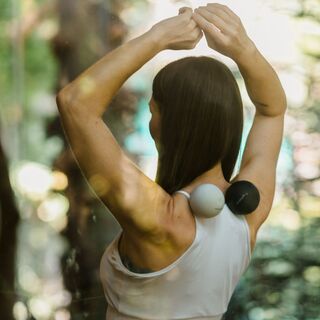
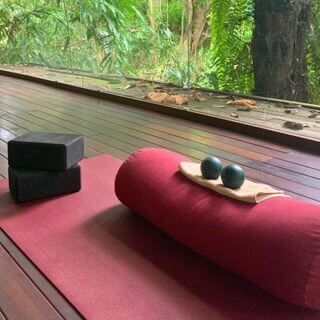
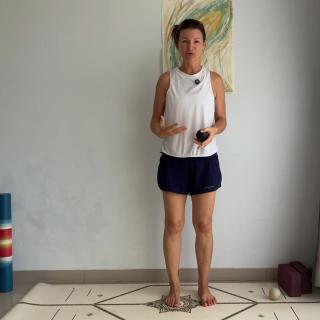
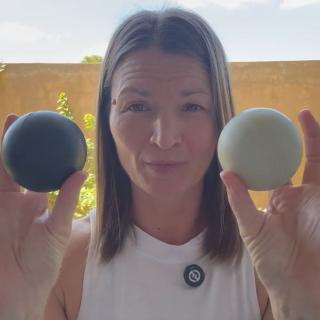
Practice as I said please make sure we actually just need one ball today so if you have a tennis ball at home perfect If you have something harder than that,
Maybe something like a cricket ball or a baseball ball,
Maybe you want to have a towel or something handy as well so that you can cover the ball and make it a bit softer.
That can be very useful in today's practice because we'll be working on the base of the skull and that can be very sensitive.
Great,
So if you've got your block and your ball,
Then I invite you to first.
.
.
Come into a comfortable seated position.
Close your eyes just for a moment.
And then simply feel your breath.
It's nothing for you that you need to change.
It's just an observation how your breath is right now.
Where does your breath expand your upper body?
Can you notice how it also shrinks?
And just observe where it's going.
You don't need to modify it.
In any particular way,
Just allow your body to breathe the way it wants to breathe.
Then I invite you to feel into your body for a very brief body scan.
Starting from your feet.
Your lower leg.
Your thighs,
Your hip.
Your sit bones.
Feel the floor under you or the chair or the couch,
Wherever you're seated right now.
Feel that support under you,
Feel your body connected.
With that surface.
And then feel into your lower back,
Your belly.
Your stomach,
Your meat back section.
Your entire shoulder area,
Chest.
Come to the top of the shoulders,
Outwards,
Down your arms.
Cross your elbows,
Make your way down into your very fingertips.
And then come back to your throat.
Feel the light continuing over your face.
For your ears.
Over the base of your skull,
All the way up to the very top of your head.
Then take two more cycles of breath to feel yourself.
Seed it whichever way you are.
Arriving in your body,
Arriving for this practice.
And in particular,
Feel into the base of your skull.
And into your neck.
Maybe into your jaw as well.
Just observe,
Notice.
If there is tension that you can already feel.
Some heavy notes.
If your head is straight or maybe already tilted one way.
Just notice what is present in that region right now.
Last cycle of inhale.
And a sigh out.
And slowly reopen your eyes so that you can see.
The screen again.
And I will just turn around so I can see.
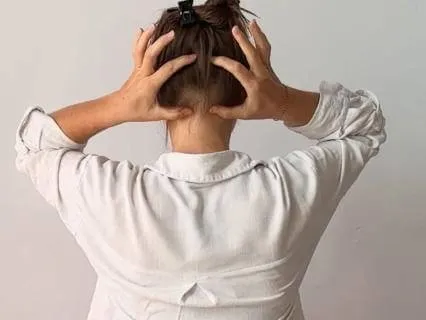
Show you the placement of the ball,
So you just keep on looking.
And where we want to work on today is in particular this lower region here.
So we may want to go into the neck,
But we're starting up here in the center point.
So where your spine enters into your skull,
You'll have this soft spot here in the center.
That is where we want to start.
And then there is this rim out here.
Where your skull bones start.
That can be very sensitive because your spinal muscles go usually across this rim of bones here and that can create some tension.
And we want to make sure we are also supporting the entire neck muscles in a cross fiber movement.
So we go 90 degrees over the spinal muscles.
The spinal muscles go straight up,
Right?
And we will work with the balls across it between ear to ear basically,
That line.
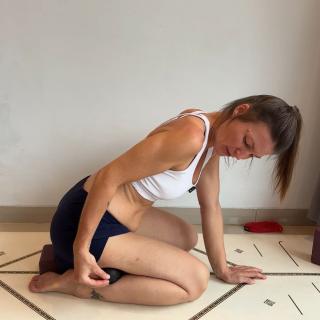
So what I invite you to do is grab this one ball and then place it here in the base on top of that soft spot to start.
And then you can.
.
.
Just gently press against it.
You can stay seated if you want,
If you know.
You are very sensitive here already.
You can just do this practice seated as well.
If you're close to a wall like me,
You can also just lean.
Against the wall with the ball behind you.
And that can be a very,
Very gentle starting point to have.
If you feel that is not enough pressure,
You can.
.
.
You can use the block.
And then come down onto the floor.
The block is there for the ball to be rested on.
So find the block and the ball in it.
And with that position.
With the ball higher on the block.
You can actually really press against it and find the right pressure that you want to have for every point that we are working on.
For me,
This is my favorite position to work on it.
But sometimes when I'm super tight,
Super sensitive here.
Are lay against the wall.
See what works for you.
It's not that one option is better than the other or more advanced than the other.
Different options to find.
Just the right.
Pressure for you.
And initially,
Just stay here in the center.
And connect with your breath.
So what I'm inviting you to do throughout this practice here is to change your breath.
In a way to always inhale through your nose.
But then exhale through the mouth.
And you may want to make that exhale auditable and really sigh out.
And that rhythm,
Especially the sigh,
Tells your nervous system that it can let go of the tension that it's holding onto.
So it's an overall support for the nervous system here to recognize,
Oh.
We are safe.
We can let go.
However,
This only works if you are not applying too much pressure.
If you're applying too much pressure,
Your nervous system.
.
.
Recognizes a threat and goes into alarm mode,
Goes into protection.
So just find enough pressure to feel the sensitivity here on the base of the scalp.
And then work with your breath throughout the entire practice.
We've now stayed here in the center point for a while,
So I'm inviting you now to introduce some movements.
Maybe just a little bit of it.
Yes movement with your head.
So bring your chin all the way down to your chest.
And then lift it up so that the ball moves.
Just across the entire space.
After that.
Soft spot in the back.
And as you're moving,
You might feel different responses,
Whether you're at the very base.
Of it or if you further up.
If you feel there is a particular sensitive spot,
Just stay with that spot.
Pause your movement in that spot.
Stay with it for a few cycles of breath.
The magic in myofascial release yoga really happens.
As a combination of finding the right trigger point that you want to work on.
Finding the right pressure for that spot.
Staying with the spot somewhere between half a minute and two minutes.
Sometimes longer if it feels really good,
But that depends.
Half a minute to a minute is a really good mark.
And then just allow the gravity and the time and your breath in combination.
Shift the tissue.
And that's what I meant earlier with the invitation for the practices to be slow.
Less is more here,
Because your tissue and your nervous system needs this space,
Needs this non-pressure environment,
No force.
There's pressure,
But there's no force.
In order to open up very slowly.
You cannot force your body to release the tension it is holding.
It's there for a reason,
Your body is holding it for a reason and it will only let it go when your body feels safe.
And it has the right environment and the right timing.
For it to open up.
So stay with whatever tension you're feeling,
Stay long enough with it.
And once you feel a shift happening,
You can stay a few more cycles of breath,
But then continue your journey.
Now we are still doing some nodding movement,
But you can also slowly start into a knee movement.
Just a little bit left with your hand,
A little bit right.
So that you're still moving your head but within.
That soft spot.
So within the rim of the bones that are starting there.
And even as you do that,
You might already recognize as you're coming close to the edge where your bones start.
Maybe that soft spot is getting very sensitive.
At least that's definitely the case for me.
You might even notice that one side is more sensitive than another.
And that is valuable information that just tells you where your spinal muscles are more tense as they come from the neck.
And cross into your skull.
So a lot of the activities and movements we do here is also information gathering.
Sometimes depending on how connected you are and how much you felt in body scan earlier.
You might be surprised how much you feel now compared to the body scan.
So we are not noticing every single tension that our body holds.
And this practice here really gives you the invitation to feel much,
Much deeper.
All right.
And now what I'm inviting you is coming to the next area.
So we now want to circle the rim of the bone.
So moving away from the inner soft spot to the very edge where that spinal muscle goes.
And for that you might need to hold the ball so it doesn't move.
Slip away,
But you want to come to one side and then circle your head.
Across it.
You want to come up one side.
Come over the other side and then come down on the left side,
For example.
So you might need to slowly reposition the balls every now and then.
Or you can also just stay on one side,
But really position.
The ball right at the edge between the soft spot and the skull so that you're really working along.
Those sensitive spots over and really adjust the pressure that you're giving.
You should always,
As I said,
Just find to sweet spot of feeling the pressure.
And relaxing.
Whenever you have a spot here as well,
Stay there.
Give it some time.
Give it your attention.
Give it your breath.
In through the nose,
Sigh out through the mouth.
Just give it some patience,
It will shift.
And maybe.
.
.
You feel that the point you're working on is achieved.
Maybe you feel the shift going and extending across the skull.
So you might feel a softening going over your ear.
Maybe it goes down to your neck,
Maybe it goes all the way to the top of your head.
That shows you where those muscle strings that we are working on at the moment,
Where they are connected.
To the rest.
After it.
Tissue.
And then once it's shifted again,
Continue your journey slowly,
Really observing.
Feeling into what is the next step.
Interesting spot here.
It's a very small area that we are working on,
So you can really take your time.
In exploring every single centimeter that you have here.
Square centimeter I guess.
And really feeling into which are the interesting spots.
For some it's really like at the base.
Where the spinal muscle from the neck goes right into the starting points of your skull and for some people it's further up.
Just be.
Interesting words for you.
Use this practice to be very.
.
.
Much in an explorer mode,
Really get to know your body in a much different way.
Beautiful.
And then come back to the base again,
To the center point.
And we'll come into our next layer.
So if you remember,
I've told you,
We will be working from ear to ear,
Like across the base of the skull.
So that's what I'm inviting you to do right now.
So starting at the base,
You just move your head in a nay-like motion.
Position.
So that the ball can move all the way over.
Just behind your left ear.
And then you might still need to hold the ball so it doesn't slip around.
Just as you're moving to the left.
Maybe every now and then you stay in your position,
Make some knee movements as well.
Some yay movements,
Sorry.
For me the interesting spot is really just on the spinal muscle.
As it comes into the skull.
That's where I'm feeling the most tension and that's where I'm staying,
But I'm feeling as I'm connecting into that,
I'm feeling how that is connected to tension here in my jaw.
Which is very usual.
And for every one of you who tends to have issues with the draw or team trade issues or you're very night guards,
Which I used to as well.
Or if you have recurring headaches.
There's also a course that you can take.
Watch.
If you're a subscriber of the app,
There's a course that's called something along headaches and TMJ release.
And that will walk you through the most important areas around neck,
Around the skull,
Around your face.
To release the tension that is all connected.
And with that over time,
You can really ease up any clenched jaws,
Any headaches should be released.
Of course not if you only do it once,
It's regular practice,
But over time.
That will really create a big shift.
And then let's make sure we also have time for the other side.
So if you haven't yet,
Come over.
And move your head all the way to the right side.
So you're moving the ball closer to your right ear.
And you might feel here that the tension is in a different spot than on the first side.
And that is perfectly fine.
That is what we're looking for.
We're not expecting that the left and the right side of your body is always the same.
We are exploring every new region,
Completely new.
But it stays the same to always find the right pressure for whichever point you want to stay on.
And calmly stay with your breath in through your nose,
Out through your mouth.
To stay in that pose for however long it feels right for you.
There is a chain for movements if they feel supportive.
When you stay in an area you shouldn't like freeze and just not move.
The intention is to kind of like feel like you melting over.
The ball and the tension that it touches.
Will basically just release at the same time.
But again,
That takes its time.
You cannot force your body.
To release a certain tension it's been holding for a while.
We can only support it and teach it that now is a good time.
To remember that you can also let it go.
And yeah,
If you listen to my introduction talks about my facial release,
You will also learn that I used to have clenched jaws and used to wear nightguards.
And with practices like this,
What we're doing here.
It's one of my key practices to ease up all the tension that I was holding in my jaw.
And then over time.
.
.
I could.
Create enough ease that I don't need a night guard anymore and I'm not I'm not ruining my teeth any longer.
Which is why I was.
.
.
Wearing the nightgowns because my dentist noticed I was already producing.
On my teeth,
Which is not a good thing.
Okay,
Last few breaths here before we conclude.
Coming back to the center where we started.
And maybe you notice now that this point already feels different compared to how we started.
And then I invite you to lift your head up with your next inhale,
Remove the ball,
Allow your head to come down to the floor or onto the block.
Just stay here for a minute,
Just breathing into the areas that we've just worked on.
Really give that area now without the pressure.
Time to integrate the practice we've just done.
This is still part of the practice,
So don't skip it.
Feel into what is happening in the base of your skull right now?
Does it feel warm?
Tingling?
Do you feel some softening?
Maybe you feel some softening even in your face.
Maybe it goes down your neck or your throat.
Just notice how things are connected from the area that you've just worked on.
And your body is at the moment restructuring the fascia tissue that we have just compressed.
It is rehydrating with the liquids that we have pressed out,
So with that extra hydration.
Now able to reconstruct the body.
The fascia tissues and layers in a new way,
Which is what we're looking for to make it last.
Stay here for a few more cycles of breath.
Really feeling into that softness that may have happened.
Check in with your breath,
Check in with your nervous system.
If you're working at trigger points for it was a good 15-20 minutes.
That is also always a slight irritation for your nervous system.
So laying here without any pressure.
Just a gentle breath.
Also signals your nervous system to calm down.
And support the integration that is happening in your base of ISKA.
Then with your next inhale,
Slightly roll over to one side of your body.
Maybe still stay there for another cycle of breath.
Then when you're ready,
Find your way back into a seated position.
And I hope that has helped you today.
Really,
Please let me know how it was for you.
What has shifted?
What did you discover?
What was maybe challenging?
How does your face and your scalp feel right now?