Hello there.
Thank you so much for joining me for this continued reading of Anne of Avonlea,
The charming old novel from 1909 by Canadian author Lucy Maud Montgomery.
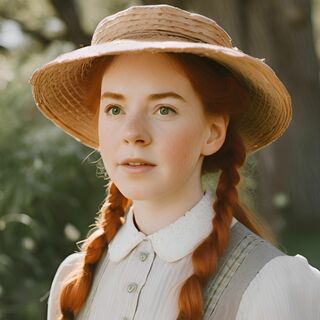
She's one of my favourite authors and in this book we are hearing about the indomitable Anne Shirley as a 16 year old who's beginning her school teaching career.
I do hope you're enjoying the story if you've been listening along already.
If you haven't heard the preceding parts of this book and you'd like to,
You can certainly look for the playlist for Anne of Avonlea and you'll find everything there in order.
But for now let's just take a moment here to have a nice deep exhale,
Letting go of the day,
Letting go of whichever baggage we might be bringing along with us into this moment.
For right now there's nowhere else we have to go,
Nothing else we have to be doing.
So we can just relax,
Get ourselves comfortable and enjoy another charming instalment from Anne of Avonlea.
Chapter 5.
A full-fledged school mom.
When Anne reached the school that morning,
For the first time in her life she had traversed the birch path deaf and blind to its beauties.
All was quiet and still.
The preceding teacher had trained the children to be in their places at her arrival and when Anne entered the schoolroom she was confronted by prim rows of shining morning faces and bright inquisitive eyes.
She hung up her hat and faced her pupils hoping that she did not look as frightened and foolish as she felt and that they would not perceive how she was trembling.
She had sat up until nearly 12 the preceding night composing a speech she meant to make to her pupils upon opening the school.
She had revised and improved it painstakingly and then she had learned it off by heart.
It was a very good speech and had some very fine ideas in it,
Especially about mutual help and earnest striving after knowledge.
The only trouble was that she could not now remember a word of it.
After what seemed to her a year,
About ten seconds in reality,
She said faintly,
Take your testaments please,
And sank breathlessly into her chair under cover of the rustle and clatter of desk lids that followed.
While the children read their verses,
Anne marshaled her shaky wits into order and looked over the array of little pilgrims to the grown-up land.
Most of them were,
Of course,
Quite well known to her.
Her own classmates had passed out in the preceding year,
But the rest had all gone to school with her,
Excepting the primer class and ten newcomers to Avonlea.
Anne secretly felt more interest in these ten than in those whose possibilities were already fairly well mapped out to her.
To be sure,
They might be just as commonplace as the rest,
But on the other hand,
There might be a genius among them.
It was a thrilling idea.
Sitting by himself at a corner desk was Anthony Pye.
He had a dark,
Sullen little face and was staring at Anne with a hostile expression in his black eyes.
Anne instantly made up her mind that she would win that boy's affection and discomfort the Pyes utterly.
In the other corner,
Another strange boy was sitting with Artie Sloan,
A jolly-looking little chap with a snub nose,
Freckled face and big,
Light blue eyes fringed with whitish lashes.
Probably the Donnell boy.
And if resemblance went for anything,
His sister was sitting across the aisle with Mary Bell.
Anne wondered what sort of mother the child had to send her to school dressed as she was.
She wore a faded pink silk dress trimmed with a great deal of cotton lace,
Soiled white kid slippers and silk stockings.
Her sandy hair was tortured into innumerable kinky and unnatural curls surmounted by a flamboyant bow of pink ribbon bigger than her head.
Judging from her expression,
She was very well satisfied with herself.
A pale little thing with smooth ripples of fine,
Silky,
Fawn-coloured hair flowing over her shoulders must,
Anne thought,
Be Annette Bell,
Whose parents had formerly lived in the Newbridge school district but,
By reason of hauling their house fifty yards north of its old site,
Were now in Avonlea.
Three pallid little girls crowded into one seat were certainly cottons.
And there was no doubt that the small beauty with the long brown curls and hazel eyes who was casting coquettish looks at Jack Gills over the edge of her testament was Prilly Rogerson,
Whose father had recently married a second wife and brought Prilly home from her grandmother's in Grafton.
A tall,
Awkward girl in a back seat who seemed to have too many feet and hands,
Anne could not place at all.
But later on discovered that her name was Barbara Shaw and that she had come to live with an Avonlea aunt.
She was also to find that,
If Barbara ever managed to walk down the aisle without falling over her own or somebody else's feet,
The Avonlea scholars wrote the unusual fact up on the porch wall to commemorate it.
But when Anne's eyes met those of the boy at the front desk facing her own,
A queer little thrill went over her as if she had found her genius.
She knew this must be Paul Irving and that Mrs.
Rachel Lynde had been right for once when she prophesied that he would be unlike the Avonlea children.
More than that,
Anne realized that he was unlike other children anywhere and that there was a soul subtly akin to her own gazing at her out of the very dark blue eyes that were watching her so intently.
She knew Paul was ten,
But he looked no more than eight.
He had the most beautiful little face she had ever seen in a child.
Features of exquisite delicacy and refinement framed in a halo of chestnut curls.
His mouth was delicious,
Being full without pouting,
The crimson lips just softly touching and curving into finely finished little corners that narrowly escaped being dimpled.
He had a sober,
Grave,
Meditative expression,
As if his spirit was much older than his body.
But when Anne smiled softly at him,
It vanished in a sudden answering smile which seemed an illumination of his whole being,
As if some lamp had suddenly kindled into flame inside of him,
Irradiating him from top to toe.
Best of all,
It was involuntary,
Born of no external effort or motive,
But simply the outflashing of a hidden personality,
Rare and fine and sweet.
With a quick interchange of smiles,
Anne and Paul were fast friends forever before a word had passed between them.
The day went by like a dream.
Anne could never clearly recall it afterwards.
It almost seemed as if it were not she who was teaching,
But somebody else.
She heard classes and worked sums and set copies mechanically.
The children behaved quite well.
Only two cases of discipline occurred.
Morley Andrews was caught driving a pair of trained crickets in the aisle and stood Morley on the platform for an hour and,
Which Morley felt much more keenly,
Confiscated his crickets.
She put them in a box and on the way from school set them free in violet veil,
But Morley believed then and ever afterwards that she took them home and kept them for her own amusement.
The other culprit was Anthony Pye,
Who poured the last drops of water from his slate bottle down the back of Aurelia Clay's neck.
Anne kept Anthony in at recess and talked to him about what was expected of gentlemen,
Admonishing him that they never poured water down ladies necks.
She wanted all her boys to be gentlemen,
She said.
Her little lecture was quite kind and touching,
But unfortunately Anthony remained absolutely untouched.
He listened to her in silence with the same sullen expression and whistled scornfully as he went out.
Anne sighed and then cheered herself up by remembering that winning a Pye's affections,
Like the building of Rome,
Wasn't the work of a day.
In fact,
It was doubtful whether some of the Pye's had any affections to win,
But Anne hoped better things of Anthony,
Who looked as if he might be a rather nice boy if one ever got behind his sullenness.
When school was dismissed and the children had gone,
Anne dropped wearily into her chair.
Her head ached and she felt woefully discouraged.
There was no real reason for discouragement,
Since nothing very dreadful had occurred,
But Anne was very tired and inclined to believe that she would never learn to like teaching.
And how terrible it would be to be doing something you didn't like every day for,
Well,
Say 40 years.
Anne was of two minds whether to have her cry out then and there or wait till she was safely in her own white room at home before she could decide.
There was a click of heels and a silken swish on the porch floor,
And Anne found herself confronted by a lady whose appearance made her recall a recent criticism of Mr Harrison's on an overdressed female he had seen in a Charlottetown store.
She looked like a head-on collision between a fashion plate and a nightmare.
The newcomer was gorgeously arrayed in a pale blue summer silk,
Puffed,
Frilled and sheared wherever puff,
Frill or shearing could possibly be placed.
Her head was surmounted by a huge white chiffon hat,
Bedecked with three long but rather stringy ostrich feathers.
A veil of pink chiffon,
Lavishly sprinkled with huge black dots,
Hung like a flounce from the hat brim to her shoulders and floated off in two airy streamers behind her.
She wore all the jewellery that could be crowded on one small woman,
And a very strong odour of perfume attended her.
I am Mrs Donnell.
Mrs H.
B.
Donnell.
Announced this vision.
And I have come in to see you about something Clarice Almira told me when she came home to dinner today.
It annoyed me excessively.
I'm sorry,
Faltered Ann,
Vainly trying to recollect any incident of the morning connected with the Donnell children.
Clarice Almira told me that you pronounced our name Donnell.
Now,
Miss Shirley,
The correct pronunciation of our name is Donnell.
Accent on the last syllable.
I hope you'll remember this in future.
I'll try to,
Gasped Ann,
Choking back a wild desire to laugh.
I know by experience that it's very unpleasant to have one's name spelled wrong,
And I suppose it must be even worse to have it pronounced wrong.
Certainly it is.
And Clarice Almira also informed me that you call my son Jacob.
He told me his name was Jacob,
Protested Ann.
I might have expected that,
Said Mrs H.
B.
Donnell in a tone which implied that gratitude in children was not to be looked for in this degenerate age.
That boy has such plebeian tastes,
Miss Shirley.
When he was born,
I wanted to call him Sinclair.
It sounds so aristocratic,
Doesn't it?
But his father insisted he should be called Jacob after his uncle.
I yielded because Uncle Jacob was a rich old bachelor.
And what do you think,
Miss Shirley?
When our innocent boy was five years old,
Uncle Jacob actually went and got married,
And now he has three boys of his own.
Did you ever hear of such ingratitude?
The moment the invitation to the wedding,
For he had the impertinence to send us an invitation,
Miss Shirley,
Came to the house,
I said,
No more Jacobs for me,
Thank you.
From that day,
I called my son Sinclair.
And Sinclair,
I am determined he shall be called.
His father obstinately continues to call him Jacob,
And the boy himself has a perfectly unaccountable preference for the vulgar name.
But Sinclair he is,
And Sinclair he shall remain.
You will kindly remember this,
Miss Shirley,
Will you not?
Thank you.
I told Clarice Almira that I was sure it was only a misunderstanding and that a word would see it right.
Donnell,
Accent on the last syllable,
And Sinclair,
On no account,
Jacob.
You'll remember?
Thank you.
When Mrs.
H.
B.
Donnell had skimmed away,
Anne locked the school door and went home.
At the foot of the hill,
She found Paul Irving by the birch path.
He held out to her a cluster of the dainty little wild orchids,
Which Avonlea children called rice lilies.
Please,
Teacher,
I found these in Mr.
Wright's field,
He said shyly,
And I came back to give them to you because I thought you were the kind of lady that would like them.
And because he lifted his big,
Beautiful eyes.
I like you,
Teacher.
You,
Darling,
Said Anne,
Taking the fragrant spikes.
As if Paul's words had been a spell of magic,
Discouragement and weariness passed from her spirit,
And hope upwelled in her heart like a dancing fountain.
She went through the birch path light-footedly,
Attended by the sweetness of her orchids,
As by a benediction.
Well,
How did you get along?
Marilla wanted to know.
Ask me that a month later,
And I may be able to tell you.
I can't now.
I don't know myself.
I'm too near it.
My thoughts feel as if they had been all stirred up until they were thick and muddy.
The only thing I feel really sure of having accomplished today is that I taught Cliffy Wright that A is A.
He never knew it before.
Isn't it something to have started a soul along a path that may end in Shakespeare and Paradise Lost?
Mrs.
Lynde came up later on with more encouragement.
That good lady had waylaid the schoolchildren at her gate and demanded of them how they liked their new teacher.
And every one of them said they liked you,
Splendid Anne.
Except Anthony Pye.
I must admit,
He didn't.
He said you weren't any good,
Just like all girl teachers.
There's the Pie Eleven for you.
But never mind.
I'm not going to mind,
Said Anne quietly,
And I'm going to make Anthony Pye like me yet.
Patience and kindness will surely win him.
Well,
You can never tell about a pie,
Said Mrs.
Rachel cautiously.
They go by contraries like dreams,
Often as not.
As for that Donnell woman,
She'll get no Donnelling from me,
I can assure you.
The name is Donnell,
And always has been.
The woman is crazy,
That's what.
She has a pug dog she calls Queenie,
And it has its meals at the table,
Along with the family,
Eating off a china plate.
I'd be afraid of a judgment if I was her.
Thomas says Donnell himself is a sensible,
Hard-working man,
But he hadn't much gumption when he picked out a wife,
That's what.