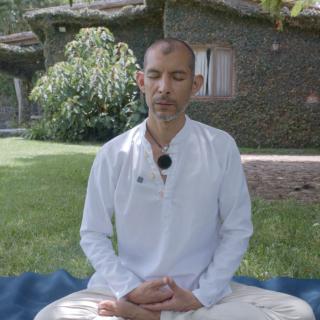
Welcome to today's class where we will be covering one of the foundational pieces of meditation.
Samatha Meditation.
An essential practice to understand in order to move into deeper states of meditation.
So let us now travel within.
This is a class on Samatha Meditation.
This is the foundation of all meditations.
I'm going to be combining both asanas and the meditative practice in this class.
The reason why I'm going to be doing the asanas first is because it allows us to bring the mind to the body and the breath.
Starting this way is a good way to set the stage for deeper meditation.
So we'll begin with the asanas.
15 minutes of asanas.
Followed by the meditation,
Dhyana,
For another 15 minutes.
If you replace the asanas with walking meditation,
Focus on the breath and the body as you're walking.
The intention is to bring your mind away from the past and the future.
This sets the stage for the Samatha meditation.
Before we begin,
I want to explain how Samatha meditation fits into the bigger picture of meditation.
As I mentioned earlier,
Samatha meditation is the foundation of all meditation.
For many of you who struggle with meditation,
And using it to the extent where you're able to do some serious work like remove anxiety from your day.
Or do deeper inner healing work,
Like looking deep inside and looking at the past to understand where some of your traumas may be coming from.
Or even using meditation as a way to provide insight in how to navigate your life moving forward.
That is,
Finding your Dharma,
Your purpose.
Then it is important to understand the structure of meditation.
Samatha is the foundation.
Think of it like building a house.
You need concrete at the bottom in order for the house to be structured.
Also.
For example,
If you want to see the bottom of a lake,
The surface must be calm.
This is the practice of Samatha meditation.
Calming the surface of the water.
The purpose of Samatha meditation is to train concentration by resting attention on a single object.
Most commonly the breath.
Each time the mind wanders,
We gently bring it back.
This repetition develops mental stability,
Sustained attention,
And inner calmness.
The idea is not to keep the mind from thinking,
But rather,
Training the mind to be concentrated on one thing.
This concept of concentration is one of the most important parts of the Eight Noble Truths taught by Buddha.
And it is an important skill for diving deep,
Deep inside,
And gaining access to a lot of the information that is needed in order to remove anxiety.
Heal trauma.
And find direction in our life.
So with that said,
Let's begin.
We're going to find our way into a seated position.
Taking a deep breath in.
Working the nose.
Exhaling.
Take a deep breath in.
Exhaling into a forward bend.
Feel the stretch.
Bringing the mind to the present moment.
That is the purpose of this practice.
Preventing ourselves from moving from the past in the future.
And bringing ourselves to the body.
To the breath.
Relax.
One more time,
Exhale,
Falling forward.
Breathing in.
Exhaling Repeat again.
Exhaling.
And relax.
Placing her palms behind us bridging our way up.
To the reverse bridge.
Everything in.
And relax.
Bringing the palms in front of us,
Twisting.
To the outside.
Twisting in.
Repairing the wrists for.
More stabilizing poses that we're going to move into.
Behind the back back up.
Slowly,
Three,
Two,
One.
Two.
One.
And relax.
Pressing the palms into the mat,
Rocking back and forth.
Repairing the wrist.
We can go ahead and plant our palms into the mat.
Bring in a.
.
.
Rear end off the ground just a little bit.
Taking a deep breath in.
Exhaling and relax.
Coming back.
Reverse bridge Breathing in.
Exhaling.
We'll pull our left foot in underneath us.
Allow yourself to come up.
Preparing for a side plank.
It should be on the left hand.
And deep breath in.
And relax coming down.
Coming up into our bridge.
Pooling all right for him.
Nerd plant.
And coming into a bridge.
Inhale.
Exhale.
Coming back down.
Relaxing.
The intention of these asanas are to Prepare yourselves for the meditation.
Bring ourselves to the present moment.
Not thinking about our work,
Not thinking about things we need to do.
Not thinking about our future,
Just being here right now.
From here we're going to turn over.
Bring yourselves down.
And tabletop.
Period.
Heart to our back,
To chat,
Breathing in.
I'm exhaling.
Breathing in.
Cat pose.
I'm exhaling.
Breathing in.
Ahhhhhh and exhaling.
From here we're gonna.
.
.
Let's bring ourselves back into mountain pose.
Getting a nice stretch into the calves.
Pedaling it out.
Again,
The intention here is not to.
.
.
Do a complicated asana series.
We'll do these in other videos.
The intention here is.
.
.
To relax the body.
Prepare it for meditation.
Stretch the muscles,
Releasing the stress in the body.
That we've accumulated in the day.
Mirror,
Let's step forward.
Equestrian pose,
Left foot forward.
Stretching the body.
.
.
Breathing in.
Exhale.
From here we're gonna move from hands to the inside.
Where are you?
Left and right hand are to the right side of the body.
The left leg.
For lizard pose.
Breathing,
Bring the mind to the breath.
Present moment.
From here we're going to extend our left hand up.
Twist and lizard pose.
Up into the sky.
Getting a nice stretch.
Turning back into her.
Question pose.
Tighten your left hand.
Preparing to move back into mountain pose.
Exhale.
Breathe in,
Stepping in with the right foot.
Exhale.
A nice deep stretch.
From here we're going to wander our right hand again.
Closer to the left palm,
So they're both inside.
Into.
.
.
LIZARD POSE Again,
A deep breath in.
Stretching.
Right palm up into the sky,
Exhale.
Bringing the mind to the body.
To the breath.
Taking our last breath in.
And planting it.
Breath in,
Bringing ourselves back into mountain pose.
Down into your stungin' mascara and into cobra pose.
I think that.
.
.
Feet flat on the floor.
Getting a nice stretch.
From here we can go ahead and twist to the right.
Exhale,
Breathe in.
Exhale twisting to the left Hail!
Breathing in,
Finding our way back into mountain pose.
And now into bridge.
Hold for just one moment.
Coming back in the mountain pose.
Nice stretch.
From here.
Putting both knees into the mat.
We find our way into Child's Place.
I'm taking a breath in.
Go ahead and prepare.
For some seated positions,
Seated stretches.
Placing both.
Palms of the feet together.
Grabbing the ankles wobbling back and forth.
Getting settled in.
Feeling a calmness to.
.
.
Starting to settle,
Preparing us for our meditation.
Know the asanas are actually intended to prepare us for meditation.
It is not necessarily designed as an exercise.
In the way in which we We use asanas today.
The origin of the asanas.
Were intended.
Prepares for Giardina.
Meditation.
Exhale.
And relax.
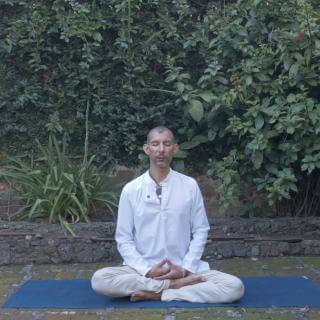
We're going to now move into the Samatha meditation.
This,
As I mentioned before,
Is the foundation.
Of all meditations.
This technique is intended.
To calm the mind in order to prepare us for deeper states of meditation.
Then go into explaining how this works.
How to do this?
This practice is the Samatha technique.
Is used.
As an anchor,
Right?
If you're going to go into like extended one hour meditation,
This should be the first 10 to 15 minutes of the meditation.
Okay.
This is what brings our mind to a calm state.
It prevents us from our mind moving from the past and the future.
And brings us to a present moment.
Brings us to the breath.
This is kind of like stretching in.
And exercise.
Right,
In order to live.
The heaviest weights that we can.
We want to.
Work our way up gradually with heavier and heavier weight rather than just jumping straight into lifting the heaviest weight that we can.
And in this analogy,
You're more likely to be able to lift heavier weight if you're preparing the body and warming it up properly.
Okay,
So look at it that way.
Okay,
The technique.
Of the Samatha meditation is too.
Begin by breathing.
You're going to be breathing through the nose.
Inhaling.
And exhaling through the nose.
You can use the top of your lip to focus on as your eyes are closed as another form of anchor.
And as you're doing the meditation,
Your mind is naturally going to be drifting.
Into different thoughts.
That's natural.
The point here is not to eliminate thinking,
But rather control it and bring it to a point of focus,
Which is the breath.
Okay,
So that is the technique of Samatha meditation.
Let's begin.
Taking a deep breath in.
Exhaling.
Deep breath in.
Exhale.
Repeat this pattern.
On your own.
Walk slowly.
Breathing in.
And exhaling.
Left your mind.
Is drifting with thoughts.
Bring it back and focus.
On the breath.
This is a time to.
Let your worries.
.
.
Go away.
Stop thinking about things you need to do.
Today,
Tomorrow,
And the future.
Stop thinking about the difficulties that we may be having in relationships and work.
This is a time.
Calm the mind.
Taking your deep breaths,
Breathing with the nose.
Exhaling with the nose.
It's now user.
Technique 2.
Bringing ourselves deeper into the breath.
More aware of the breath by.
Taking a deep breath in.
Holding for four seconds.
Exhaling slowly and controlled.
Holding for four seconds on the exhale.
Take a slow breath.
Breath in.
Holding for.
Seconds.
And repeat this pattern on your own.
Right now,
The heart should be slowing down.
The mind should be slowing down.
Relax the shoulders.
Straighten the spine.
Deep breath in.
Now.
Have a constant breathing pattern that's slow and controlled.
Slow breath in.
Slow breath out.
Slow breath in.
And repeat this pattern.
Slowing down the heart and mind.
Relax the shoulders.
So much of how we this slide too.
Think about.
Our world,
How we understand.
The people in our life,
How we understand the jobs that we are supposed to perform.
Are we?
Decide to react to.
Certain moments.
Often a result.
Of patterns,
Repeated patterns.
Often be.
Source of The.
Behaviors in which we wish we can change are hidden deep down inside.
Underneath the surface.
And what we're experiencing today is just.
.
.
Conditioned repeated pattern.
These traumas.
Samatha Meditation is a foundational step.
That allows us to calm the mind.
In order to go deep inside.
Perhaps find and understand.
Experiences that we've had.
Perhaps we're trying to find direction in our life.
It is to learn.
Call mine that we can find direction.
Learn to calm the mind.
Find the wisdom that sits inside of all of us.
Side of yourself.
You have the answers.
Is heading deep inside.
Bring your mind back to the breath.
Brain to mind.
Back to the breath.
You From here,
We're going to take some very deep breaths.
Deep breath in.
Hold for four seconds.
Exhale.
Hold for four seconds at the end.
Technique is designed to.
Slow down.
The census.
You're almost there.
You're doing great.
The mind to the breath.
Be aware.
And how the body expands with every inhale.
And collapses with every exhale.
You're mine.
To that experience.
To the expansion.
The body.
Collapsing.
Focus on this.
You Slowly bring yourself back.
Bring yourself back.
Now sway left and right.
Bringing yourself back.
Be aware of this.
Relaxed state.
And also be aware after this meditation how you feel.
Your focus has shifted.
Notice your.
.
.
Your reactions.
Maybe a little bit calmer.
May be more aware of how you're responding.
Let's go ahead and open our eyes.
Okay,
So how do you film?
More relaxed.
Settled,
Calmer.
Perhaps your doing this before you're going to sleep this is a great way to to help with sleep actually.
And settling the mind.
If you're having sleep problems,
This is a great technique of doing Samatha meditation before you sleep.
If you're starting your day with this,
Then perhaps you're starting your day a little bit more calmer.
With this technique,
Again.
As I mentioned,
It is calming the mind.
It is preparing the body.
Preparing you for deeper states of meditation.
If you were looking to do a short meditation in the day,
Samatha meditation is a good practice to use.
Continue to practice this because this is the foundation for you in the more advanced and more.
The more advanced methods of meditation,
Which I'll be teaching in other videos.
Right,
So use this technique,
Do it three times,
Four times.
And yeah,
Enjoy the experience.
Namaste.