Once upon a time,
On an uninhabited island,
On the shores of the Red Sea,
There lived a Parsi,
From whose hat the rays of the sun were reflected in more than oriental splendor.
And the Parsi lived by the Red Sea with nothing but his hat and his knife and a cooking stove of the kind that you must particularly never touch.
And one day he took flour and water and currants and plums and sugar and made himself one cake which was two feet across and three feet thick.
It was indeed a superior constable,
And he put it on the stove because he was allowed to cook on the stove,
And he baked it and he baked it till it was all done brown and smelt most sentimental.
But just as he was going to eat it,
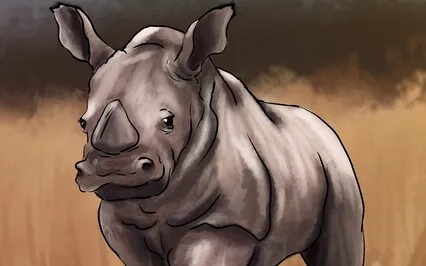
There came down to the beach from the altogether uninhabited interior one rhinoceros with a horn on his nose,
Two piggy eyes and very few manners.
In those days the rhinoceros' skin fitted him quite tight.
There were no wrinkles anywhere.
He looked exactly like Noah's Ark rhinoceros,
But of course much bigger.
All the same,
He had no manners then,
And he has no manners now,
And he never will have any manners.
He said,
How?
And the Parsi left the cake and climbed to the top of a palm tree with nothing on but his hat,
From which rays of the sun were always reflected in more than oriental splendor.
And the rhinoceros upset the oil stove with his nose,
And the cake rolled on the sand,
And he spiked that cake on the horn of his nose,
And he ate it.
And he went away,
Waving his tail to the desolate and exclusively uninhabited interior,
Which abused on the islands of Mansdoran,
Socotra,
And Prometores of the larger equinox.
Then the Parsi came down from his palm tree,
Put the stove on its legs,
And recited the following sloka,
Which,
You have not heard,
I will now proceed to relate.
Them that takes cakes,
Which the Parsi man bakes,
Makes dreadful mistakes.
And there was a great deal more than you would think,
Because five weeks later there was a heat wave in the Red Sea,
And everybody took off all the clothes they had.
The Parsi took off his hat,
But the rhinoceros took off his skin and carried it over his shoulder.
In those days it buttoned underneath with three buttons and looked like a raincoat.
He said nothing whatsoever about the Parsi's cake,
Because he had eaten it all,
And he never had any manners,
Then,
Since,
Or henceforward.
He waddled straight into the water and blew bubbles through his nose,
Leaving his skin on the beach.
Presently,
The Parsi came by and found the skin,
And he smiled one smile that ran all around his face two times.
Then he danced three times round the skin and rubbed his hands.
Then he went to his camp and filled his hat with cake crumbs,
For the Parsi never ate anything but cake and never swept out his camp.
He took that skin,
And he shook that skin and he scrubbed that skin,
And he rubbed that skin just as full of old,
Dry,
Stale,
Tickly cake crumbs and some burned currants as ever it could possibly hold.
Then he climbed to the top of his palm tree and waited for the rhinoceros to come out of the water and put on his skin.
And the rhinoceros did.
He buttoned it up with the three buttons,
And it tickled like cake crumbs in bed.
Then he wanted to scratch,
But that made it worse.
And then he lay down on the sands and rolled and rolled and rolled,
And every time he rolled the cake crumbs tickled him worse and worse and worse.
Then he ran to the palm tree and rubbed and rubbed and rubbed himself against it.
He rubbed so much and so hard that he rubbed his skin into great folds over his shoulders,
And another fold underneath where the buttons used to be.
And he rubbed some more folds over his legs,
And it spoiled his temper.
But it didn't make the least difference to the cake crumbs.
They were inside his skin,
And they tickled.
So he went home,
Very,
Very angry indeed,
And horribly scratchy.
And from that day to this every rhinoceros has great folds in his skin and a very bad temper,
All on account of the cake crumbs inside.
But the parsee came down from his palm tree,
Wearing his hat,
From which the rays of the sun were reflected in more than oriental splendor,
Packed up his cooking stove,
And went away in the direction of Ortevo,
Amygdala,
The upland meadows of the Antoverio,
And the marshes of Sonapeu.