Alright,
I want to show you here a nice three movement practice that really helps with improving balance and just a general sense of coordination and mobility.
I have the chair here,
So I'm going to show you how you can do this without using the chair,
Which is kind of what you want to lead towards.
But once again,
Don't force it.
And if you find it too hard to do these movements without the prop,
Without leaning on a chair,
Then use the chair.
So I'm going to show you different ways.
The first one comes out of Tai Chi.
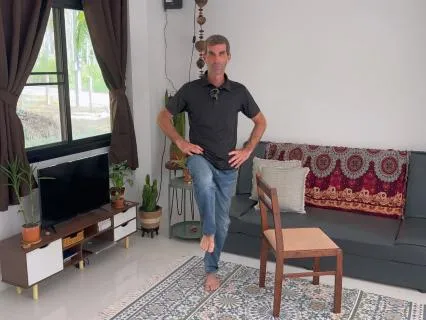
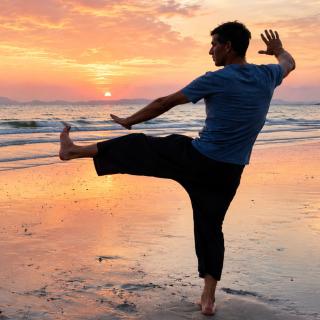
It's called Rooster Stands on One Leg.
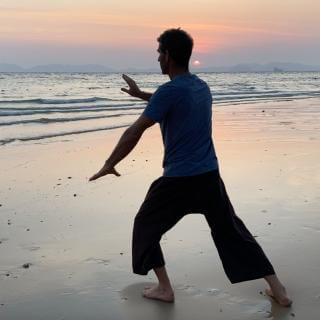
So what you're going to be doing is you're going to come on one leg.
You're going to bring this leg up.
It should become as high as the parallel to the floor,
Not higher.
Okay.
But if that feels uncomfortable,
Stop here.
Really be conscious,
As I say,
About that 70%.
Okay?
Don't force it.
You're not here to do what I do.
You're here to listen to your own body.
So you're bringing this leg up and then you bring the elbow to knee.
So I'm on my left leg.
My left hand is going to be by my hip.
Palm down,
My right leg is up,
My elbow goes towards my knee.
I feel like I'm almost like there's like something I'm going to kind of crack and I use my like some nuts or something.
Bring it down.
Now,
If you find yourself losing balance,
Two things.
One option,
What I want you to focus on is three things.
You grab the floor with your toes if you're using sneakers or shoes just kind of still feel the toes kind of crunch up almost like you're going to grab a pencil or pen off the floor.
The other thing is to make sure you bend your knee because the feeling is you want just like a tree.
Imagine like a tree.
Roots go down deep.
And then if there's a storm,
The tree's going to stay.
If the roots are not deep,
A tree can fall over.
It's the same with our balance.
A lot of us,
If we,
This is what we want to kind of improve in our life.
If we find ourselves losing balance,
We bring our body up,
But then you feel more wobbly.
So force yourself,
Grab the floor at the toes,
Bend your knee,
And find the focus point.
Don't let the eyes wander.
Okay,
So those are three things we're working on.
I come up,
I exhale.
Grab the floor with my toes.
I bend my knee and I focus on something.
And it's somewhere in the distance,
Anywhere five feet to 20 feet in front of me.
Now let's say that's too hard for you.
Use a chair.
Do these same movements.
But you see I'm going to take my left hand and I'm just going to lightly use the chair for balance.
I'm going to do the same movement.
Maybe at the beginning,
You need to hold on pretty.
Hold on with a lot of effort into the chair to be able to come up.
Slowly start letting less holding until maybe you could take the hand off,
But feel free to use the chair for balance.
The second movement is really nice,
Very starts the same and it's really nice because it kind of nice little groin stretch and then we do a kick so it's good for the groin.
It's good for the knee as you'll see.
It's also really nice for balance.
So what I recommend here is if you do it once again I'll show you how to use the chair.
In a second,
Hands on hips,
Raise the leg.
You open,
And once again,
Don't force it.
You're just going to your 70%,
Bring the leg out.
Bring it back and then you just very slowly.
You just extend the leg till you're kicking with your toes.
Now you're not trying to kick high.
If you want to visualize you're kicking the knee,
You kick the knee.
If that's too high,
It's almost like you can imagine you're kicking someone in the ankle.
Maybe some of you that's even high,
Maybe you're kicking just the top of the foot.
So you're here.
Grab the floor with the toes,
Bend the knee.
Open.
Back.
Gentle kick.
Try to do like two or three in a row.
Then you take a break.
Maybe do a few more.
Now let's say this is hard.
You can't do this.
Two or three in a row,
You lose balance on the first one.
Once again,
Same thing,
Hold the chair.
And back.
Once again,
Find your 70%,
Very,
Keep your back aligned and very slow.
Extend that toe to kick.
The third movement is kind of a more of a flowing movement.
We're going to be doing Once again,
The weight's on our left.
With the right foot,
We swing it in front of us and it comes over to the left side of the left foot,
Just kind of on the big toe.
Then we take the foot.
I'll demonstrate first holding the chair because it's a little harder.
And then you swing it behind you,
Kind of coming to the same place.
So it swings here.
Swings here.
Maybe after a while,
You take your hands off and on your hips.
Or just hold it out if you need for balance,
Just whatever.
So if you need to use the chair,
Use the chair.
Then slowly see if you can do this without it.
So as you notice with these movements,
These train dynamic balance.
We're not going in like a classic yoga pose,
Tree pose,
Where you bring the leg up and trying to hold for minutes at a time.
Because remember,
This isn't about improving static balance.
This is about improving our coordination,
Mobility,
And dynamic balance.
Thus,
Which is how we walk and what we need to really improve.
So those are three really nice movements.
Once again,
Feel free to use a chair.
Obviously I just demonstrated this on one side.
So if you notice,
Really practicing.
Just balancing on my left leg.
Obviously you want to go to the other side where you're just working on the right.
We do the same thing,
Right?
Coming up here.
Then we come open and kick.
And then we do the same thing with this.
Once again,
These are movements you can do anytime during the day.
You could have this just be a focused practice where you take five minutes or so to do this without listening to music,
Without watching a show.
You could do this if you're just waiting for something.
Do one movement once in a while.
But the more you train this,
The better your balance will be,
The kind of easier you're gonna see going for walks.
And even if it's in a challenging terrain,
All that stuff's going to seem a lot easier.