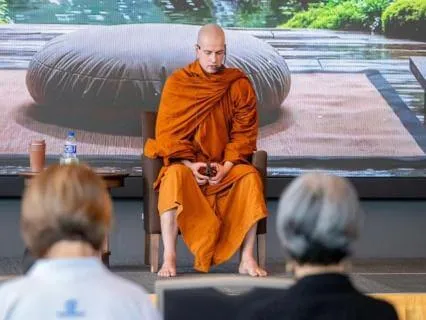
This guided meditation,
We will be meditating with the breath.
Being aware or mindful of the breath.
This meditation is connected to an earlier guided meditation.
Although this meditation that you're listening to now can also be done in and by itself.
While the previous guided meditation focused more on the very basics of breath meditation,
In this session we try to go a little bit deeper.
We specifically try to do in this meditation is to become in a deeper way aware of the breath,
To understand better the deeper significance of the length of the breath,
In and out.
And we also try to work with the length of the breath and the depth of the breath for the purpose of calming down the mind and the body.
So that is the main aim of this session that we will be doing together.
As usual,
You can get ready by getting into the position that you will be meditating in.
For most of us,
That will be sitting down.
This meditation can be done also in other positions.
So you can take a moment to get comfortable in the position that you are in.
And even just again,
As we can do again and again,
Just checking in with the body.
Just being aware of the body sitting or being in whatever position it's in.
And then within that awareness we become aware of the breath.
Do you notice the breath in the body?
The in and out breath?
Sometimes we can be aware of the breath in a very focused way,
Maybe a specific point where the body is moving or we can feel the breath coming in and out of the nose or the mouth.
But we can also practice in a way that we are aware of the breath in a bit broader way.
Zooming out a little bit and noticing the breath going through the body.
Or just in a broader way being aware of the body breathing in and out,
Without focusing on one particular point,
But more on the process as a whole.
And like we practiced in the earlier guided meditation we can start counting our breaths.
Breathing in for a count of one and breathe out for a count of two.
Breathing in,
We count three.
Breathing out,
We count four.
So we just let the breath be itself in a way.
We let the breath just breathe as it is.
All we do is count.
And whenever you make it to a count of 10,
You can start again.
Start with one again.
And whenever you forgot where you are counting wise.
You can also do start again,
Start over.
That's why it's so helpful to count.
We might become more aware when we have lost track of the breath.
And the count that we make with it.
And so we can just start from the beginning again.
And whenever you lose track.
You don't know where you are with your accounting.
You just start again with the first breath.
The first count,
One,
Two.
Now we want to have a bit of a deeper look or a bit more specific awareness of the breath.
And the first step in doing so.
Just to be aware of how deep or how shallow both the in-breath and the out-breath are at this time.
So again,
We don't change the breath,
We try to let the breath be as it is.
Because we just know it is.
If we do this regularly in our meditation we can over time see certain patterns.
You can see the way we breathe when we are relaxed or energized.
When we are stressed.
And in the next step,
What we will do is we will invite the mind to shift a little bit.
It's a bit different than trying to control the mind.
Or control the breath in this case.
We're just inviting the mind.
To let the breath change a little bit.
Depends a lot on our current mental state the way we want to invite the breath.
But we notice that we are stressed,
Not relaxed at this time.
We can invite the out-breath to lengthen a bit.
In the same way if we indeed are stressed at this time,
Or more stressed than is helpful,
More alert than is helpful.
Then we can also limit a bit our in-breath.
Or in a way we suggest to the mind.
That the embrace might be a bit more small,
A bit more shallow.
We cannot really just change the breath as we wish,
Because we might not have enough breath.
That's why you don't really try to control it in that way.
Because it will feel uncomfortable if you do it like that.
Sometimes just having the awareness of the way you are breathing and inviting less intense in-breathing and more lengthened out-breathing can be relaxing.
If you notice that you might be controlling the breath a bit too much.
It can help after the out-breath to just let go of the breath and wait until the breath comes back by itself.
That can often be a good way to break when we are controlling the breath,
Maybe subconsciously,
Not intended to do it.
And in the same way,
If we notice that actually our energy is maybe too little,
We can emphasize a bit more the in-breath.
So one part is inviting the mind to breathe in a bit deeper.
And also just paying more attention to the in-breath.
These are just some suggestions,
But these are some basic principles of how the breath is correlated with our mental state.
And how also just changing the way we breathe,
Inviting the breath to change.
Can also impact again the mental state.
So if we can learn to breathe in a way that's more calming,
It can have a stabilizing effect.
If you are focusing more on breathing out in a longer way.
You can really have that perception of relaxing with it.
So when you breathe out,
You're thinking about letting go.
And whenever you have that perception and whenever the out-breath is more calming,
Longer,
Deeper.
Often there is a way that we can feel that in the body.
How does the body feel when you breathe out?
So you kind of really breathe out into the body in a way.
So when you think about breathing out and relaxing,
You really direct the mind at relaxing the whole body with it.
Like you're breathing the relaxation into your arms or torso.
Especially in our hands,
It's more easy to really feel the effect of it.
But maybe you can feel it in the bigger area of the body,
Maybe even the whole body.
And if you might not feel enough,
You can also choose to breathe in a bit more strongly.
And then breathe out in a relaxing way to energize the breath and then apply the calming sense as well.
It's best to find a balance of having enough energy and calming down.
If there is not enough energy,
Also the calming effect will be less strong.
And in a way we can use that to really calm the body down.
And we do those while the mind also calms down.
You can take a moment again to check in with how the body and the mind are feeling at this time.
Is there any change that took place?
Maybe not.
It's also a practice that we need to try out for a longer time.
Start to be more familiar with the breath and how it impacts the way we feel in the body and mind.
Can use the breath and meditating with the breath to balance the body and the mind.
I encourage you that you can continue to practice in this way on your own.
So whenever you need a reminder,
You're also welcome,
Even if it's daily,
To come back to this practice.
But again,
It's very much something that you can take into your life.
Make a part of your meditation practice but as you can imagine from this practice that we've just done is that goes far much deeper than that.
We meditate to learn to balance the body and mind.
And that we can take with us in our day.
So having said that,
We are coming to the end of this session.
I wish you still a good day and hereby this session is finished.