So finding a position that asks the least of you.
You could be lying down,
You could have.
.
.
Somehow your feet slightly elevated,
You could be seated,
You could be standing,
Everything's fine.
And there's no need to relax fully.
There's no need really to change how on alert you feel,
Or maybe not how not on alert you feel.
And just finding that position that can be sustained without too much effort.
And you may let your eyes close or soften.
And if either of those options don't feel right,
Just keeping a gentle gaze.
There's no requirement here to surrender totally.
And you might take a moment to notice that you are here.
And you might even want to notice the contact points between your body and what supports it.
Just brief noticing and letting your attention rest again.
And if it feels okay today,
You might bring awareness to your breathing.
There's no requirement to focus on the breathing.
And if the breath is not helpful today to rest your attention,
You may use something that is completely different.
I'll go through a few choices that you may have for an anchor.
And you may move between them or not use them at all.
So if you do focus on the breath,
Notice that breath in the most general possible way.
There's no need to track the breath.
Or count.
And there's just no need to change the breath.
Just noticing that breathing is happening.
And if that becomes too activating,
You can let that go.
Another anchor that may be helpful is noticing the points of contact,
Once again,
Between the places where your body meets the surface beneath it.
You might feel weight in the back of the body.
You might notice the contact with the floor,
The chair,
The bed,
Whatever surface you're on.
And you might notice also any points of pressure where you feel that you're being held.
And there's no need to change anything here,
Just noticing support.
And another option for an anchor might be to notice sound.
Those sounds could be near or far away.
They could be steady or changing.
You could even notice the silence between the sounds.
And there's no need to analyze them or locate them.
Just letting sound be something that is happening around you.
Another anchor could be the visual field.
And you could let your attention rest on what is in front of you.
Even with eyes closed or half open.
In those cases,
You might notice the darkness behind the eyelids.
Or just faint light patterns.
You might notice shapes or color fields.
You might also notice the sense of space in front of you.
And once again,
With no need to interpret anything,
Just noticing what is there.
And you could also focus on some kind of neutral object.
If it's helpful,
You can imagine something that's very simple and neutral.
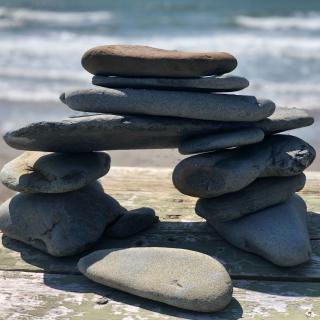
It could be a small smooth stone.
More a blank wall.
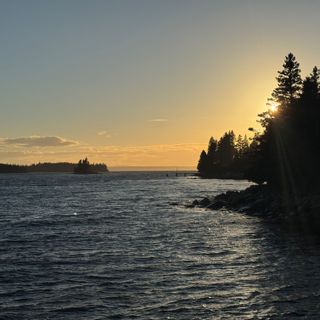
A still surface of water.
Or the horizon.
And there's no need to visualize this very clearly,
Just letting it be a soft placeholder for your attention.
And the.
.
.
Last option is no anchor at all.
You don't need to focus on anything.
You can just let your attention wander.
You can rest in awareness without selecting a target.
And there's no correct choice.
You can change anchors at any time.
You're not trying to stabilize your attention perfectly,
Just giving your nervous system some options that don't require effort or vigilance.
And you might gently notice the space around the body.
No need to scan or check,
Just a sense that the space is there around you.
And if it feels okay,
You might notice the distance in front of you.
The space behind you.
And the space around your sides.
And if that feels like too much,
You might want to return to feeling the points of contact between the body and the surface beneath.
And for our rotation of consciousness,
Our body scan,
We're going to go slow with minimal cues.
Still bringing attention to the forehead.
Just noticing.
Paying attention to the eyes.
Noticing what is present.
Bringing your attention to the jaw.
Sensing the jaw without changing it.
And the neck and throat just resting your awareness lightly.
The shoulders noting or noticing contact,
Weight,
Or maybe even a sense of neutrality.
And the chest,
You may find that breath is present,
Noticeable,
Or maybe not noticeable.
Either way is fine.
And the upper back,
If it's resting against a surface,
Noticing the contact with that surface.
The belly,
With nothing to adjust.
Just noticing.
The pelvis and the hips.
Sensing their weight or sensing stillness.
The legs,
The thighs,
Knees,
Calves.
Is scanning them generally without detail.
And the feet noticing contact with the surface or absence of sensation.
And finally,
Allowing your awareness to include the whole body all at once.
No need to organize anything.
No need to smooth anything out.
Just the body as it is.
And for visualization,
We're going to use a very simple image.
Not something to hold on to tightly.
Just something to lightly return to.
So imagining that you are resting in a quiet space where nothing is required of you.
And that space doesn't have to look any specific way.
It could be a room with soft lighting.
It could be an open space outdoors.
It could just be the sense of being held by space.
And in that space,
There's nothing happening that needs attention.
You're not responsible for that space.
You're not moving through that space.
You're simply there,
And nothing is asking anything of you.
And if the image of that space fades,
That's fine.
And if it feels unclear that's fine also.
You can come back at any time to the breath,
Another anchor,
Or the contact of your body to the surface.
And if there's a part of you that stays alert,
Observant,
Tracking,
That doesn't need to change.
It doesn't need to soften or step back.
It can remain present alongside everything else.
Nothing here requires it to stop doing its job.
And for a few moments,
There's nothing to do.
There's nothing to adjust.
Nothing to achieve.
Your attention can move,
Rest,
Or drift.
There is no need to manage your attention.
And if you'd like to stay here,
You may allow yourself to do so.
Or you can begin to notice your body again.
The contact with the surface.
Breath moving in its own way,
Or another anchor that isn't the breath.
And you might start to notice the room around you.
There's no urgency to open the eyes if they're closed.
And when it feels right,
You might experience some small movements in the fingers or toes.
And you can also simply remain still.
You can return at your own pace.
And if there was anything during this practice that felt unsettling,
Please reach out to a trusted person or do something that feels grounding for you.
And I'd like to thank you for taking the time for taking care of yourself today.
Namaste.