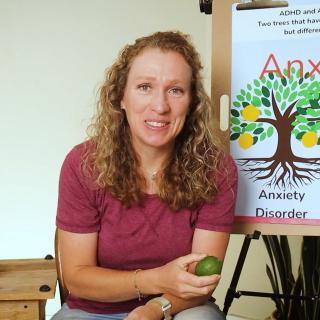
This exercise we're about to do together is,
In my opinion,
Life-changing.
It will fundamentally transform how you interact with painful thoughts and emotions and relationships.
You'll practice creating space for them so that you can be less reactive and more intentional in your actions.
It's a powerful,
Transformative exercise.
And at the same time,
It's not difficult to practice.
It's a simple skill.
And I've invited mindfulness expert Thomas McConkie to join us to teach it.
As this exercise is designed to work with disturbances or uncomfortable emotions,
It's going to be a little uncomfortable.
But if you find yourself getting overwhelmed,
Feel free to take a break.
Do something comforting,
And then come back to this exercise when you feel more resourced or safe.
This exercise is about 12 minutes,
And I've made a longer version of this video where I debrief and explore my experience with Thomas,
Because each time I do this exercise,
Something inside of me changes.
But the first couple times,
It was pretty mind-blowing for me.
So if you struggle or feel confused during the exercise,
Definitely check out the longer version of the video to explore.
The why.
Okay,
Without further ado,
Let's jump in.
One of the things I've noticed is that for a lot of people,
They have a hard time feeling their feelings.
Like they don't know.
What it means to feel their feelings and that could include their emotions.
Like they don't quite know what it means to feel what their emotions are saying,
But they also don't know how to sit with their body's sensations and what's going on there.
And I think a lot of people have a tendency to distract themselves or avoid having these feelings,
Whether they're emotional or physical,
Or they maybe suppress them.
They try not to feel them.
They're maybe afraid of them.
Or they intellectualize or distract themselves mentally so that they don't have to sit with them.
That's what I'm hoping you can talk with us about today,
Thomas.
I'm excited to talk about this today.
I'm happy to.
I love the introduction.
It needs no embellishment,
But if I were to add anything,
I would just say from a Buddhist perspective that yes,
We all do that as human beings.
We avoid ourselves.
We are in conflict with reality,
Meaning like what is true right now?
What's the truth of our embodied experience?
We're often in conflict with that,
And that causes profound suffering.
So this exercise is in service of everyday suffering for people like me and you in a way to commit more fully to our embodied experience.
So the running and the evasion can all stop right here.
I love that.
And a friend introduced me to this exercise.
And when I did it,
I was reminded that we can talk about feeling our feelings all day.
But this exercise,
We're actually just doing it.
We're just simply practicing it.
And I found it really valuable.
Really helpful for me.
So I was so grateful you were willing to share it with my audience.
Amazing.
Yeah,
I'm happy to do it.
Do you want me to jump in?
Yeah,
Let's go.
Let's jump right in.
Amazing.
I'll ring some bells because they sound beautiful,
And it also helps us kind of settle in and really come to presence for this time.
And we'll just go,
We'll see,
Five or ten minutes.
Great.
Sounds great.
So take these first few moments to.
.
.
Settle into a posture that will allow you to be relaxed,
Comfortable.
But also very present and alert.
It might feel natural to take a couple of big breaths.
I really like to take an audible sigh and audible out breath.
To just help me relax and let go.
Yeah,
Whatever works for you.
And this is also a really good moment,
An important moment to ask yourself if it feels safe to really move deeply into sensation.
For many of us,
At least some of the time,
It's not the best moment to go deep into the body.
So we shouldn't assume that An experience like this,
A practice like this,
Is always the right thing to do at any given time.
You want to check in with the body.
Get permission from yourself.
Like,
Yeah,
I feel resourced enough.
I feel grounded enough to go deep into my embodied experience.
And if you do feel resourced,
And if you do feel a little bit adventurous,
I'll invite you to really just join your awareness right now with physical sensation.
Notice what's present.
We're working in this exercise with everyday disturbance.
Hundreds of times a day,
Maybe thousands of times a day,
Things are happening.
At a pre-conscious and unconscious level where we just feel a little ruffled,
A little disturbed.
A little stirred up.
And those moments go undetected.
And we don't realize that we choreograph our lives around avoiding.
Our embodied experience.
So when you come into the body right now,
Oh,
Happy day,
You might notice that there's already disturbance there,
In which case you don't need to go looking for it.
You don't need to produce it.
But if you're feeling quite tranquil and calm,
I'm going to ask you to stir that up a little bit just for the purposes of this exercise too.
Call to your attention a moment today or a moment this week where you had a kind of troubling encounter It could be with life itself.
It could just be inclement weather.
But the deepest disturbance are often related to other human beings' relationships.
So the basic possibilities is when you bring your attention to the body,
You already feel disturbance here.
But if you don't feel any disturbance,
You can actually use this exercise to call up some disturbance.
Maybe the image of a person that you're struggling with in a relationship right now.
Maybe an interaction that didn't go very well and it's kind of stuck in your system.
It just doesn't feel very good.
And this is normally the exact kind of experience sensation that we avoid.
We try to shove it down,
We repress it,
We distract ourselves.
And we're doing something counter instinctual here by like going right into it,
Going right into the heart of the sensation.
Call up a disturbing encounter.
Something someone said to you,
Something they did,
Something that happened in life that left you feeling.
.
.
Unsteady.
Unmoored.
Anxious,
Disturbed.
And as you continue to breathe,
You can notice where this shows up in the body.
Where is the disturbance?
Where is the intense sensation that you would prefer not to be feeling?
But nevertheless,
It's present in your system.
And rather than running,
Evading,
Distracting,
Repressing,
Can you just relax into it?
Letting awareness soak into the sensation like water soaking through a sponge.
And really feeling what's here to be felt.
A key to doing this.
Is to let go of any interpretations.
Because oftentimes with disturbance,
We get a story going.
How dare that person?
That should have never happened.
Had that person been doing what they were supposed to be doing,
I wouldn't be feeling like this.
But in fact,
We are feeling like this right now.
So it's an opportunity to actually really commit to our embodied experience.
Letting go of the story,
Even something as simple as an emotional interpretation.
Letting go of even emotion and going right to the raw sensation.
And if it helps,
You can use a word or two to describe whatever physical sensation you're aware of in the body.
For me,
With my disturbance in this moment,
I'm aware of.
Clenching,
A contraction.
And the throat.
Pressure.
I feel some ache in my heart.
So see if you can do that just physical sensation,
No emotion,
No story.
And it's important when we do this exercise to ask ourselves,
Is the signal I'm getting from my body indicating real danger?
In this moment,
There might actually be something unsafe.
And you want to ask yourself that.
Is this signal from the body,
This intensity,
This disturbance,
Is it signaling that something about the environment is unsafe?
And if it is,
We want to take care of ourselves.
And change our circumstances as best we can.
But if it's a disturbance that's not indicative of any immediate danger,
If we actually feel safe.
That is,
On an objective level.
We can use this opportunity to go even deeper.
Really finding our awareness on the inside of this intense sensation.
Not trying to understand it.
Not trying to heal it.
Not trying to liberate it.
We're not performing any operation on it at all.
We're just training ourselves to stay embodied.
Commit to the truth of our embodied experience right now.
Stay with her.
And when you feel like you're really resting in this disturbance in a way that we do not normally do day to day unless we bring some intention to a practice like this.
You have the option of saying to yourself,
Saying out loud,
I commit to feeling this way on and off.
For the rest of my life.
I commit to feeling this way on and off.
For the rest of my life.
Sometimes when we make this declaration,
We feel despair,
Like,
Oh no.
I thought one day I would finally be free of sensations like this.
I would finally be delivered from the suffering of my life.
And if you feel despair,
Let that be a signal that you can let go of any fantasy.
One day as a feeling.
Human being you'll stop feeling.
And accept this embodied reality that Sometimes life hurts.
Sometimes it brings us joy.
And that these are passing ephemeral energies.
On the other hand,
Sometimes we make this declaration that I commit to feeling this way on and off the rest of our lives and a light bulb goes on.
We realize that a deeper part of us is completely resourced to feel these sensations,
All sensations as they come and go,
No matter what.
We get an insight into the part of our identity that is bigger than all experience,
All feeling.
And we realize that no matter what life throws at us,
We can remain radically embodied.
Committed to the truth of this experience.
And so if that's your response to this practice,
Just notice that,
The freedom that comes with committing to this experience.
Either way,
It's good.
The despair is good.
The freedom is good.
Whatever we feel,
It's information for us.
Let this sensation run its course,
However long it takes.
And at some point,
As all sensations ebb and flow,
You'll find yourself on the other side of intensity.
And you'll realize that you didn't abandon yourself.
You committed to staying embodied.
And now you're free to act from a place where you're not avoiding yourself,
Not avoiding your embodied experience.
You can be choiceful.
You have agency to decide Do I do something?
Do I do nothing?
What's the next thing I can do?
The most wise,
Compassionate,
And skillful thing I can do.
In response to life.
Hi there!
If you found anything in this video helpful,
I would really appreciate it if you could give it a thumbs up or share it with someone who could benefit from it today.