The world’s largest free audio library for everyday wellbeing
Sound-Based
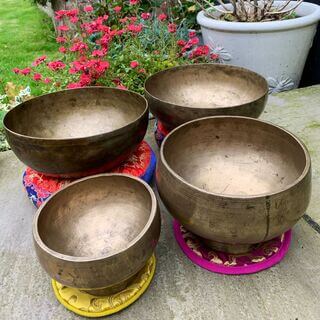
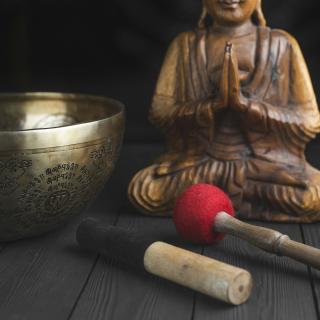
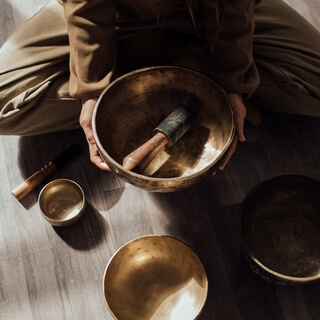
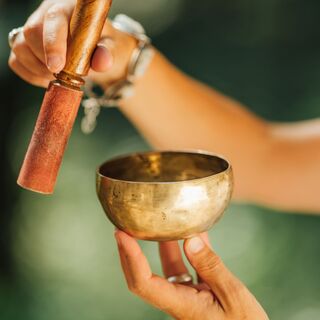
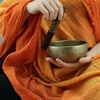
Tibetan Bowl Striking Meditation is a sound-based practice in which a singing bowl is struck and the resulting tone is followed from impact through its full decay into silence as the focus of attention (Inácio et al., 2006).
Last Updated
4 Jul 2026
We are still reviewing this page. Our research team checks every technique page for accuracy and evidence quality before final release. Details may change as that review completes. The evidence badge shows our current reading of the published research.
RECOMMENDED DOSE
Singing-bowl trials produced measurable relaxation from short, single exposures — a randomized crossover study used a 12-minute Himalayan singing bowl segment, and a controlled listening study measured effects over roughly 5 minutes. A brief 10–15 minute session is a well-supported, achievable starting point. No study reported how often per week to practise, so the frequency here is an editorial estimate.
A 20–30 minute session is supported in part by a crossover study that paired singing-bowl sound with a 20-minute directed relaxation, and by a randomized study using 30 minutes of related low-frequency Tibetan sound. Because one source uses bowls directly and the other a closely related listening modality, the session length is a mixed estimate. Weekly frequency is an editorial estimate, as no study tested it.
A peer-reviewed group study analysed a full one-hour Tibetan singing bowl session, supporting a longer 45–60 minute practice for experienced participants; this reflects an observed session rather than an RCT-established minimum, so it is treated as a mixed estimate. A near-daily rhythm is an editorial suggestion for maintenance, as no study tested weekly frequency.
Session length
Session length: 10–15 minutes
10
MIN
How long each individual practice session should last from start to finish.
Frequency
Frequency: 3–4 days
3
DAYS
The number of days per week to fit a session into your routine.
Session length
Session length: 20–30 minutes
20
MIN
How long each individual practice session should last from start to finish.
Frequency
Frequency: 4–5 days
4
DAYS
The number of days per week to fit a session into your routine.
Session length
Session length: 45–60 minutes
45
MIN
How long each individual practice session should last from start to finish.
Frequency
Frequency: 5–6 days
5
DAYS
The number of days per week to fit a session into your routine.
About this card. Session lengths draw on singing-bowl studies, but no study tested a weekly practice frequency, so how often to practise is an editorial estimate. These recommendations are not a substitute for personalised guidance from a qualified practitioner.
Quick answers to what people most often ask. Each card links to the deeper section below.
evidence
A 2025 systematic review of 14 studies and a randomized trial link Tibetan singing bowl sessions to lower anxiety and improved well-being in adults. A crossover trial of 51 adults found a struck bowl before relaxation lowered heart rate and blood pressure more than silence. Most research studies singing bowls broadly, not this exact striking protocol.
Read moregood for
Adults who feel wired, anxious, or unable to settle a busy mind may benefit from Tibetan Bowl Striking Meditation, which offers a rich, fading sound for attention to follow instead of forcing stillness. It supports in-the-moment calm and steadier well-being, not treatment for diagnosed anxiety, depression, or trauma, which need professional care.
Read moresafety
Most healthy adults can practise Tibetan Bowl Striking Meditation safely, with no serious adverse effects reported in the research so far. Because sound is the whole practice, people with tinnitus, hyperacusis, or sound-triggered migraine should start with a quieter bowl at a distance and stop if the tone feels sharp. Rise slowly after long, relaxing sessions.
Read morehow it works
Tibetan Bowl Striking Meditation gives attention a single, slowly fading tone to follow, which anchors a wandering mind and shifts the body toward its rest-and-recovery system, slowing heart rate and easing tension. Studies tracking heart-rate variability and brain waves point this way, though how the bowl's vibration produces the shift is still being mapped.
Read moreTibetan Bowl Striking Meditation is a sound-based practice of striking a singing bowl and following each tone from impact through its full decay into silence, using the sound and the space after it as the focus of attention.
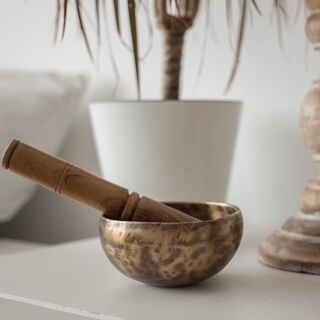
A practitioner strikes a hand-hammered singing bowl, then follows one tone through its bright attack, its long harmonic decay, and the silence before the next strike, treating the gap between strikes as part of the practice. The rich, layered overtone structure of the bowl serves as a naturally interesting focus object, and a session typically uses a single bowl struck repeatedly with quiet rests between each sound.
Distinct from rubbing or rimming a bowl to produce a continuous, sustained hum; here the bowl is struck once and the sound is allowed to fade before the next strike. It differs from passive sound-bath listening in that attention actively follows each tone through its whole lifecycle rather than washing over the listener. Not to be confused with vibroacoustic bowl massage, in which bowls are placed on or near the body for their physical vibration.
Not to be confused with
Singing bowl massage / vibroacoustic therapy
In a singing bowl massage the bowls are placed on or around the reclining body so vibration passes through the tissue. Tibetan bowl striking meditation keeps the bowl separate and works through following the sound, not through direct bodily contact with the vibration.
Rubbing or rimming the bowl (continuous tone)
Running a mallet around the rim produces a sustained, unbroken hum with no clear ending. Striking meditation is built on the opposite shape: a single attack followed by a long decay into silence, where the fading and the gap between strikes are the point.
Himalayan singing bowl practice
Himalayan and Tibetan singing bowls are often used interchangeably in the research, and several cited studies actually tested Himalayan bowls. The core striking-and-decay meditation is the same; the label mainly reflects sourcing and marketing rather than a different technique.
Keisu bell ritual use in Zen
In Zen the same struck bowl serves as the keisu bell, rung to mark the start and end of sitting rather than as the meditation object itself. Here the strike and its decay are the focus of the practice, not a ceremonial punctuation around it.
Tibetan Bowl Striking Meditation appears to work by giving attention a single, slowly fading sound to follow, which anchors a wandering mind and shifts the body toward its parasympathetic branch, the rest-and-recovery side that slows the heart and eases tension. Small sessions tracking heart-rate variability, the beat-to-beat flexibility that rises as the body settles, point in this calming direction (Nasrat et al., 2025). How the bowl's vibration and tone produce that shift is still being mapped, and the most direct mechanism work so far comes from mouse studies rather than human practice, so this route is best read as a working hypothesis (Misrani et al., 2023).
As a struck bowl's tone thins into silence, many people feel their breathing slow and their shoulders drop, a sign the body may be settling toward its parasympathetic branch, the rest-and-recovery side of the nervous system that slows the heart and eases tension. Small sessions tracking heart-rate variability point this way (Nasrat et al., 2025), though researchers are still mapping how the sound and vibration produce the shift (Misrani et al., 2023).
A struck bowl gives an over-alert nervous system something simple to follow, and as the tone fades the body's alarm system has room to power down, a shift researchers call arousal downregulation. Early laboratory work, so far mostly in animal models, hints that the vibration and sound may lower this high-alert state, though researchers are still working out exactly how (Misrani et al., 2023).
A settled, less-braced feeling can follow a session as the nervous system tilts its balance away from fight-or-flight and toward rest-and-recovery. Small studies tracking heart-rate variability during singing bowl sessions point toward this autonomic shift, though the evidence is still early (Nasrat et al., 2025), (Trivedi & Saboo, 2019).
The bowl's slow, beating tone gives the brain's own electrical rhythms something steady to fall into step with, a process called entrainment that early studies link to a more relaxed, meditative state (Kim et al., 2023). Following one sustained sound from strike to silence can feel like attention stops jumping and settles into the pace the sound sets.
A struck bowl gives off layered tones and a physical vibration you can feel as much as hear. Researchers are testing whether this vibroacoustic resonance, the pairing of low-frequency sound with a tactile buzz, helps settle the nervous system, though the idea rests mainly on animal studies so far (Misrani et al., 2023).
During a session the body tends to shift toward rest: heart rate slows, blood pressure eases, and heart-rate variability increases in the moment. In a randomized crossover study of 51 adults, a struck bowl before a relaxation session lowered heart rate and systolic blood pressure more than beginning in silence did (Landry, 2013), and small observational recordings show the same settling toward the body's recovery state (Panchal et al., 2020). Brain-wave measures move the same way, with slower, drowsier theta rhythms rising and faster, more alert activity dropping (Walter et al., 2022). In the body this can feel like breathing deepening, the shoulders loosening, and thoughts losing their urgency. Most of these readings were taken during or right after sessions in small, mostly healthy groups, so they describe what may happen within a session rather than a lasting change to your resting numbers.
When you feel tense or wired, a singing bowl session can help your pulse ease, you may notice your breathing deepen, your shoulders drop, and the body settle as the tone fades. Heart rate tends to slow during and just after a session (Landry, 2013), a shift toward the body's rest-and-recovery state; because studies measure this in the moment, treat it as what may happen during a session rather than a lasting change to your resting pulse.
If your body feels braced and wound-up, a short singing bowl segment before a guided relaxation session may help it ease off. In one crossover trial, that lowered systolic blood pressure, the force of blood pushing against artery walls, more than starting the same session in silence did (Landry, 2013). Many people notice this as a slower pulse and the chest and shoulders letting go.
During a singing bowl session, many people feel a soft, dreamlike settling in which thoughts slow and the mind drifts toward the edge of sleep without falling in. That shift shows up as theta brainwave activity, a slower brain rhythm linked to drowsy, deeply relaxed states, which tends to rise while faster, more alert brainwave power drops (Walter et al., 2022), (Kim et al., 2023).
Many people feel their mental chatter quiet during a singing bowl session, and brain recordings show a matching shift: beta activity, the fast brainwaves tied to alert, effortful thinking, tends to drop as the sound settles (Walter et al., 2022), (Kim et al., 2023).
As each tone fades, breathing slows, muscles soften, and the body settles. That felt shift reflects rising parasympathetic tone, the nervous system's rest-and-recovery branch, which small studies track as increased heart-rate variability during singing bowl sessions (Nasrat et al., 2025), (Trivedi & Saboo, 2019), (Panchal et al., 2020).
Moderate evidence supports Tibetan singing bowl sessions for easing anxiety and supporting well-being in adults, with a 2025 systematic review of 14 studies and a randomized trial both pointing that way (Lin et al., 2025), (Río-Álamos et al., 2023). Limited, observational evidence links a single session to less tension and easier mood right afterward (Goldsby et al., 2016), and physiological signals of calm sit at an emerging level. Most of this research studies singing bowl practice broadly rather than this exact striking-and-decay protocol. What is not yet supported: large controlled trials, lasting change beyond a session, and any claim that the practice treats a diagnosed anxiety, mood, or other condition.
Anxious tension often loosens during a singing bowl session, as attention rests on the fading tone and the body settles toward its parasympathetic, rest-and-recovery state. A systematic review of 14 studies found singing bowl sessions can reduce anxiety and support well-being in adults (Lin et al., 2025), and in one trial a single session eased anxiety at least as much as a standard muscle-relaxation exercise (Río-Álamos et al., 2023).
After a stressful stretch, some people feel the body settle, breathing slow, and a sense of steadiness return during a singing bowl session, a shift that shows up as measured rises in heart-rate variability, the small beat-to-beat changes in the heartbeat that signal a flexible, recovering nervous system (Nasrat et al., 2025), (Trivedi & Saboo, 2019), (Panchal et al., 2020).
After a singing bowl session, many people describe feeling steadier, calmer, and more at ease. A systematic review of 14 studies linked Tibetan singing bowl practice to reduced anxiety and better psychological well-being, the overall sense of feeling emotionally settled, though it pools different session formats and remains early (Lin et al., 2025).
Anger and tension often sit in the body as tightness rather than words. In one study, adults reported feeling noticeably less tension and anger right after a single Tibetan singing bowl session, following the fading tone instead of pushing against it (Goldsby et al., 2016). Early evidence like this points to an in-the-moment mood shift, not a lasting fix.
Sessions have been linked to lower anxiety, easier mood, and a calmer nervous-system state across a systematic review and several small trials (Lin et al., 2025), (Goldsby et al., 2016). A randomized crossover of 51 adults found a struck bowl before relaxation lowered blood pressure and heart rate more than silence (Landry, 2013), and small heart-rate and brain-wave studies point the same way toward relaxation. The main caveats are that most work studies singing bowls broadly rather than this striking protocol, that samples are small and sessions single, and that the most direct mechanism findings come from mixed animal studies (Misrani et al., 2023).
0
Meta-analyses
1
RCTs
3
Systematic reviews
2
Observational
9
Pilot
Studied populations
Effects of Tibetan Singing Bowl Intervention on Psychological and Physiological Health in Adults: A Systematic Review
2025
Finding: This review gathered 14 separate studies of Tibetan singing bowl sessions and found that most of them reported clear drops in anxiety and low mood, along with better overall well-being and quality of life, across a range of adults from generally healthy people to those living with cancer or chronic illness. For someone considering the practice, that points to a fairly consistent calming and mood-lifting effect worth trying, though the results come from different kinds of studies that were too varied to combine into a single hard number. Because the pool of quality studies is still small and the picture is not uniform, treat this as encouraging early support rather than proof, and not as a substitute for care if you are dealing with clinical anxiety or depression.
See full citation in referencesAcute Relaxation Response Induced by Tibetan Singing Bowl Sounds: A Randomized Controlled Trial.
n = 50
Finding: In a randomized trial of 50 adults with high anxiety, a single Tibetan singing bowl session lowered self-reported anxiety and shifted the body toward calm, showing more relaxed brain-wave activity and greater heart-rate variability (a sign of a more flexible, settled nervous system) than either progressive muscle relaxation or simply waiting. Both the singing bowl and muscle relaxation eased anxiety compared with doing nothing, but the calming effect was more pronounced with the bowls. For someone curious about the practice, this suggests even one sitting may help you unwind, though the study tested only a single session with a small group of people who were anxious but not clinically diagnosed, so it can't tell us how the effects hold up over weeks of regular practice.
Tibetan Bowl Striking Meditation grows out of Tibetan and Buddhist contemplative traditions, where a struck bowl has long been used to mark the opening and closing of meditation, and where the same carrier appears in Zen as the keisu bell (Seetharaman et al., 2023). These roots help explain the practice's form, the striking of a tone and the attention paid to its rise and fade, rather than proving any clinical effect.
Striking a Tibetan bowl and following its tone into silence is low-risk for most healthy adults, and the reviewed research reports no serious adverse effects (Stanhope et al., 2020), (Cai et al., 2025). Because sound is the whole practice, a few situations still call for care. Loud or sustained resonance can feel sharp or jarring for people with tinnitus, a persistent ringing or buzzing in the ears, or hyperacusis, where everyday sound feels uncomfortably intense. This caution comes from how the practice works rather than from measured harm, and the discomfort is usually mild to moderate, so starting with a quieter bowl held at a distance normally settles it. Singing bowl sessions support calm and focus rather than treat anxiety, depression, or trauma; the evidence so far shows early promise but is limited in quality, so use it alongside professional care rather than in place of it.
People with tinnitus, hyperacusis, or sound-triggered migraine may find a struck bowl's resonance uncomfortable, and should begin quietly, keep the bowl at a comfortable distance, and stop if the sound turns sharp. This is a practical, practice-informed caution of mild to moderate severity, not a measured safety risk. Anyone working through trauma or a diagnosed condition such as an anxiety disorder, depression, or PTSD is best treating the practice as a complement to care from a qualified professional, since the encouraging findings so far come from single, short sessions in general adult samples rather than clinical treatment trials (Río-Álamos et al., 2023), (Goldsby et al., 2016).
Because sound is the whole practice, a struck bowl's loud or sustained resonance can feel sharp for people with tinnitus, a persistent ringing or buzzing in the ears, or hyperacusis, where everyday sound feels uncomfortably intense. This caution comes from how the practice works rather than from measured harm, and the discomfort is usually mild to moderate. Begin with a soft strike on a quieter bowl held at arm's length or more, raise the volume gradually, and stop if the tone turns sharp.
| Technique | Best for | Use with care | Evidence strength | Distinction |
|---|---|---|---|---|
| Progressive muscle relaxation (PMR) | Releasing physical tension when you prefer a hands-on body technique that needs no equipment. | If deliberate muscle tensing feels uncomfortable, or a sound anchor holds your attention more easily than body sensation. | moderate EVIDENCE | PMR settles the body by deliberately tensing and releasing muscle groups in sequence, so the anchor is physical sensation rather than sound. Tibetan bowl striking instead rests attention on a single fading tone from strike to silence, letting the body downshift as the sound thins. Both aim at the same calm, less-braced state through different doorways. |
| Resting quietly in silence | A completely equipment-free reset when a quiet mind settles easily on its own. | If unanchored silence tends to fill with rumination, a sound cue may hold attention more reliably. | emerging EVIDENCE |
It is a sound-based meditation in which you strike a hand-hammered Tibetan singing bowl and follow one tone from its bright impact through a long decay into silence, then rest in the quiet before the next strike (Inácio et al., 2006).
+
It is a sound-based meditation built around a single struck tone. You strike a hand-hammered Tibetan singing bowl and let attention follow the sound through its whole lifecycle, the initial impact, the long harmonic decay, and the silence before the next strike, treating the space between sounds as part of the practice. The bowl's rich, layered overtones give a busy mind a naturally interesting anchor to keep returning to (Inácio et al., 2006). This describes the form of the practice, not a claim that it treats any condition.
Because the whole arc of the tone is the anchor. Following a single strike through its long decay into silence gives attention a naturally changing, self-signaling object to return to, and the quiet gap before the next strike is treated as part of the practice rather than dead time (Inácio et al., 2006).
+
Because the tone's full lifecycle is what holds attention. A struck bowl produces a bright attack followed by a long, thinning decay, so following it all the way into silence gives a wandering mind a slowly changing sound to track and a clear cue for when to re-gather focus (Inácio et al., 2006). The silence between strikes is treated as part of the practice, not a pause, a framing that reflects the Tibetan and Buddhist traditions where a struck bowl marks the opening and closing of meditation (Seetharaman et al., 2023). This explains why the practice is structured this way; it does not claim that the fade or the gap produces a separate measured effect.
The gradual fading of a struck bowl's layered tone from its first bright impact down into silence. Following this whole lifecycle, including the quiet after the sound, is the core of the practice.
Steadying attention on one clear target, here a single fading tone, so the mind stops repeatedly drifting to worries or distraction. It tends to feel like sharper focus and fewer spiraling thoughts.
Sensing and attending to the outside world through the senses, such as the overtones and shifting frequencies inside a struck bowl. It is the outward-facing counterpart to noticing internal body states.
Increased activity in the body's rest-and-recovery branch of the nervous system, which eases the body out of fight-or-flight. People usually notice it as slower breathing, softer muscles, and a settled feeling.
A shift toward parasympathetic (vagal) dominance, commonly indexed by increased heart-rate variability and reduced heart rate.
The small beat-to-beat differences in the timing of your heartbeat; higher variability signals a nervous system that can flex between alert and rest. It often rises as the body settles during a session.
Time-domain HRV indices such as SDNN, RMSSD, and NN50, used as markers of autonomic and parasympathetic activity.
A common heart-rate-variability measure that captures the overall spread of time between heartbeats. A higher value is generally read as a more relaxed, flexible nervous-system state.
A slower brainwave rhythm that rises as the mind moves from alert thinking toward drowsy, deep relaxation. Practitioners often feel it as a soft, dreamlike settling near the edge of sleep.
Fei-Wen Lin, Ya-Hui Yang, Jiun-Yi Wang, F.-W. Lin, J.-Y. Wang, Y.-H. Yang (2025). Effects of Tibetan Singing Bowl Intervention on Psychological and Physiological Health in Adults: A Systematic Review. https://doi.org/10.3390/healthcare13162002
Cristóbal Río-Álamos, Rodrigo Montefusco‐Siegmund, Toñi Cañete, Joaquín Sotomayor, Alberto Fernández‐Teruel, Rio-Alamos Cristobal (2023). Acute Relaxation Response Induced by Tibetan Singing Bowl Sounds: A Randomized Controlled Trial.. https://doi.org/10.3390/ejihpe13020024
Explore guided sessions to deepen your Tibetan Bowl Striking Meditation technique.
The keyed-up, fight-or-flight edge tends to settle during a singing bowl session. Small studies have measured heart-rate variability, the beat-to-beat flexibility that rises as the body relaxes, increasing while heart rate slows as the bowls play (Nasrat et al., 2025), (Panchal et al., 2020), a pattern that points to lower sympathetic arousal, the body's stress-branch activation, and that practitioners often feel as tension leaving the shoulders and jaw.
When stress leaves the body braced and slow to downshift, a singing bowl session may help it settle. Small studies show heart-rate variability rising while heart rate slows (Nasrat et al., 2025), (Trivedi & Saboo, 2019), a shift in sympathovagal balance, the tug-of-war between the body's stress and rest branches, toward the calmer vagal side, often felt as breathing slowing and muscles loosening.
Outcomes measured
| Outcome | Effect size | 95% CI | N | Comparator | Source |
|---|---|---|---|---|---|
| tension, anger, fatigue, depressed mood, spiritual well-being | reported significant; P<.001 | — | — | — | Goldsby et al., 2016 |
| SDNN (HRV) | reported significant; p=0.02344 | — | — | — | Nasrat et al., 2025 |
| global EEG power after intervention | Cohen's d = -0.46 | — | 34 | — | Walter et al., 2022 |
| systolic blood pressure and heart rate | reported significant; systolic p=.044; HR p=.003; diastolic p=.073 (ns) | — | 51 | silence prior to directed relaxation | Landry, 2013 |
The research is small and indirect: most studies examine singing bowl practice broadly rather than this specific striking-and-decay meditation, use small and mostly healthy adult samples, and measure change within a single session rather than over time. Several results are reported only as statistical significance rather than full effect-size estimates, and the most direct mechanism evidence comes from mixed animal studies, so how well the findings carry over to everyday human practice remains uncertain (Stanhope et al., 2020), (Cai et al., 2025).
reported narratively
Exploring the healing power of singing bowls: An overview of key findings and potential benefits.
2023
Finding: This peer-reviewed overview places singing bowl sound meditation within a long contemplative tradition, describing it as a practice used for centuries in Tibetan and Buddhist cultures for healing and relaxation. For someone considering it today, that means you are stepping into an established sound practice with deep cultural roots rather than a recent wellness trend. The overview speaks to the practice's history and setting, not to specific health outcomes, so it tells you where the tradition comes from rather than what results you should expect.
See full citation in referencesVibration-reduced anxiety-like behavior relies on ameliorating abnormalities of the somatosensory cortex and medial prefrontal cortex
2023
Finding: In a study using stressed mice, the physical vibration from singing bowls, on its own, reduced anxiety-like behavior and shifted brain-signaling markers linked to calm, while the combination of audible tones plus vibration did not produce the same benefit. That points to the felt buzz of the bowl, rather than its sound, as a possible active ingredient, which may be worth noticing in your own practice. Because this was done in animals and the results were mixed, we can't yet say how or whether the same pathway works in people, so treat it as an early clue rather than a proven explanation.
See full citation in referencesEffects of Singing Bowl Sound Meditation on Mood, Tension, and Well-being: An Observational Study.
n = 62
Finding: In this study of 62 adults (average age around 50), people reported clearly less tension, anger, fatigue, and low mood right after a Tibetan singing bowl session, along with a greater sense of spiritual well-being. Those who were new to the practice felt the drop in tension even more strongly than experienced participants, which suggests you may notice a shift from your very first session. Keep in mind this was a before-and-after look at a single session with no comparison group and relied on people's own reports, so it points to a promising, immediate mood lift rather than proof that the bowls alone caused it.
reported narratively
The Effect of Tibetan Singing Bowls on Stress Reduction: A Heart Rate Variability Study.
n = 8
Finding: In a small study of 8 healthy adults, a single 30-minute Tibetan singing bowl session measurably raised heart-rate variability, a sign that the body's rest-and-recovery system was taking over from its stress response. For someone trying the practice, that points to a genuine physical shift toward calm within a single sitting, not just a subjective sense of relaxation. Because the group was tiny and the effect was measured over one session with no comparison group, though, these results are an early signal rather than proof of lasting benefit.
reported narratively
A Serene Segue: Examining College Student’s Perceptions of Starting Classes with Micro-Meditations
2021
Finding: This study explored how 61 college students experienced starting their classes with a short Tibetan singing bowl meditation, used as a kind of "attention bridge" to help them shift from the noise of daily life into focused learning. Rather than measuring the practice against a comparison group, it gathered students' own accounts of that transition during a period of heightened stress, so it offers a first-hand look at how a brief bowl meditation can mark a mental reset before demanding tasks. If you're considering the practice, it suggests a simple way to signal "begin here" to your attention, though the small size and reliance on personal reports mean these are early impressions rather than proof of a lasting effect.
See full citation in referencesThe dynamics of Tibetan singing bowls
2006
Finding: This study examined how singing bowls actually make their sound, showing that the rich, layered tone comes from either striking the bowl or rubbing its rim, with the choice of technique, where you make contact, and the hardness of the mallet all shaping the overtones you hear. For anyone drawn to this practice, that means the sound you meditate to is not random: small changes in how a bowl is played produce noticeably different tones and how long they linger. This is an acoustic and instrument-focused study rather than a test of health effects, so it explains what the bowls do rather than what they do for you.
See full citation in referencesTherapeutic effects of singing bowls: A systematic review of clinical studies.
2025
Finding: This review gathered 19 clinical studies of singing bowl sound and found signs of benefit across anxiety, depression, sleep, and thinking, with people generally reporting calmer moods and easier rest after sessions. For someone considering the practice, that points to singing bowl meditation as a reasonable, low-risk way to unwind, though the review's authors were careful not to call it a proven treatment. The studies were mostly small and varied widely in how they were run, so the evidence is still early and best treated as promising rather than settled.
See full citation in referencesA Comparative Study of the Impact of Himalayan Singing Bowls and Supine Silence on Stress Index and Heart Rate Variability
2019
Finding: In this small study, 33 adults either listened to Himalayan singing bowls or simply rested lying down in silence for 20 minutes. Both groups relaxed, but the singing bowl group showed a steadier, more measurable drop in stress and a bigger rise in heart-rate variability, a sign the body was settling into a rest-and-recovery state, across each five-minute stretch of the session. For someone considering the practice, this hints that the sound may help you unwind more reliably than quiet rest alone, though with only 16 people in the bowl group and a single session, it is an early signal rather than firm proof.
See full citation in referencesImpact of Himalayan Singing Bowls Meditation Session on Mood and Heart Rate Variability – An Observational Study
2020
Finding: In this small study, eight healthy adults sat through a single 30-minute Himalayan singing bowl session, and afterwards their heart-rate variability rose measurably, a sign the body had shifted toward its rest-and-recovery mode rather than a stressed, on-alert state. For someone trying the practice, this hints that even one session may leave the nervous system calmer and more settled. With only eight participants, no comparison group, and just one sitting measured, though, these are early signals rather than proof of lasting benefit, so treat it as an encouraging reason to try the practice, not a guarantee.
See full citation in referencesPhysiological and Psychological Effects of a Himalayan Singing Bowl in Meditation Practice: A Quantitative Analysis
n = 51
Finding: In a randomized crossover study of 51 adults, starting a 20-minute relaxation session with 12 minutes of Himalayan singing bowl sound lowered systolic blood pressure and heart rate more than beginning in silence did, so the sound appeared to deepen the body's shift into calm rather than replace the relaxation itself. Diastolic blood pressure eased slightly too, though that change was small enough that it could have been chance. These were in-the-moment effects measured during single sessions, so the study speaks to how a bowl can enhance one relaxation practice, not to lasting changes in blood pressure over weeks or months.
reported significant; systolic p=.044; HR p=.003; diastolic p=.073 (ns)
Does the Sound of a Singing Bowl Synchronize Meditational Brainwaves in the Listeners?
2023
Finding: When 17 healthy young adults (average age 25) listened to a struck singing bowl for five minutes, their frontal brain activity picked up rhythm at the bowl's own beat frequency, falling into the slower theta range associated with calm, meditative attention. In plain terms, the brain appeared to settle into a relaxed listening state that tracked the sound of the bowl. This was a small snapshot study that measured brain-wave activity during listening rather than any longer-term wellbeing outcome, so it points to how the practice engages a resting nervous system but doesn't tell us how you'll feel over weeks of practice.
See full citation in referencesThe human health effects of singing bowls: A systematic review.
2020
Finding: This review gathered the small pool of studies on singing bowl therapies, just four in total, and found that people reported better mood and some measurable physical changes after sessions. Because so few studies existed and their methods varied, the reviewers stopped short of recommending singing bowls as an established treatment. For someone drawn to Tibetan bowl striking meditation, the early signals are encouraging, but this is a practice worth exploring for how it feels to you rather than relying on for a specific health result.
See full citation in referencesNeurophysiological Effects of a Singing Bowl Massage.
n = 34
Finding: In a study of 34 healthy adults, researchers tracked brain and heart activity during a Tibetan singing bowl massage and found that overall brain-wave activity quietened afterward, with a moderate drop in the faster, more alert frequencies and a slower heart rate, a pattern that lines up with the body settling into a relaxed, meditative state. For someone trying this practice, that suggests the sound and vibration may help shift the nervous system toward calm rather than simply feeling soothing in the moment. Keep in mind this was a small session-based study measuring physical signals rather than long-term wellbeing, and it had no comparison group, so it shows what the body does during a session more than what regular practice delivers over time.
Cohen's d = -0.46
People whose migraine can be triggered by sound may find a struck bowl's resonance uncomfortable. This is a practical, practice-informed caution of mild-to-moderate severity rather than a measured safety risk, since no study has specifically tested singing bowls in this group. Start quietly, keep the bowl at a comfortable distance, and stop if the sound feels overwhelming.
Singing bowl sessions support calm and focus rather than treat anxiety, depression, or trauma. Anyone working through trauma or a diagnosed condition such as an anxiety disorder, depression, or PTSD is best treating the practice as a complement to care from a qualified professional, since the encouraging findings so far come from single, short sessions in general adult samples rather than clinical treatment trials.
Tibetan bowl striking is best approached gently, starting with a soft strike and letting the tone build as you learn how the resonance feels in your ears and body. A sensible starting format keeps the bowl at least an arm's length away in a quiet space where you can rest your attention on the sound and simply pause if anything ever feels sharp. If you live with tinnitus, hyperacusis, or a diagnosed condition, treat this as a way to unwind that sits alongside professional care rather than replacing it.
Begin with a soft strike and let the tone rise gradually, so you learn how the resonance feels in your ears and body before playing more firmly. This keeps anyone sensitive to sound within an easy range.
Place it an arm's length or more away rather than close to your head, and move farther back if the sound feels intense. This simple adjustment helps if you have tinnitus or hyperacusis.
Strike the bowl and let attention track the sound through its whole lifecycle, the bright impact, the long decay, and the quiet before the next strike, resting in the gap as part of the practice.
Notice whether the tone stays soothing or starts to feel sharp or overwhelming, and pause or stop if it does. There is nothing to gain from pushing through a jarring sound.
Heart rate and blood pressure may ease during practice as the body settles toward rest and recovery, so sit for a moment and rise gently after a longer or deeply relaxing session rather than standing up quickly.
Use singing bowl meditation to unwind and steady attention, and keep care for anxiety, depression, trauma, or another diagnosed condition with a qualified professional. The current research is encouraging but still early.
This information is educational and is not medical advice. This practice is not a substitute for professional care and should not replace prescribed medication or treatment for any medical or mental-health condition. If you are managing a health condition or taking medication, talk with a qualified health professional before changing your practice. If you are in distress or crisis, seek professional support.
| Sitting or lying in silence offers rest with nothing to attend to, which suits some people but lets a busy mind drift toward worry. Tibetan bowl striking gives that same quiet an object: a resonant tone to follow and a defined silence between strikes, so attention has somewhere to land before the next sound. |
| Sound bath (passive group listening) | Passively receiving layered, enveloping sound in a group without needing to play or focus on anything specific. | If you want the deliberate focus of following one tone from strike to silence rather than a wash of overlapping sound. | emerging EVIDENCE | A sound bath immerses a group in continuous, overlapping tones from multiple instruments while participants lie back and receive the sound, with no active task. Tibetan bowl striking is a single-tone, one-at-a-time practice where you follow each strike through its decay and rest in the gap, making attention active rather than simply bathed in sound. |
| Focused-attention meditation | Building general attentional control with a portable internal focus that needs no instrument. | If holding a silent internal focus feels effortful, an external tone can give attention a clearer, more forgiving object. | moderate EVIDENCE | Focused-attention meditation anchors the mind on an internal object such as the breath or a repeated word, with the practitioner supplying the focus. Tibetan bowl striking uses an external, naturally fading sound as that anchor, which can feel easier to return to because the tone itself signals when to re-gather attention. |

Moderately, but the evidence is early. A 2025 systematic review and a randomized trial both suggest singing bowl sessions can ease anxiety and support well-being in adults (Lin et al., 2025), (Río-Álamos et al., 2023). This points to in-the-moment relaxation, not treatment of a diagnosed anxiety disorder.
+
Moderately, though the research points that way rather than settling it. A 2025 systematic review of 14 studies links singing bowl sessions to lower anxiety and better well-being (Lin et al., 2025), a randomized trial found a single session eased anxiety at least as much as progressive muscle relaxation (Río-Álamos et al., 2023), and observational data show less tension right afterward (Goldsby et al., 2016). The main caveats: most studies cover singing bowls broadly rather than this striking-and-decay protocol, samples are small and single-session, and overall quality is limited (Stanhope et al., 2020), (Cai et al., 2025). It is best read as support for acute calm alongside professional care, not a replacement for it.
Moderate but early. A 2025 systematic review and small trials link singing bowl sessions to less anxiety and a calmer nervous system, but most studies cover singing bowls broadly, use small, mostly-healthy samples, and carry a high risk of bias (Lin et al., 2025), (Stanhope et al., 2020).
+
Moderate but early. The strongest signal comes from a 2025 systematic review and a handful of small trials pointing to reduced anxiety and steadier physiology (Lin et al., 2025), but the quality is limited: most studies examine singing bowls broadly rather than this exact striking-and-decay practice, samples are small and often healthy, and measures usually capture within-session change rather than lasting effects (Stanhope et al., 2020), (Cai et al., 2025). Mechanism findings are mixed, with the most direct work coming from animal studies (Misrani et al., 2023). Read it as an encouraging early signal, not settled proof, and not a treatment for any diagnosed condition.
Yes, as a measurable in-the-moment shift. In a randomized crossover of 51 adults, a struck bowl before relaxation lowered heart rate and systolic blood pressure more than starting in silence (Landry, 2013). This describes what may happen during a session, not a lasting drop in your resting numbers.
+
Yes, and the calming shift is measurable rather than just a feeling, though it reflects an in-session change, not a lasting one. A randomized crossover study of 51 adults found that a struck bowl before a relaxation session lowered heart rate and systolic blood pressure more than beginning in silence (Landry, 2013), and small heart-rate-variability recordings point the same way toward a calmer nervous-system state (Nasrat et al., 2025). These readings come from small, mostly healthy groups and study singing bowls broadly rather than this exact striking-and-decay protocol, so they suggest a within-session effect, not a treatment for any cardiac or anxiety condition.
Likely because the single fading tone gives wandering attention one clear thing to follow, and its gradual decay is thought to cue a shift toward the body's parasympathetic, rest-and-recovery branch, seen as rising heart-rate variability and a slowing heart rate in small studies (Nasrat et al., 2025). This is a working hypothesis, not a proven mechanism (Misrani et al., 2023).
+
The proposed pathway is twofold: a discrete, slowly decaying sound anchors attention so the mind drifts less, while the fading tail appears to shift the nervous system toward its parasympathetic, rest-and-recovery side. Small human recordings track this as increased heart-rate variability, the beat-to-beat flexibility that rises as the body settles, alongside a slowing heart rate (Nasrat et al., 2025). Treat this as a working hypothesis rather than a proven route: the most direct mechanism work so far comes from mouse studies, and the human signals are small and within-session, so how the vibration and tone produce the shift is still being mapped (Misrani et al., 2023).
Use care. For most healthy adults no serious adverse effects have been reported, but if you have tinnitus, persistent ringing in the ears, or hyperacusis, a heightened sensitivity to sound, a struck bowl's resonance may feel sharp. Start with a soft strike, keep the bowl at a distance, and stop if it feels uncomfortable (Stanhope et al., 2020).
+
Use care. The reviewed research reports no serious adverse effects in healthy adults, but no study has specifically tested singing bowls in people with tinnitus, hyperacusis, or sound-triggered migraine, so this caution is practice-informed rather than a proven risk. Because loud or sustained resonance can feel sharp for sensitive ears, begin with a quiet bowl at arm's length or more, raise the volume gradually, and stop if the tone feels jarring. This is a mild-to-moderate comfort caution; if sound reliably triggers distress, check with a qualified professional first (Stanhope et al., 2020), (Cai et al., 2025).
No. Singing bowl meditation may ease anxiety and support well-being as a calming complement, but it is not a treatment and should not replace professional care for diagnosed anxiety or depression (Lin et al., 2025).
+
No. Tibetan singing bowl sessions may help reduce anxiety and support well-being, but the evidence is encouraging rather than settled, resting on small, mostly single-session studies of singing bowls broadly rather than this striking protocol (Lin et al., 2025), (Stanhope et al., 2020), (Cai et al., 2025). Use it as a support for calm and focus alongside care from a qualified professional, and keep any treatment for a diagnosed anxiety or mood condition with that professional.
Start simple: strike a hand-hammered bowl softly, let the tone rise, and follow it from impact through its full decay into silence before the next strike, resting in the quiet between (Inácio et al., 2006). Keep the bowl about an arm's length away, pause if the sound feels sharp, and rise slowly after longer sessions. This is a way to unwind, not a treatment.
+
Start simple, with practical steps rather than clinical instruction. Begin with a soft strike and let the tone build gradually so you learn how the resonance feels, place the bowl roughly an arm's length away, then follow each tone through its decay into silence and rest in the gap before striking again (Inácio et al., 2006). Check in as you go and pause or lower the volume if the sound feels sharp, and sit for a moment before standing after a longer, deeply relaxing session. Treat it as a way to settle a busy mind, and keep care for any diagnosed condition with a qualified professional.
Striking meditation is an active, single-tone practice: you strike one bowl, follow its tone through the full decay, and rest in the silence before the next strike. A sound bath is passive group immersion in continuous, overlapping tones from several instruments, with no task except to lie back and receive the sound.
+
The difference is structural, not a matter of which works better. In striking meditation your attention is active and one-at-a-time: you follow each strike from bright impact through its long decay into silence, treating the gap between sounds as part of the practice. A sound bath instead surrounds a group with layered, sustained tones from multiple instruments while participants simply receive them. No study has compared the two head-to-head, so this describes their form rather than claiming that either produces stronger effects.
The tendency of the brain's electrical rhythms to fall into step with a steady, repeating sound, much like walking in time with a drumbeat. It is one proposed reason bowl sessions can feel calming.
The pairing of low-frequency sound with a physical vibration you can feel as well as hear when a bowl is struck. Researchers are studying it as a possible calming signal to the nervous system.
A whole-body shift toward calm, with slower heart rate, easier breathing, and reduced tension, that can be triggered by practices like sound meditation. It is the opposite of the stress-ready fight-or-flight state.
Heightened sensitivity to everyday sound, where ordinary noises feel uncomfortably loud or sharp. For someone with hyperacusis, a struck bowl may feel jarring, a signal to lower the volume or move farther away.
Cited in: Benefits, Comparison, Faq, Research, Use with care, Who should use care
Rajmohan Seetharaman, Sanika Avhad, Jitesh R. Rane, Seetharaman Rajmohan, Avhad Sanika, Rane Jitesh (2023). Exploring the healing power of singing bowls: An overview of key findings and potential benefits.. https://doi.org/10.1016/j.explore.2023.07.007
Cited in: Faq, Roots and tradition
Afzal Misrani, Sidra Tabassum, Tintin Wang, Huixian Huang, Jinxiang Jiang, Hongjun Diao (2023). Vibration-reduced anxiety-like behavior relies on ameliorating abnormalities of the somatosensory cortex and medial prefrontal cortex. https://doi.org/10.4103/1673-5374.385840
Cited in: Faq, How it works, Research
T. Goldsby, M. Goldsby, M. McWalters, P. Mills, Tamara L. Goldsby, Michael E. Goldsby (2016). Effects of Singing Bowl Sound Meditation on Mood, Tension, and Well-being: An Observational Study.. https://doi.org/10.1177/2156587216668109
Cited in: Benefits, Faq, Research, Use with care, Who should use care
Nasrat Sara A, Alskafi Feryal A, Ahmad Dalya Y, Alameri Raghad O, Albadawna Haya A, Aldosari Asmaa J (2025). The Effect of Tibetan Singing Bowls on Stress Reduction: A Heart Rate Variability Study.. https://doi.org/10.1109/embc58623.2025.11253160
Cited in: Benefits, Faq, How it works, Research, What happens in the body
Steve Haberlin (2021). A Serene Segue: Examining College Student’s Perceptions of Starting Classes with Micro-Meditations. https://doi.org/10.1080/87567555.2021.1987181
Cited in: –
Octávio Inácio, Luı́s Henrique, José Antunes (2006). The dynamics of Tibetan singing bowls. https://doi.org/10.1126/science.155.3762.518
Cited in: Faq, What it is
Yiqing Cai, Guoyan Yang, Yibo Liu, Xiangyun Zou, Heng Yin, Xinyan Jin (2025). Therapeutic effects of singing bowls: A systematic review of clinical studies.. https://doi.org/10.1016/j.imr.2025.101144
Cited in: Faq, Research, Use with care
Gunjan Y Trivedi, Banshi Saboo (2019). A Comparative Study of the Impact of Himalayan Singing Bowls and Supine Silence on Stress Index and Heart Rate Variability. https://doi.org/10.14302/issn.2474-9273.jbtm-19-3027
Cited in: Benefits, Comparison, How it works, Research, What happens in the body
Saharsh Panchal, Fariburz Irani, Gunjan Y Trivedi (2020). Impact of Himalayan Singing Bowls Meditation Session on Mood and Heart Rate Variability – An Observational Study. https://doi.org/10.14302/issn.2574-612x.ijpr-20-3213
Cited in: Benefits, How it works, Research, What happens in the body
Jayan Marie Landry (2013). Physiological and Psychological Effects of a Himalayan Singing Bowl in Meditation Practice: A Quantitative Analysis. https://doi.org/10.4278/ajhp.121031-arb-528
Cited in: Faq, Research, What happens in the body
Seong Chan Kim, Min-Joo Choi, Kim Seong-Chan, Choi Min-Joo (2023). Does the Sound of a Singing Bowl Synchronize Meditational Brainwaves in the Listeners?. https://doi.org/10.3390/ijerph20126180
Cited in: How it works, Research, What happens in the body
Jessica Stanhope, Philip Weinstein, Stanhope Jessica, Weinstein Philip (2020). The human health effects of singing bowls: A systematic review.. https://doi.org/10.1016/j.ctim.2020.102412
Cited in: Faq, Research, Use with care
Nike Walter, Thilo Hinterberger, Walter Nike, Hinterberger Thilo (2022). Neurophysiological Effects of a Singing Bowl Massage.. https://doi.org/10.3390/medicina58050594
Cited in: Research, What happens in the body
Editorially curated. Tracks are not themselves clinically studied; evidence on the page applies to Tibetan Bowl Striking Meditation as a technique.
Beginner content for Tibetan Bowl Striking Meditation

★ 4.8
·
Music
·
40 min
Dante Baker
How hard is Tibetan Bowl Striking Meditation?
This singing-bowl row fits the active participatory default without needing a stronger override.
2
Mental Effort
2 / 4
▾Emotional Depth
1 / 4
▾Physical Intensity
2 / 4
▾Prior Knowledge
2 / 4
▾