Hi,
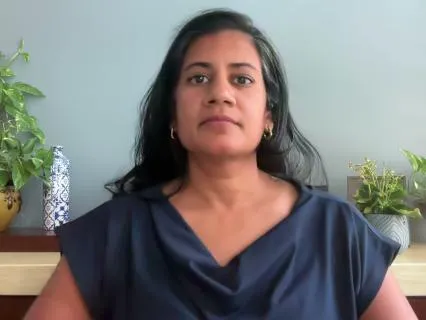
And welcome to this demonstration of an MBSR base.
Mindful eating exercise.
Mindful eating is one of the first mindful practices that is taught in mindfulness-based stress reduction.
And one of the reasons for doing so is to emphasize the importance of paying attention in the present moment,
To appreciate Something that we do every day is eating.
So we'll walk through this exercise together,
Which will take.
.
.
Somewhere between maybe 7 to 10 minutes or so.
And what you'll need with you is.
.
.
Just a couple of raisins.
If you don't have any raisins or you can't eat raisins for whatever reason,
It's okay to have a handful of nuts,
A small piece of chocolate,
Just something that you can pick up,
Place in your hand.
And move around.
So if you need to,
Just pause this video and do that.
Go find that little piece of food that you need.
And we'll meet you right back here.
So now that you have your item,
What we're going to do,
What mindful eating is really all about,
Is simply bringing an awareness,
All of our senses.
To this.
Practice of eating,
Something we do every day and sometimes don't even really pay attention to.
And the way that we do this is quite systematic.
So we will move through each of our senses,
Taking in this piece of food,
Experiencing it.
Even before we start to eat it.
So.
.
.
Let's take a moment just to arrive.
In this space.
So wherever you're coming from,
Whatever other practice you've been doing,
Whatever the tasks you've been doing before this,
Let's just take.
.
.
A pause.
And maybe a breath.
Maybe even just a simple statement.
I have arrived.
I am here.
I'm in this moment.
And We'll transition into this mindful eating.
By bringing our sense of sight.
To this food.
One of the ways to think about this practice is to imagine that You are.
Or there's an alien that has landed on Earth.
And perhaps this is the first time that they're seeing a raisin.
Right,
So we want to bring that sense of newness.
That sense of curiosity and that willingness.
To experience something in a new way.
So we'll first bring our sense of sight.
To this object.
And you don't even have to pick it up just yet.
But just noticing.
And I'll go through and describe what it is.
To describe the raisin.
But if you have something else in front of you,
Nuts,
Chocolate,
Anything else.
You can just use this as a guidance,
As a prompt for the ways that you would describe or experience this through your site.
Just take a moment.
Perhaps to look.
At this raise end noticing.
The complexity of the texture.
Maybe noticing just how the light is falling on it.
How it's sitting on your table or your napkin or your plate.
Noticing,
All the different wrinkles.
And if you have more than one reason,
Perhaps maybe noticing visually.
How different they each are.
Or how similar.
Maybe the size.
So just take a few minutes now to describe what you're seeing to yourself.
And once you feel that you've described the reason fully to yourself.
And bring our sense of touch.
To the raisin.
So just.
Bringing the raisin into your hand.
Maybe noticing.
What it feels like between the fingers.
Perhaps the ridges or.
.
.
The dips and the curves that you saw as you were analyzing it visually.
Maybe just feeling them now.
A sense of if it's a soft raisin.
It's a little stale if it's been sitting in your pantry for a while.
And as part of this touch,
Maybe putting it in the palm of your hand.
Just seeing what it feels like in the palm.
You notice perhaps any similarity between the wrinkles and the raisin,
The lines on your hand.
Again,
Remembering we're trying to experience this as if it's the first time we've ever seen.
This object.
Perhaps you notice.
The texture.
Feeling different as you handle it more.
As it sits in your palm.
Then we'll bring our sense of smell to this practice.
So just bringing the raisin up to the nose.
Noticing if there's any odor.
Any scent.
Describing that to ourselves.
Maybe any sweetness.
It's noticing.
Anything there is there to observe.
That's perfectly fine to say.
I don't smell anything.
And then in the spirit of this practice,
We'll also bring the raisin to our ear just to bring our sense of sound to this.
There may be no sensation at all to a raisin.
Or maybe there is as we squeeze it,
As we roll it around in our fingers.
And then next we'll bring the raisin to a boil.
Just feeling the reason on the lips.
You may notice at this point,
Perhaps.
The mouth is salivating.
Maybe there's an urge to.
Go ahead and pop it in the mouth and chew it up.
We're just observing all of these things that happen as we prepare to eat.
And when you're ready.
You can put the raisin on the tongue,
Put it in the mouth.
And before you start to chew it,
Just rolling around.
The tongue.
Maybe experiencing the texture as it touches the top of the mouth.
Describing that to yourself.
What do you notice?
And we're using our sense of taste,
But in some ways,
It's also still the sense of touch with the tongue.
And when you feel ready,
You can decide.
You want to take a bite of the raisin.
And as you take that bite,
Doing so mindfully aware.
Maybe as the teeth break into the raisin,
The skin of the raisin.
Chewing consciously.
And you can decide when is the right time to swallow.
Allowing the raisin to travel down into the throat,
Into the stomach.
And as you're doing so,
Noticing if there's any change in the aftertaste.
Perhaps the raisin tastes differently.
As it moves further back into the mouth.
As you swallow,
Noticing.
Is there any.
.
.
Residual.
Any pieces left over.
Any other flavors that are remaining after you've swallowed the raisin.
And then once you've swallowed it,
Just taking a moment to reflect on what that experience was like to mindfully eat something.
You may have the experience of feeling an urge.
To eat another if you have.
A couple of nuts or a couple of raisins lying around oftentimes.
Before we've even swallowed the first bite,
We're reaching for the second or the third and putting that in our mouths before we've even fully processed the first one.
Perhaps noticing also if you have any sense of satisfaction.
Of enjoyment.
Or perhaps unpleasantness if raisins are not your most favorite thing.
And as we end the practice.
It would be.
Helpful to practice this.
Either your next snack,
Next meal.
You don't necessarily have to eat the whole meal mindfully.
That may take a little bit longer than you have.
But perhaps the first few bites.
Perhaps noticing.
Everything about that meal before it enters the mouth,
Before we chew it and swallow it,
Appreciating the sight.
The smell.
The sounds.
The texture of it.
And in that way bringing.
All of our being into this experience of eating,
Something that we do every day.
Mindful eating.
Not only encourages us to pay attention to some of the simple joys of life,
Of eating and sustaining ourselves.
But it also can help us slow down.
And eat less.
If that is something that we are trying to do.
Many times we tend to overeat or become uncomfortably full because we eat quite quickly and we don't really pay attention.
To our signals of fullness.
And it often takes our stomachs.
20 to 25 minutes to tell our brain that we've had enough.
And so this.
.
.
A habit of eating more slowly,
Of eating more mindfully,
May also lead to eating less but enjoying more.
Of our foods over time.
So I hope you enjoyed this practice,
And I hope you get a chance to try it on your own.
Wherever you are,
Be well.
Take care.