So tonight.
I'd like for you to come.
On a tech journey with me.
I have in the last few months.
Been asked to be part of.
A group that is studying the question How can human beings flourish?
In the age of artificial intelligence.
And most of the people in this group.
Technical experts,
They're AI experts.
And That alone is daunting.
But then.
I've been asked to bring My perspective as.
One who studies.
Human life,
But also one who practices Zen.
And the question.
.
.
I post.
For myself was Does AI have Buddha nature?
Does.
In the words of the famous Mu Koan.
Does the dog,
In this case,
AI?
Have the awakened nature.
That we say is in all things.
And Zen.
Is meant to be an infinitely flexible practice.
It was a set of teachings meant to Help human beings with how the human mind encounters the world.
A world that is constantly changing as we know.
And so it's meant to be a practice that is flexible enough to encompass everything,
Including The advent of something.
As strange.
As AI.
But I found myself.
Really resistant.
I found myself thinking of all the ways that this isn't.
Anything to do with Zen,
That.
.
.
This is the opposite.
What we talk about over and over again,
Just this.
The map.
Over the terrain,
And how can we arrive at really experiencing the terrain,
The world as it is.
And how could AI do anything but keep us?
From that endeavor.
And yet,
As I began to.
.
.
Dig into it more in my own mind,
I realized that I was bringing assumptions.
About this new technology that didn't hold up.
When I looked more closely.
For example,
The truth of interconnectedness.
That AI systems are literal demonstrations.
Of interdependence.
You know,
A large language model made up of millions of texts written by humans.
Labeled.
By lots of technicians dependent on a power grid.
Dependent on rare earth minerals.
And of course,
All the human choices that go into creating and shaping.
One of these.
Astonishing models.
And of course,
In AI there is no separate self.
Generating an AI response to my inquiry?
It's just something arising moment to moment out of causes and conditions.
I started out thinking,
Yeah,
But AI has nobody home.
There's no one there when I looked.
And then I stopped to think,
Wait a minute.
What do we ask ourselves when we sit down on the cushion and we say,
What is this?
When we say,
Who am I?
And of course,
When we search and search for the self,
We don't find it.
We don't find.
Somebody there at home.
In ordinary human life as well.
Our teaching is the self.
Is a story.
That we stitch together moment to moment.
And so what then if AI has no fixed self?
Is this a deficiency or is it really more just an uncomfortable reflection of my own.
Awareness of no fixed self.
Now there are some differences,
To be sure.
Um We don't think about.
Sort of raw cognitive horsepower.
As what we study.
In Zen.
Our practice emphasizes attention and presence.
And clear seeing of justice.
And so we're not about the speed with which the human mind can calculate something.
And in this sense,
Artificial intelligence may be just that.
Whereas what we hope to acquire.
In Zen practice.
Is true wisdom.
Our practice is about noticing all the automatic ways.
That we respond to the world,
The ways in which we're on automatic pilot.
Conditioned responses,
Monkey mind,
If you will.
And of course,
A L I B O T S Are.
Extremely sophisticated monkey minds.
The very thing that our Zazen is training us to.
See through and see beyond.
But with all these musings.
About what AI is and isn't,
How it relates to our Zen practice.
What I came down to.
Was that the most important question for us is how do we want to relate?
To AI,
How do we want to relate to these tools that are powerful,
That are frightening.
That are magnificent.
Do we relate to them with the three poisons?
That we often bring to everything we encounter.
Greed.
Aversion.
Ignorance.
And I realized that the relevant question is not.
Does AI have Buddha nature?
But really,
What is my mind doing in each moment in relation?
To AI.
That that's the practice.
And there are big challenges.
One of the things we know about human well-being.
And equanimity is that it rests on a sense of safety.
And a sense.
Of trust.
Trust in each other.
Trust.
In the ground of being.
And of course,
One of the most disconcerting aspects.
Of artificial intelligence is that it leaves open the question of what and who we're dealing with.
I mean,
Think about the number of times a day you have to assure your computer that you are not a robot.
And think about the many encounters we have where we are trying to understand,
Is this Spam.
Is this a bot?
Sending me a fake message,
Or is this someone who really wants to connect with me?
Another pillar of our practice and of our well-being is this interconnectedness that's grounded in love.
So what does it mean?
When more than one in four Americans now reports that their primary love relationship is with a bot.
What does it mean?
Win.
People say,
I know it's not real.
I know it's not a person.
But I'm in love with it.
And these are the reports.
Flooding the internet these days.
And finally,
There is that pillar of spiritual well-being,
That grounding.
In spiritual practice.
Where we strive for authenticity.
I ordained.
As a Zen priest.
Many years ago now,
And it was one of the most moving experiences of my life.
This vow of service.
Well,
In 2025,
In South Korea,
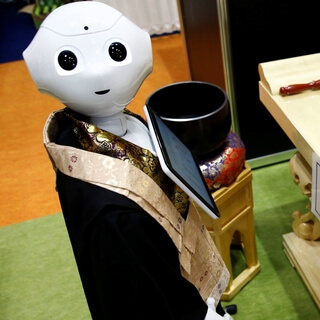
A group of Zen masters ordained Gabi,
A robot.
And the robot took valves to protect life?
To be kind to other robots.
And some form of precepts that seem to have to do with Robot functioning.
You can see a little video of this ordination.
On the web.
And for me,
This was perhaps one of the most horrifying experiences.
This came under the category of what were those real,
Live Zen masters thinking?
The worry is that.
Spiritual well-being,
Love,
Trust,
That these are among the things we hold most sacred and where authenticity is most highly prized.
What happens when we keep blurring the lines?
Between.
What is AI?
What is digital?
And what is human.
Trust is undermined.
And fear.
Abides.
One more.
Example of the challenges of AI,
My little grandson who is now a year old.
Has started.
Alerting and smiling every time anyone takes a picture.
And we thought he was all excited because his picture was being taken and he could relate to the parent who was taking his picture or the grandparent.
It turns out that's not what he was alerting to.
He's come to know already at 12 months,
That those phones that take pictures have these wonderful alluring screens.
He crawls over and tries to grab the screen every time he sees someone taking his picture.
And so again,
We see a kind of potential for grabbing our attention,
Holding our attention,
Hijacking it.
That has the potential to take us away from just this,
From the truth.
Of the terrain,
From the truth of knowing for ourselves whether the water is is warm or cold.
So of course.
We're left not knowing,
And AI has created so much in the realm of uncertainty.
And don't no mind.
Is something that we practice.
Every day.
On the cushion.
We also know from the unfolding of karma that we cannot control the outcomes of our actions.
And so,
As we know,
We cannot control where this new artificial intelligence is going to take us.
What we can do,
What Zen reminds us we need to do.
Is set our intentions,
That even if we can't control the outcomes,
Of what happens as we unleash these new capabilities.
We can set our intentions with the Bodhisattva precepts.
That include refraining from evil.
Doing good.
Relieving suffering.
And so there are miraculous uses.
Better diagnosis of cancer,
Better drug discovery,
Tutors for children who otherwise would have no one to teach them.
There's so many possible ways to relieve suffering.
To do good,
To save all beings.
But other precepts include not taking that which is not freely given,
And in this case meaning not hijacking our attention.
Not intoxicating the mind.
As my young grandson has become intoxicated.
With screens.
And the other teaching.
Of our way.
Is that we need to anticipate impermanence.
Just as we can't control the outcomes,
We can't set something in motion and then assume that it will stay the same.
And so.
Our job is to pay close attention to all the unfolding.
Of artificial intelligence and everything that flows from that.
And be ready to pivot when we can.
To understand how we need to reshape,
Rethink,
Redo.
What we set in motion.
And so our practice has a lot to guide us.
In the ways that we encounter this new.
Technology.
And it takes us back to the reading,
The little reading we did tonight.
From Alexandra Porter.
Where she writes,
It takes three things to practice Zen.
A great question.
Great courage,
And great faith.
What is this?
Who am I?
It's absolutely necessary to go back to these essential questions over and over.
In this way.
We keep,
Don't know,
Mine.
And then we can get let go of our conditioned way of looking at ourselves and the world.
And respond to situations.
In a fresh way.