Welcome to the mindfulness meditation podcast presented by the Rubin Museum of Art.
We are a museum in Chelsea,
New York City that connects visitors to the art and ideas of the Himalayas and serves as a space for reflection and personal transformation.
I'm your host,
Dawn Eshelman.
Every Monday we present a meditation session inspired by a different artwork from the Rubin Museum's collection and led by a prominent meditation teacher from the New York area.
This podcast is a recording of our weekly practice currently held virtually.
In the description for each episode,
You will find information about the theme for that week's session,
Including an image of the related artwork.
Our mindfulness meditation podcast is presented in partnership with Sharon Salzberg and teachers from the New York Insight Meditation Center,
The Interdependence Project,
And Parabola Magazine.
And now,
Please enjoy your practice.
Hello,
Everyone.
Welcome to mindfulness meditation online with the Rubin Museum of Art.
I'm Dawn Eshelman.
So nice to be here with you to host for you today.
We are a museum of Himalayan art and ideas in New York City,
And we're so glad to have you all joining us.
This is our weekly program where we combine art and meditation online.
Inspired by our collection,
We take a look at a work of art and we hear a brief talk from our teacher today,
The fantastic Tracy Cochran with a story for us,
I'm sure.
And then we have a short sit together.
Tracy leads us for 15 or 20 minutes.
Happy Asian American and Pacific Islander Month,
AAPI.
Happy Mother's Day to those of you who have created anything,
Which is all of us.
And we're just so happy to be coming to you here from New York City,
Where it's a beautiful day once again after much rain.
And we're bringing this artwork to you as a way of exploring this theme that we have this month,
Which is harmony.
And that's really coming out of the exhibition currently on view,
Healing Practices through the lens of Tibetan Buddhism and through Tibetan medicine.
Healing and health and well-being is all about balance.
So finding harmony in your body,
In the elements,
In what you're eating,
And all of those things.
So of course,
We love to take that metaphor to different places here in our meditation practice and think about what makes our lives harmonious and what benefit that can bring to our lives.
What can we discover through exploring this theme in our meditation practice or in a conversation around that?
So that's what we'll do today.
So let's take a look at the art that we've chosen for today.
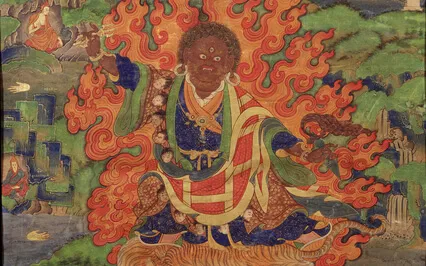
This is Dorje Drölo.
This is one of the eight manifestations of Padmasambhava,
Known as the second Buddha who brought Buddhism to Tibet.
And this was made in the 18th century,
Bhutan or central Tibet.
It's pigments on cloth.
And Dorje Drölo,
Also known as the wrathful Vajra.
And Dorje Drölo is one of the eight different manifestations of the legendary Buddhist master Padmasambhava,
Again,
Revered as the second Buddha in Tibetan Buddhist culture.
And it's believed that Dorje Drölo manifested in this expression to fly to 13 places in the tiger slayer and to subdue and work with and transform and harmonize local deities.
So he bound them by oath to protect the teachings and imprinted his hands and feet in the landscape.
And here you can see feet and hands here,
And we'll see them again in these kind of lower areas of the painting here.
We were just kind of in a close up there.
And this is amidst the images of Padmasambhava meditating in caves and in different locations throughout this narrative painting,
Which really tells a story sort of like,
You know,
Different frames of a comic strip in some ways.
So where he made these imprints and rocks and hid his teachings as treasures or the terma is also depicted here.
And I think that's a really wonderful story.
An element of Padmasambhava's narrative is this idea that he buried these treasures that would be revealed at later dates.
And there are actually two handprints on the left side inscribed as Namstoket,
Which is the place where Padmasambhava is said to have left such marks himself.
So let us bring on our teacher today,
The wonderful Tracy Cochran.
Tracy has been a student and teacher of meditation and spiritual practices for decades.
She's the founder of the Hudson River Sangha,
Which is now virtual and open to all.
The link for her weekly meditations can be found on her website at tracycockran.
Org.
And in addition to teaching at the Rubin,
Tracy has taught mindfulness meditation and mindful writing at the New York Insight Meditation Center and many other places.
She's the writer and editorial director of Parabola,
An acclaimed quarterly magazine that seeks to bring timeless spiritual wisdom to the burning questions of the day.
Her writings,
Podcasts and other details can be found on her website and on parabola.
Org.
Welcome Tracy.
Thank you.
I'm so glad to be here today.
As Dawn was talking,
I was enchanted by the little hands and feet of that beautiful image of that beautiful figure.
And at its most simple and direct,
It's a reminder,
I am here,
I am with you,
This great second Buddha.
And the teachings,
The term of these very teachings also can be felt,
Can be understood by us as reminders that this great ally,
This great presence is with us.
Which brings me to the short story that I would like to tell today,
Very short.
And it's a story about being with what frightens us.
Starting with what's inexplicable or difficult or not easy to control.
So anyway,
Decades ago,
I was assigned,
I'm a writer,
And I was given this juicy assignment to write about ghosts and hauntings.
So the very first one haunting I was sent off to explore was right here in New York City.
And it was in a stately apartment on Washington Square.
One of those storied looking places.
So up I went to the apartment and I met a young woman who was an acclaimed photographer.
And she sat me down at the kitchen table and told me an amazing tale.
That one night,
Just like any other night for her,
She heard a knock at the door.
And she thought nothing of it because they were going to have a dinner party.
She was very happy and excited,
Except when she went to the door,
There was this dark,
Hunched over figure that hurried past her.
Not solid,
She said,
But more like smoke.
If smoke can be cold.
And it huddled over and rushed down the hall and back and then disappeared.
And she was incredibly shaken.
But at the time,
She lived with her older mother and she didn't want to find her.
So she said nothing.
Until a few days later,
She was sitting,
Reading in the living room and looked up to see her mother standing in an archway in the hallway,
Shaking with fear.
And she too had seen this dark,
Huddled over figure walking back and forth quickly in the hall.
And several other people reported the same sighting.
So they called in at the time,
The equivalent of Ghostbusters,
People who were trained to look into this,
Who came in with Geiger counters and infrared photographers and so on,
Trying to find out what this apparition was.
I think was conclusive.
And on her own,
She looked into it.
She looked into the history of the area and discovered that right outside the apartment,
And I remember standing at a window observing this myself,
There was a huge gnarled oak tree.
It was enormous.
And she discovered that in that very tree,
In the 1800s,
A serpent had been hung for stealing.
Can you imagine what a drastic punishment.
But as I went into my investigations,
I discovered from all kinds of psychic researchers that ghosts most often appear where something terrible has happened,
A battle.
There are many,
Many people,
Thousands of people have reported seeing ghosts in Normandy,
For example,
At the site of the landing strip for that great invasion.
But over the years,
What haunted me is that they were more concerned with somehow controlling,
With knowing scientifically,
With pinning down this apparition rather than making space for why,
Why was this haunting taking place?
And it began to occur to me that in my inner life too,
And probably in yours,
There are ghosts.
There are visitors that return to me again and again at the scene of the crime,
So to speak.
There's a person inside me who's still five and remembers being hurt.
It doesn't have to be as drastic,
Of course,
As a hanging or even a major trauma,
Though many of us have those.
But the tiny traumas of rejection,
Of feeling not accepted.
I remember being 18 and feeling not accepted at one point different than my peers.
Too much of a hippie or some such.
A trauma is anything that separates us from the whole of ourselves,
From that sense of presence,
Awareness that we're called to when we practice together here and alone.
But the reason I love this image is because it reminds me,
Reminds us that what really brings us into harmony isn't banishing the parts of us that have been hurt or damaged.
It isn't repressing them or controlling them,
But welcoming them with a kind attention.
You are welcome,
Five-year-old Tracy or 18-year-old Tracy.
All our ghosts are welcome to come into the wholeness of our awareness.
And we begin to discover,
Like that image beautifully portrays,
That real harmony isn't any kind of outrunning the bad or the fierce or the mysterious or the unknown.
It's not freezing in the face of it.
It's not any kind of repression.
It's taking our seed and bringing light to those dark places.
It's becoming whole and not meeting these parts,
These split off parts,
These painful feelings like a judge from on high,
But as in the image,
Just like them.
So I love and wish to leave you before we sit with the idea that our practice is not one of judgment or banishment,
But of taking on a powerful friend,
A best friend,
Who will go with you everywhere and do all the places that scare us and that will remind us again and again that we are not alone.
So let's take our seat to sit together and let your back be as straight as you can comfortably make it and that's so the whole of us can be present,
Body,
Feelings,
Thinking.
Just let the eyes close or lower your gaze,
Closed eyes as best if you can.
Let them notice how it feels to be here today without thinking about it,
Without judging or commenting.
Just notice.
Noticing that there's an awareness inside you that you don't have to strive for,
That you can be with what comes.
Notice that this attention softens you just a bit and if there's tension in the body or pain,
Emotional or physical,
Notice that this attention can go to that,
Can rest there.
And notice that you can bring the attention to the feet on the floor or the hands and the feet or the weight of the body as a whole,
The rhythm of the breath,
Whatever feels natural to you.
And notice that as we do this,
As we bring the attention home to the body,
Presence opens.
The sensation of being here.
And that this presence also includes seeing and being seen by an awareness that's spacious and compassionate and kind.
And notice how it feels to let everything be touched by this presence,
This awareness.
So that even if there's restlessness or worry or sorrow or fatigue,
Notice that it can be touched,
Met by this awareness and that it can open.
Notice how it feels to let yourself be soft,
Just soft,
Not striving for anything.
Not running,
Not clinging,
Just letting yourself soften and open to what's here today.
And notice how it feels to let yourself be soft,
Just not striving for anything.
And notice as we do this,
As we let ourselves just be,
That we open to a light of awareness that's inside and also around us.
As we soften,
We begin to remember that we're more than what happened to us.
A presence that sees with compassion and innate wisdom,
The wisdom of kindness and letting be you.
.
And notice that if you meet some fierce protector,
Some defensiveness,
Some anger,
Some obsessive thinking,
Some old argument,
That you can meet this with gentleness,
With appreciation,
Knowing that this part was protecting you,
Defending you against pain.
And notice that welcoming it into the light of presence can allow it to soften and open.
Notice how it feels to be completely acceptable.
Every part,
Every thought,
Every feeling.
Acceptable and of interest and worthy of care.
And notice how it feels to be completely acceptable.
And notice how it feels to be completely acceptable.
And notice how it feels to be completely acceptable.
And notice how it feels to be completely acceptable.
Notice how it feels to meet worry or fear with kindness,
With acceptance,
With compassionate interest.
And notice how it feels to be completely acceptable.
And notice how it feels to be completely acceptable.
And notice how it feels to open to this presence that accepts the whole of us,
The whole of our experience,
As a compassionate friend.
And notice how it feels to be completely acceptable.
And notice how it feels to be completely acceptable.
Completely acceptable,
Forgivable,
And worthy of love and interest.
Everything that comes up.
And notice how it feels to begin to remember just by softening and coming home to sensation,
To remember that we're not alone,
But accompanied by a presence,
An awareness that sees with love and compassion.
And notice how it feels to be completely acceptable.
And notice that as we're seen,
We come into a new kind of harmony.
As if the parts of ourselves are taking their place,
Body,
Heart,
And mind.
We are welcoming ourselves home.
Into the light of an awareness that sees with compassion and no judgment.
.
.
Thank you,
Tracy.
Thank you.
That concludes this week's practice.
If you'd like to support the Rubin and this meditation series,
We invite you to become a member.
If you're looking for more inspiring content,
Please check out our new podcast,
Awaken,
Hosted by Laurie Anderson.
The 10 part series features personal stories that explore the dynamic path to enlightenment and what it means to wake up.
Now available wherever you listen to podcasts.
Thank you for listening and thank you for practicing with us.