Welcome to the mindfulness meditation podcast presented by the Rubin Museum of Art.
We are a museum in Chelsea,
New York City that connects visitors to the art and ideas of the Himalayas and serves as a space for reflection and personal transformation.
I'm your host,
Dawn Eshelman.
Every Monday we present a meditation session inspired by a different artwork from the Rubin Museum's collection and led by a prominent meditation teacher from the New York area.
This podcast is a recording of our weekly practice currently held virtually.
In the description for each episode,
You will find information about the theme for that week's session,
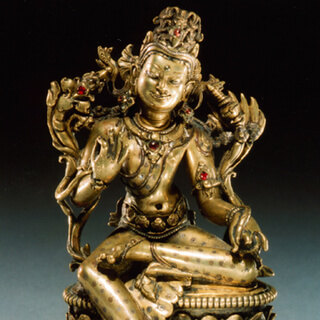
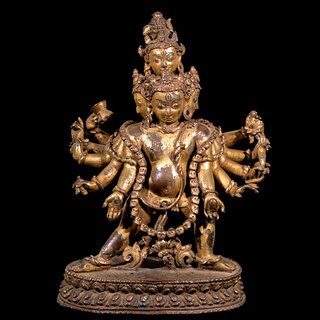
Including an image of the related artwork.
Our mindfulness meditation podcast is presented in partnership with Sharon Salzberg and teachers from the New York Insight Meditation Center,
The Interdependence Project,
And Parabola Magazine.
And now,
Please enjoy your practice.
Good afternoon,
Everybody.
Welcome.
Welcome to the Rubin Museum of Art and to our weekly practice.
My name is Dawn Eshelman,
And it's a pleasure to be here with you just about every Monday where we bring to you this program of practice.
We combine art and meditation online.
So we really are framing our practice,
Utilizing one artwork from our collection each time.
And every month we have a different focus,
A different theme.
This month we've been talking about awareness.
So today for our program,
We will take a look at one work from our collection.
We'll hear a brief talk from our teacher,
Who today is the wonderful Sharon Salzberg.
And then we will have a short sit guided by Sharon,
15 to 20 minutes.
We'll take a look at the beautiful artwork we were looking at just a moment ago.
This is our beautiful shrine room up on our fourth floor.
And for those of you who haven't gotten the chance to visit lately,
We wanted to bring it to you today.
This is,
I think,
One of kind of the aspects of the Reuben that really compels people to come again and again.
It's this remarkable environment,
The shrine room,
That is really a facsimile of a shrine room,
But beautiful and meaningful to many who visit.
Since it first opened,
The Tibetan Buddhist Shrine Room has been one of the most popular installations and it's a very immersive experience.
This particular installation reflects the Kagyu tradition.
And I think what I really wanted to bring your attention to here with the shrine room is just imagining the sensory experience of what it might mean to be here.
Imagine the kind of sensory experiences.
So if you were to come into this space or a shrine room,
You would have the scent of incense.
You might smell a butter lamp,
A strong smell of a butter lamp.
You might imagine what it would feel like to touch some of these different surfaces.
The smooth wood,
The embroidered fabric,
The cool metal of some of the offering cups and musical instruments.
You might imagine the sound that those musical instruments would make,
The symbols.
You would hear chanting in this case if you were to visit us.
And you would see,
Of course,
This beautiful,
Rich ensemble of colors and the dim light and a variety of detail of objects to take in here from sculpture to painting to ritual object.
So I'm bringing that to your attention because,
Of course,
I want to cultivate your senses.
That is one tool used to create awareness and presence.
And the shrine room itself is meant to do that.
It's meant to enhance a practitioner's awareness towards their presence,
Towards their senses,
Awareness of their mind,
Body,
Emotions,
And surroundings.
So I hope that you'll take that quality of awareness into your practice today.
So we have with us,
As I mentioned,
The fabulous Sharon Salzberg,
Who's the co-founder of the Insight Meditation Society in Barre,
Massachusetts,
And who has guided meditations and retreats all over the world for many years.
Her most recent book is called Real Change,
Mindfulness to Heal Ourselves in the World.
She has many,
Many other very useful,
Practical,
Funny books.
And it's wonderful to call Sharon,
Important friend of the Reuben who's been on many of our onstage conversations.
And you can find out about the many,
Many things that she's up to these days at SharonSalzberg.
Org.
Thank you,
Sharon.
Thank you so much.
It's actually SharonSalzberg.
Com,
By the way.
I don't know.
It would be interesting to type in SharonSalzberg.
Org and see where it takes you.
It might take you somewhere else altogether.
So hi,
Everybody.
I'm really delighted to be with you all.
And I'm really delighted to have a moment in that shrine room,
Which is one of my favorite places in New York City.
So whenever I'm doing or preparing one of these sessions,
I sit with the topic for a while and see what comes up for me.
And in this particular occasion,
I got to sit mentally in the shrine room,
Which was very beautiful.
And clearly it's an environment that is designed to help enhance awareness.
And so it's awareness in a certain way.
It's a certain kind of awareness.
It's not as we've talked about before.
It's not just knowing something's going on that you have painful emotion arising or,
Or you're hearing a certain kind of unpleasant sound or whatever,
But it's knowing with some spaciousness,
Some balance,
Some presence,
Some kindness.
And that's the whole realm that we cultivate in something like meditation,
Not to have only certain things come up,
Like only serenity or peace or delight,
But to be able to bring a quality of awareness to anything that comes up pleasant,
Painful,
Or neutral.
And that's what frees us because of course we try to exert some influence on what our experience is.
Maybe we purposefully go to the shrine room and spend an afternoon there and we don't go to someplace we find jarring,
Horrible,
You know,
Terrible.
If we can possibly avoid it.
That's that's absolutely true.
So while we might influence or affect certain conditions and we do try,
Ultimately we don't have a kind of absolute control.
You can't insist like only beautiful memories will come up in your mind,
Or,
Um,
You won't have any aches and pains forevermore,
Or you'll never feel frightened again or something like that.
And so our real superpower is in terms of how we are with what our experience is,
Because that will make all the difference.
So with what I thought of talking about today,
And then we can practice together is one particular formulation of the kinds of awareness,
The quality of awareness that we generally call mindfulness,
But this is an acronym that many of my colleagues use and it's called RAIN R A I N.
And it's been interesting through the years to see how the letters themselves have started to stand for somewhat different things,
Because there are lots of options.
There are lots of alternatives,
But basically it is an expression of what we are doing when we are shifting kind of into mindfulness mode.
When we're looking at an emotion,
We're looking at a thought pattern,
We're looking at sensations in our body.
We're listening to sounds,
We're seeing an image,
Whatever it might be that our experience is,
We're practicing looking in a certain way and the,
How we are trying to look is encapsulated in that acronym and RAIN.
So the first letter is R and that is to recognize.
There's joy,
There's sorrow,
There's hearing,
There's seeing whatever term,
If you're going to use a term would somehow express,
Oh,
This is what's happening right now.
This is the truth of the present moment.
And this of course is a journey for us as we uncover more nuance and more subtlety.
And maybe we realize I'm not so full of desire.
Really I'm lonely.
If I look at the desire,
What pops up is the sense of loneliness.
Really I'm not angry at that person.
I'm more hurt,
Something like that.
We recognize what is happening and this isn't a forced position.
You know,
Where you're trying to like dig deep and make yourself uncover something,
But just by hanging out with what is actually happening,
We begin to recognize these two different shades of conditions that are really a part of it as well.
So R is for recognize.
A is sometimes described as accepts,
Sometimes as acknowledge.
I tend to use acknowledge because accept is kind of a loaded word for some people.
You know,
Sometimes it might imply,
Which it's really not meant to,
But it might imply,
This is cool.
I don't care.
You know?
And it's much more a quality of,
You know,
Not trying to deny what's going on and not pushing it away and not trying to cover it over or disguise it by calling it something a little more socially acceptable or palatable or acceptable to us or our families or whatever.
But just like saying again,
It's like,
Okay,
This is what's happening right now.
And it's the,
Okay.
Okay.
That is really important so that we can begin to discover if we're fighting our experience,
There's not a true sense of exploration or discovery.
It's just not possible.
So we have R we have A the I you could say,
Uh,
Stands for investigate.
It really is a quality of interest.
Investigate might seem a little too analytical because it's not meant to be probing like why in the world am I feeling what I'm feeling or where this come from,
But it's taking an interest in our experience instead of feeling I shouldn't feel this.
I'm like the worst person in the world,
Or this is the only thing I'll ever feel.
I'm so angry.
I'm such an angry person and I always will be.
It's taking an interest.
What is this feeling?
What is this?
What do I feel in my body?
If I hang out with the feeling,
Just looking at it,
What else does come up?
So we have our AI and then the end has probably gone through more changes than any other letter.
Um,
It started out as people were using it as a teaching tool,
Really to be non identifying.
And so,
Uh,
That last thing I just said,
I'm such an angry person and I always will be as a big identification.
This is the real me.
This is permanent.
This is always here lurking somewhere.
This is who I really am.
That's all identification.
And so what we want to do is see what in truth is our experience is that all of these feelings and thoughts and sensations and images,
They come and they go however intense they are.
And they may be quite intense when they're there.
Nothing is permanent.
It's always shifting and changing and moving.
And over time,
The N has actually these days,
The most common interpretation of the N is nurturing.
And that means having a sense of kindness and compassion to yourself,
No matter what.
So it wouldn't be uncommon,
For example,
For somebody to be meditating and a kind of resentment to come up about a long ago thing,
You thought you let go of a long time ago and guess what surprise here it is again,
Can we recognize that?
Can we honor what we're feeling and pay attention to it and also be kind to ourselves in the face of it or in the story I often tell about myself as a young,
Young meditator.
And so I was 18 when I went to India and my first teacher was a S.
N.
Goenka,
You know,
Having marched up to him one day and looking him in the eye and saying,
I never used to be an angry person before I started meditating,
Thereby laying blame exactly where I felt it belonged,
Which was clearly on him.
It was,
It was totally his fault.
So of course he laughed and,
And of course I had been hugely angry,
But I hadn't really seen it.
And I was not kind to myself in the face of it.
I was very distressed.
That took a real maturing process to understand that that's crucial,
That no matter what we're seeing or sensing or feeling,
The bottom line is this sense of caring,
Compassion for ourselves.
And so we bring that forth,
Whatever we're encountering.
We recognize,
We acknowledge,
We take an interest in,
And we nurture ourselves,
Whatever our experience is.
And so one way we put this into practice is we start out as,
As we will,
By establishing some base,
Some foundation of concentration,
Just having a way of resting our attention,
Collecting our energy,
Gathering our energy,
Coming into the moment that may be settling your attention on the feeling of the breath,
For example,
And then lots of little things will come up.
It doesn't matter.
You can pretty well just stay connected to the feeling of the breath.
And then something comes up with a bang,
Intense emotion,
Pleasant,
Wonderful,
Or painful.
Be with that emotion in that rain kind of way,
As best you can recognize,
Acknowledge,
Take an interest in it.
What is this?
And be kind to yourself.
Nonetheless,
It's not a distraction.
It's not the wrong thing to do.
You don't have to like hurry your attention back to the feeling of the breath,
Stay with it.
As long as you feel you can be observing it in this way,
And then see if you can let go and come back to the feeling of the breath,
Assuming the breath is your,
Your primary object or home base.
We have no control ultimately on what will arise.
It may be glorious and beautiful and it may be kind of boring,
Uh,
Prosaic,
And it may be difficult.
That's all right.
Because how we are looking is really the whole point.
And it may be times in the sitting where really you're just gone.
You have no idea what you're thinking or feeling.
You're just some other place really lost in thought or spun out in a fantasy or you've fallen asleep.
That's the moment where we practice what we have talked about so many times before we practice letting go and we practice beginning again,
Just bringing your attention back to the feeling of the breath.
So let's sit together.
See if you can sit comfortably,
Close your eyes or not.
Start by listening to sound,
Whether it's the sound of my voice or other sounds.
It's a way of relaxing deep inside,
Allowing our experience to come and go.
Of course we like certain sounds and we don't like others,
But see if you can just have the sound wash through you.
And bring your attention to the feeling of your body sitting,
Whatever sensations you discover.
Again,
See if you can feel the earth supporting you.
And feel space touching you.
Bring your attention to your hands and see if you can move from the more conceptual level like a fingers to the world of direct sensation,
Picking up,
Pulsing,
Throbbing pressure,
Whatever it might be.
You don't have to name these things,
But feel them.
And bring your attention to the feeling of your breath,
Just the normal,
Natural breath.
You don't have to try to make it deeper or different.
Wherever you feel the breath most distinctly,
At the nostrils,
At the chest or the abdomen,
Find that place,
Bring your attention there and just rest.
See if you can feel one breath.
And if images or sensations or sounds,
Emotions should arise,
Just let them be.
And if you can feel the breath,
Just let them flow on by you breathing just one breath.
And if you can feel the breath,
Just let them flow on by you breathing just one breath.
But if something comes up and it is strong,
It pulls you away,
Take a look at it for a few moments.
See if you can utilize that sense of RAIN.
Recognize this is what's happening right now.
Acknowledge it,
Accept it,
Taking interest in it.
What is this?
What does it feel like?
And nurture yourself.
Then see if you can let go,
Bring your attention back to the feeling of the breath.
If you find you're really just gone,
Completely lost,
You fall asleep,
That's the moment to try to practice letting go and beginning again.
It's okay.
Just bring your attention back to the feeling of the breath.
Let's all just let it settle.
You you you you you you you you you you you you you