Welcome to the Mindfulness Meditation Podcast.
I'm your host,
Dawn Eshelman.
Every Wednesday at the Rubin Museum of Art in Chelsea,
We present a meditation session led by a prominent meditation teacher from the New York area.
This podcast is a recording of our weekly practice.
If you would like to join us in person,
Please visit our website at rubinmuseum.
Org slash meditation.
We are proud to be partnering with Sharon Salzberg and teachers from the New York Insight Meditation Center.
The series is supported in part by the Hamera Foundation.
In the description for each episode,
You will find information about the theme for that week's session,
Including an image of a related artwork chosen from the Rubin Museum's permanent collection.
And now,
Please enjoy your practice.
Hi,
Everybody.
Welcome to the Rubin Museum of Art and to our weekly mindfulness meditation practice.
My name is Dawn Eshelman.
Happy to see you all,
Have you all here.
And as is our practice,
We select a theme to explore every month and then artwork from our collection or from exhibitions that we have going on upstairs to kind of illustrate that theme.
So different ways in to talking about a theme.
Last month,
We were talking about story.
We were inspired by this,
The importance of story and narrative histories in Tibetan Buddhist art,
Specifically the second Buddha,
Great storyteller Padmasambhava,
Who actually planted some of his teachings in the future to be revealed to specific people at specific times when they needed them,
Often in the form of story.
So we also talked about that quality of story in our own lives that can be really useful to help us kind of retell stories as they change over time as we change story as something that connects us with one another.
And then also this idea that sometimes we can cling too tightly to a version of a story and that that's what sometimes how that word stories is used within the context of meditation.
Right?
Like maybe you've heard that phrase,
Drop the story,
Right?
So different ideas of this concept of story.
The reason I'm talking about this so much is because there's this interesting relationship between last month's theme of story and this month's,
Which is emptiness,
Emptiness,
Which is this core concept of Tibetan Buddhism and which is really connected to that idea of story being fluid,
Not fixed.
So something that we can have a relationship with,
But also allow it to change.
And that is an element of this idea of emptiness.
It's not that through emptiness,
You know,
Nothing exists and there's no there there.
It's more about our relationship to change and being willing to see things as unfixed,
As shifting and emptiness as that quality of fluidity.
So all year long here,
We're talking about this idea of the future and the future being fluid.
And there is a quality of emptiness that's required to kind of have a relationship with the future in that way.
This brings us to this artwork today.
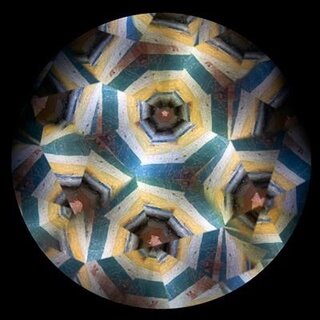
So it's rare that we get to look at contemporary photograph here together.
And this is from the Autolith Group,
The exhibition,
A Lost Future up on the fifth floor.
And this is kind of our most recent exhibition.
So a little reminder for all of us there to turn off our cell phones.
Thank you.
And the Autolith Group has a series of photographs in which they overlay on pictures of this university campus that is particular to them and their practice,
Images from the present and the past,
Kind of suggesting as this one here does that a reality is not fixed,
That our relationship to time is very fluid.
And just reminding us to keep an openness about our approach to life.
So I'm just going to talk a little bit about what we're seeing because I think it might be a little bit challenging here.
But if you,
I recommend you take a look at this series in particular in relationship to this idea of emptiness.
So we're seeing this courtyard in present day and then imposed upon it is a kind of green overlay,
Right,
From the past,
A past photograph of a doorway and a woman kind of seated in that doorway there.
So there's a lot of symbolism to unpack here in details of this actual physical place that are relevant here.
And if you're interested in doing that,
You can take the tour with Jeremy right afterwards.
He'll be in the lobby afterwards and we'll take you up to the fifth floor and you can talk a little bit more about it.
Tracy Cochran is back with us today and will be talking with us a little bit about this photograph and emptiness.
And she is the editorial director of the quarterly magazine parabola,
Which can be found online at parabola.
Org.
And of course,
Upstairs in our shop,
She's been a student of meditation and other spiritual practices for decades.
And in addition to teaching here at the Rubin,
Which she does in our regular Wednesday series,
But she's also going to have an upcoming little Saturday retreat here,
Which we'll tell you about in just a moment.
But she teaches as well in Hudson and in Tarrytown at the Hudson River Sangha.
And you can find her online at parabola.
Org at tracycochran.
Org.
And on Facebook and Twitter,
Please welcome her back.
Tracy Cochran.
I'm delighted to be back and sitting under this tree.
And I was listening to people as they came in and more than one person was like,
Oh,
A tree.
That's so nice.
It feels so cooling,
Doesn't it?
To be here under this tree.
And I was wondering,
I've been thinking about being very young and climbing a tree.
And I'm wondering if anyone here has ever had the experience of either climbing a tree or lying under a tree,
Looking up through the branches,
I see a few nodding heads.
And I have such a vivid memory of being a little girl climbing a tree in my backyard.
And I had this fantasy of being a jungle princess.
And obviously,
In decades of past and I can own the fact that I was probably influenced by the Disney version of the jungle book,
You know,
And without elaborating that too much.
At the heart of that sense was the sense that I was more than my parents knew I was.
Did you ever have that sense that you had an acuity and a sensitivity and a possibility that they didn't know about?
And I also had an invisible black panther concert they didn't know about,
You know,
And I could teleport.
And they didn't know about that either.
And I would be sent because I was a child of the Cold War,
I would be sent to hot spots like Berlin and with my panther,
You know,
To help deal with things,
Which I would do.
And it's interesting to realize after all these years of past,
There was something very true about my sense that there is a word meta that we use a lot in this practice,
M-E-T-T-A,
But there is a Western word,
Meta,
Which comes from a Greek root that means beyond.
There is something in us that's beyond our little borders.
And it's not something necessarily metaphysical,
It's something that's right in the body.
That right now as we relax in this softly lit,
Cool space together,
You can begin to experience that your borders are more porous than you sometimes think.
You can feel the cool in the room and you can feel the presence of other people and the presence maybe even of our collective intention to sit down together.
So the body is a kind of mind that is giving you this nourishment and this information.
And I was looking into trees because I was so excited to have a tree as my companion illustration today.
And I was reminded again that trees only look separate.
They're actually parts of communities,
Vast,
Intricate communities.
And one professor in particular at the University of British Columbia has elaborated how their root systems don't just go for miles,
But they interact with this fungi.
That's how she pronounced it,
So I'm sticking to it.
Fungi.
That underground,
These intricate collaborations,
These networks of exchange where the trees nourish each other really and they give carbon,
They give sugar to this fungi and fungi gives nitrogen back.
So they're not separate.
They work together to survive.
It's not survival of the fittest.
And it's not all sweetness and light.
There are sometimes there are villains,
There are orchids and black walnut trees.
They're sort of like the evil Disney queens of the forest who will take resources from other trees.
You know,
There are people like that too.
Yeah.
And black walnut trees will sometimes send out poisonous messages.
Don't you hate when that happens?
But basically,
Basically the forest works together.
And it gave me a fresh appreciation of this word emptiness.
I prefer the word fullness.
And I also like fluidity,
Of course,
This idea that we're not as small and alone as we think.
And we don't have to feel that in rare moments.
We can feel that right now,
Sitting together,
Feeling the responsiveness of the body to the coolness,
To the relaxing light,
To the safety here.
We know we can be still here and breathe.
And our body is telling us this.
And going back to trees for a moment,
Something else that was incredibly heartening is apparently they have trees that they very fondly call mother trees.
They're these great big old trees that nourish all the other trees.
No matter what the species is,
They send out the roots so that even when they die,
Right up until they collapse,
They're sending out nourishment,
Information,
Material.
I was so heartened,
I watched this little video three times and I was full of the sense that I could be a mother tree.
I mean,
If we begin to soften our gaze and realize the truth,
Which is that we are porous,
We are open to each other,
We influence each other,
We support each other,
You can be reminded of that when you leave here and look at those trees in New York.
They're not alone.
Even the ones that look like they're standing like soldiers,
They're not alone.
They're connected to each other and they're communicating.
And so are we.
And we can begin to soften and open and realize that our impact on one another doesn't stop with our skin or how we're looking or feeling or sounding on that particular day.
That we can impact each other without even knowing it,
Just our presence.
And long after we're gone.
And I have to add this,
I didn't expect to but I really must.
One of our great American bodhisattvas,
Mr.
Rogers,
Who has sweetened so many of our lives and continues to.
I looked at a little video clip where he invited a graduating class at Dartmouth College to let themselves be still and remember everyone who may have helped them get there.
And it dawned on me watching this that we can do that even before we shut our eyes,
Realizing all the people that have helped us get to this room to be here today.
To be willing to be open,
To be able.
And all the people who have sweetened our lives and encouraged us,
Maybe just with their presence or a smile.
Maybe some of them you came with today and maybe some of them are far away,
Far away.
But realizing that you're part of a network of beings,
Including the Buddha,
Including Mr.
Rogers,
Including trees you have known and loved.
That our borders are open.
They really are.
And that this is a way to understand what it means to be empty.
It means to be full,
To be full of life,
To have nutrients coming in and to have impressions and gifts that you can send out.
So we'll start practicing on that spirit.
So we take a comfortable seat with our back straight,
Our feet planted firmly on the floor.
And just notice how it feels to be here in this body,
The way you find it today.
Without thinking about it,
Just notice how it feels to be under a gaze that doesn't judge.
Feeling that we begin to relax when we bring the attention home to the body.
And as this begins to happen,
Allowing the attention to come particularly to the breathing.
Without changing it,
Just notice the experience of breathing.
And all kinds of other impressions will be happening.
Sensation,
Thinking,
Memory,
Sound.
And allow everything to be exactly as it is without judgment,
With kindness.
And when you find yourself taken,
Bring the attention home to the breathing and the experience of being present now in a body.
Sati,
The word for mindfulness,
Means to relax.
To remember,
To remember to come home to the present moment.
To the experience of being in a body breathing.
No matter what is arising,
Notice how it feels to be completely accepted in the gaze of an attention that isn't thinking,
That's present.
And as this begins to happen,
Just notice how it feels to be in a body.
And all kinds of other impressions will be happening.
And all kinds of other impressions will be happening.
And all kinds of other impressions will be happening.
And all kinds of other impressions will be happening.
If you find yourself dreaming or worrying or thinking,
Notice how it feels to notice without judgment,
With kindness,
And to come home to the body and the breath.
And all kinds of other impressions will be happening.
And all kinds of other impressions will be happening.
And all kinds of other impressions will be happening.
And all kinds of other impressions will be happening.
As we make this movement home,
We may notice that we open,
We settle down,
And we also open,
Opening to a presence that isn't thinking,
That we share.
And all kinds of other impressions will be happening.
And all kinds of other impressions will be happening.
Noticing that we can start again at any breath.
Opening to a vibrancy,
A presence that's always here.
And all kinds of other impressions will be happening.
And all kinds of other impressions will be happening.
And all kinds of other impressions will be happening.
And all kinds of other impressions will be happening.
And all kinds of other impressions will be happening.
Noticing how attention softens us so that we can feel a larger field of awareness.
An awareness that's inside and outside.
And all kinds of other impressions will be happening.
And all kinds of other impressions will be happening.
And all kinds of other impressions will be happening.
And all kinds of other impressions will be happening.
And all kinds of other impressions will be happening.
Noticing that there is a life and a light in us that doesn't stop.
That doesn't stop with our borders.
That opens to receive.
And all kinds of other impressions will be happening.
And all kinds of other impressions will be happening.
As we come to close,
Noticing that there is a stillness that's very alive.
That we share.
Thank you.
Thank you.