Welcome to the Mindfulness Meditation Podcast.
I'm your host,
Dawn Eshelman.
Every Wednesday at the Rubin Museum of Art in Chelsea,
We present a meditation session led by a prominent meditation teacher from the New York area.
This podcast is a recording of our weekly practice.
If you would like to join us in person,
Please visit our website at rubinmuseum.
Org slash meditation.
We are proud to be partnering with Sharon Salzberg and teachers from the New York Insight Meditation Center.
The series is supported in part by the Hamera Foundation.
In the description for each episode,
You will find information about the theme for that week's session,
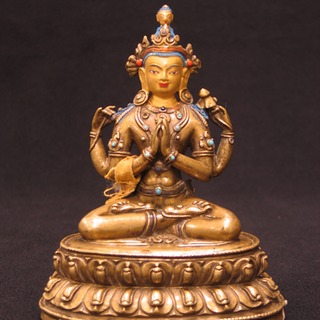
Including an image of a related artwork chosen from the Rubin Museum's permanent collection.
And now,
Please enjoy your practice.
Good afternoon,
Everybody.
Welcome to the Rubin Museum of Art and to our weekly mindfulness meditation practice.
My name is Dawn Eshelman.
Great to have you all here.
Each month,
We select a theme to explore.
And the theme we've selected for this month is refuge,
Seeking refuge.
And,
You know,
Often here at the Rubin Museum,
We have people coming through our doors for all kinds of reasons and with all kinds of motivations.
One of them is often seeking refuge.
And many of those folks will find themselves wandering the galleries and coming upon our Shrine Room and taking a seat there and enjoying the refuge that it offers.
So this month,
All of the objects that we'll be looking at come from the Shrine Room.
And after each meditation session,
You will be invited upstairs on a gallery tour of whatever object we're looking at.
And you'll end up in the Shrine Room every,
Every week.
So I hope you enjoy that.
This week,
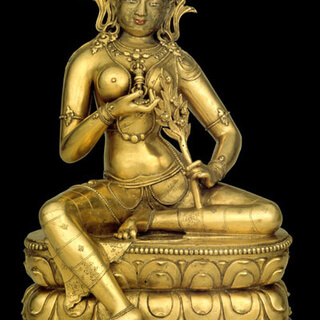
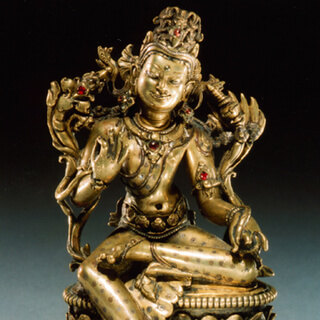
We are looking at Tara.
And she is a goddess that is perhaps familiar to you if you have some experience with Himalayan and Tibetan Buddhism.
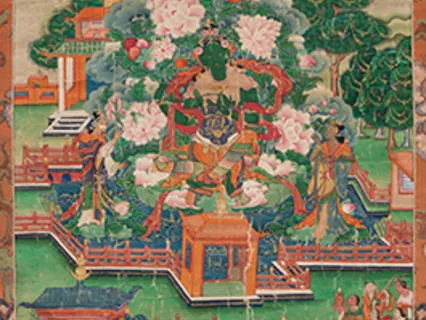
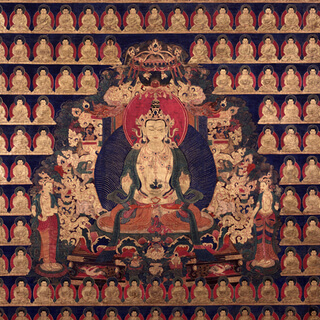
And in this image here,
We have Tara as a central figure.
And she is sitting on kind of surrounded by a throne of lotus blossoms.
Tara is often depicted with a foot,
One of her feet angled outwards so that she can immediately jump up and help.
She is known as a compassionate figure and one that practitioners turn to,
To seek refuge,
To seek help and support,
And is known to offer it in many ways.
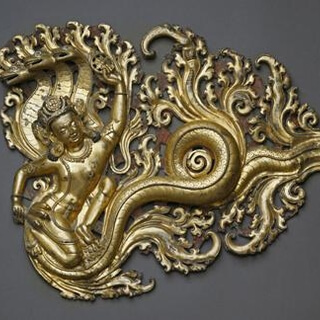
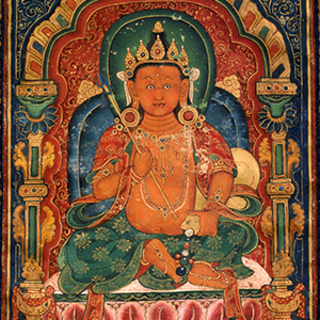
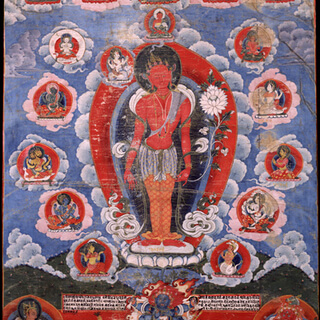
These are two different paintings that are featured in the Shrine Room.
They actually come from a set of,
I believe,
Nine paintings that depict Tara in her many different actions.
And Tara is known for offering refuge for travelers that are on their,
On their journey,
And also for helping people face the eight great fears.
And the eight great fears,
I've got them here in a list in case you're curious.
Drowning,
Thieves,
Lions,
Snakes,
Fire,
Spirits,
And flesh eating demons,
Captivity or imprisonment,
And elephants.
And of course,
You know,
These are real fears.
They all are also symbolic.
So I'm going to read those to you as well.
And the one that is pictured here that Tara is helping to protect someone against is the fear of drowning.
And that symbolizes craving.
So that craving or clinging action.
And what I think is so interesting is that the language here is telling us that Tara helps protect you from your fear of something,
Not the thing itself,
But your own fear of it.
So it's actually very empowering helping you release your fear and face something.
So drowning is respectively craving.
And then we have thieves that represent wrong or false views.
Lions,
Pride,
Snakes,
Envy,
Fire,
Hatred,
Flesh eating demons,
Doubt.
That's an interesting term.
Captivity or imprisonment.
And then elephants,
Which is ignorance.
So interesting just to think about that and also that that action of Tara to help you really defeat your own fear and encounter your own fear and to come to terms with it.
So we'll hear a little bit more about this idea of refuge from our teacher today,
Tracy Cochran,
Who's back with us.
Always great to have you,
Tracy.
And before I introduce Tracy to you,
I also just would want to make sure you all know about a special workshop that Tracy is going to be offering here in January.
And that's something that we do because you all have really asked for that.
And this will be a writing and meditation workshop.
You don't have to have any experience as a writer or,
You know,
You know,
Have come to come to it with any experience.
Everyone is welcome.
That's what I'm trying to say.
And and I'll let Tracy,
I'd love it,
Tracy,
If you will talk a little bit about more specifically what people can expect.
Tracy Cochran is a writer and editorial director of the quarterly magazine Parabola,
Which can be found in our shop,
Of course,
And online at parabola.
Org.
She has been a student of meditation and other spiritual practices for decades.
And in addition to teaching here at the Rubin,
She teaches as part of the Hudson River Sangha,
The Terrytown Insight in Terrytown,
New York.
And you can find more about her and Parabola on Facebook,
Twitter and Tracy Cochran dot org.
Please welcome her back,
Tracy Cochran.
Well,
I'm I'm delighted to be back.
And for those of you who haven't been here before,
There's something very special that happens in this space,
Which is that we all participate in it somehow.
I feel very strongly sitting up here that it's not just me.
It's us together.
And in a certain way,
What's so wonderful about this inspiration is that it restores these artworks,
These objects to their original purpose,
Which is that you would come into a space,
A temple originally meant an empty space,
A space like this with nothing to do except remember to let the object let you remember who you most deeply are.
So this is an image of Tara helping people in the midst of a storm.
That's the way I experienced it.
And I thought of it originally I was attracted to it because a couple of weeks ago,
I was first in Key West,
And then I sailed into Havana Harbor.
And both of those places have endured hurricanes and damage.
So I was reflecting on what helps us what gives us shelter in the storm.
What can we trust no matter what happens,
Whether it's an external storm,
Like the hurricanes that swept through the Caribbean and across the keys,
Or whether it's an internal storm,
Or whether it's the storm of life.
And I talked to people even today,
Even when I came in who feel overwhelmed by the way things are.
And especially at this season,
Do you find that?
Yeah,
I'm getting a lot of nodding heads.
It's like,
Not ho ho ho now for me.
It's it's a season that can make us feel particularly isolated.
It can make people feel particularly lonely.
And apart from the merriment that they are supposed to be having or other people in advertisements are having,
Or or that they once had,
You can have an acute sense of time passing.
And it's cold today.
It's cold and gray.
Finally,
It's cold.
Tomorrow could be 84 again.
So we don't know.
But there's something in us that naturally contracts often and pulls back.
So being a Dharma teacher,
I couldn't help but think of that great Dharma story involving a figure called Ebenezer Scrooge.
And Scrooge,
I looked into it in my Dharma version,
Was described first and foremost as grasping,
Contracted,
Squeezing,
And solitary as an oyster,
Which rings true for me.
I never quite bought into this happy as a clam business,
You know,
How could a clam be happy?
He was,
Scrooge was completely isolated and alone on Christmas Eve.
And he went home and he had some horrible thin gruel.
Have you ever made dinner for yourself when you're in a really bad mood?
It was like kind of gruel.
And he had plus he had a cold.
He had a bad cold.
And he was all by himself.
And he was completely contracted and had this horrible dinner.
Can you relate?
And then he went to bed and he heard this horrible sound clanking,
Chains dragging,
And moaning sound.
And he tried to tell himself it was an adjudction from this horrible dinner he had.
But he got up and he saw a ghost.
I know this is kind of a theme with me,
But it's a ghost of his former business partner,
Marley,
Wrapped in chains.
And he kept trying to tell himself it was just a nightmare.
But Marley said,
Listen to me,
Scrooge,
Listen to me.
And Scrooge said,
But you're wrapped in why are you fettered?
That's the language from Dickens.
You are a fettered.
Tell me why.
And Marley said,
I wear the chains I forged in life.
And the chains were made of cash boxes and ledgers and all the tools of their their money trade.
Today it would be the keys to offshore accounts,
You know,
Or secret dealings with the Russians and all kinds of fetters that we pick up.
And Marley's going,
Scrooge,
You have to remember you're more than what you did in our money-grubbing little hole.
He describes it as a hole.
And Scrooge is like,
I don't understand.
You were an excellent man of business.
And Marley said,
Business.
And he had this horrible moaning voice,
Business,
Humanity was my real business.
Being alive,
Caring for the earth and for life,
That was my real business.
And Scrooge isn't quite buying it.
And Marley is saying,
Scrooge,
Basically he's saying,
Remember,
Remember you're more than you think you are.
And even when we come into this room,
All of us,
On any individual day,
Just to get here,
We have an identity.
We cling to this idea of who we think we are and who we think we aren't.
And what we think is possible for us and what is no longer possible for us.
And what we're invited to do when we sit together here is to do nothing in particular.
There's nothing that you have to do or gain or learn.
You have to engage in something that I think of as a kind of thawing out so that you begin to remember that there's a body sitting here,
Breathing.
There's a heart beating inside the body.
There's a way of listening and receiving and responding that's here all by itself.
So Scrooge,
I'm sorry to say,
Didn't immediately grasp this.
Marley took him over to the window before he left and showed him all these ghosts flying through the air,
Wrapped in chains,
The chains of who they thought they were.
And they were suffering and they were crying because it was too late for them,
Because they didn't have bodies and hearts and ability to come back to the breath and be present.
Just be present.
So Marley said,
Remember what I showed you.
And Scrooge didn't get it.
So he was visited by three spirits who showed him the past.
And the past was as simple as remembering what it's like to sit in the body and breathe.
And feel okay.
You remember what that felt like when you were a little kid?
Just for a moment.
And showed him his future if he kept forgetting,
Which was lonely.
And then showed him the present when he was shown what he could do right then.
And he woke up on Christmas morning and he started giving,
Giving,
Giving and rushed off to dinner with Tiny Tim.
And so I just want to say that it might sound like just a story,
Even though it's a classic story.
But the important thing to remember is what,
When you think,
What do I have to give?
What is this generosity that I can give?
It's the generosity of allowing yourself to sit here right now,
Softening up,
Letting go of your worries,
Letting go of who you think you are.
Because it turns out that a bodhisattva like Tara,
Her generosity is not just in some fixed notion,
It's in her ability to let go and be with whatever's arising.
Let go,
Let go.
Just abandon who you think you are in a certain way and come back to the breath.
Come back to the breath and the beauty of this moment.
So this might sound again like just a story,
But making a seemingly wild segue.
I was just in Havana in Cuba a couple of weeks ago and Havana's been through a lot,
Not just a hurricane but new trade embargoes,
The collapse of subsidies they once got from the Soviet Union.
Things are physically difficult.
So that even my tour guides,
Nobody has running water all day long,
Nobody.
But in the midst of this I was taken to this little neighborhood called Fusterlandia.
It used to be a village and now it's part of Havana.
And there was a great artist,
Folk artist named Fuster,
And forgive me if I'm mispronouncing it.
And he had a little wooden house and not much else.
No money,
No prospects,
No running water all day long.
Probably some excellent rum and a few superb cigars,
But that was about it.
So he started making this beautiful mosaic art and he covered his house.
And then he asked his neighbors if he could cover their houses with art.
Yes,
Yes,
Yes.
Now it's 80 houses.
It's a whole village.
It includes this wild,
Free,
Beautiful art.
Like there is one house completely dedicated to Princess Diana.
Why?
Who knows?
And it had this big,
Beautiful rooster on it.
Why?
I don't know.
But just to be in this neighborhood,
Remind you that beauty can happen with the next breath,
The next little piece of glass that you find from a Coke bottle or something.
What there is to do is what's present.
To be present is beautiful no matter what.
So we'll take our seats.
I have to stop myself or I'll go on and on.
We take our seats.
Don't take my word for it.
And the only requirement is that you be comfortable so your feet are firmly on the floor and your back is straight and your body is easy.
And you allow your eyes to close.
Some people are uncomfortable with closed eyes in which case you can avert them.
But it's best to close them.
And notice how the body feels.
Just take in a simple impression of how it feels right now.
And allow it to be exactly as it is.
You might have pain.
You might be cold.
You might have tension.
So you aren't going to direct it or prod it.
You're going to give this body a feeling of welcome,
Of kind attention.
You're welcome to be you exactly like this.
Noticing how the attention itself begins to relax us a little bit.
And as we notice this we allow the attention to come to the breathing without seeking to change it in any way.
We just notice the in-breath and the out-breath.
And the experience of sitting here in this body.
And immediately we'll notice thinking,
Sensation,
Images of all kinds can pop into your head.
And we notice this with no judgment.
No comment.
Even about our judgments and our comments.
And when we notice we're being taken away we gently bring the attention home again to the breathing and the sensation of sitting here in this body.
Sati,
The ancient Pali word for mindfulness,
Literally means to remember.
To remember the experience of the present moment of this body breathing.