Today is 20th of May.
We are here with the second session of Mindful May that is focused on connecting with your body.
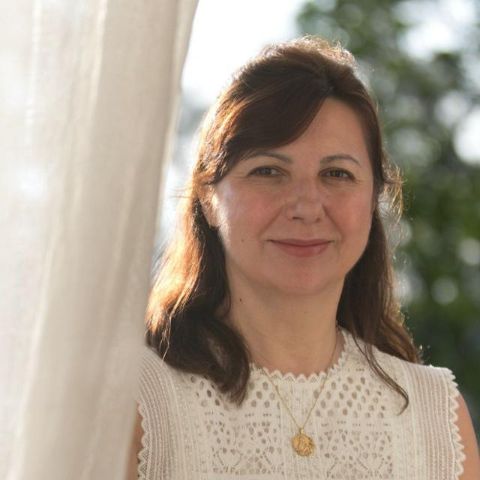
My name is Maggie and I'm a certified mindfulness meditation teacher.
And I will be offering,
Starting from this month,
Guided meditations every every month and possibly every week.
I mean,
That at least is our ideal.
I'm also very pleased to have launched my own mindfulness platform called One Kind Voice.
And this marks a special moment because May is considered the Mental Health Awareness Month.
One kind voice platform hopefully will become a space where we can meet on a weekly basis and a space that can support you with whatever you need most.
We aim to create a space that's inclusive,
Promotes kindness,
A space where we can approach mindfulness and meditation with a beginner's mind and also with compassion and kindness.
So this is an opportunity for us to build an oasis of practice and for those with similar interests in topics around mindfulness and meditation.
Important note for today's setup.
I will introduce some minutes of pause and silence.
So until you hear me saying goodbye or you hear a gong,
Please know that I'm still with you.
And I have switched the video off because I consider this a distraction for the purpose of this guided meditation.
I will start through a bonk.
I think the setup on my zoom is not really fixed yet and mainly because there are too many noises in this room as well,
So you might hear this gong interrupted,
But I will use it anyway.
I welcome all of you here.
And please bring yourself with an open mind and an open heart.
Even if some of the instructions may be during the guided meditations might sound a little bit unnatural at first,
It's always an interesting aspect to understand how much are we aware of our body.
We think it's something we know very well.
However,
We discussed through these practices that it's a nice way to pretty much ground ourself and stabilize a little bit our nervous system just purely by connecting with our body.
The easiest way in a meditation to start doing that and connecting the mind,
The heart and the body is actually really to start with your posture.
So we can start with this adjustment first.
We can simply connect with our body by adjusting our sitting position to your liking.
We can sit on a chair,
We can sit on the floor,
Legs cross it over or not,
Or you can simply lie down.
Take a posture that seems natural to you,
And in an ideal world,
It might also keep you awake.
So once you find a seating that works for you,
Um,
You can close your eyes.
What I would like to say that if at any time you might feel dizzy or sleepy,
Just keep the gaze open.
There is no strict rule around this.
And of course you can keep this posture for any other meditations in the future once you understand what helps you mostly.
Spine straight,
But not rigid,
Shoulders relaxed,
And if you can,
Drop them down.
This posture adjustment can teach you at any time,
Become aware of sensations,
Point of contacts.
And it is,
You know,
In a nutshell,
A moment of reconnection with your physical self.
Without too much judgment,
Without really asking too many questions.
So what we would like to do in the next round after all these adjustments is just to turn our attention back to our breathing.
And starting to consciously breathe in and breathe out.
We do not have to manipulate our breath to make a very strong breath.
We just aim to pay attention to our breath.
So find your own rhythm.
And bring your attention inwards to the breath.
Feel free to make a sound if you wish so,
Just to notice your own breath.
Some of us might find that the breath becomes deeper as a signal of relaxation and slowing down.
Some of us might not perceive their own breath.
This actually has happened to me a couple of times.
I got quite anxious that I do not know how to breathe at all.
In fact,
What we are doing here during this meditation,
We try to unlearn all that we know about breathing.
This session is not about following a particular yoga breath.
We do not reach out deeply to our belly.
We do not force our diaphragm or practice various exercises around breath.
All of them,
In fact,
They are very important and they are great skills to have.
Yet our today's meditation is a form of simply noticing.
Through conscious breathing.
We hope to find a connector.
A simple and effective gateway that offers us definitely oxygen,
But also adds grounding.
Through this conscious breathing.
We help find new perspectives.
When noticing our own body.
We are now established in this space.
We have safety in the seating and we have a natural rhythm of our breaths.
I would like to move on to a very simple instruction.
And that means I bear you in joy.
Or perhaps suffer,
I don't know which side you are,
Three minutes of total silence.
This could be too long for some of you.
And again,
Eyes closed or open.
We begin.
Three minutes.
Silence doesn't mean we stop breathing.
So please continue to feel your breath and notice any sensations.
Congratulations.
We completed a very important task.
And now I will challenge you with what do we usually observe?
When we were in these three minutes of total silence.
Our thoughts rush in.
Perhaps we checked our watches.
I did check the timer.
We perhaps say to ourselves,
I cannot do it.
Not sure if meditation is for me.
Maybe some spiraling.
In the past,
More thoughts.
Maybe planning for tomorrow.
Is that normal,
All these thoughts,
What was happening to me?
So only in the three minutes of silence.
We have notice.
A lot of planning go back and forth between the past and the future.
We have noticed some impatience.
And perhaps we may be forgot again to connect with our breathing.
On a positive note,
For some of us,
Not all the stories are bad news.
Three minutes of silence,
It can be really a total bliss.
As some might say,
Silence is gold.
I would definitely love to hear your feedback later and share more of your experience.
But definitely what has happened for most of us was thinking.
Many thoughts and all of this is normal.
So just leave them,
All of them as they are.
Because at the same time,
There is a lot of passing by and going happening.
So some of these thoughts have maybe evaporated already.
We are returning more towards the breathing again.
Becoming again conscious.
And I would like to increase from three breaths in a row to 10 breaths in a row.
In and out.
Steady.
Easy.
Breathe and pay attention.
Notice if any new sensations this time.
You can count if this makes more sense for you.
Maybe you notice a nostril is blocked.
You can't breathe properly through one side.
Maybe you make a funny sound involuntarily.
Maybe you might feel a pain.
In your chest area.
Maybe this is something new.
Please complete this 10 breaths.
I see you are very courageous.
You surrender the beads in these steps.
I feel you are ready to take up on a second challenge.
And the second challenge is.
.
.
We do come back.
To another pause of silence.
I will still keep it for three minutes just to keep it synchronized with the first one.
However,
I'm adding a little bit of guidance.
When a thought comes in.
Let it be.
Include overall yourself today.
Here.
And connect right away with the breath.
Notice in and out breathing.
Notice the flow.
The key words are breathe in,
Breathe out,
Notice sensations.
Again,
You can calm your breath.
We call this in the meditation world anchoring.
We find an object and when too many thoughts come or some emotions get together,
Reconnect to your breathing.
So let's start another series of three minutes.
Breathe in.
Breathe out.
Notice.
Breathe in.
Breathe out.
Notice.
Breathing.
Breathe on.
Note.
You gain a new reflex.
Just to simply check in with your own breathing.
Breathe in.
Breathe out.
Notice.
So what did we really notice first?
Maybe we noticed the long list of thoughts,
The long list of things to do.
We notice the minds drift away even if we are trying to sort of concentrate or to stay aware.
But we also notice the movement of our chest maybe,
Maybe the flare of our nostrils,
The sound we make when we breathe.
So breathing here becomes this direct sensory link to being alive and being awake.
And when we need it most,
We can know,
We know in fact that we can return to breathing in and breathing out.
And this is a very simple tool that we just need to remember.
So make these sensory links and place these sensations.
You know,
Sometimes we might notice we are caught out of air and we might need more oxygen,
So we might be tempted to breathe in through our mouth instead.
You notice everything and the more you notice about how your body reacts,
The more you reconnect with your body.
This connection coexists.
And with this and with every session,
We want to learn new things about ourselves again.
To kind of retrain ourselves in very simple basic functions.
So thank you so much for taking this break and remaining a good portion of time in silence.
And I would like to close with a quotation actually from Thich Nhat Hanh.
I will practice next time a meditation method that actually is consisting of repetition.
Verses that he repeats in a particular way that make this meditation very accessible to us.
This time,
You know,
Time is precious.
So I will just leave you here with a quote to understand why we consider breathing also important.
So he is telling us that this is a connection,
First of all,
With the present moment.
The quote goes like this.
By dwelling in the present moment.
We put an end to attachments to the past and anxieties about the future.
We need to return to this moment to be in touch with life.
As it really is.
So now that we are alive.
That we can be in contact with all the wonders within us and around us is truly a miracle.
We need only to open our eyes.
And to listen carefully to enjoy life's richness.
In using conscious breathing.
We can transform the present moment.
Into a moment full of wonder and beauty.
So what we would like to remember is that this is not just a simple exercise.
This is not a breathing technique,
What we are doing here.
It's beyond that actually a way of calming the mind.
Calming our thoughts,
But also inducing a sense of joy.
And stability,
You know,
Stemming first from our posture.
And combine everything with nourishment and relaxation.
The most important step you took today is actually to.
Let yourself have,
You know,
This 30 minutes,
A break from everything and trying to shift your perspective.
So I think I will repeat this question every single time.
What did we do?
We found a new level of awareness.
And that means really we paid attention.
And we paid attention with purpose.
Thank you.
I will close with a sound of gong that might be very short,
But I will still try.
Thank you very much.
Bye-bye.