Welcome to Dream Birds,
A sleep story collection drawn from the Bird Study Book,
First published by the Audubon Society in the early 1900s.
Tonight,
We follow the graceful journey of birds as they migrate across vast distances,
Moving with the seasons and the rhythms of nature.
As you settle into bed,
Let yourself relax fully.
Feel the softness of your pillow,
The comfort your blankets bring,
As you allow the day's worries and thoughts to drift away.
This is your time to unwind,
To let go,
And to prepare for a peaceful night's sleep.
The Migration of Birds There is something fascinating about the word migration,
And we are not alone in possessing the migrating passion.
Menhattan,
In vast schools,
Sweep along our Atlantic coast in their season.
From unknown regions of the ocean,
Herring and salmon return to the streams of their nativity when the spirit of migration sweeps over the shoals into the abyssal depths.
There are butterflies that,
In companies,
Rise from mud puddles beside the road and go dancing away to the south in autumn.
And even squirrels,
Over extended regions,
Have been known to migrate en masse for hundreds of miles.
There is,
However,
No phase of the life of birds which is quite so distinctive.
The extent and duration of their migrations are among the most wonderful phenomena of the natural world.
Ornithologists have gathered much information,
But knowledge on many of the points involved is incomplete.
It is only of recent years that the nest of the solitary sandpiper has been found,
And yet this is a very common bird in the eastern United States in certain seasons.
Where is the scientist who can tell us in what country the common chimney swift passes the winter?
Or over what stretches of sea and land the arctic tern passes when journeying between its summer home in the arctic seas and its winter abode in the Antarctic wastes?
The main fact,
However,
That the great majority of birds of the northern hemisphere go south in autumn and return in spring,
Is well known.
By the time the young are able to care for themselves,
The plumage of the hard-working parents is worn and frayed,
And a new suit of feathers becomes necessary.
They do not acquire this all at once.
The feathers drop out gradually from the various feather tracts over the body,
And their places are at once taken by a new growth.
While this is going on,
The birds are less in evidence than at other times.
They keep out of sight,
And few song notes are heard.
Perhaps there is some irritation and unpleasantness connected with molting,
Which causes a dejection of spirit.
With swimming water birds,
The wing quills disappear nearly all at once,
And the birds are unable for a short time to fly.
But being at home in the water,
Where they secure their food,
They are not left in the helpless,
Even desperate condition in which a land bird would find itself if unable to fly.
In a few cases,
Birds begin to migrate before the molting takes place.
But with the great majority,
The molt is complete before they leave their summer homes.
Why birds migrate,
We can only conjecture.
Without doubt,
The growing scarcity of food in autumn is the controlling factor with many of them.
And this would seem to be an excellent reason for leaving the region of their summer sojourn.
Cold weather alone would not drive all of them southward,
Else why do many small birds pass the winter in northern latitudes,
Where severe climatic conditions prevail?
Should we assume the failing food supply to be the sole cause of migration,
We would find ourselves at fault when we came to consider that birds leave the tropic regions in spring,
When food is still exceedingly abundant,
And journey northward,
Thousands of miles to their former summer haunts.
There is a theory held by many naturalists,
That the migrating instinct dates back to the glacial period.
According to this theory,
North America was inhabited originally by non-migrating birds.
Then the great arctic ice cap began to move southward,
And the birds were forced to flee before it.
Now and then,
During the subsequent period,
The ice receded,
And the birds returned,
Only to be driven again before the next onrush of the ice king.
Thus,
During these centuries of alternate advance and retreat of the continental glacier,
The birds acquired a habit,
Which later became an instinct,
Of retreating southward upon the approach of cold weather,
And coming back again when the ice and snow showed indications of passing away.
To the bird student,
There is keen delight in watching for the first spring arrivals,
And noting their departure with the dying year.
It is usually in August that we first observe an unwanted restlessness on the part of our birds,
Which tells us that they have begun to hear the call of the south.
The blackbirds assemble in flocks and drift aimlessly about the fields.
Every evening for weeks,
They will collect a chattering multitude in the trees of some lawn,
Or in those skirting a village street,
And there at times cause great annoyance to their human neighbors.
Across the Hudson River from New York,
In the Hackensack Marshes behind the Palisades,
Clouds of swallows collect in the late summer evenings,
And for many days one may see them from the car windows as they glide through the upper air or swarm to roost among the rushes.
These swallows,
And the blackbirds,
Are getting together before starting on their fall migration.
In Greensboro,
North Carolina,
There is a small grove of trees,
Clustered about the courthouse,
Which is a very busy place during the nights of summer.
Here,
Before the first of July,
Purple martins begin to collect of an evening.
In companies of hundreds and thousands,
They whirl about over the tops of the houses,
Alight in the trees,
And then almost immediately dash upward and away again.
Not till dark do they finally settle to roost,
Until late at night,
A great chorus of voices may be heard among the branches.
The multitude increases daily,
For six or eight weeks,
Additions in the form of new family groups constantly augmenting their numbers.
Sometime in September,
The migration call reaches the martins,
And,
Yielding to its spell,
They at once depart toward their winter home in tropical South America.
Many of our smaller birds,
Such as warblers and vireos,
Do not possess a strong flocking instinct,
But nevertheless,
They may be seen associated in numbers during the season of the northern and southern movements.
Such birds migrate chiefly at night,
And have been observed through telescopes at high altitudes.
Such observations are made by pointing the telescope at the disk of the full moon on clear nights.
On cloudy or foggy nights,
The birds fly lower,
As may be known by the clearer sounds of their calls as they pass over.
At times,
One may even hear the flutter of their wings.
There is a good reason for their traveling at this time,
As they need the daylight for gathering food.
There appears to be certain popular pathways of migration,
Along which many,
Though by no means all,
Of the aerial voyageurs wing their way.
As to the distribution of these avian highways,
We know at least that the coastlines of the continents are favorite routes.
Longfellow,
In the Valley of the Charles,
Lived beneath one of these arteries of migration,
And on still autumn nights,
Often listened to the voices of the migrating hosts,
Falling dreamily through the sky.
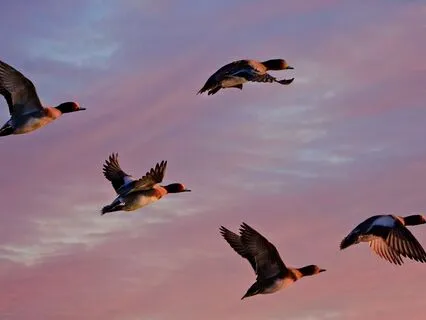
A small number of the species migrate by day.
Among these are the hawks,
Swallows,
Ducks,
And geese.
The last two groups also travel by night.
The rate at which they proceed on their journey is not as great as was formerly supposed.
From 20 to 30 miles an hour is the speed generally taken,
And perhaps 50 miles an hour is the greatest rapidity attained.
Flights are usually not long-sustained,
150 miles a day being above the average.
Individuals will at times pause and remain for a few days in a favorable locality before proceeding farther.
When large bodies of water are encountered,
Longer flights are of course necessary,
For land birds cannot rest on the water,
As their feathers would soon become water-soaked.
Multitudes of small birds,
Including even the little ruby-throated hummingbird,
Annually cross the Gulf of Mexico at a single flight.
This necessitates a continuous journey of from 500 to 700 miles.
Some North American birds migrate southward only a few hundred miles to pass the winter,
While many others go from Canada and the United States to Mexico,
Central and South America.
The ponds and sloughs of all that vast country lying between the Great Lakes and Hudson Bay on the east,
And the mountains of the far west,
Constitute the principal nursery of North American waterfowl.
Whence,
In autumn,
Come the flocks of ducks and geese that in winter darken the southern sounds and lakes.
One stream moves down the Pacific coast,
Another follows the Mississippi Valley to the marshes of Louisiana and Texas,
While a third passes diagonally across the country in a southeasterly direction until it reaches the Maryland and Virginia coastline.
Thence the birds disperse along the coastal country from Maine to Florida.
Turnstones,
Sanderlings,
Curlews,
And other denizens of the beaches and salt marshes migrate in great numbers along our Atlantic coast.
Some of them winter in the United States,
And others pass on to the West Indies and southward.
The extent of the annual journeys undertaken by some of these birds is indeed marvelous.
A renowned admiral told me once that he found shorebirds on the most northern land,
Where it slopes down into the Arctic Sea,
Less than 500 miles from the North Pole.
And these same birds pass the winter 7,
000 miles south of their summer home.
One of these wonderful migrants is the golden plover.
In autumn,
The birds leave eastern North America at Nova Scotia,
Striking out boldly across the Atlantic Ocean.
And they may not again sight land until they reach the West Indies or the northern coast of South America.
Traveling as they do in a straight line,
They ordinarily pass eastward of the Bermuda Islands.
Upon reaching South America,
After a flight of 2,
400 miles across the sea,
They move on down to Argentina and northern Patagonia.
In spring,
They return by an entirely different route.
Passing up through western South America,
And crossing the Gulf of Mexico,
These marvelous travelers follow up the Mississippi Valley to their breeding grounds on the shores of the Arctic Ocean.
Their main lines of spring and fall migration are separated by as much as 2,
000 miles.
During the course of the year,
The golden plover takes a flight of 16,
000 miles.
The bird which makes the longest flight,
According to the late Wells W.
Cook,
America's greatest authority on bird migration,
Is the Arctic Tern.
Professor Cook,
To whom we owe so much of our knowledge on the subject,
Says of this bird,
It deserves its title of Arctic,
For it nests as far north as land has been discovered.
That is,
As far north as the bird can find anything stable on which to construct its nest.
Indeed,
So arctic are the conditions under which it breeds,
That the first nest found by man in this region,
Only seven and one-half degrees from the pole,
Contained a downy chick surrounded by a wall of newly fallen snow that had been scooped out of the nest by the parent.
When the young are full-grown,
The entire family leaves the Arctic,
And several months later they are found skirting the edge of the Antarctic continent.
What their track is over,
That 11,
000 miles of intervening space,
No one knows.
A few scattered individuals have been noted along the United States coast,
South to Long Island,
But the great flocks of thousands and thousands of these terns,
Which range from pole to pole,
Have never been noted by ornithologists competent to indicate their preferred route and their time schedule.
The arctic terns arrive in the far north about June 15th,
And leave about August 25th,
Thus staying 14 weeks at the nesting site.
They probably spend a few weeks longer in the winter than in the summer home,
For the 150 miles in a straight line must be their daily task,
And this is undoubtedly multiplied several times by their zigzag twistings and turnings in pursuit of food.
The arctic tern has more hours of daylight and sunlight than any other animal on the globe.
At the most northern nesting site,
The midnight sun has already appeared before the birds' arrival,
And it never sets during their entire stay at the breeding grounds.
During two months of their sojourn in the Antarctic,
The birds do not see a sunset,
And for the rest of the time,
The sun dips only a little way below the horizon,
And broad daylight is continuous.
The birds,
Therefore,
Have 24 hours of daylight for at least eight months in the year,
And during the other four months have considerably more daylight than darkness.
As we come to the end of tonight's journey,
I invite you to keep the serene images of the birds we've explored in your mind.
Picture them gliding gracefully through the sky,
Following their ancient migration paths,
Their wings carrying them surely across vast landscapes.
Imagine the peaceful rhythm of their flight,
The effortless way they soar,
As you drift deeper into a state of calm.