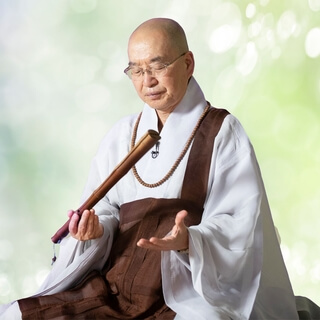
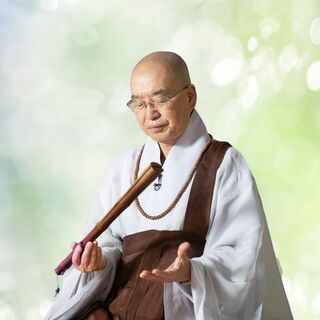
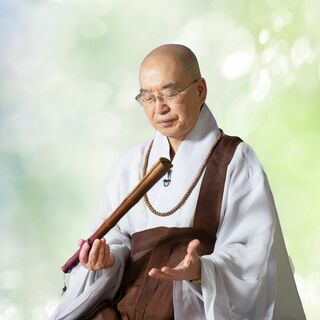
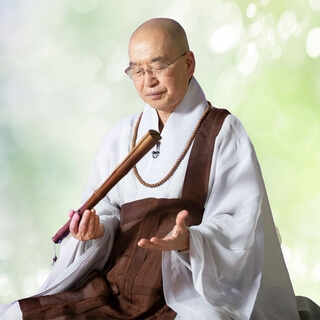
Sunim has said previously that we should be comfortable when we meditate.
But when I try to sit in the meditation position,
I am typically uncomfortable.
My back aches from trying to stay straight,
My hips are tense in trying not to fall over,
And my legs lose feeling.
I find that this discomfort distracts me when I try to meditate.
What should I do to improve?
Yes,
He meditated.
Everyone was supposed to be at ease.
But the posture of meditation.
.
.
Should be careful.
If you don't fall down,
You will lose the strength of your pelvis and the sense of your legs.
This inconvenience itself is a hindrance to meditation.
How can I get better?
Yes,
It is true that it interferes in the short term.
But in the long term,
It is more helpful to do it right away.
So in the short run,
It is true that this discomfort is going to be an obstacle for you to overcome.
But in the long run,
This is the best position for you to get used to.
There are three things that can be a hindrance when meditating.
So there are three main distractions or obstacles when meditating.
First is,
You're sleepy,
Drowsy.
If you go in and sleep,
You are sleeping,
Not meditating.
But if you fall asleep while meditating,
Then you're sleeping,
You're not meditating.
Even if you are sleepy,
Meditating is still a meditation.
Or when you need to catch your breath.
But if you're meditating while being drowsy,
It's that you are.
Becoming your mindful one despite being drowsy.
That's meditation.
And then that's not a bad,
That's not the wrong meditation.
Does he have shortness of sleep?
Because they are physically tired.
It is a physical problem,
Not a mental problem.
You're drowsy because you're either tired or your body's tired.
So it's a matter of a physical issue,
Not your mental issue.
If you keep practicing breathing awareness,
You will be able to meditate while doing it.
So let your body be drowsy as it will,
But maintain your mindfulness while it's being drowsy and you're practicing meditation that way.
The second is physical pain.
The second is physical pain.
When we sit in a left-handed posture,
통증이 옵니다.
And we feel that pain because we're still young.
Set in a lotus position.
If you exercise or go hiking without exercising,
You will feel tired and pain in your body.
Similar to the pain you feel after you exercise for the first time in a long time.
But you can't just give up.
If you keep doing it for a week,
Your body will get used to it and you'll be able to exercise and hike.
But you can't quit there because after a while,
Your body will get used to the new activity and be fine with it.
If a person who didn't give up like this gives up,
Or according to your body's resistance.
그래서 동증이 일어납니다 So if you're not used to the half lotus position,
Then your body's going to resist and that's going to cause pain.
After about a week,
The pain will go away.
But after a week or so,
The pain will go away.
What I'm saying is that if you do it all day for a week,
That's what it means.
When I say after a week,
I mean after a week of consistent everyday meditation in that position.
And your body will adjust to that new posture.
네,
그러면 이렇게 앉는 것이 정신 집중에 조금 더 도움이 됩니다.
And then once it gets used to it,
That posture is going to help with your mental concentration.
The process of physical resistance.
We call it conquering the body.
That period in which you overcome the resistance of the body and train it to the new posture,
We call that kind of training the body.
Mmmmm.
It's like when we get injured in the arm or leg,
We get a cast for a long time,
And then we get a rehab treatment.
It's the same as the pain.
If we don't get a rehab treatment because of the pain,
You will find it difficult to use it.
To overcome the pain and rehabilitate.
It's almost like going through physical therapy after you've been.
.
.
Immobilized or in crutches for a long time.
Although the first time in physical therapy and rehabilitation is going to hurt,
You have to keep at it and make sure that you return to your normal kind of activity.
If you have a disability,
Such as an injured foot,
Hip,
Or back,
You have to sit on a chair or take a posture that suits your disability.
However,
If you actually suffer from a physical handicap on a permanent basis,
Then you have to adjust your posture to accommodate the level of your disability.
Even if you don't have that value,
조금 불편하다고,
힘든다고.
Comment on that one.
That is,
The goal of meditation is freedom from desire.
If you can't overcome this uncomfortable desire,
You will not be able to achieve your original goal.
However,
If you don't have those kind of permanent disability,
Then if it's the discomfort or the pain that you're kind of complaining about,
Then you have to go back to the root,
The reason of meditation,
Which is to free yourself from the desires attachment.
And this is,
You should consider that as a first obstacle to freeing yourself of your desire to be comfortable.
The third is to stop causing thoughts to arise constantly.
The second is the content.
And your thoughts arises that provide distraction is to be able to pause that.
If you sit still and close your eyes,
You will see the past happening over and over again.
If you are comfortable,
Close your eyes,
Kind of try to focus.
But then all the thoughts from the past will come unbidden.
There are many thoughts in the future,
Such as concerns,
Worries,
Or good ideas.
And then all these concerns or great ideas of plans for the future.
Will unseason me.
Korean translation It's like watching a video.
Then you know that you're not awake to the here and now,
But you're kind of watching videos of the past or the future.
So,
If you keep losing your focus on the breath,
You are not meditating.
You are thinking or imagining.
And if your awareness kind of chases after these dreams or these thoughts or plans of the future,
Then there's a scale.
Thinking,
You're not really meditating.
But we don't want to stop thinking.
We don't want to stop thinking.
We want to create a story.
However,
If you say you want to cease all thoughts,
You can't really cease.
But you can choose not to be distracted and create stories around them and chase after those stories.
So you're just trying to focus on the breath alone in the spite of these thoughts.
So no matter who you are,
All three obstacles I just talked about,
They'll come to you,
Whether sequentially or all at once.
If we keep meditating for 10 days from morning to evening,
We will be able to get rid of drowsiness in 2-3 days.
We will be able to get rid of pain in 5 days.
However,
The more we meditate,
Chimae jinme.
So if,
Say,
We were to do this 10 days,
Every day,
Meditate for 10 days,
Then your sleep,
Your drowsiness will go away after two to three days.
The physical pain,
You'll get used to it after five days or so.
However,
The distracting thoughts will actually get worse.
It is not about being able to meditate without these disabilities.
It is about being able to focus and be aware of these disabilities.
So it's not the absence of these obstacles that determine the success of your meditation.
It's that you are able to focus on the breath and despite of the presence of these obstacles.
It's not that it doesn't work well,
But it's a meditation to move forward step by step in the direction of overcoming the reality of things that don't work well.
So meditation is not being able to singularly focus on the breath despite this obstacle.
It's you attempting to actually focus on the.
.
.
Breath as much and as well as you can in spite of these obstacles.
So,
Even though there is a disturbance,
It is a meditation to practice steadily.
You should not evaluate yourself by saying,
Meditation is good or bad.
할 수가 없습니다.
Practicing,
Continuing to practice despite these obstacles is meditation.
So meditation is really not subject to kind of performance rating every time you do something or a session.
In conclusion,
While you are relaxing your body and mind,
Daman Hoobae Jibjonghara So in conclusion,
It's simple.
Relax your body and mind,
And in the midst of that relaxation,
Focus on the breath.
안 된다고 낙담하거나 포기하지 말고 된다고.
조아거나 들뜨지 말고.
Whether it works or not.
Do not get disappointed or despair if you don't do well.
And do not get excited or happy if you do well.
Despite all this,
Just be continuous and consistent in your breath.
It right there.
자세를 바로 하는 것이 도움이 된다.
In this case,
The right posture helps.
However,
In the short term,
It manifests as a disorder due to pain.
But in the short run,
That posture,
It'll cause pain,
And it will be a distraction.
But if you get up after hearing the disability,
나중에 그 장애는 사라지게 된다.
But if you overcome that obstacle,
It will no longer be an obstacle.
환자는 예외다 unless you have like permanent disability.