You have been carrying it around all day.
The reply that has not come,
The decision somebody is making about you in a room you are not in.
The result,
The offer,
The thing you said on a Tuesday that you cannot now unsay.
You pick it up.
You turning over?
You put it down.
Four minutes later It's back in your hands.
And you know the advice.
You've heard it a thousand times.
" You have probably heard it from me.
Let go of what you cannot control.
So why does it so rarely work?
At the moment you actually need it.
I want to give you the honest answer to that.
Then I want to give you the practice.
The Honest Answer makes possible.
Sit however you already are.
You do not need a better position.
Than the one you have got.
Let the eyes close if that is comfortable.
If closing them makes the thinking louder,
Leave them open and rest them on something dull.
Let the out-breath run a little longer than the in-breath.
Not a technique.
You are just unclenching for a minute.
You do not have to stop thinking about the thing.
It can stay in the room.
We are going to work on it directly.
Here is the honest answer.
The word you were given breaks the first step.
Apectetus taught in Greek.
And the phrase the whole of his philosophy hangs on is Ta-ef Hay-min.
Ta Fhéimín.
It means the things that are up to us.
Not the things we control,
Up to us.
Those sound like the same thing,
But they are not.
And the distance between them.
.
.
Is important for this practice.
Because when you hear control,
You think about outcomes.
And outcomes will not sort.
Try it.
Take your health.
Is that in your control,
Or outside it?
Take your work,
Your children,
Your marriage,
The conversation you are dreading.
On any given day.
In every one of those,
You have real influence and no authority whatsoever.
So you sit down to divide your life into two piles.
And nearly everything ends up in a third pile.
Pile the instruction,
Navigate the name to.
And you stop there.
You aren't weak.
Because the first step of practice,
The sort,
Cannot be completed with that word.
Control.
You never get to the second step,
Which is the main one that actually helps.
Up to us points somewhere else entirely.
It's not about outcomes.
It's about a faculty.
The judgment you make about a thing.
Whether you sign off on it.
What you go after.
What you back away from.
That is the whole list.
It is.
Short.
It is dull.
And it's completely yours.
And here's the part that matters.
The line is not a sliding scale.
It is a clean cut.
And a clean cut is something you can actually make at midday.
With the thing in your hands.
And this is where the specialists have landed.
A.
A.
Long renders the phrase up to us.
So does Robin Waterfield,
Susan Bobsy,
And argues for depending on us.
I should say that this point is still argued over.
In Our Power has some good defenders,
And the old translator I am about to quote uses control himself.
Nobody is calling the old versions incompetent.
The claim is a bit narrower than that.
It's about what a modern ear hears.
If you say control to somebody in 2026,
And they think about outcomes,
This is missing the point.
But you say up to me,
And now we look somewhere closer.
So the sword was never going to work with the word that you were given.
I'm not trying to give you a flattering excuse.
And it does not make the practice suddenly easy.
It just means now,
For the first time,
You can actually start it.
Epictetus taught the real version.
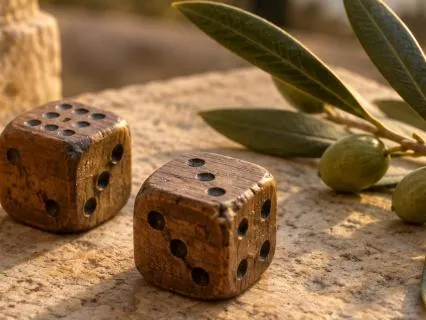
With a gambling image,
Which is not what people expect from him.
Old Father's Translation,
Discourses Book 2 And One Word First counters are the gaming pieces,
The tokens on the board.
The counters are indifferent.
The dice are indifferent.
How am I to know what is going to fall?
To make a careful and skillful use of what has fallen.
That is now my task.
" Listen to what he does not say.
He does not say that the game does not matter.
He does not say,
Stop playing.
He does not say,
Pretend you never wanted to win.
He splits one move into two moves,
The throw and the play.
The throw was never yours,
Not partly,
Not mostly.
It falls.
And in the instant it lands,
Something becomes completely yours.
What you do with it.
That is the faculty.
Not a stretch of time,
Not a list of outcomes,
The use you make of what is in front of you.
And that is why this division works when the outcome version does not.
You are being asked not how much power you have had over a result.
You are being asked which part of this is the throw and which part is the play.
Okay,
Right,
Let's do the actual thing.
Bring it to mind.
The one that has been in your hands all day.
First,
Say it to yourself in one plain sentence.
No adjectives,
Not the disaster with the flat,
Just what happened,
The way you would report it to a stranger who has no stake in it.
Is usually shorter than the version you have been carrying.
Now,
The first question.
What here is the throw?
What has fallen or is falling?
Or is in somebody else's hand?
What you could not have made land differently and cannot make land differently now.
Take your time.
Most people find that this list is longer than they expected and that the size of it comes as a relief rather than as a big blow.
Take a breath.
Now the second question.
And this is the important one.
What here is the play?
Not what you wish were different.
What use of this is actually yours?
The next thing you say,
The next thing you send,
What you decide this means about you.
There is nearly always something.
It is usually smaller than you wanted.
And more available than you thought.
Now pick one.
Just one.
The next move.
And as you commit to it.
Add the old clause that Stoic writers attached to their plans.
Later writers called it the reserve clause.
I should tell you the exact ancient wording is harder to pin down than the idea.
So what follows is the idea,
Not a quotation.
You do the thing fully.
And inwardly you add if nothing prevents me.
Not as a get-out.
But more as an accurate description.
Of every plan any human being has ever made.
So,
I will do this if nothing prevents me.
See whether the grip has changed hands,
Not the result anymore,
The move.
One honest thing.
The cut is easier to see than to hold.
When the stakes are high,
The hand goes back to the result on its own.
That is not the practice failing.
This is actually what the practice is for.
And it is why it is a daily thing rather than something you do as a one-off.
That is the drill.
The move is called the throw and the play.
Two questions.
What here is the throw?
What here is the play?
And this is the sentence I want you to take with you.
You can even write it somewhere,
You can see it every day,
So you can gradually internalize it.
Here it is.
But to make a careful and skillful use of what has fallen.
That is now my task.
Make a careful and skillful use of what has fallen,
That is now my task.
One last thing.
And I personally find it the most useful when nothing else lands.
The dice do not care.
Whether you have made your peace with them.
And that.
Is exactly why.
It makes it safe to put them down.
Open your eyes.
When you are ready.
There is a move.
To make.