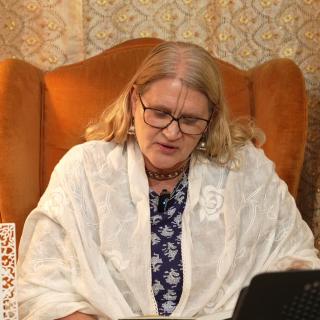
Welcome to the Vedic Psychology Book Club.
Today I'm going to start a new chapter,
But before I do that,
I just wanted to show you guys,
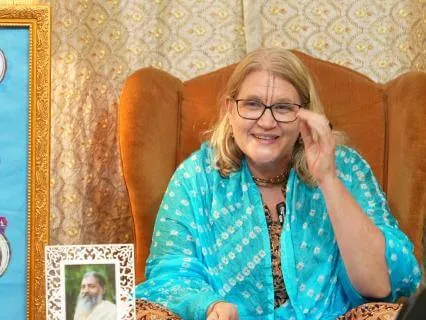
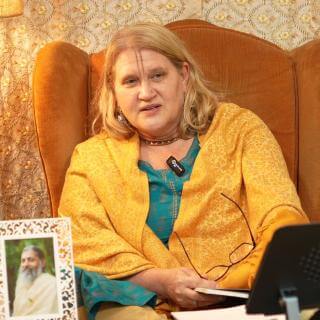
This is the original card that we made for Babaji.
Ten years ago with the kids and you can see these are his responses.
I don't know if,
Alas,
You can point the camera to show the card.
So everyone online can see it too.
So these are Babaji's responses.
I don't know if you can zoom in and see it.
What he did was he emailed them to me and then I wrote them up and put a picture of him.
Those are the kids' questions in the book that I was reading,
And these are his responses.
And you see how they put stickers all over it,
You know?
And then on the back side is their original.
Questions that they wrote that each child wrote.
So I'll try to show it to you without knocking anything over.
Here's the kids.
Questions.
This says,
Get well soon,
And then they each made a get well soon wish.
For him.
And then they wrote back again,
He wrote back something and then they wrote back,
He answered their questions about love,
But these were the Get Well Soon original.
Messages.
Let me see if I can read one of them.
This is Babaji.
I hope you feel better.
I hope you feel good.
Don't feel bad.
You're a good person and I hope you feel well.
Slow.
These things I don't think I put in the book,
But this is their original handwriting and their original messages,
And these are the kids I read to about,
You know,
Having so much struggle.
But they in their heart were writing such kind things to him.
I hope you get well soon.
You're such a gift to this world.
I wish I could meet you.
I believe you will overcome this sickness.
Get well soon.
Some of them are a little hard to read.
But anyway,
I'll leave it on that side.
Babaji's Get Well Soon card.
I typed all those messages up to him and sent them,
You know,
Once they wrote all that out.
And I took the picture and sent it to him.
And then I brought it here to Randolph and gave it to him when I saw him.
And I don't know what happened to it,
But on the other side,
I mean,
I just framed it now.
So for 10 years,
It's just been rolled up.
You know,
It was somewhere like,
I don't know where,
But I found it and a mouse had eaten one of the hearts.
So I thought,
Okay,
We better frame it,
Keep it away from the mice here.
I just wanted to show you that.
Does anybody want to share anything?
Anything else about the kids that I worked with at the hospital before I go to the next chapter?
Any insights you had from last week?
From what we discussed.
Love Knows No Bounds was the topic.
If you can manage the online,
Because I don't have a screen with anything online,
I don't see any people,
So if you could just manage it if anybody's raising their hand.
Okay.
Okay,
So you ready to move to Chapter 8?
So this chapter is called,
Woe is Me,
Babaji Triggered My Painful Memory.
So a few months after meeting Babaji,
I began teaching with him.
It happened fast.
Although I was still living in Florida and working at the psychiatric hospital,
He invited me to teach Vedic psychology with him in France.
So I took my vacation days from work to embark on this big adventure with my guru.
I felt excited but also nervous about teaching with such a great person.
He has thousands of followers around the world and I was a nobody.
So who was I to teach with him?
I was worried I would say the wrong thing or misrepresent his teachings in some way.
But what happened next was not in my arsenal of worries because it was so out of the blue that I didn't expect it.
One day as we were preparing our PowerPoint.
Babaji casually asked me.
So why did you become so worried when I did not respond to your email a few months back?
When you are working on the Hito Badash Worksheets.
I was caught off guard.
What?
I stammered.
What made you so worried when I did not respond to your email for a few days?
He calmly repeated.
He's putting me on the spot.
Like this made me feel nervous and like I was suffocating.
My hands began to tremble.
I wish I could just disappear into the thin,
Fresh mountain air of the French countryside.
I never thought about why I had become so worried a few months back.
And quite frankly,
Why did it matter?
What was he getting at?
In any case,
I had no response.
The silence felt so painful as he waited for me to come up with something.
My mind was blank.
No answer was coming.
The only thoughts going on in my head were along the lines of what a stupid idiot I was because I could not respond to his simple question.
Exasperated I finally blurted out,
I don't know.
Hoping that would suffice and we could get back to our work.
But he was on to something and he would not let it go.
He quipped,
What do you mean you don't know?
What kind of answer is that?
I felt my face turn crimson red.
My cheeks were burning hot.
I really don't know.
He relentlessly pressed on.
And why were you so worried in our morning presentation?
You rushed through the material,
And you spoke so fast.
I don't think anybody could understand you.
My throat went dry and felt too tight to speak.
And meekly squeak.
No sorry,
Just tell me,
Why are you crying?
What are you so worried about?
He innocently killed.
Inquired.
My eyes welled up with tears.
I was surprised at how quickly the words just rolled off of my tongue.
The floodgates.
Of my emotions open.
I blabbered,
I'm worried that you don't think I'm good enough.
I'm worried that you will one day realize how stupid I really am.
And I'm most worried about you becoming angry with me.
What if I mess up when we are teaching together?
What if I say the wrong thing?
Babaji calmly stated,
That's a samskara,
It's just some old programming from your childhood.
That is causing you to not see the situation clearly.
Introspect.
He didn't smile at me.
Nor did he say any nurturing words to make me feel better about my insecurities.
Is he angry at me?
Is he dismissing me?
Telling me to not continue teaching this course with him?
Should I just leave?
I felt crushed.
My mind was spinning.
I couldn't think straight.
I excused myself and went to my room and tried to think about what was going on in my crazy mind.
Maybe this is just too much for me to handle.
Maybe I should just go home.
What was I thinking,
Believing I could offer something valuable to support my Guru's teachings?
He seemed annoyed with me.
He was being so cold,
Colder than ice-cold stone walls of the old castle we were staying in.
What should I do?
We have class again in one hour and I have to be ready to present.
I have to get it together.
There's Babaji at the castle.
Where Lottalie hosted us.
I have to get it together and show up to do my part.
I'm stuck in this old castle,
A torture chamber,
In the remote French forest with no escape.
That's how it feels when you're triggered,
Right?
We had driven for miles up a treacherous switchback road with no sign of life to arrive at this remote place.
I couldn't run away even if I tried.
My heart sank as I realized I was doomed.
Somehow,
I miraculously got myself together and made it to class one hour later.
Feeling like a zombie,
I took my seat.
As usual,
Babaji's smile made his whole face glow.
It was truly a sight to behold.
I thought to myself,
How can he be so happy when he just punched me in the stomach?
He carried on like normal with his teachings like nothing had ever happened.
Even though I was reeling inside,
Externally I followed suit.
When it was my turn to teach,
I did my part as planned.
I talked too fast in my usual manner,
Explaining things at warp speed.
Nevertheless,
I got through the material without revealing my tormented mind.
My interpreter was gracious and didn't give me a hard time about my rapid speech.
Bless her soul.
At the end of class,
Babaji promptly got up and walked out the door,
Leaving me in the dust.
Can any of you guys relate to this?
When Babaji triggers your samskara?
It's so hard.
And I was on stage.
It was the first time I was ever teaching with him.
It was already stressful enough,
Right?
But then he was picking a scab that I didn't realize I had.
I wanted him to explain what he saw in me that he wanted me to introspect on.
Let's see.
No,
Sorry,
Isn't that what a guru is supposed to do?
If he can see my problem,
Why doesn't he just tell me what it is?
Maybe he's giving me the cold shoulder because he's mad at me.
That night,
I was restless.
I couldn't catch a wink of sleep.
My mind was going in loops,
Questioning over and over again.
What did he mean when he said,
I was not seeing the situation clearly?
Was my samskara really that big of an issue that he had to point it out like that,
Right in the middle of us working so harmoniously together?
What's the big deal about me being worried from time to time?
Finally,
I remembered Babaji's advice.
That I should introspect.
I recalled one time when he told me that it is very difficult to introspect.
Because our mind is conditioned to analyze the other person and not our own self.
Babaji explained that this characteristic of the mind enables us to rationalize all the reasons why we don't need to change.
As his words rang in my head.
I vowed to myself that I didn't want to be like that.
I wanted to change and for the better.
So I try to focus my attention away from analyzing him.
And onto myself.
I reflected upon why I had got so worried when Babaji didn't respond to my email for a few days.
What could have caused that extreme anxiety in me?
After a while,
I remembered a time.
When I had this similar feeling of worry with my father.
When I was a child.
You see,
My father was a very passionate person.
And with every passionate person comes a streak of anger.
And adult anger is very,
Very scary for a child.
Who relies on the adult for their survival and safety.
However,
My father's passion also fueled his good.
Highly admirable qualities such as pursuing his lofty goal in life to change the way the world thinks.
He wanted people to be able to see and understand the unintended consequences of their actions.
And subsequently change their behavior.
To make this world a more self-aware,
Mindful place.
That was what my dad was doing with his life.
And he created some software to teach people that.
So he created software to teach people how to think from the systems,
It was called systems thinking point of view.
He dedicated his life to this teaching this concept for nearly two decades.
As an engineering professor at the prestigious Dartmouth College in Hanover,
New Hampshire.
My father's passion enabled him to be a professor,
Create software,
Start and run his own company,
Be a husband,
A dedicated father,
And raise a family.
Nevertheless,
Despite how impressive he was,
That didn't take away from how scary his anger was to me as a kid.
When he became angry,
He would throw something.
He would kick the nearest thing around,
Or lash out and shout a personal insult at me.
Too hurtful for me to repeat.
And sometimes when I knew he was really irate,
He would simply say nothing at all.
Out of all these scary things he did,
The silent treatment was by far the worst and most painful.
From form of emotional abuse I ever experienced.
And those times he would just look past me.
Like I was worse than a pile of dog shit.
At least he had to look at the dog shit so he didn't step on it when he passed by.
But when he was angry at me,
It felt like he was looking through me,
Like I was invisible to him.
He treated me like I didn't exist.
I felt like I was dead to him.
The most excruciatingly painful time my father gave me the silent treatment was on a family vacation.
We were on a road trip driving across the United States from New Hampshire to California.
That's far,
You guys.
It's like 3,
000 miles.
I don't know how many kilometers that is,
But it is really far.
It's across the whole United States.
We lived on the East Coast,
And we drove straight across to the West Coast.
It's a very long,
Long.
.
.
Many,
Many,
Many days of driving.
So it was the summer of 1984,
And my dad had felt inspired to pack us all up into the car and head west to visit my aunt in Palo Alto,
California.
I was 12 years old.
My father had also decided that even though we could have flown there and arrived that same day,
He would rather take the long route and spend one month driving and cramping across the whole United States.
He had explained to me,
To my mom and me and my three younger sisters,
That getting there is half the fun.
I don't know if you guys have ever done a trip like that.
It's like not half the fun.
And so the trip began just fine because we all felt excited for this new adventure with my enthusiastic father leading the way.
But a few days into the trip,
When we were in Iowa,
Which is basically in the middle of nowhere,
It's like farm country just in the middle of the U.
S.
There's nothing there.
I hope nobody's from Iowa,
But I mean,
It's a beautiful place.
It's a beautiful place,
Don't get me wrong.
Actually,
There's something called a Vedic city there.
Maharishi Mahesh Yogi,
His Vedic city is there.
He created a whole city in Fairfield,
Iowa where you can get a college degree.
In all the ancient Vedic science,
So it's special for that.
But when you're 12,
And I didn't know that,
And it was just big cornfields is all you see for miles.
Okay,
So where was I?
So we were in Iowa,
In the middle of nowhere.
We were sitting in the backseat of the car,
Pulling each other's hair,
My sister and I.
We got into a fight.
As my dad was trying to concentrate on driving.
This was the same sister,
The one that I always fought with,
The one who I thought had stolen my father's heart away from me.
I hated her and anything she did angered me.
In this particular case,
She had innocently fallen asleep on my shoulder.
And I got mad and pushed her off me.
She woke up and we started fighting.
I was so engrossed in the fight that I didn't even notice that my father had,
He had stopped the car and he had pulled over and we were still fighting,
You know.
And,
Um.
.
.
So he pulled over on the side of the interstate,
And the way the car was set up,
It's an old-fashioned station wagon,
So there's the two front seats like my mom and dad,
Then there's the middle seat,
There's three.
Seats in the middle,
And then the back seat is not facing forward.
It's like facing back.
It's facing the opposite way,
So you're looking at the car's.
.
.
Like driving towards you that way,
You know?
So her and I were in this small two-seater facing the other way looking out.
So it's not,
It's like we weren't even actually in the car with the rest of the family,
You know?
It's very weird.
So we were in our own world fighting.
My dad pulled over and he pulled up the back door of the car.
He had to pull it up to have us get out.
And he said,
Jesse,
Get out!
And he began yelling at me.
And he demanded,
Like,
Get out!
And I'm like,
Oh.
I was shocked and I couldn't move.
I mean,
I was so scared when he would get mad,
I would just get like paralyzed,
You know?
He then grabbed my arm and he threw me out of the car on the side of the road.
And before I could even catch my breath,
He got in the car and he drove off.
He left me in the middle of Iowa on the side of the road.
It was so scary.
I was so terrified.
Standing on the side of the road,
Thousands of miles from my home,
My family vanished from my sight.
I actually don't remember it from that point.
I completely blacked out.
I still couldn't tell you.
I mean,
Maybe if I did some hypnosis or something,
But.
.
.
I don't remember how long I was there.
I don't remember what happened to me.
Nothing.
I don't remember how long I stood there or what I did or what I even felt or what I thought.
That whole time it's just my family left and I just went black,
Blank,
You know?
I wonder if I cried or maybe I was too terrified to even feel anything.
I wonder if I walk down the road and I tried to get help.
Or if I was so stunned if I just stood frozen in one place.
I wonder how long I stood there and if I got thirsty or if I got too hot.
Because it was summer.
I remember it was very hot,
You know?
The next thing I remember.
.
.
Was that my father,
He was pulling up,
You know?
And but the exits were very far away.
It's not like every two minutes you could get off the road.
I mean,
They might have gone for 10 or 15 minutes and had to come back.
I don't know.
We were really in the middle of nowhere and there was nothing.
But the next thing I actually can remember in my consciousness was that my father,
He pulled up.
And he shouted at me,
Get in the car.
I climbed back in the car and he just sped down the road.
Not even acknowledging that anything had happened.
My mom didn't say a peep.
She didn't defend me.
She let him do all that.
And neither did any of my sisters.
I mean,
They were younger than me,
You know.
And they're probably relieved I wasn't there.
Because I was the oldest,
And me and the one who was two years younger were always fighting.
Or maybe they were too scared,
Or I don't know.
So then we sat in silence,
The whole family,
For what seemed a very long time.
And I could feel my father's seething anger.
Which made me feel so scared that I lost my appetite.
I tried to be very small and not make a sound or ask for anything for fear of upsetting him again.
I even held in my pee and I patiently waited for him to decide when we could stop for bathroom breaks.
I was a shell of a human living with the sole purpose of not upsetting my dad ever again.
That became like my mantra,
You know,
After that.
This memory helped me realize why I felt so worried when Babaji didn't respond to me.
Because his lack of response mimicked.
My father's hateful silent treatment.
So you see how a sunscar can work?
Those things have nothing to do with each other,
Right?
I mean,
Obviously Babaji is a very busy man.
He's getting tons of emails.
He doesn't need to respond to me within 24 hours or something,
Right?
But I was so triggered when he didn't respond for a few days and so worried because it tripped up that samskara of my dad giving me the silent treatment.
And that's why all those intense feelings came.
I connected the dots from the samskara,
My painful childhood experience,
To my current overreaction to Babaji.
Now things started making sense.
Of course I had freaked out and felt worried when Babaji didn't answer my email after so many days.
I misinterpreted his lack of response for the silent treatment.
Which felt exactly like my childhood experiences.
When my father abandoned me on the side of the road.
I mistook Babaji's silence for my father's.
That's how some scars work because.
.
.
For many people,
You know,
Especially if Babaji is your guru,
That relates to the father,
Who whatever your relationship is with your father or lack of relationship,
It's going to get projected onto Babaji.
But it's not obvious at all.
Like most people would not connect these two stories and be like,
Oh,
Because it seems very mild.
Okay,
Babaji didn't respond for a few days.
So it seems very mild,
Like it seems like I'm just overreacting,
You know,
Getting worried about that.
But actually,
If you can see the emotional response to both,
That's how That's how I matched it,
You know?
Feeling worried,
And then in my mind I'm like,
He's giving me the silent treatment.
He wasn't giving the silent treatment.
He was just busy,
But the way I interpret it,
That's how you can match it to the samskara,
To which one it is.
But it's very hard to see when it's your samskara.
The father,
Some scar,
Whatever you have,
And we all have some medium ones,
Some good ones,
Some bad ones,
And some not at all.
There are some experiences we never had with our father,
So somehow If you're ever getting triggered by something with Babaji,
Try to check and see if there's a matching feeling.
To some relationship with your father or lack of.
Sometime he wasn't there for you or was there for you or should have been or I don't know,
Somehow.
Usually you can tie it to that.
And if it's not that,
Just say you didn't have a father in your life.
It could be just whoever the male authority figure was in your life as a kid.
It could be a teacher,
It could be an uncle,
A grandfather,
But whoever that person was that you kind of looked up to in your life as the male.
Sorry.
Is there a problem?
Oh,
Yeah.
Could you maybe,
I find it very interesting,
Could you maybe give some example maybe from your,
You know,
What you've been observing over the years from your clients and so on to make it a bit practical?
How,
What kind of samskara could there be that Yeah,
That gets projected on Babaji and then.
.
.
People come to you and say things,
Oh yeah,
I'm just confused,
But actually you find out then,
Oh,
This is the program that was running.
I picked this one because it's very common.
That he's ignoring me.
He doesn't care for me.
He doesn't love me.
He doesn't listen to me.
He doesn't whatever.
It's something about it.
He doesn't lack.
Lack of his.
Interest or lack of his response or lack of his caring or something like that.
To misread how he is,
You know?
Because whatever we didn't get from Deb,
We're going to try to get from him.
So then if he's being silent and what I got from dad was silent,
That's gonna be a matchup.
But also what I didn't get from dad was gentle.
Soft,
Kind,
So then when Babaji's like that,
Then I want more of that.
And that's when the jealousy thing comes.
That's another big one that gets tripped up.
Whatever we didn't get from dad,
We're trying to get from him.
Even though we're supposed to be trying to give from him,
But that comes later on,
Right?
First we come and we're trying to get.
And we're working through all those,
You know,
Anarthas and samskaras,
But then when somebody else comes and they get in the way of us trying to get,
I mean,
We didn't get it from dad and then we better get it from him,
You know?
Although it's not that obvious,
But that's what's happening.
And then jealousy comes in,
You know,
Because it's like,
How did he get it or how did she get it?
Why does he or she get that from him?
I need that.
I want that.
So the jealousy one's a big one.
And the.
.
.
He didn't.
Give enough in some way.
Can you relate to that?
My question is more like about this overreacting.
So then,
When we overreact in an apparently little way,
So not so much important.
Factor and we have a big reaction out of it,
Then this is mostly the sign that there is a string attached to it.
Yeah,
The samskara has been triggered.
Because our adult self,
You know,
Because those samskaras when they got made,
Those childhood samskaras,
We were little kids and you see little kids,
They're crying all the time,
They get angry,
They get anxious because they don't have,
They aren't able to regulate themselves yet.
That's actually the mom's job in those early years,
Right?
And if mom does it well,
That's how we learn how to do it.
But as an adult,
If we act like that,
If the emotions are all anxious or angry or depressed or sad or jealous,
All that,
That's a little kid unresolved samskaras.
So,
I mean,
To call it an emotional overreaction feels harsh when it's happening to you.
You're like,
I'm not overreacting.
But really the emotions are coming from a very young child.
Unnurtured place,
I could call it.
And once that samskara gets digested and nurtured,
As an adult we can do that for ourselves.
Once that's done,
You'll see that your mind is much more calm.
You won't have those kind of strong emotional reactions like that.
So that's how you can tell as soon as the emotions are getting strong.
Just be like,
Okay,
What samskara could this be?
And even if you can just get in the category.
In other words,
If it has to do with a female in your life,
A partner,
A therapist,
Somebody who's older or a partner or therapist,
A female.
Most likely it's going to be your mother or some guy.
And if it's a male in your life,
Like a guru or a male teacher just say,
Some older male or authority male,
That's going to be your father samskara.
Painful.
Emotions are coming from those two.
In general,
But when I work with clients,
We uncover other ones because maybe you had some teacher who hurt you in some way.
Maybe you had a grandparent.
It just depends on the person,
But in general,
You can look for mother and father first.
And try to tie it back like I did here.
But that's for sure what it is.
But usually because we don't really understand how samskaras work at that level of detail,
And because we can't see it,
Because they're in our subconscious mind,
We immediately think whoever is the person who triggered it.
That's why the whole first part of this chapter I'm analyzing Babaji.
Why did he do that?
Why did he give me the.
.
.
On and on about Babaji.
And then I'm like,
Oh wait a minute,
He told me to introspect.
Well,
Let me see why I'm reacting like this.
But we're not used to doing that.
And then what usually happens is when we're triggered,
First we analyze the other person.
And then we tell them how they need to change so we can be calmer,
So we can be pacified.
So it's like,
Stop doing that.
It really annoys me when you do that.
And it's like,
Okay,
So can you take care of your own feelings of being annoyed and try to tie it to this mascara,
Or are you going to try to get the other person to change for you?
And that.
To me,
I said it last week too,
Would be a miracle.
Then you'd be the world's best therapist.
Because people sit with me for 10 years and I still can't get them to change because it's not in my power.
They have to want to change.
They have to want to do the hard work and see their samskara and take care of their feelings and all that.
But we don't understand that and so then we try to tell the other person,
Basically,
I don't like your behavior and you need to change in this way.
It's like,
Okay.
Not to ignore.
It doesn't matter.
No matter how clear it is.
Even me,
You know,
15 years I've been doing therapy,
I don't tell people,
I don't like your behavior,
You know.
A lot of people are not so nice to me,
You know,
But I don't tell them that because I know there's no point.
It just triggers them,
You know,
It just makes them more disturbed and more bad behavior comes.
So you just see it and say,
Okay.
That's where they're at.
Obviously,
There's some painful,
Some scar that's getting projected on me because I tripped that wire.
And just try to be compassionate to that person and say,
Okay,
They haven't worked through that yet,
They're probably not aware of that yet.
That's the idea.
Once you can see it,
Imagine you could have like x-ray vision,
You could see.
Like,
You know how,
If you've ever been scuba diving,
You could see under the sea all the different shipwreck,
Just say,
Or all these different,
That's how it looks when you're seeing somebody with some scars.
It becomes more obvious,
Like,
Okay,
That's the father of Simskar.
At least the father hurt them in a certain way because they're acting like that.
They're trying desperately to get attention from Babaji,
You know?
So you can tell that's not normal.
They're doing that because it's some.
.
.
Lack of attention from father,
You know?
Or they're acting out against mother,
You,
The woman in their life.
Then you can be more compassionate and say,
OK,
We all have that.
It's just how it's playing out in my life.
But it's better to then say,
OK,
That's some specific samskara.
I'm feeling triggered by that person.
So that means there's something in me I've got to work on.
And take care of and rewrite that part of the story.
That's what I do in the individual sessions.
We rewrite the hurtful part of the story so it's a nurturing,
Loving part,
You know?
And I first read this chapter and this story,
What you've been sharing.
I'm a parent of two girls who could fight.
They're elder now,
But they didn't grow up in silence.
So I could relate very much to your father,
Not to the fact that he made this drastic decision to put you there out in the middle of nowhere,
But I could understand why it annoyed him so much that these girls were having this fight in the back of the car to that extent that he was,
You know,
Getting furious from the inside.
So I was wondering,
Because we always,
I know we relate to ourselves as a little kid that gets triggered and all that,
But also as adults we can also try to see the other perspective and I was wondering whether there is also room for seeing his side and also the fact that your mom didn't interfere but the adult side to it and whether there's also I don't know,
Like you explain how it works with Babaji,
Whether there's also that part of relating to Babaji in a different way from the more adult perspective that doesn't get triggered.
So you have a few different things in there.
So the first part is,
Can we see the adult side?
You're asking,
Can we see the father side?
Which I think you'd probably be interested in,
Because you're the mother.
You could relate to that.
So the parent side,
You're saying the adult side,
But it's not really the adult.
He acted like a five-year-old.
That's the whole,
That's what I'm saying.
Some scars make you act the age that they happen to you.
So my dad's father was abusive to him.
Surprise,
Surprise,
You know?
And he didn't really accept him.
So guess what's going to happen?
He's going to be like that to me.
I'm the firstborn.
It's going to be the hardest on me.
That's what happened.
So yes,
I understand that,
But we don't want to write it off for him and be like,
Oh yeah,
He was angry,
Understandably.
No,
He was five.
He was acting like a five-year-old triggered.
So that's the important part.
The only thing that changes as we age as our body,
Not the mind.
That has to be worked on,
Otherwise you will die with the samskaras at the age they were created.
And when Babaji taught me that,
I was like,
Whoa.
You know,
That's a very profound truth that he shared.
He hammered into me,
And that's why this samskara work is so powerful.
If you can work on it now,
And when we're in our bodies and rewrite those painful traumas,
You won't take that with you to the next life.
You'll get a different kind of body.
You'll get a different kind of experience.
But for my dad,
Yes,
He was reacting from his trauma,
And guess what?
My mom,
I think I maybe said in one of the groups,
My mom's father was a very high up in charge of the Air Force.
He was in charge of the U.
S.
Air Force.
He was in charge of NORAD,
The North American Defense.
In Colorado Springs.
He was very high up.
He reported to President Kennedy.
In our home,
In my mom's home,
They had the red phone.
Kennedy could just call at any point and be like,
Hey.
War is on,
And my grandfather would deploy the whole Air Force.
That was his job.
And he had,
Of course,
No sons,
Five daughters.
My mom is the oldest.
So how do you think she grew up?
Do you think she had a great relationship with her father?
He was constantly in his military suit with the five-star general.
He was not huggable.
He was not the snuggly bear type,
Right?
So she grew up.
Completely afraid of him and mostly just shuddering at the thought.
And when he came home,
They would get us in trouble all the time.
And of course,
All five of his daughters,
They all were born one year apart,
So they were teenagers together.
Can you imagine?
And they're growing up year by year,
All different Air Force bases they had to move around to.
They were young,
Beautiful girls,
You know,
So they started dating boys.
And when he found out,
My mom,
She just went on one date with a guy.
She was just walking back from the pool.
And he found out,
Like he got word from one of his friends.
People that reported to him that your daughter was like walking back with a guy,
You know?
The next day she went to go meet him again at the pool.
Guess where he was?
Alaska.
She,
He just said,
You're out.
And he transferred the guy to Alaska.
You will never see her again.
Welcome to my mom's life.
You think that's somebody who's going to really attune to you as a father and love you and snuggle you and get to know you?
No.
So then now just fast forward.
So when my dad's like,
Get out,
You think my mom's going to say,
What the hell are you thinking?
She was like,
Oh,
He's doing that thing again.
So my mom regressed to five because her father,
The Air Force general,
You know,
Like,
So you can see,
All of our sunscars were triggered,
But as a kid.
.
.
What's interesting,
There some scars were triggered,
So they're very emotionally mature,
Like most adults,
Nothing about them.
But for the kids.
.
.
We were not emotionally mature.
We were kids.
That's how we're supposed to be acting,
Fighting in the car,
You know?
Like,
Obviously we had issues,
But if the parents were mature,
They would have dealt with us in a mature way.
But because then it was four kids.
My mom,
Like,
Afraid,
You know?
My dad,
Like,
Acting like how his father treated him.
My mom reacting to him as her father.
She didn't see that as her husband.
She didn't see her job as taking care of me,
You know,
Protecting her 12-year-old.
She saw her job as,
Oh,
Don't piss off my husband.
Daddy,
Don't piss off my daddy,
Even though they're the same age.
So that's how powerful some scars are,
You know?
Yeah,
Good question.
Yeah,
Good.
And later in life,
You know,
Now,
My mom is 78,
My dad passed away a long time ago,
Over 20 years ago,
So I have talks with her now.
And she doesn't remember most of this stuff.
She's like,
That happened?
I mean,
Now she has actually some dementia,
But.
When she was still okay,
She doesn't remember these things.
They were so traumatic for me,
You know?
She doesn't remember.
She's like,
That happened?
I didn't get out with you?
And then she'd cry and said,
Oh,
Like,
Actually,
I should have gone out with you.
I was so weak.
You know,
To dad,
I never stood up to dad.
She's grown a lot,
But,
And she was young.
And she hadn't really worked on herself.
So that's kind of a nice ending.
It doesn't change the samskara that originally happened and how I perceive the world.
That was a little bit healing to hear her say,
I'm sorry,
I should have actually gotten out and stayed with you,
Which I don't think is the best answer.
I think she should have told him,
What the hell are you thinking?
I've been stronger.
Because still,
Her getting out is like being his daughter.
Like,
I'm a bad girl too,
Let me stay with the other bad girl,
Right?
But anyway,
It's in the right direction.
But these sunscars are so powerful.
And the more I work on them,
You know,
Now I've been doing it 10 years,
You know,
Looking at other people's sim scars,
Helping them see them.
It's so fascinating.
There's always a new one.
And I'm like,
Ooh,
I've never seen that one before.
Because you're trying to watch how people are acting today,
And then you're trying to tie it back to what happened to them to create them to act that way.
And it would be so fun to write a book just on samskaras,
All the different types that I've seen.
Sometimes,
One of them was.
.
.
I had this client and she would have a very hard time,
Anxiety.
Like every day around seven o'clock at night.
And she would just have to drink alcohol,
You know?
She just couldn't deal with her anxiety,
But she didn't know why.
She's like,
I have a good job.
I have a nice home,
I have my friends,
Everything's good,
I can't figure it out.
So through a lot of questioning.
It actually turned out that at 7 o'clock p.
M.
When she was growing up.
Her parents would leave her alone to eat dinner by herself.
And it was triggering that samskara.
Which seems very obvious now,
But not the way she presented herself as a successful businesswoman.
She had it all together.
Why does 7 p.
M.
Bother me?
Basically combing the bottom of the sea,
And we triggered that.
And oftentimes when I hit it,
If they're not aware,
Either they burst into tears and go,
Or they either take a deep breath and go,
Or they burst into tears,
Or they say,
Yeah,
That's not it,
But it's actually it.
It's just buried so deep that we have to go over and over.
If they say it's not,
I'm like,
Well,
Would you mind journaling about that memory?
And let's see.
And we might come around to it and realize that connection.
But if it's too painful,
Sometimes it gets covered up and they can't have a feeling about it.
It's fascinating,
This world of samskaras.
Any other questions?
Bush on!
Thank you for sharing your experience with us.
I was quite amazed that you were able to kind of introspect in yourself and figure out some kind of a biology.
So my question is when you,
In your experience,
In your practice of introspection,
Have you ever come across a doubt that maybe it's a Okay,
Maybe it's not the past,
Or maybe it is.
.
.
Like for example,
Babaji is a holy person,
Right?
So you want the holy person to bless you,
You know,
To kind of not be angry at you,
To not,
Like,
Shut you down,
Right?
So,
Does it.
.
.
Do you feel anxiety,
Like,
That,
Okay,
Maybe it's a samskara or whatever,
But I have to get him to kind of look at me in a nice way,
Otherwise,
You know,
Krishna is angry at me or something.
Did that ever.
.
.
Did those thoughts ever,
Anxious thoughts or something,
Did they ever come to you,
And how did you address it?
No.
The thoughts that I said are the ones that came to me,
But I wasn't like,
Oh,
He's a holy man,
And he must be angry,
Or he has to look at me in a good way,
Because I at least knew that I couldn't control him.
I couldn't control his thoughts and I also knew that he's pretty much eternally blissful.
From the beginning,
I knew that.
Do you know that?
If he was angry at me,
Just say,
Which I believed.
At the non-triggered place,
I thought,
This is for my own good.
He's trying to purify me.
In my triggered place,
I'm like,
He hates me,
It's my whatever,
He's angry at me,
Silent treatment.
But when I wasn't triggered,
I wasn't thinking,
How can I get him to change,
To look at me,
To like me,
Nothing like that.
It was more like,
Okay.
He's triggered.
I mean,
I'm triggered.
Blissful person he's blissful you know and so he's just If he's acting like that,
Then he's trying to help me see something and get it out.
If he's acting angry.
It's only for my own good is how I would always think and how I still think.
If he's ever upset with me,
I think,
OK,
This is for my own good.
He's helping me.
He's such an honest person and such a loving and kind person and compassionate.
And he's only doing everything out of compassion.
I never thought like.
.
.
That I have to now change him to get him to.
.
.
Or anxiety about this holy person doesn't see me in the right way.
I didn't think that way.
Does that make sense,
Pushan?
Yeah,
Okay.
What do you think about that way that I thought?
That was interesting,
Maybe,
Like,
I was brought up with this culture that if you make a holy person angry,
You're screwed.
It's worse than,
Like,
Drinking and whatever,
Or any kind of vice you can think of.
But that's,
Like,
The worst thing,
Never do that.
So,
For me,
It did create anxiety,
Maybe not now,
But,
Yeah,
It did create anxiety,
But maybe it's the cultural thing,
I guess.
Yeah,
Interesting.
Thank you for sharing that.
Anything else?
Janova?
Okay,
Janova.
Yes,
Joshika,
I have a question about your mom.
You said that actually she was not remembering any of that.
And I'm a bit surprised of that because It must have been such a,
You know.
.
.
Very,
How do you say,
Traumatic experience,
Not only for you,
But for all of you.
And also,
In my personal experience,
My mom also,
When I ask her something,
She's like,
Did it really happen?
So I want to know,
Like,
Why?
Why do they do that?
Yes,
Is there too much magic for them that they just completely forget about it?
Or how does samskara work?
My guess is,
And I'm not 100% sure,
But at least for my mom,
I don't know if it was that traumatic for her.
Because I didn't cry,
I didn't show anything.
And she was so focused on him and not upsetting him.
You know what I mean?
I think she was desensitized,
Actually,
At that point,
And maybe even before she had kids.
I mean,
Because of the father she had.
Later on,
When she became sensitized,
When she worked through her feelings,
She went through her own therapy,
She got remarried with a different husband,
She became more in her heart.
Then she realized,
Oh my God,
And she also learned what it meant to be a more attuned mother.
Then she was like,
Oh my God,
I should have taken care of you.
But I think she didn't think it was that big of a deal,
Actually.
That's why she doesn't remember.
She was desensitized to it.
I didn't come back crying.
I came back and I got in the car,
Quiet.
I said nothing and I never brought it up because I was so scared,
You know?
But I think the other option could be,
For example,
If your mom didn't remember something,
But it was traumatic for her too.
That's the other thing that could happen.
It just gets covered.
Out of some feeling of guilt.
Like,
Oh my god,
I feel so guilty or so ashamed that I wasn't able to be there for my kid and I let that thing happen,
They might cover it,
You know?
And they're like,
I don't remember.
It's not that they're lying,
You know.
They literally had to cover it.
They weren't consciously trying to cover it,
But it just got pushed way down because it was too painful.
So those are the two options I can think that might be why.
What do you think,
Jennifer?
Thank you.
It makes totally sense.
Yeah,
Those two options.
It happens a lot in therapy.
I do sessions with.
.
.
Adult,
But they're remembering something painful from childhood,
And then they'll get their mother or father in the session.
It's like a communication session,
Right?
And the child will say,
When you did this or this,
That hurt me so much.
And they're like,
What?
I didn't do that.
What are you talking about so it even happens in therapy?
And the adult child that was reading,
And I felt like this,
And I felt like that,
And they were like.
.
.
Oh,
I'm sorry you felt that way.
Like,
No,
It's not registering.
So I think it's kind of common.
And also I think they're distracted by all their own sim scars and all their own stuff.
Like,
Maybe my mom was more triggered by my dad getting angry than the fact that he got angry at me and kicked me out.
So she was just reacting to like,
And maybe when with her father,
She would shut down emotionally is my guess.
So she just shut the thing down,
You know?
Interesting to analyze the parents,
Though.
In a way,
It's kind of a relief.
It's like,
Oh,
They're going through all their own drama,
Too.
That's why they couldn't really be there for you in the way that you needed.
Yes,
Kamala.
Is about the silent treatment,
How the silent treatment has made you feel.
Like you are feeling like less than now.
A poop of a dog,
How much it was really impacting.
So,
How is the mechanism,
How the silent treatment makes a person feeling so much.
.
.
Like being even zero,
Not existent,
At that particular point,
How it happens.
So for every person that's different,
Some people actually probably don't mind it.
They're like,
Oh,
Look at how peaceful Babaji is or something.
Like for me,
My samskara was.
.
.
From my 12-year-old brain that I almost died.
The silent treatment for my father was that he was so angry at me,
He kicked me out of the car.
Somebody on a truck,
Big trucks are going by,
They could have picked me up and raped me and killed me.
They could have hit me.
Many bad things could have happened.
So I was about basically how I felt at the time I was about to die.
And my dad leaving me like that was this basically silent treatment.
And when I got back in the car.
.
.
What's father's number one job,
Right?
Protect.
No protection,
He did the opposite,
And then he didn't apologize,
He didn't acknowledge,
He didn't repair.
So for me,
The whole package of him dropping me,
Which is abandonment samskara,
Plus not talking to me when I came back,
The silent treatment,
And I could feel his anger.
I was hypersensitive to his mood because I had to be careful that I never,
Ever,
Ever,
Ever made him feel like that again.
But the silent treatment,
From that experience,
Those two things.
The silent treatment and the abandonment.
It made me,
If anybody ever did that again that was a male.
In a position of authority,
Or that I loved,
Like a boyfriend,
Or my ex-husband,
Or Babaji,
Any of those people that fits on that.
Samskara trajectory of male in position of power,
You know.
Is going to trigger,
If they do the silent treatment to me,
Is going to trigger that painful thing that I almost died.
When you treat me like I'm invisible,
I feel like I'm dead.
Now,
For some people,
They don't have that experience,
Obviously,
That I had,
But they have a similar experience with mother,
Where mother wasn't there for them when they were crying.
When they were a baby in that first year of life,
You know,
And they were crying out and mother's not there.
And that can trigger the same thing because you feel invisible.
You needed to be fed breast milk.
You needed to be held close to her and all that.
And if that didn't happen,
You can feel the same,
I'm invisible and I'm about to die.
So the silent treatment can trigger a lot of people.
But for different samskaras,
But the same idea.
If you're made to feel invisible by mom or dad in those early years of life where you relied on them for your survival.
.
.
Going to trigger that when Babaji does the silent treatment when he's not doing it.
He's just a quiet person,
It turns out,
And he's not that chatty.
You know what I mean?
But to me,
I'm like,
Oh,
It's a silent dream,
But you know.
But it's going to trigger that thing unless you're really aware of it and you work through that.
And it's hard because you're nurturing the little,
Really,
Really young self of you.
Okay,
Anything else?
Shall I read a little more?
Okay,
So where did we left off?
So I was misinterpreting his lack of response for the silent treatment.
I mistook Babaji's silence for my father's and I thought that Babaji didn't respond to my email because he was angry at me,
Which was not the case at all.
He was sick and dead with malaria.
My wires had got crossed.
And I had superimposed the painful memory of my father's angry,
Silent treatment right onto Babaji.
Now I could understand what Babaji meant about me not seeing the situation clearly.
I felt relieved.
And excited to share my insights with him the next day.
When I saw Babaji the next morning,
I explained what I understood from my introspection.
He responded,
Good.
Now you have to get out of this old conditioning.
You are smart and a good teacher.
You do not have anything to worry about.
Teach what you know,
Slow down and relax.
Thank you,
Babaji,
But how?
You make it seem so easy,
But I don't know how to get out of my conditioning.
The first step is awareness.
Now that you know your samskara of your father's anger and silent treatment is getting projected onto me,
You have to catch it and control it before it controls you,
" he explained.
I will try,
But it sounds very difficult to watch my own mind and control it like that,
I complained.
Babaji remained firm and he didn't mince his words.
If you are sincere on this path,
You will introspect daily and then change your thoughts and behaviors so you are not being driven by old toxic patterns that come from your childhood.
And then surprise,
Surprise,
What did he do?
He walked away.
Might as well just drop me on the side of the road again.
It's so hard.
Wow,
This guy is serious,
I thought to myself.
I made it through the rest of the week,
And as the days passed,
I began enjoying teaching with Babaji.
I started to find my voice and become more relaxed and confident in how I taught.
As I write this,
It has been over seven years since Babaji and I taught our first Vedic psychology course together in France.
We have taught many more classes together since then.
But that first time teaching together left a deep impression on my heart because right out of the gates.
He pummeled me with such intense lessons about myself.
I also began a regular introspection practice.
When I could search for,
Identify,
And then work on those troubling programs within me that caused me to see situations and people in a distorted manner.
Here's another place that we taught,
Which was in Bobolyn,
Poland.
I will forever be grateful for Babaji's tough love approach in which he gave me the opportunity to clear out my childhood trauma.
In an ideal world,
I would have worked through all of my samskaras before I began teaching with him.
However,
That's not the way the cookie crumbled.
Maybe it would have taken a lot longer for me to see my painful programming if I had not been invited to teach with Babaji.
I don't know.
All I do know is that in Babaji's great wisdom,
Kindness and compassion,
He accepted me as I was,
Scared,
Confused,
Insecure,
And worried.
My deficiencies didn't deter him.
He didn't reject me or become angry at me.
And he didn't give me the silent treatment.
Turns out that Babaji is just a quiet person.
And I had really misunderstood his nature.
Even though I blamed him,
He did not get defensive.
Through His infinite compassion,
He accepted me and guided me to understand my own self.
And my reflection is,
I can't help but wonder how I could have done better.
I wonder what it would have been like if I had introspected right away when I was feeling upset.
Perhaps then I could have figured out my samskara without dragging Babaji into my emotional turmoil.
Maybe then I would have not suffered for so long.
And I could have been more relaxed and enjoyed that precious opportunity to teach Vedic Psychology with Babaji.
My lesson learned was at the first sign of feeling emotionally upset.
I need to stop.
Introspect.
Take responsibility for my emotions.
Don't blame or involve the other person.
For these feelings are mine and mine alone.
Coming from my samskara.
Anybody want to share anything?
Sunscara City.
That's what I should have titled the chapter.
Sunscara City.
What do you guys think?
Yes,
Patrick.
I want to ask you,
Do you have a system or a process for introspection,
Like everyday introspection?
Is there some advice or some tip you can give us in order for us to be more efficient regarding introspection?
Yeah,
That's a good question.
I just check my feelings.
If I'm not feeling peaceful,
I see what the feeling is that's off.
And then I write about it.
Whatever I'm feeling and then I write about it,
Okay?
Am I feeling anxious because of what?
Why?
What is it related to?
I mean,
Obviously,
It's something happening now,
But what else?
Deeper,
You know?
But I always just start very simply.
You know,
And some people,
If they're uncomfortable,
You know,
Even trying to figure out their feelings,
Then I just get out the feelings wheel.
You look at it and you can pick,
Okay,
That one.
Feeling anxious,
Or I'm feeling angry,
Or I'm feeling worried,
Or whatever the thing is.
And then I just write,
Like,
What's going on now,
And I don't censor myself.
Whatever's happening now,
I write it down.
What's bothering me?
But then at some point after I've gotten it out,
Then I have to tie it back.
To my own self instead of,
Oh,
So now I need to go tell that person.
Then I tie it into me and say,
Okay.
Which one is it?
It's not that there's millions of some scars,
There's a few big triggering ones that usually I can tie it back to.
I'm wondering whether you still get triggered by the silent treatment,
And I do not mean this as,
You know,
As a question to prey on your life.
It's more as a perspective.
Can we get rid of this samskara,
And is it effective?
Yeah.
Now I see it.
When somebody does it,
I see it.
It's not that it's completely gone,
But it's mild.
I can see it coming up and I'm like,
Okay,
That's me getting triggered because of silent treatment,
But it's not like,
Oh my God,
And I go off,
You know?
I know what it is,
You know?
So it's effective,
But it's really hard work.
It doesn't go away overnight,
You know?
Slowly you turn the volume down and down and down and down and down and then Some of them I've gotten rid of altogether,
But some of them I'm still working on.
Turning down,
You know,
The real deep ones when I almost basically to me that felt like I almost lost my life.
So that's not going to be something that's going to go away so easily.
You know.
Some other ones,
Depending on the severity,
Are more easy to turn down and then you're like,
Oh,
This is working,
You know.
I'm not triggered by that anymore.
But some of the ones you have to have compassion with yourself and acknowledge the severity of what it meant to you.
And then don't be hard on yourself when it's not all fully gone.
Good question.
But once they're gone,
They're gone.
It's possible.
And once you keep acting on it,
Like when you nurture yourself and say kind things and rewrite that story,
You know,
That's how you bring it down.
But some people don't know how to do that step.
So what they do is they act on it in the same way as always,
And that makes it stronger.
So we can also,
It's not that it just stays as it was.
You can make it weaker.
Or stronger.
In other words,
You have a stronger emotional reaction.
Like imagine that I.
.
.
Didn't realize that's some scar,
I would be probably still telling people that they're giving me the cyanide treatment and stop that and it hurts me,
You're hurting my feelings,
I'm so triggered,
Please talk to me.
So if I'm doing any of that,
I'm making that some scar stronger,
I'm fortifying it.
Now if I feel it,
I'm like,
It's coming up,
But I'm never going to tell anybody you're giving me the side treatment.
Why are you doing that?
I'm like,
That's their thing.
My thing is to calm myself down and realize that I'm not being left on the side of the road.
And nobody can hurt me like my father did,
Because I'm a full grown woman and I won't put myself in that position.
You see what I mean?
Every question.
You're certain to switch on.
Do you think it's useful to focus on the and on the sensations of the body when we get triggered.
Yeah,
That's a good point.
Yeah.
Some people have it more emotionally.
Some people have it more physically with the sensations.
And some people have it more as thoughts.
Whatever is coming up for you that you can grasp is good.
So some people are like,
I'm tingling,
My head's spinning,
Or I'm shaking,
Or some strong physical sensation,
Pay attention to that.
And then if you can,
Once you try to cool that down,
You can connect it to say what feelings are related to that.
What thoughts are related to that.
But don't force yourself to do feelings if you're having a really strong bodily sensation.
And don't force yourself to do a body sensation if you're having strong feelings,
You know what I mean?
You go with yourself.
And the whole thing is that our mothers most likely didn't do that.
So we have to learn how to attune to ourself and just honor whatever's coming and start with that.
And some people have no bodily sensations and no feelings.
I mean,
They do,
But they're not aware.
So they're just having lots of thoughts.
Great.
Acknowledge the thoughts.
I told them.
So I think we're just out of time.
Is there any last one?
No?
Okay.
All right,
I'm just turning off that alarm.
Thank you guys all for being here.
Haribo.