Take a moment to lie back and relax.
For the next little while,
We are going to travel far back in time.
To the northern edge of the Roman world.
An ordinary rainy day near Hadrian's Wall,
In the province the Romans called Britannia.
The year is somewhere in the second century.
The Roman Empire stretches across lands so wide that no single person can truly picture all of it.
From the warm coasts of North Africa to the cities of Gaul,
From the hills of Hispania to the eastern provinces beyond the Mediterranean.
Roads,
Horts,
Messengers,
Soldiers,
Merchants,
And officials connect distant places into one vast imperial system.
And here in the north of Britain.
That system needs the rain.
Low clouds move slowly over green hills.
The ground is dark with water.
Grass bends under the steady fall of rain.
Cold mist gathers in the folds of the landscape,
Softening the view of the ridges and the fields beyond.
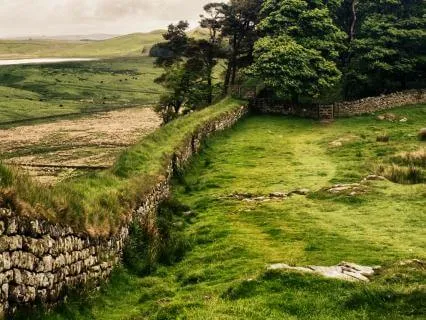
Somewhere in the distance stands the line of Hadrian's Wall,
One of the most famous frontiers of the Roman Empire.
The wall is not alone.
It is part of a wider world of forts,
Roads,
Mile castles,
Watchtowers,
Ditches,
Settlements,
Storehouses,
Bathhouses,
Workshops,
And muddy paths worn down by years of use.
This is a place of work.
A place of smoke,
Wool,
Leather,
Grain,
Letters,
Footsteps,
And rain.
Near this frontier stands a Roman auxiliary fort.
Like Vindolanda,
South of the Wall.
Unlike Rome,
It is not a great marble city filled with the grand temples or crowded forums.
It is smaller.
Colder.
And more practical.
Buildings are made for duty.
The walls and gates are made to bring order to a landscape that feels far from the center of the Empire.
Inside the fall.
The morning begins slowly beneath the rain.
Water taps on roofs and runs down timber walls.
It gathers in narrow channels beside the roads.
The air smells of wet earth,
Wood smoke,
Damp wool and leather.
A soldier steps out from the barrack block.
Fastening his heavy cloak.
In Northern Britain,
A cloak is not just decoration,
It is shelter.
Wool holds warmth even when the air is cold.
The brooch keeps the fabric close to the soldier.
The belt gathers the tunic beneath.
His boots already dark with mud.
The road under his feet is not the smooth marble of an imagined Rome.
Is practical.
Stone,
Gravel,
Packed earth,
Drainage repair.
The empire is built not only with monuments,
But with surfaces people can walk on,
Carts can roll across.
And armies can maintain in bad weather.
Much of life at a fort like this is routine.
The popular imagination often thinks of Roman soldiers in battle.
Standing in neat lines under bright sun,
Shields locked and standards raised.
But on most days,
Especially here at the frontier,
Life is quieter.
There is cleaning,
Counting,
Repairing,
Carrying,
Writing,
Waiting,
Watching.
Soldier's cloak must be dried.
Strap must be mended.
Boot must be patched.
Blade must be kept free of rust.
Horses must be fed.
Report.
Must be delivered.
Gate must be guarded.
A storehouse must be checked.
And on a rainy morning in Roman Britain,
The Empire continues through these small duties.
Inside the barracks,
The light is dim.
Few oil lamps still glow.
The men sleep close,
Store their equipment close,
And live according to the order of the unit.
The soldiers stationed here are not necessarily from Rome itself.
Many are auxiliaries,
Recruited from different parts of the Empire.
They may come from distant provinces,
From communities with their own languages,
Climates,
Gods,
And customs.
To be at the frontier.
Is to be far from home.
And yet,
Even here,
The structures of Rome are everywhere.
Orders are written.
Supplies are measured.
Roads maintained.
Buildings repair.
Names recorded.
Messages travel.
The fort wakes in layers.
First the watch,
Then the kitchens,
Then the workshops.
Then the movement of people through the gates.
Rain falls steadily as smoke rises from hearths and cooking fires.
The smoke lifts,
Fades,
And is pulled apart by the damp air.
In the granaries,
Grain is kept raised from the wet ground.
Grain is one of the quiet foundations of Roman power.
A fort cannot function without food.
Soldiers need bread.
Animals need fodder.
Fires need fuel.
Leather workers need hides.
Blacksmiths need iron.
Clerks need writing materials.
A frontier fort is a machine of daily needs.
Every day it eats,
It burns,
And it wears through boots,
Tools,
Rope,
Cloth,
Wood,
And patience.
Every day,
Someone has to count what remains.
The clerk sits in a dry room,
Or as dry as the room can be on a day like this.
Before him are thin wooden writing tablets.
These tablets are one of the reasons we can imagine life in this place with unusual closeness.
At Vindolanda,
Many such tablets survived in the damp conditions of the soil.
They are small,
Fragile pieces of the past,
But they carry voices from nearly 2,
000 years ago.
Not voices of emperors making grand speeches,
Not only laws or official inscriptions carved into stone.
These and more.
Ordinary messages.
Quests,
Lists,
Invitations.
Reports.
Notes between people trying to imagine life.
At the edge of the empire.
Person asks for supplies.
Someone writes about clothing.
Someone sends a greeting.
Someone invites a friend to a birthday celebration.
Someone records what is needed,
What is missing,
What must be delivered,
What must be remembered.
This is one of the most human things about Roman Britain.
The rain,
The mud,
And the distance from Rome did not erase ordinary life.
People still needed cloaks,
Food,
And news.
On the frontier,
Writing becomes a kind of thread.
Ties people to one another across roads and forts,
Across duties and seasons,
Across the distance between one post and the next.
Imagine one of those tablets resting on a table while the rain taps on the roof above.
The ink is dark.
The wood thin.
The message practical.
Perhaps it asks for more clothing before the weather worsens.
Perhaps it records supplies in storage.
Perhaps it carries a personal greeting from one household to another.
Outside,
A courier may be waiting for the weather to ease.
Or perhaps he will go anyway.
The empire does not stop because the road is wet.
Beyond the fort gates the world is not empty.
Around many Roman forts,
Civilian settlements grew.
Traders,
Craftspeople,
Families,
Innkeepers,
Labourers,
And local people gathered around the military presence.
Where soldiers are stationed,
People come to sell.
Where people sell,
Others come to repair.
Carry,
Trade and build.
Thought creates its own small economy.
On this rainy day,
Outside the gate,
A workshop is open.
The doorway is dark but within it.
The worker sits near the light,
Repairing leather.
There are shoes to mend,
Straps to stitch,
Harnesses to check.
And melts to strengthen.
Leather is everywhere in Frontier Life.
It carries,
Fastens,
Protects,
And of course,
Wears down.
Roman Britain is both local and imperial.
It is local in its weather,
Fields,
Animals,
Rivers and older communities.
It is imperial in its roads,
Coinage,
Administration,
Army and trade.
Hot may be made nearby,
Its style may come from Gaul.
God may be honored under a Roman name and a local name together.
A soldier may have been born far from Britain,
Serve under Roman command,
Eat local grain,
Wear a cloak suited to northern rain,
And write home in a language that carries his world across the empire.
This blending is part of what makes the frontier real.
It was not Rome copied perfectly onto a new landscape.
It was Rome adapting,
Absorbing.
And organizing.
And Britain in turn shaping the daily life of those who came here.
The rain continues.
Softens the road,
Darkens the timber.
And gathers in hoofprints.
The cart arrives slowly through the wet.
Its wheels press into the mud beside the road.
Perhaps it carries grain.
Perhaps pottery.
Perhaps firewood.
Perhaps lettuce.
Perhaps something for the commander's household,
Or for the settlement beyond the walls.
Driver pulls his cloak closer.
The animals breathe steam into the cool air.
At the gate,
A guard checks the movement in and out.
Not with drama or urgency.
Just as a part of the day's rhythm.
Entry.
Exit.
Names.
Loads.
Messages,
Duties.
The Roman frontier depends on such ordinary acts of control.
The thought itself has a pattern.
There is a headquarters building,
The administrated heart of military life.
There are barracks for the soldiers.
There are storehouses and workshops.
There may be stables.
There is space for command,
Discipline,
Records and repair.
Everything has a place.
And in that order,
Rome makes itself visible.
Even in the rain and the mud.
Even hundreds of miles from the city whose name it carries.
Somewhere within the fort or nearby.
A household goes about its morning.
Officers could have families.
Women are present in the social world of the frontier.
The Vindolanda tablets remind us of this through personal messages.
Birthday Invitation Greeting a note between women connected to the military community.
Small traces.
They show that the frontier was not only a masculine line of defense.
It was a social place.
Place of households,
Relationships,
Obligations,
Celebrations.
And loneliness.
Imagine a room warmed against the weather.
A lamp on a table.
Garment folded over a chest.
A message waiting to be sent.
The sound of rain beyond the doorway.
A woman may be managing part of a household.
Speaking with servants.
Receiving news,
Planning a visit,
Or sending a note to a friend at another fort.
She may be far from the more comfortable centers of Roman life.
She may be used to the north by now.
Or she may still feel its distance every time the weather closes in.
On such a day.
A message.
Is more than information.
It is company.
It says,
I remember you.
Come if you can.
Send what is needed.
Right back.
As the rain keeps falling.
By midday the fort had settled into work.
In one place,
Tools are being repaired.
In another,
Food is being prepared.
Another writing continues.
Soldier scrapes mud from his boots.
Another checks the condition of a shield or strap.
Someone carries a bundle of wood undercover.
Someone curses softly at the weather,
As people have always done.
In the settlement outside,
Local Britons and people from across the Empire may pass one another beneath awnings and dripping eaves.
There are accents here.
Different ways of speaking.
Different habits.
Different gods.
Different memories of home.
Late in the afternoon,
The air grows colder.
The light fades early in the north.
Forts bathhouses begin to feel especially inviting.
Roman bath houses.
Were not only about washing.
They were about social places.
Cultural places.
Places of warmth and routine.
At a frontier fort,
A bathhouse could be one of the clearest reminders of Roman comfort.
Outside,
The road is wet.
Inside,
The air is warm.
Steam rises from heated rooms.
Oil lamps glow softly against the damp stone and tile.
The sound of water changes the mood of the day.
The rain outside is cold and persistent.
The water inside is controlled.
Heated.
Held within walls.
Man steps into the warmth and feels the chill of the road begin to leave his body.
Conversation lowers.
The body relaxes.
Mud is washed away.
Muscles soften after duty,
Walking,
Lifting,
And standing watch.
There is something deeply practical about this comfort.
The edge of the empire.
Warmth,
Cleanliness,
And routine are important.
The bathhouse is a reminder that Rome did not only build walls.
Build Habits.
Built systems of daily life that people carried with them into distant places.
Outside,
Rain gathers on the roof.
Inside,
Steam gathers near the ceiling.
For a little while,
The harshness of the northern weather is held at a distance.
As evening approaches,
The fort begins to quiet.
The last business of the day is finished.
Record is set aside.
Tool is put back in its place.
Cooking fire is lowered.
Animals settle.
The road beyond the gate grows emptier.
In the barracks,
Damp clothing hangs where it can dry.
Boots sit near warmth,
Not too close to the fire.
Cloak is folded.
Belt is unfastened.
Someone eats the last of a simple meal.
Someone speaks quietly of another posting,
Another province.
Another season.
Somewhere in the headquarters building,
The day's records wait for morning.
Somewhere nearby,
A writing tablet lies dry enough to travel.
Perhaps tomorrow it will be carried along the road.
Perhaps it will ring a request,
Greeting an invitation.
Or news.
Perhaps many centuries from now,
Something like it will be found in the wet soil.
And read again by people living in a world that's righter.
Could never have imagined.
For now.
It is only evening.
Only rain.
Only the edge of the Roman Empire settling into sleep.
The wall lies quiet in the distance.
The Roads of Dawn.
The granaries hold their stalls.
The bathhouse calls.
The hearths glow low.
The fort rests beneath the weather.
And the rain continues,
Steady and soft.
Over the northern hills of Britain.
Allow the story to fade now.
Allow the old road to disappear into the dark.
Allow the lamps to grow dim.
The voices.
Become distant.
There is nothing more to follow tonight.
Only the sound of rain.
Only the hush of wind over the frontier.
Only the gentle,
Endless weather.
At the edge of the empire.
And as the fall sleeps.
The rain remains.
Softly.
Steadily.
Through the night.