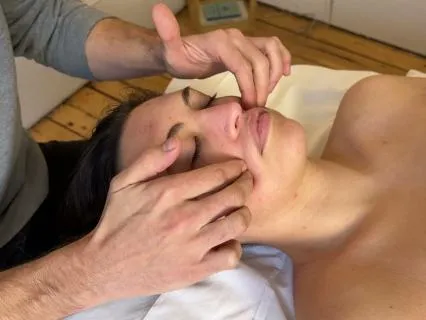
We've done the assessment and we've looked at the individual techniques that you can do.
For this,
We're going to do a general massage,
Something that you could do on anyone with TMJ pain.
We're going to start with some myofascial techniques,
And then we're going to get into the soft tissue techniques.
Okay,
So just so you guys know,
This is my cat,
Mr.
Nelly.
He's gonna be lying on my client's lap.
So we're having a bit of fun here.
So as I do this massage sequence and we learn the techniques,
Just know that if you hear a meow,
It's Mr.
Millie.
So I like to start my massage sequences with the TMJ off with a little bit of a myofascial kind of stretch to the soft tissue style techniques.
Now,
Of course,
Face massage is really going to be something that's very nice when you're working with the TMJ.
What I like to do is work around the zygomatic arch.
I'll just do some soft fingertips,
Very gentle at first.
And it's nice to work around the zygomatic arch because of its relationship with the masseter and also where it is in proportion to it.
What I like to do is you can kind of sink in here just underneath the cheekbone.
And just hold there.
Give the muscles time to relax underneath your fingertips.
So I'll just have two fingertips there and I'm kind of hooking in quite gently.
And you're just allowing things to soften.
Now once you feel things soften up there,
You can move out laterally towards the masseter.
And then hold and allow for another myofascial stretch to the soft tissue.
After you've felt like that's relaxed,
Then you can go in and just along the master.
Just provide a nice light.
Slight,
Soft traction.
You're bringing down the client's nervous system.
You're communicating.
With the body and the nervous system.
That it's time to take a break.
And you're just settling everything into a nice relaxed state.
Once you feel like there's a nice stretch that's been done there.
Then I like to go up and work around the temporalis.
I have no oil on right now,
Just so you guys know.
So I'll start at the middle of the forehead.
It's nice and gentle move up towards the temporalis.
I'm using the pads of my fingertips.
And then I'm just slowly sinking in with my breath.
With her breath.
And I'm providing a nice stretch to the temporalis fan.
And you're slowly allowing your fingertips to move at the rate at which the tissue allows them to move.
Try not to force anything here in the beginning.
This is all about bringing the nervous system down and relaxation to start.
But at the same point we are specifically targeting the muscles that could cause issues for the TMJ.
Once you've done some nice stretches around the masseter,
Around the zygomatic arch,
Around the temporalis,
After that is when I'd go in and start doing some soft tissue techniques.
So after those introductory techniques are done,
That's when we'll go in and work the soft tissue.
As you guys know,
I'm a pretty systematic person,
So I like to go about this in quite a thorough,
Systematic way.
So usually I'll put some fractionated coconut oil on my hands.
And then just Spread the oil throughout the upper traps,
Into the neck and then a little bit over the chest as well.
Now you don't need too much oil here.
But that's up to you guys to figure out what amount you like.
So I'll take my fists and then I'll place them on the upper traps.
And then what I'm doing here is just a nice stretch technique.
So you're warming up the tissue,
Nothing too deep to start and you're just stretching out the upper trap muscles with some nice little twists of your fists and stretching all the way down and then you could even follow that a bit into the triceps.
So sink into the muscle.
Allow it to relax and we know that the upper traps have a tight close-knit relationship with the neck.
And the neck has a close-knit relationship with the jaw,
So we need to work all these different muscles.
So I'm moving down and just down the triceps.
Routing a nice little stretch from the upper traps all the way into the cervical spine.
And then spread out laterally the fingertips across the base of the ox foot.
To stretch out and warm up the suboccipitals.
I'm going to start with some trigger point techniques.
At the beginning,
Because you don't want to aggravate things too early.
You're just getting a nice overall treatment for all the muscles that you're going to go in and treat.
I don't know if you guys do this,
But as I'm treating,
I also like to assess,
So I'm assessing as I'm treating.
And I'm also telling the client before the treatment to let me know if they feel like there's any referral pain or any tender or trigger points that they notice as I'm working through the muscle.
Because the pecs have such a close relationship with having forward head posture,
Which is what you're going to see in a lot of clients that come in with TMJ pain,
I always like to do some techniques to bring some kinesthetic awareness.
To the client.
Of how tight the pecs are and how the shoulders are rounding forward.
A lot of people don't notice but when you do this and you work the muscles it brings their awareness to how tight their chest is.
So I like to just roll up,
Slowly spreading out with just a slight bit of oil or cream.
And I'm stretching up.
From the pectoralis all the way into the anterior deltoid muscle.
So I'm anchoring down.
And then slowly,
Slowly,
Slowly.
Stretching all the way up.
And then a nice broad contact with the palm of my hand to work over the anterior deltoid.
I'll do that on both sides.
Just to make sure that Everything is even,
And also once again,
You're assessing as you're treating.
If this is the first time the client's come to see you.
Clients want treatment.
I like to give it to them so you want to assess their packs,
See if their chest is causing them to move.
Round forward,
Tension from everyday life.
And these are things to note in your files as you're treating the client if you notice upon the first treatment that the pecs are really rolled forward.
But it's always a good.
Thing to do is to treat the pecs first.
Bring the chest down and relax all of those muscles.
So we just did the traps,
We did the pecs,
And now we're going to work up into the neck.
So just slowly slide your fingertips up either side of the cervical spine.
And then fan them out.
When you're towards the base of the ox foot.
So I'm going up the cervical spine here and then fanning out.
Up the cervical spine,
Fan out so the neck is nice and relaxed.
You can even do the technique where we slowly glide up either side and then we drop our hands down into the table stretching out the suboccipitals,
And then.
.
.
Down and back.
Once the chest,
The shoulders,
The neck is relaxed,
That's when we can go in and start working on the face and the jaw.
Just simple,
Go on either side of the jaw.
And just slowly bring your hands up.
Working nice and slow,
Working with the nervous system.
Making sure the client's nice and relaxed.
And you're just working all those muscles,
The masseter.
Up into the TMJ joints.
And then down and across the forehead.
Into the temporalis.
Working around the fan just relaxing everything in that area.
You can even go down and work in the zygomatic arch again.
But this time we have a little bit of oil on our hands.
And there's a little more glide and the muscle has already been softened up so we can provide a slight bit more pressure.
Once we've done that,
We can glide up the masseter.
Into the TMJ joint.
And then we can reverse direction.
And glide down.
So here I would get the client to slowly open their jaw.
And as they do that.
.
.
Colliding down.
The masseter muscle and you're going to feel it firing as they open their mouth.
And then.
.
.
Relax.
You can also do this with your hands on either side and you're kind of using the palms of your hands.
And I'll get you to open your jaw.
And as they open their jaw,
Using the palms of your hands.
To stretch down the TMJ.
And then back.
So yeah,
When you're thinking about massaging the TMJ,
You also want to do a nice facial massage.
Relaxing everything in the forehead,
The cheeks.
And just remembering that everything is connected.
Sometimes people with TMJ pain are going to have pain that kind of goes into their eyebrows and their eyes,
So it's really nice to do.
Some nice relaxing massage techniques in this area.
I like to do a technique where I take two fingers,
Go up the forehead,
And then with three fingers go down and across the scalp.
Just remember that people.
.
.
With TMJ issues are going to have a lot of tension in their scalp as well so you can do some nice stretches and holds.
You don't want to pull their hair,
You want to make sure they're comfortable.
Some people,
Once again,
Will have more sensitive uh.
.
.
Sensitivity with if their hair is more brittle so just make sure that you are very cognizant of that when you're using those myofascial stretches up into the scalp.
So once again,
We're working the digastric.
With one fingertip you can get the client Come this way and extend the jaw slightly.
You can do some nice little spreads just below the mandible.
And up the angle.
You want to make sure that when you're doing a massage for TMJ pain that you work along the mastoid process into the SCM.
So some nice circular kneading around the mastoid process to help relax everything in that area.
Is really,
Really nice.
You can do a very superficial stretch down the anterior neck.
And work around the mastoid process.
Now you can do a technique where you stretch into it and then pull back.
So nice little zigzags around the scalp.
And this is really good for unhooking some of that glued soft tissue and fascia to the mastoid process,
Which can happen to the bone.
A lot of times tissue adheres to the bone,
So you want to make sure that you work that area with some nice kind of zigzags just to help break up all those very specific adhesions.
That can amass around the bone.
You can even work a little bit behind the ear.
Just using a couple of fingertips.
And that's also working the posterior portion of the temporalis.
You want to make sure when you're doing the massage that you do both sides.
And that everything's kind of even.
So just think of this,
Guys,
As like the template of kind of the standard basic massage you could do for TMJ.
And then all those individual techniques are the ones that you would use for specific issues if you suspected something from your assessments.
So once you've relaxed around both mastoid processes,
We've got the pecs,
Upper traps,
Face,
All along the masseter,
Around the neck in the mastoid processes.
Then you've had sort of this nice overall approach.
For the TMJ.
What I like to do is I'll follow that step-by-step,
So I'll do the myofascial release.
Techniques as my opener.
Then I'll go in,
Upper traps,
I'll do the spreading along the pecs to bring the shoulders down.
And then once the shoulders are down,
Traps are relaxed,
Face is relaxed,
That's when I would go in with the specific individual techniques that I taught you guys.