Namaste and welcome.
Welcome to Yoga for Beginners.
This is a four-class series.
This is class number two.
If you missed class one,
Don't worry,
We'll catch you up.
My intention with this series is to introduce you to very basic yoga postures,
A little bit of breathing.
How to relax and,
You know,
To give you a little bit of insight as to why I love to practice yoga,
What it does for me.
Hopefully it's something that you enjoy as well.
So for me,
Yoga is definitely a way to make a transformation.
We make a physical transformation in the body.
We open up the heart and the mind.
I think our view of the world can expand.
So when you want to make a transformation,
You can't just set an intention and sit back and wait for the universe to do all the work.
You have to engage and you have to take action.
So it takes commitment to do the work to get what it is that you want.
And in our yoga practice,
It's similar.
We can't just say,
Oh,
I want to.
You know,
Do this triangle pose.
Um.
.
.
Yes,
That's how we start.
We start opening to the possibilities.
We talked about that last one.
We have to be open and see the big picture.
But then we also have to engage.
We have to use our muscles.
We have to take action.
And this helps us.
You know,
Get stable,
Get strong.
And Get committed.
When you commit to yourself,
When you commit to improving your balance,
To becoming more flexible,
To getting stronger.
You know,
Then you start to see the results of the action.
So today we're going to explore an action called Hugging the Midline.
And hugging your muscles onto your bones.
It's really two actions.
But these are both components of how we engage our muscles.
So the first way really is to just like wrap your muscles around the bone.
So like you make a fist and you tighten up.
You engage the biceps and the triceps.
Like you just,
You feel the muscles just hugging right on and that helps to create support.
And the other way that I like to think about engage is to hug in towards the center.
So if,
You know,
Your arms and legs are out to the side,
You just lightly pull in,
You draw in like from the periphery,
From your fingertips into the shoulder blades,
And that helps to lift your heart.
And you just,
You get more,
I don't know,
It's like you're recruiting all of your muscles.
So we want to do that in our poses today.
So take a seat.
And when you sit,
It's good to sit.
I keep backing up here.
It's good to sit up on something.
You can sit cross-legged if that works for you.
You can sit with the ankles stacked one in front of the other and the knees go a little wider.
You could also sit,
It's fine to sit with your legs extended out in front or even up in a chair if the floor is not up.
Comfortably working for you today.
And then once you're seated,
We do this little movement.
We roll the thigh bones in.
So you grab hold of your thigh on the top and from underneath,
And you turn the whole leg.
Inward and make an inner rotation.
Then you set that sitting bone back down on your blanket or on the floor.
And you do the same thing on the other side.
You try to move the whole thigh in.
And then set it down.
What that does is that creates space in the pelvis.
Pelvic bones widen,
And you get a little curve in your low back.
So this helps to set up for your posture,
Good posture.
Join the thumbs and index fingers together,
Palms face down,
And then lift up through your side breath.
Take the shoulders back.
And lightly hug the arms in.
So right away,
We start to hug in towards the center,
Towards the middle.
And here you can close your eyes.
And.
Focus on your breath.
As you take some deep breaths,
Invite the breath to come down deep into your lungs.
You fill your lungs from the bottom all the way up to the top.
And as you exhale,
You soften.
Because if you engage your muscles too much,
You create too much tension in your body,
That's not so good either.
You start to feel tense.
Okay.
It's like too much,
Too much stress.
So we need to.
Engage just enough to find that place of strength and stability,
But then not over engage and over work.
So a big part of yoga is also about letting go and finding a place.
Peace and serenity in the body.
We'll practice a breath technique today called ujjayi breath.
And I need to adjust my microphone setting here.
There we go.
So Ujjayi breath.
Is the word Ujjayi Muse uplifting or victorious?
And it's a breath that you just lightly engage.
You lightly tone the muscles in the base of your throat so that you can hear the sound of the breath.
If you were to do ujjayi with your mouth open it would sound like this.
You make the shape of the letter H in the back of your throat,
And the air passes across.
Back of the throat you hear it it feels like a little scraping But we do it with the mouth closed,
So you're breathing in and out through your nose,
But you still keep that open shape in your mouth like you're trying to fog up a.
.
.
A mirror or something.
And you'll still be able to hear the sound.
So it'll sound like.
.
.
And I know it's hard to hear on the Zoom,
But it sounds a lot like Darth Vader.
They sometimes call it the Darth Vader breath,
But it's also the ocean breath,
So it sounds like the waves.
So give that a try,
Either with your mouth open or with the lips closed.
It's easier a little bit to try it first few rounds with your mouth open.
So let's try that together.
Just open your mouth and go.
Like you're saying ha,
But in a whisper.
And then you keep that shape and you breathe in.
And then exhale.
Inhale.
And then close your mouth,
Keep the shape.
Exhale.
Inhale.
And at first,
You know,
Whenever we take on some new technique,
We try to learn something new.
It's challenging.
It's difficult.
It's awkward.
It feels weird,
Right?
But over time with a lot of practice,
This breath becomes second nature,
And you can use it throughout your whole practice.
But for now,
Just take a few more breaths here.
Ujjayi breath,
A little bit of engagement,
Not too much.
If you engage too much,
You close the breath off and it gets stuck.
Ultimately,
The purpose of Ujjayi is to free the breath.
You create a channel for the prana,
The life force,
Energy from the breath to come in and fill your energy body.
Good,
Then let that go.
Come to your natural breath.
And we'll bring our palms together in front of the heart.
And acknowledge that making a transformation isn't easy.
It takes effort,
It takes work.
But when you do it,
You put in the effort,
You put in the work,
Then the universe listens.
It's like,
Oh,
Okay,
She's really trying.
I'm going to step in and help.
And then we do make a big shift.
So with that in mind,
Let's chant an OM.
Om,
Chanting the sound Om represents our willingness,
Our ability to step into this greater flow of universe.
Take a breath together.
And then bow your head to your heart.
When you're ready,
Release your hands.
Gently open up your eyes.
All right,
So let's transform ourselves.
We're going to start standing up today.
And if you have a yoga block,
Then we'll use that.
If you don't have one,
You're going to use an invisible,
Imaginary yoga block.
Zoom out here.
Okay,
So.
Mountain pose.
Mountain pose.
Your feet are as wide apart as your hip bones.
Your feet are parallel to one another.
So the toes aren't turned out.
They're not turned in.
They're just neutral.
If you drew a line from the middle of your ankle to the base of your second toe on each foot,
You'd have a parallel line.
You put your block in between your thighs.
And you put it the longest way.
So you've got the whole length of the block between the thighs.
And this gives us something to hide in.
And if you don't,
Like I said,
If you don't have a block,
You just hug into an invisible block.
So you squeeze the block.
And then imagine you had another block between your shins.
Squeeze the shins into the floor.
And this helps us find the center.
When we come into the center,
We think of the heart,
And we think of being centered,
Coming into the place in the middle.
And from the center,
You lightly expand out.
To broaden the shoulders,
Open the heart space.
Keep hugging your block,
And now as you inhale,
Reach your arms out to your sides and stretch the arms up alongside your ears.
And then exhale,
Turn the palms away and float your arms back.
Bring the hands.
To the heart of center.
Continue this a few times.
Inhale,
Reach out and up.
Now if you could use the ujjayi breath here as you move,
That's a bonus.
If not,
Don't worry about it.
Focus on squeezing the block.
Inhale,
Reach up.
You can now lift your head,
Look up between your hands.
Then exhale,
Release,
And bring your awareness back to your center.
One more time,
And now reach up.
And exhale.
All right,
Keep the block between your legs.
Or your invisible block.
And one more time,
We're going to reach the arms up.
I'm going to turn sideways here.
Reach your arms up.
And now as you exhale,
Bend your knees slightly.
Hinge forward and keep squeezing your legs towards each other.
You're going to bring the hands down.
If you can't reach the floor,
You can bring your hands to your shins.
Or if you have another yoga block,
You can put your hands on the block or fingertips can touch.
All the way down.
And continue to hug in,
So squeeze the block with your thighs.
And then think of wrapping all of your leg muscles around your leg bones,
So they're just kind of 360-degree shrink wrap,
And that makes your legs strong and powerful.
It makes you feel like you're ready to make that transformation.
You're ready to make things happen.
You are engaged.
Take a breath.
Look up halfway.
You can bring your hands up onto the thighs.
Draw your little back in.
Continue to squeeze the block.
And then exhale and round and bring the hands down.
Again,
Inhale,
Look up halfway.
If you can keep the hands on the floor and just stretch the spine,
That's an option.
Or you bring the hands up.
And then exhale and fold.
Good.
When you come all the way up now,
Engage your legs.
Push down into your feet.
Reach your arms out.
Lead with your heart.
You come up with straight back.
And then exhale,
And we'll bring the palms together.
The Heart Center.
Fantastic.
Alright,
Let's move this block out of the way.
And we're going to keep.
.
.
Keep that imprint of the block between your legs.
We'll keep coming back to the idea of hugging it.
So then come on up towards the front of your mat.
And bring your palms together,
The heart center.
Stand in mountain pose and set your intention.
What is it that you're ready in your life to transform?
Maybe it's your physical being,
Your physical body.
You want to make a shift.
Maybe it's something in your life,
Something with work,
Something with your relationships.
There's something.
We're always wanting to make a shift.
So think like what's important that you're ready to take action.
To make a difference.
And we set our intention there.
Hug in strongly.
Fire up your strength.
And here we go.
Inhale,
Reach your arms up.
And then exhale,
Fold forward.
Squeeze your legs in towards the middle.
Take a breath,
Lift your chest.
And now.
.
.
Bring your hands to your hips.
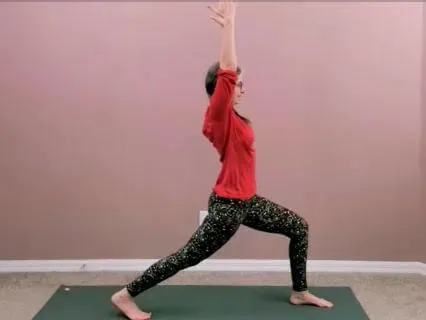
Step your left foot back into a lunge.
Stay up on the toes.
And then squeeze your legs.
So we wrap the muscles around the bones and then hug your legs towards the middle.
If you can take a bigger step here,
You can get a little deeper.
You can try to get this front thigh more parallel to the floor,
And it's fine to be up a little bit higher,
Too.
What we want to avoid is the front knee going past the ankle.
So you want your shin vertical,
And that's going to be the healthiest alignment for your knee safety.
Okay good reach your arms up And the more you have the legs in,
The easier it is to move the upper body.
So the engagement creates stability.
And then we have more freedom.
Release your hands to your hips.
So forward,
Back to mountain pose.
Then we'll do the other side.
Inhale,
Stretch your arms up.
Exhale hinge forward come into that forward bend Inhale,
Come up halfway.
Hands to hips.
Now step your right leg back,
Way up on the tiptoes,
Bend into the left knee,
Right over your ankle.
The back leg strong.
You can wrap the muscles around the bones.
Hug to the middle.
Engage strongly.
You're ready.
You're taking action.
Let's transform.
Reach your arms up.
And then push down into the earth and stretch up to the sky.
Take a few deep breaths.
And then release,
Hands to hips.
Push off your back foot,
Step forward.
Release your arms down.
Really great.
So that's a lot like Warrior I,
Which is one of the basic standing poses,
Only we did it with the toes up on the back foot rather than putting the heel down because that makes it easier to keep your hips square.
A similar pose is lunge,
So let's try the lunge.
From standing,
Hands to heart center.
Inhale reach up Exhale,
Bow forward,
Touch down to the floor.
So now we're going to keep the hands down,
Step back with your left foot,
And then walk your hands to either side of that front ankle.
So up on fingertips.
If you need to bring the back knee to the floor,
That's fine.
Another nice option here.
If you have the block,
Is to put your block under your hands.
To give you a little more space,
Okay?
I'm going to keep my back knee off the floor because that way I have to use a little more of my muscle engagement to stay up.
So you squeeze and you hug the center.
You draw into your center.
You draw into your capacity to make a shift.
And then from that place of feeling strong and powerful,
You expand out.
You reach back through the back foot.
Forward through the right knee,
Which again is right over your ankle.
Chin vertical and lift your chest.
Take a deep breath in and then give a little push off with your left foot and come back to your standing forward fold.
Inhale,
Rise up halfway,
Long spine.
Now we'll keep the left foot in front.
Take your right leg back.
Sorry.
And then firm your legs.
Again,
Hug the center.
When you hug the sensor line,
The hips will square a little bit more.
So we don't want the right hip going way back.
Try to bring that right hip more forward.
Push down into the feet.
Lift your heart.
You're doing great.
Awesome.
And then we'll push off the back foot again and fold over the legs.
Here we get that great stretch in the back of your legs.
And if you need to keep your knees bent some,
That's perfectly fine.
Bring your hands to your hips.
Of the elbows toward the middle.
Make the commitment to keep your heart open,
Keep a low back curve,
And then root down into your feet.
Inhale,
Come all the way up.
And stretch your arms overhead.
Exhale.
And put your hands to your heart center.
So all these little poses that we're doing here,
These are components of sun salutation.
Which is a 12 move.
And by the end of our four-week session,
We're gonna have all the moves.
Put it all together.
So another.
.
.
Another pose we need to be able to do that well is the downward facing dog.
So let's work on that one next.
So come down to your mat and start.
In a table pose.
I'm just moving my blocks out of the way here.
So table pose.
Your Wrists are underneath your shoulders.
Line up with that outside of the shoulder.
So if your hands are close together here at that.
.
.
Doesn't create a really good alignment in your shoulder,
So you want the hands.
They might go all the way to the edges of your mat,
Depending on how wide your mat is and how broad your shoulders are.
And that's okay if the pinky fingers are right at the edge.
And then the crease of your wrist on your hand.
Is parallel to the short.
End of the mat.
Now we want to engage the arm.
With that remembrance of the transformation that you want to make,
Claw the mat.
Press into the finger pads.
Press the roots of your fingers where the finger meets your palm.
You had a good connection there to the earth.
And then the arm muscles will wrap around your arm bones,
And you can even draw energetically up from the palm all the way up into the shoulder.
So your arms are strong and solid.
Walk your knees back three more inches from your hand.
Curl your toes under.
And here comes down dog.
Lift your knees up.
And so we pull in.
We hug the middle.
Squeeze your hands towards each other.
Find your center.
And draw up from the hands up into the heart.
Hug your legs towards each other.
Imagine you still have that block between your thighs.
And then from the heart,
Stretch.
Push the floor.
Push into your fingers.
Reach your heels back and down.
Heels are not going to touch the ground,
But they're stretching back.
Keep a little micro bend.
In your knees,
And this is down dog.
Good,
And then lower your knees to the floor.
So then you can just sit back on your feet for a moment.
An option,
If down dog is,
Like,
Really intense in your wrist,
There's a variation in this pose called dolphin.
So let's do that one,
Too.
Dolphin is on your forearm.
So instead of being up on the palm,
You come down elbows now.
As wide as the shoulders.
You interlace your fingers together and press your wrists into the floor.
So here you hug in,
You squeeze your arms in,
You hug your elbows towards each other.
Soften your heart a little bit.
Remember,
We don't want to be too rigid.
We want that heart to open.
And then lift your knees.
And stretch.
And the stretch comes from your heart.
You push down into your arms,
And you keep your shoulders back behind your elbows.
You're reaching the chest towards your legs.
You push the floor.
You lift the seating bones up toward the sky.
The hips are way up.
Heels stretched down.
And this pose really helps to build upper body strength and flexibility.
So it's a great confidence booster.
It gets your energy up.
Make sure you're breathing well in and out.
Good,
And then we'll bring the knees.
Now let's take child's pose.
Separate your knees a little wider.
Big toes go together.
And you set the hips back towards the feet.
Release your arms out in front.
And bring your forehead down.
If your forehead doesn't come all the way to the floor,
You can stack your arms.
And rest your head on the back of your hand.
If your hips don't go all the way to the feet,
It's fine if they're up a little bit.
Okay,
So this is fine here.
You just want.
.
.
Where you feel like you're not having to use your arms and you can rest.
Catch your breath and soften.
When you over effort and you try to force a transformation to happen.
It usually doesn't work so well.
Like we get,
I don't know,
We get burnt out.
Okay,
Really good.
So that was the down dog and the dolphin.
Let's try a variation okay we're going to take One leg.
Up in the air.
So you'll either be a dolphin or downward dog.
So you can choose.
I'm going to do the downward dog.
It gives me a little more space,
And it really opens the shoulders really well.
So set your foundation of your hands.
Claw the mat.
Hide to the midline.
Toes turn under.
Lift your knees,
Lift your hips.
In downward facing dog or in dolphin.
Connect into the center.
Remember your intention to transform your body or your mind or your life.
Notice how that makes you feel.
More alive,
More committed to yourself.
Now,
Continue to hug the legs towards each other like you had a block between your thighs,
But then lift your right leg up behind you,
And you bring the foot up.
So your leg makes a straight line with your torso.
Keep your hips facing down,
So we're not twisting or turning.
You just lift straight up.
One-legged dog.
And then bring that foot back down to the mat.
Good.
Let's go right to the second side.
Take your left leg up.
You roll the thigh in as you lift.
Push the floor with your hands.
Push your toes of your left foot up toward the ceiling.
Incredible.
Well done.
And then bring the foot down.
And again,
Let's take your child's pose.
Knees to the mat.
Reach your hips back,
Arms out in front.
Forehead down.
And rest.
And appreciate the effort that it takes to do these postures,
These poses.
Not easy.
But it's rewarding.
And it builds your strength.
It builds your.
.
.
It makes you more flexible.
Super.
Alright,
Let's come back up to standing now.
So any way you can get there.
You can use your blocks.
You can use a hand on the thigh here.
My stomach's growling.
Okay.
So let's review from last time we did,
I believe we did this side angle pose.
This is a great kind of all-purpose generic standing pose.
It opens the hips,
It opens the shoulders,
And it'll give us an opportunity to practice this idea of hugging into the middle.
Even when our legs are wide apart.
So take your feet nice and wide on your mat.
And if you can,
You want the ankles to line up under your wrists when your arms are out to the sides.
And if that feels like,
Well,
That's too wide,
Then you start in a little bit closer.
Bring your hands to your hips.
Turn your right foot out 90 degrees.
Your left foot is now perpendicular to your right foot.
And heel of your right foot.
Lines up to the middle.
So right in the center of your arch.
So you don't want like any crisscross happening here.
All right,
So here we go.
First,
Take a breath,
Open.
To the possibilities that you can transform yourself and your life.
Because you can.
According to yoga philosophy,
You're the only one who can.
Okay,
So then embrace that.
Hug your muscles to your bones.
Bend your right knee right above your ankle.
And if you need to adjust the width of your stance,
If you need to make it wider,
Or if you're like,
It's too wide,
I need to bring it in,
That's fine.
I'm going to find somewhere in the middle.
Works in my body.
And then we'll take the right forearm here onto your thigh,
Left hand to your hip.
With the legs engaged,
Squeeze your feet towards each other.
Imagine you could wrinkle up your mat in between your feet,
And,
Like,
That's how much we need to work the legs.
To create steadiness and to keep from falling over.
Move the thighs back a little bit.
Now scoop your tailbone under.
When you scoop the tailbone,
You get more length.
In your low back.
And then for shoulder integration,
We draw the shoulders toward the ears.
Take the shoulders back,
Both of them,
Even this bottom one.
And then we'll stretch the left arm up alongside your ear.
Your palm faces down.
And now we made this nice long line from the left foot all the way out to the left fingertips.
So you stretch along that line.
And you breathe.
And you feel it.
Feel your muscles working.
Feel how engaged your muscles are.
Your body is getting stronger.
You're getting more powerful.
You're opening up channels of energy all around this hand here and just relax.
On your next inhalation,
Push down into your feet,
Lift up through the arms,
Release.
And then we'll go to the second side.
So we'll turn the right toes in.
So your foot is parallel to the back edge of the mat.
Turn your left foot out.
Heel to arch.
Bring your hands to your hips,
Take a breath.
Firm your muscles around the bones and then bend the knee.
Bring the left forearm down now.
Remember that you're part of a bigger energy and that when you put your effort out into the universe,
The universe and that's when,
Like,
Those,
You know,
Coincidences start to happen.
Like,
You meet just the right person or some opportunity comes up,
And it's,
Like,
It's totally in line with what you want.
If you don't put in the initial effort,
They're like,
That tends to happen less.
Okay,
So squeeze your legs in towards each other.
Take your thighs back so you line up the hips more in line with the ankle.
And then scoop the tailbone.
Lengthen through your side ribs take the shoulders back And then we'll stretch right arm.
Over your ear.
Push down from your pelvis into your feet.
And from your pelvis,
Extend up and out through your head,
Through your hand,
Through your fingertips.
Follow your breath in and out.
And then press down into the floor and inhale.
Float yourself back up.
Release your arms turn the toes and And then step your legs together.
And back to Mountain Pose.
Close your eyes.
Feel the steadiness,
Stillness of the mountain.
Mountains are strong and powerful.
And so are you.
Because we resonate,
We align with nature.
All right.
Let's try another Oh.
Okay,
So we're gonna come into tree pose.
This is a great pose for accessing this idea of hugging into the middle.
Tree pose is balancing on one foot pose.
And in order to do it well.
You might need something to hold on to.
There's a few different levels we can try.
The first one,
We'll have both feet on the floor and then our second variation,
Second time we go through,
We'll bring the leg up a little higher.
So I like to do this with one hand at the wall.
I'll have my right hand at the wall.
You stand on the right foot first.
So you place your foot down.
You set your foundation just like you set your intention.
And then.
.
.
Think of a tree and the bark around the tree.
Like you just hug the bark onto the tree.
So you hug,
You wrap.
The muscles of your right leg around your leg bone.
And take the left knee out to the side.
We're going to start with the toes on the floor.
And your heel up against your inner shin.
So it looks like this.
And then you're holding on to the wall for stability.
If you need it.
If you don't,
You can let go.
And then we bring the palms together in front of the heart.
So we've got two different ways of engaging here.
First is the muscles wrap around the bones.
Standing leg especially,
And then with the hands.
And with the legs.
Hug into the midline,
Hug into yourself.
Then you push down into your right foot.
Lift up the heart.
Take the shoulders back.
With your eyes,
It's helpful if you look down at the floor.
That is one.
Bottom of the floor about.
Five or six feet out in front of you.
And then make sure you keep your breath flowing.
Okay,
So important.
We don't want to cut off the breath.
Breath brings oxygen and prana,
Life force energy into every part of your body.
Good,
And then release your hands and stuff your foot down on the floor.
And just shake it out a little bit,
Walk it out.
Notice how much energy those muscles had,
Like how much work they were doing.
And then we'll go to the second side.
So now we'll balance on the left foot.
Left hand is at the wall if you're using the wall.
Spread your toes.
Bend the right knee out to the side,
Toes stay on the floor,
Heel comes up against your inner shin.
Wrap muscles around the bones and then find your center.
Come back to your intention,
Come back to your heart.
What do you want?
How are you ready to make a shift?
And if you feel balanced,
You can bring the palms together in front of your heart.
And the toes on the floor,
Just give you a little extra feedback,
A little more stability.
A little more awareness.
Of the earth.
Great,
And then release.
Bring your hands down,
Step your foot down.
Very nice.
All right.
So second variation,
Tree pose.
In Sanskrit,
This pose is called vrikshasana.
Vriksha is a tree.
Vriksha is a tree.
And.
We'll practice this a little more challenging now.
Bring your right hand to the wall.
Wear your feet in parallel.
Hugged in the blind.
Wrap the muscles around your bones.
Bend your left knee out to the side and bring your foot up to the heel.
Either comes below your kneecap or you reach down,
You pull it up above your knee.
And the higher up you go,
The more challenging it's going to be.
All right,
So hug the muscles onto your bones.
Hug the midline.
Push your foot into your leg,
But also pull your leg against your foot like you had.
$100 bill you're trying to hold there.
You don't want to drop it.
Basically squeezing,
Hugging.
Eyes down on the floor.
If that feels comfortable,
You can look straight ahead at eye level.
It's a little more challenging on the balance.
And then you can keep the hand at the wall or.
.
.
Bring the palms together in front of the heart.
Now you're going to feel your right foot.
Moving it's like trying to correct for your balance If that's happening,
That's fine.
If you need to set the left foot down to get stable,
That's fine.
You can come back to toes on the floor.
Or try again,
Come back up.
Because we know transformation doesn't happen all at once.
It takes time,
Takes repetition,
Takes effort.
And if it's something that's worthwhile,
Then it's worth.
Sticking with it's worth making a commitment to.
Commit to breathing here.
Don't stop breathing.
Don't hold your breath.
It's very difficult to hold the breath when you're trying to balance,
But you need the oxygen,
You need the breath.
Awesome,
Release your hands,
Stuff your foot down.
Good.
And you can feel like that right leg is stronger already.
The muscles are working.
Walk it out a little bit.
And.
Come back to Second Side.
So let's talk a little bit about the foundation of the foot that you're standing on.
We talked a little bit about foundation last week.
We want to spread the toes wide.
So you activate the arches in your foot.
You want all five toes on the floor.
And you want even weight in the front of the foot and the back of the foot,
In the inner edge of the foot and the outer edge of the foot.
So if you picture your foot as a rectangle,
You want all four corners evenly placed on the floor.
Left hand on the wall.
As you write me.
Take the foot up either below the knee or reach down and bring your foot up above your knee.
You don't want to jam your foot right into your knee.
That just puts too much pressure there in the joint.
So.
Take a breath.
Remember what's important to you.
Remember what you want to shift in your life and embrace it.
Hug into it.
You have the power.
To transform.
If you feel steady and balanced,
You can bring the palms together in front of the heart.
Like a tree,
You send your roots down into the earth.
And then you grow.
You lift up through the torso,
Reach up through the top of your head.
Breathe and enjoy.
And we learn to enjoy the wobbles and the challenges.
In our practice Terrific.
Release your hands down,
Step your foot down,
And just kind of walk it out,
Shake it out a little bit.
All right.
Let's come back to the mat.
So come on down.
Here's your table pose.
And let's try a deep one.
Okay,
We'll do a deep lunge and reach the arms.
Step your right foot.
In between your hands and come up onto Fingers crossed.
If you need more space,
The blocks are really good for this.
You put a block under each hand and that gives you a little more room.
We're gonna keep the left knee down on the floor.
But engage your legs.
Hug the muscles onto the bones.
Hug the midline so the knee doesn't go out to the side.
Keep it straight in front of the hip.
And then squeeze your front heel.
And your back knee towards each other.
You'll notice that helps you square the hips off.
That create.
A lot of strength in your leg.
In fact,
So much strength in your legs that you can bring your hands up onto the front knee and take your torso up and look straight ahead.
Reach your arms out in front.
Now let's engage the arms.
So hug your muscles to your bones.
Draw the shoulder blades back so your arms feel connected to your torso.
And then reach your arms up.
And from your pelvis,
You root down into the earth and then stretch from pelvis to your spine to your head.
Now,
It starts to get wobbly.
Hug the middle more.
Hug the legs more.
Press your palms towards each other.
That creates more steadiness.
And then release,
Bring your hands back to the blocks or the mat.
And then switch your legs,
Bring your right knee.
Step your left foot forward,
Up on fingertips.
And engage.
Again.
Draw in.
Make a commitment to yourself here.
To be steady even when Things are challenging.
Hug your feet towards each other.
Hug to the middle.
Bring your hands up to the front thigh.
Take your chest up,
Arms out in front.
And then plug in.
Plug the arms back.
Reach your arms up.
And then you sink down so the pelvis goes closer to the earth,
But you reach up to the sky.
Get a great stretch in your back leg.
Hips,
Shoulders.
The ribs We open the heart.
We open to all the possibilities for change and transformation.
Release your hand.
And let's take that child's pose one more time.
So bring the left knee back down.
Take your knees wide.
Just together.
Sit back,
Walk the arms forward,
Lower your head to the floor.
And then let go.
Soften.
Let your body release down towards the earth.
Okay,
So we're gonna move into some relaxation stuff now.
Kind of often is my favorite part of practice,
Right?
Letting go.
So let's take a seat.
And.
.
.
Maybe sit up on your folded blanket or your towel.
And as we did before,
Roll your thigh bones in.
And this really sets us up for good posture.
And place your palms face down on your lap.
Join your thumbs with your index fingers.
This is the.
.
.
Jnana mudra,
The mudra of wisdom.
And our practice helps us draw into our wisdom.
Wisdom of the heart.
So let's come back to the breath.
Add a little bit of the ujjayi sound.
Now our goal is to bring greater peace and greater ease and more relaxation into the body.
So as you inhale,
Visualize energy moving into your heart.
Visualize the heart expanding with peaceful energy.
And as you exhale,
Soften.
Relax your shoulders.
Relax your hips.
All right,
Let's take it Swiss.
So there's many different ways to twist.
The pose that I enjoy is a variation of Marichyasana.
So for Mauritiasma,
Feel bend your knees.
And then stretch your left leg on the floor to front and hold.
The shin of your right knee.
And your foot can be out close to the left knee,
Or if you can bring the foot in closer to your body and keep both hips on the blanket,
Then that works too.
Eventually,
Ultimately,
You want the footing closed.
But if that's not happening today,
Let's take baby steps toward our transformation.
Now what's great about this pose is that it really helps us find the midline,
Helps us hug into the center.
So visualize a column of energy straight up and down from the pelvic floor to the crown of your head.
And then as you hold on to your shin,
You lift up.
Along that central column.
And now the twist,
You bring your right hand behind your back,
You pull on the right knee,
And you revolve around that central column.
So you maintain a vertical spine.
Keep your ears in line with your shoulders.
Keep your shoulders back.
So we're not leaning to the side.
You're just revolving around the center.
And then this knee,
You pull the knee in towards the middle.
That helps you find the center as well.
Your chin stays parallel to the floor.
You can turn your head to the right and look over the right shoulder.
Or just keep your head in the same direction as your heart.
And from the pelvis,
Push out into your left foot.
And stretch up nice and tall as you twist.
Feel your breath.
As it goes down into the belly and up into the chest.
And the twist is a great opportunity to release,
To let go of.
Things that hold you back from making your transformation.
Those are usually things like self-doubt.
Perfectionism.
Um,
Feelings of unworthiness,
Right?
We could let go of those things.
How great would that be?
We could do so much.
And our practice of yoga helps with that.
Helps us remember who we truly are.
Yoga philosophy says you are a divine being.
You're an aspect of this universal energy.
And so you have.
.
.
All the worthiness that you could ever ask for.
You're meant to be here doing exactly what you're doing.
Let's release the twist,
Come back to center.
That always feels so good when you unsqueeze the sponge and you let it go and all the fresh,
Clean energy.
Alright,
Switch your legs.
Take your right leg down.
Bend your left knee up,
Hold.
The front of the shin with your hands.
Take a deep breath and lift your chest.
Take the shoulders back.
Find that central vertical column just in front of your spine.
And then we'll take the left hand around behind you.
Have it close to your body so you're not leaning back.
Your hand is close to your body,
Maybe even up on your blanket that you're sitting on.
And then you use this idea of hugging to the midline.
Pull the knee in towards your chest and turn your chest towards the thigh and revolve around.
The central call.
Shoulders are back,
Ears are back.
Breathe in and down into your belly.
And with each breath in a twist,
Your organs get a massage.
Nice internal massage.
And this is really healthy.
Like the organs get a little squeezed here.
The flow of blood gets a little restricted to them.
So that when you unwind your twist,
When you release the twist,
They get this big gush of cleansing fluid.
Call it the rinse and soap.
Actions of a twist.
I just always think of the twist as I'm wringing out the dirty dishrag and letting go of.
All the dirt,
All the junk that is no longer needed.
And then when you release,
You inhale,
Unwind your twist,
Lift up.
So you make space.
Take both legs long.
Out in front of you inhale stretch your arms out and up alongside your ears And then exhale,
Moving hands down.
Can we come down onto your back now?
Winding down even more.
So bend your knees.
And down onto your back.
Bye.
And let's go ahead and pull both knees up toward your chest.
If it feels okay on your spine,
You can rock a little bit from side to side here.
And this gives the hips and your sacrum.
A little massage on the floor.
No,
Bring the feet down.
And take your feet a little wider than your hips.
Bring your knees together.
Place one hand on your belly and one hand by your heart.
We'll do a three part.
Breath here to help.
Slow down the breath rate and bring more relaxation into the body.
You take a full deep breath in.
Fill your lungs all the way down into the bottom hand and all the way up to the top hand.
And then your exhalation will be in three stages.
So the first partial exhalation,
You deflate the lungs at the top a little bit.
And then you continue to exhale in the space between your two hands.
And then you draw the navel towards your spine and the belly deflates more.
And then there's like no air in your body.
And then inhale,
Fill your lungs all the way up.
So it's three partial exhalations.
Exhale the top of the chest first.
Pause.
And then exhale,
Center of the chest.
Pause.
And then exhale.
Completely.
And deep inhalation.
Okay,
One more.
Exhale,
Top of the chest first.
In the middle of the chest.
And then the bottom,
Pull your navel toward your spine,
Release as much air as you can.
And then inhale fully.
And then do one or two more rounds at your own pace.
This is called the Loma.
Variation B,
The Loma means interrupted.
So we interrupt the flow of the breath.
When you slow down your exhalations like this,
Ultimately,
It allows the parasympathetic nervous system to engage.
So that's the part of the nervous system that is responsible for rest and relaxation.
And we want that to be the active part of the nervous system here because we're getting ready for it.
Our final relaxation,
Which is called Shavasana.
We're slowing down our thoughts.
Focus the concentration on the breath.
You're focusing on your breath.
You're not thinking about everything else.
A really great way to quiet the mind is to watch your breath.
And after that next three part,
Exhalation,
You can bring your arms down by your side.
Turn your palms face up.
Stretch your legs down the floor.
Let the feet roll out a little bit.
If you're wearing glasses,
You may want to take them off so you don't have that weight on your face.
And then close your eyes.
Now just allow the breath to come and go.
And invite your body to.
.
.
Stop efforting.
This is now where the universe comes and supports you.
The earth holds you up.
You don't have to do anything.
You just relax.
Rest.
And this is an important part of the practice of yoga and shavasana is when your body takes all of the actions and all the movements and puts it into your muscle memory.
And this is also a time when the mind is quieter.
And you can touch into your essence,
Touch into your center.
You reach into the heart and you remember.
Who you really are If you notice your mind is thinking about things,
See if you can let go of the thought.
Maybe continue to just watch your breath as it flows gently in and out.
Rest here for another minute or two.
And now bring your awareness to your body lying on the floor.
A nice and gentle movement into your fingers and your toes.
Bring the legs together and stretch your arms over your head.
Nice long stretch.
When you're ready,
Bend your knees.
And roll over onto your right side.
Roll to the right.
We align ourselves with nature.
Reenact the movement of the sun across the sky.
Slowly push down with your arms and bring yourself back up to a seated position.
Sit up on your blanket.
And bring your palms together in front of your heart.
We always come back to the heart.
We always come back to the center.
Bow your head.
Look inward.
May the practice of yoga help you transform.
Your body,
Your mind,
Your heart.
In a way that is life affirming and life enhancing.
Basically,
We practice yoga so we can feel good.
We can feel better.
We get more energy.
We get more flexible.
And more powerful.
And then let's conclude our practice together today by chanting the sound Aum.
Take a deep breath in.
O.
Bye.
Thank you so much for joining me today.
Namaste.
And have a wonderful day.