Hi,
I'm Lisa,
And I'd like to welcome you to this very short hanosomatic yoga practice.
In this practice,
We are tuning in to the sensations that we hold within our body.
That's the language our body uses to communicate to our brain.
This is a practice of mind-body integration.
And we're doing what we do with the greatest degree of ease we can and within our own comfortable range of movement.
That may mean on a given day your version of a movement may need to be a micro movement or you may need to do a version in your imagination.
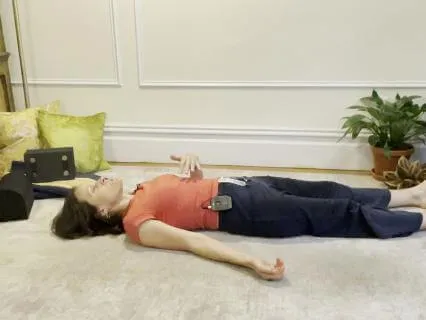
Take a moment to come to lie on the floor.
And use intentional breathing to help make that shift.
From the external sense of yourself,
Which we call third person,
To the internal sense of yourself.
It's the first person.
It's a kinesthetic sense of yourself.
Breathing a little slower,
A little deeper.
Find a rhythm that feels comfortable for you.
Scan your body and see what sensations are present.
Slowly bend your knees,
Stand your feet on the floor.
We're going to do the first exercise of Thomas Hannah's daily cat.
Arch your low back,
Lifting it up a little,
Tailbone goes back into the floor.
Slowly release,
Return to your neutral.
Now flatten your low back gently,
Bring it towards the floor,
Your tailbone lifts a little,
And slowly release.
You can inhale as you arch your low back,
Focusing on your back.
Slowly release.
From neutral,
Flatten.
Tune into the abdominal muscles you're contracting.
And as you slowly release those abdominal muscles,
You return to neutral.
Inhale as you arch.
Exhale as you release.
Exhale as you flatten.
And inhale as you release.
Pause,
Take a moment to tune in.
Bring your hands to behind your head for the second exercise.
This is arch and curl.
And we're going to start with the basic movement,
And then we'll bring in your feet so we get to work with muscles in your legs.
Find an inhale to arch.
Bring your tailbone,
Your head,
Even your elbows back a little.
Exhale,
Release,
Return to neutral.
For your curl,
Bring your elbows forward,
Flatten your low back,
Chin towards chest,
And with an exhale,
Pick your head up a little.
Go just as far as you go without pulling,
And slowly release.
When you inhale and arch,
You can pick up your heels.
Slowly return to neutral.
As you exhale and curl forward,
You can pick up all of foot.
Coming back to neutral slowly as your brain decreases the level of contraction.
Do two more cycles on your own,
Arching and lifting your heels.
Slowly return to neutral.
Curling forward as you pick up ball of foot and slowly,
With control,
Return to support.
When you complete those two cycles.
Release your arms down by your side if you'd like.
You can release your legs out and take a brief moment,
Relax your body,
Tune in and feel the effect.
Visualize the posture I'm going to describe.
It's called the legs up posture.
You're going to bend your knees and stand your feet.
Bring your knees into your body to lift your feet from the floor and then extend your legs up to the ceiling.
As you do the posture,
You're focusing on the muscles that you're contracting.
They're in the front of your body for this movement.
And you only go as far as you can go with your posture in comfort.
Once you visualized it,
Slowly come into that posture.
Do as close to what you visualized as you can.
As you hold the posture,
Your motor cortex is sending a continuous volley of neural impulses,
Comes down your spinal cord,
Exits at the level of the muscles being contracted,
And maintains the proper level of contraction so you hold the shape.
If another part of your body is trying to participate or there's contraction that's taking you to the point of tension,
See if you can release that tension.
If you're experiencing strong sensations from the back of your body,
That is not contraction,
That's stretch.
And you want to back off a little bit.
In this practice,
We want to allow muscles to be lengthened.
We do not stretch.
Slowly release.
Reverse out as best you can.
Bend your knees.
Bring your feet down gently.
Slide your legs out slowly.
And relax.
Breathe a little bit slower,
A little bit deeper.
Tune in rather than out.
Notice how you have new sensations in your body for having done that yoga posture.
Now bend your knees,
Stand your feet.
Bring your right hand to behind your head.
Take your left knee in your left hand.
On an exhale,
Curl forward and turn your upper body to the left.
Aim your elbow at your left knee.
Slowly release.
Place your foot down and arch your back.
Release out of your arch,
Take your left knee,
Curl forward,
Turn,
Aim your elbow at your knee.
Slowly,
Really.
And we'll change sides.
This is the fourth exercise in Thomas Hanna's Daily Cat,
And here we're using it as kind of a reset.
If any muscle is activated,
We're reminding it it can release.
Two cycles,
Curl forward,
Turn your upper body a little to the right,
And then release.
And find your art.
Coming out of your arch,
Taking your knee,
Curling forward.
It's your abdomen that's lifting your head.
Slowly,
Really.
Let your arms come down.
Let your legs come down.
Find a comfortable position,
Invite your body to relax,
And tune in to notice the effects.
Give your body permission now to relax.
Allow me to be your voice.
When I name a part of your body,
Tune into that part of your body.
I am relaxing my feet.
I am relaxing my legs.
I am relaxing my pelvis.
I am relaxing my abdomen.
I am relaxing my chest.
I am relaxing my back.
I am relaxing my hands.
I am relaxing my arms.
I am relaxing my shoulders.
I am relaxing my neck.
I am relaxing my head.
I am relaxing my face and jaw.
I am relaxing my entire body.
Place your attention on the sensation of breathing without changing anything about your breath.
Tune into the sensation of breathing in.
And then tune into the sensation of breathing out.
Hold your attention on the sensation of breathing.
Bring your attention now,
Sense the ground under you.
Do an ending scan of your body and notice the effects of this short practice.
Bend your knees,
Gently turn to the side and slowly sit up.
Take a full breath in,
And to the end of your exhale,
Hum or ohm.
Namaste to each one of you.
Thank you for sharing this practice with me.
I look forward to seeing you soon.