Welcome and Bienvenue,
My name is Wendy and I'll take you through a pranayama session for prenatal but also beginners friendly or anyone friendly in fact,
You can do it anytime you want.
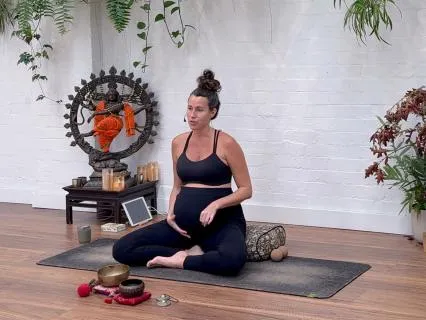
I'm now 37 weeks pregnant,
As you can see I've got a huge belly now and I've realised that actually pranayama,
Of course it is essential during your pregnancy or of course postnatal but also labouring,
When you have the wonderful contractions kicking in.
So one thing to remember is that when you are expecting,
You want to avoid the retention of breath,
So try your best not to hold at the top of your inhale or even at the bottom of the exhale,
We want to have a smooth continuous breath flowing in and out,
Very naturally.
Always prioritise your nose,
I always say to my students that the mouth is only here as an emergency exit,
The mouth is meant to speak,
To eat,
To drink,
That's it.
We don't want to breathe in and out of the mouth,
At times yes we do exhale through the mouth to release a little more but we can try this as well.
So,
Adopt a very comfy of course sitting posture and the idea why we want to sit down,
Whether we want to emphasise the quality of the breath or even meditation is to elongate the spine so that we have a lot of space to take advantage of.
Okay,
So I'm going to assume that you are ready,
You are sitting,
Maybe you want to recline against the wall if you need more support,
Maybe you want to have,
Similar to what I have now here,
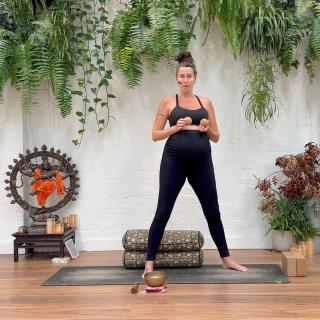
A bolster or a cushion and I also prepared some little balls next to me just to show you if you have a nasal that's a little bit congested,
One way you can do it.
If you don't have the ball,
Use your fist and then it will do the same thing.
So,
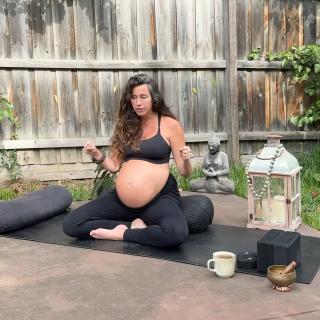
Once you have your seat you can cross your legs,
I like to always mix it up,
So try to have the unusual leg crossing over and you can have your palms facing down onto your lap.
When you're ready,
Maybe you'd like to close your eyes or keep them half closed in front of you,
Looking downward and as you settle down here into your seat in this moment,
Breathe naturally,
Completely normally without being told how to do it and just notice what it's like to breathe without receiving any cues and instructions.
You'll find that by just observing the breath,
You will improve it,
You will establish the quality of our breath naturally.
So,
Notice if it has a sound,
A sensation,
A texture,
Maybe it becomes a little bit more palpable,
Tangible.
And instead of offering you cues,
I'll offer you inquiries to just check with yourself.
So as you continue breathing in and out here,
See if you have the same duration on the in and the out breaths,
Doesn't matter how long they go for,
Maybe we can find equal measure,
Equal length.
Next question I have for you is,
Do you feel the inhalation is cooler in temperature,
In nature?
As you draw the air in and down,
The air in the room that you sit in or outside perhaps?
Is it more active?
Does it require a little bit more effort from you to suck the air in and down?
And feel the contrast with the exhalation.
If it's warmer,
You made the air warmer inside the body,
Maybe a similar temperature to your body.
As you breathe it out,
You can feel it on your upper lips.
You may find it's more passive,
Requiring less and less effort,
More ease,
As though it falls out on its own accord,
Like there's nothing you can do to stop it.
Next,
Continue to observe the contrast of a cool,
Active inhale and a warm,
Passive exhale.
Inhale and exhale in English is beautiful,
But I really also like the way we say in French Inspiration,
Expiration.
Inhalation is spelled Inspiration,
The same way you would say in English,
You feel inspired when you inhale,
Like you grow in all directions.
And Expiration is spelled the same way,
As in you release what you feel has expired inside you.
So really start to feel into those words as you inhale.
Can you feel a little bit more inspired?
And as you exhale,
Release what has expired.
Inspire.
Alright,
So the first little breath tool we'll work with is similar to Samavritti,
Which is the box breath,
However,
We're going to avoid the pause in between the breaths.
So continuous flow,
When you inhale,
It becomes the exhale,
The exhale becomes the inhale.
So first of all,
Take a big inhale through your nose.
Open your mouth to breathe out.
Together let's inhale for 1,
2,
3 and 4.
Exhale in 4,
3,
1.
Breathe in 1,
2,
3,
4.
And out 4,
3,
2,
1.
Inhale 1,
2,
3,
4.
Exhale 4,
3,
2,
1.
In 1,
2,
3,
4.
Out 4,
3,
2,
1.
Can we slow it down?
In 1,
2,
3,
4.
Out 4,
3,
2,
1.
In.
Breathing in.
Breathing out.
Breathe in and down.
Breathe up and out.
Continue at your own pace.
Few more rounds to go.
If you feel comfy,
Can you emphasize inhalation and prolong the exhalation.
So mindful of what it's like to merge your in breath to the out breath.
That smooth transition taking form.
The same awareness applies when the exhale becomes the inhale.
Whenever you have completed your last round.
Retrieve your most normal natural breath.
Remain composed.
Feel the after effect of this very simple breath in and out.
That's it.
No more,
No less.
Next one we'll practice is again similar but not exactly the same as we would if we were not pregnant.
It's called Viloma.
It's a 3 part breath from the bottom to the top on the in breath.
Depending how you feel it could be bottom to top or top to bottom on the out breath.
What we want to do is to intentionally deliberately separate the breaths in 3 parts.
To fill up the torso with air and then to empty it.
Rearrange your seat if you need to.
Maybe you want to change the cross of the legs to zhuzh it up a bit.
Maybe rearrange your seat bones onto your prop.
Maybe this time the palms will be facing up.
The soft shoulders,
Long neck and relax the jaw completely.
As always we take a full breath in together with your nose.
Fill up the whole of your torso,
The whole upper body.
With the mouth open release all the breath out.
Leave nothing inside you.
Everything comes out.
When ready start to inhale into the belly,
Into the baby.
Continue again to inhale into the rib cage.
And whatever left you have in you into the chest.
As you exhale can you empty first your chest.
Then your ribs.
And finally your belly,
Your baby.
Maybe use your hands onto your belly,
Breathe in.
Into your rib cage,
Continue to breathe in some more.
Finally in your collar bones,
In your heart.
And then calmly we empty the whole chest,
The rib cage and the abdomen.
Breathe in belly.
Breathe in ribs.
Breathe in chest.
And empty chest.
And ribs.
And belly.
Continue as you go.
Maybe you go slower than my count.
Maybe you go faster.
Really mark,
Not a pause,
But really feel the demarcation from one third to the second to the third.
Noticing the growth and how much space you can take up as you inhale from the bottom to the very top of you.
Forward,
Backward,
Sideways.
Up and down.
And as you exhale can you feel this,
Not shrinking,
But this softness as if you soften into your seat,
Into your being.
If you'd like to add on,
You could even imagine that you send your breath to the neck,
Up to the third eye.
And as you exhale you empty head,
Chest,
Ribs and belly.
Take another two rounds on your own.
Maybe you imagine or visualize your baby breathing with you as you practice for two.
And when you've done your last round,
Let go completely of Viloma,
The three parts breathing.
Come back to yourself,
Come back to this moment.
And realize the little impact that it may have on you,
Your body,
Mind and heart.
As well as your bellies,
Your babies.
And another pranayama that you can do nice and safely during your pregnancy is Nadi Shadana,
The alternate nostril breathing.
I'm going to teach it a little bit differently than what we are used to.
Just to even out the two hemispheres of our brain,
Just like the breath will do here.
So if you are right handed,
I encourage you to use the left hand and vice versa.
So let's bend the left arm,
Let's just assume that you are right handed.
Bending the left arm and using your two peace fingers to massage the third eye or just the forehead.
You could go clockwise for a little while.
Keeping your head,
Your spine,
Your pelvis as neutral as you can so your chin maintains this parallel position to the floor.
And then change the direction,
Go anticlockwise.
Trying to soothe the skin on the forehead or any tensions you may hold in your mind.
Eventually we will open the thumb and the ring finger.
Depending how you go,
Some people like to use the pinky,
Some people like to use another finger.
It doesn't really matter what you are doing.
Just opening two fingers of your hand here.
And with the pinky finger,
Let's say it's the pinky finger,
You are going to seal.
So I am not saying block because we don't want anything aggressive.
We are going to seal.
So imagine your pinky is touching the right nostril.
And you press lightly in and you lift upward.
So in and up as you breathe in through the left completely.
It will take more time to fill up your lungs.
Once you are full,
Seal the left nostril with the thumb.
And then empty through the right nostril.
I am just turning sideways so you can see what I am doing.
Again we breathe in through the right.
Close the right with the pinky and open the left,
Empty through the left.
Inhale left.
Closing the left,
Opening the right as you empty.
Inhale right.
Close and out left.
In left.
And out right.
Now you know what to do.
So continue just out.
And you may find that because you only breathe in and out with half of your nose,
That you are actually able to take twice more air in.
Or at least it takes twice longer to breathe in or out.
So realize how much slower you could actually go by utilizing one nostril only.
Trying to soften again the face,
Muscles,
Expression.
Notice if you have dropped the chin.
Maybe you keep the left arm closer to the upper body as a way to rest it.
If it becomes fatigue you can also use the right hand as a little shelf here to rest the left elbow.
And one more thing,
Try not to hyperextend along the spine.
Try to keep it nice and neutral.
Take two more rounds here.
The next time you are about to exhale,
Can you complete that exhalation through the left nostril.
And that will be the end of this pranayama.
And if it's you,
You can return your hands down onto the lap where you found them.
Welcome to open or close your eyes.
Just take a moment here to realize what just happened.
And also what happens now.
What's happening right now in the physiological body.
See if there's a little bit more room in your mind between your thoughts.
So we've just done three breaths.
I'm going to give you a last one called Zazen breath.
It is a Japanese method to relax us as simply as that.
Again,
Before we start,
Maybe you need to move your shoulders,
Move your head around.
Just have a play with the body in time and space.
Zazen is about counting from 1 to 10.
And each number has a breath in and out.
And it's about us staying with the breath the whole time until we aim for that last count.
In the real life,
Not here on the video,
But if we travel somewhere and we left the breath alone,
The game is to come back again to zero and to start over again.
So let's just assume that you stay with me the whole time.
As always,
Take a breath in through the nose.
Through your mouth.
Exhale.
And we'll begin.
One.
Inhale.
Exhale.
Two.
Breathing in.
Breathing out.
Three.
Breathe in.
Breathe out.
Four.
In.
And out.
Five.
Breath in.
Breath out.
We're more than halfway.
Six.
In.
Seven.
In.
Nine.
In.
Last one.
Ten.
Breathing in.
And breathing out.
Come back to your breath.
Don't count them anymore.
Let's all bring the hands to the heart.
Actually,
Let's keep one hand too,
Baby.
Take a moment to really capture this moment,
This experience.
What it's like to be you with your loved one.
So close to you.
In fact,
Inside you.
I really wanted to do this video to,
In a way,
Eternalize or immortalize this moment of pregnancy.
Before baby's born.
And to answer some questions to my students.
Asking me what is safe,
What is unsafe in pranayama for my baby and I.
We'll close the practice with a very simple breath in.
And the longest breath out of the day so far.
And you may take your palms together in front of the heart.
Bringing your heartbeats closer to your thumbs so there's a feedback.
Your chin towards the chest.
We humble to the heart.
We keep the confidence in our posture.
And the humility in our presence at the same time.
With a little bow towards ourselves.
Then bring your thumbs up to touch the third eye.
And namaste.
Thank you so much.
I hope it was useful to you.
Au revoir.