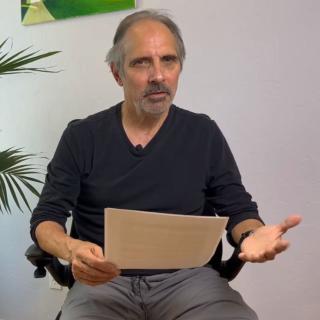
Breathing practices are an important part of what I call tinnitus hygiene.
Breathing practices are an excellent way to calm down the nervous system,
Both when we're in a spike and on an ongoing basis.
So we need practices to bring our nervous system down,
And breathing practices are about the best thing we can do on a regular basis.
And they do need to be done on a regular basis if they are to be effective,
Although done on an as-need basis,
They do have some impact,
But not as much as if you do them on a regular basis.
So one of the best things we can do for our nervous system is to breathe more slowly,
More evenly.
More deeply,
More quietly.
We breathe too quickly and we want to begin with a practice where we're just going to pace our breathing at a pace that's been determined to be very effective for calming the body down and that pace is 5.
5 breaths per minute.
Currently you probably breathe nowhere near that rate.
This is a sort of practice you can hook up into your regular meditation practice and make it a practice to breathe more slowly slowly than you usually would in your normal life and gradually you can extend that throughout your day.
So the pace we will again work with is 5.
5 breaths per minute.
Just follow me,
I will say inhale and exhale.
Inhale.
.
.
Exhale.
Inhale.
.
.
Exhale.
Inhale.
Exhale.
Inhale.
Exhale.
Inhale.
.
.
Exhale.
Inhale.
Exhale.
Inhale.
Exhale.
Inhale.
Exhale.
Inhale.
Exhale.
Inhale.
Exhale.
Inhale.
.
.
Exhale.
Inhale.
.
.
Exhale.
Inhale.
Exhale.
Inhale.
Exhale.
.
.
Inhale.
Exhale.
.
.
Inhale.
Exhale.
Okay,
So hopefully you should feel a little more relaxed and calmed down after that session.
And the point is to engage in this practice on a regular basis.
The next practice is one designed to maintain our breath during times of stress.
And it can also be used to help you get to sleep or to relax in general.
The breath is called box breathing and it's simply breathing in for four,
Holding it for 4,
Breathe out for 4,
And hold that for 4.
You can do this for as long as you feel comfortable doing with it.
It should have a stabilizing,
Calming effect.
So,
Let's begin.
Breathe in,
2,
3,
4.
Hold,
2,
3,
4.
Out,
2,
3,
4.
Hold,
2,
3,
4.
2 3 4 in 2 3 4 hold 2 3 4 out 2 3 4 hold 2 3 4 in 2 3 4 hold 2 3 4 out 2 3 4 hold 2 3 4 in 2 3 4 hold 2 3 4 out 2 3 4 hold 2 3 4 in 2 3 4 hold 2 3 4 out two,
Three,
Four,
Hold,
Two,
Three,
Four.
And you could do that for as long as you want.
It's an excellent breath practice,
And I urge you to try to integrate it into your daily life.
The final practice is one that's attributed to Dr.
Andrew Weil,
Called the 4-7-8,
And this practice he recommends is doing this twice a day.
Every day.
And it's a cycle where you breathe in for four through the nose,
Hold it for seven,
And then breathe out through your mouth for eight.
And the point is to have this as a regular practice.
He recommends starting out doing it no more than four times twice a day.
And then building up to doing it at least eight times twice a day,
That is a cycle of eight twice a day.
And you can do it more than twice,
That's fine,
But twice is the minimum and he's very clear he not to do it more than eight cycles of the breath.
So we will engage in a practice of four and the seconds are not as important as just the counting to yourself,
Just being regular with the four,
Seven and eight.
And you're going to have to breathe out slowly through the mouth or you will expand your breath on just a couple of seconds.
So again,
We'll do a cycle of four here.
So breathe out and begin.
Breathe in,
Two,
Three,
Four.
Hold,
Two,
Three,
Four,
Five,
Six,
Seven.
Breathe out,
Two,
Three,
Four,
Five,
Six,
Seven,
Eight.
Breathe in,
Two,
Three,
Four.
Hold.
Breathe out.
Breathe in.
Hold.
Breathe out.
2,
3,
4,
5,
6,
7,
8.
Breathe in.
2,
3,
4,
Hold.
2,
3,
4,
5,
6,
7.
Breathe out.
2,
3,
4,
5,
6,
7,
8.
Again,
The important thing here is that you do it at least a couple times a day,
Building up to doing a cycle of eight.
It's best when done on a regular basis,
Although it can be useful to calm yourself down in an emergency.
So those are three breathing practices I think you will find useful if you integrate them on a regular basis and practice them on a regular basis.