Hi,
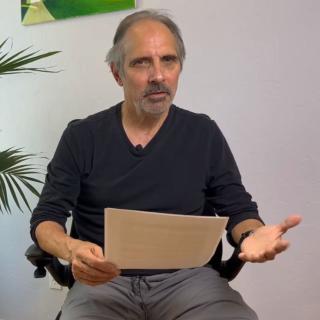
This is Dr.
Peter Vernisi,
The therapist with tinnitus,
And this is a meditation for when your tinnitus is particularly loud or spiking.
Now,
Probably the last thing you want to do when your tinnitus is spiking is to meditate.
However,
This might actually be the ideal time for meditation,
Because when your tinnitus is spiking,
There is literally nothing you can do to impact the noise.
As the National Center for Rehabilitative Auditory Research states,
Time and energy searching for a way to quiet or eliminate the tinnitus.
Unfortunately,
There is currently no therapy that can safely and consistently reduce the loudness of tinnitus.
" But you don't have to reduce the noise in order to reduce the suffering,
Because the suffering is a product of how you are reacting to the noise.
In this meditation,
We're going to work with this reactivity.
So let's begin by settling into whatever position you're able to settle into.
And if you can get into a seated position on a chair,
That's fine.
If you need to lie down,
That's fine as well.
You can even do this practice walking around.
So begin by,
If you're sitting in a chair,
Coming into a position where we can feel our feet grounded on the floor.
Noticing your sit bones in the chair.
Placing your hands somewhere where they are comfortable,
Either on your thighs or fold it in your lap.
We like the back to be erect but not rigid.
So if you're sitting and it's possible for you to come forward in the chair to keep your back straight,
And if that's not and you need to lean back against the chair,
That's fine as well.
You can either have your eyes open gently with focusing on the ground in front of you or you can close them if you're more comfortable with that.
And we're breathing in through the nose and out through the nose at a normal pace.
If you want,
You can play some background noise to balance the tinnitus.
You can have nature sounds,
White noise,
A fan.
If that works for you,
Feel free to go ahead and do that at this time.
So once you've settled in,
Begin by asking yourself,
What exactly is the suffering consistent right now?
What is bothering me?
And tinnitus distress is comprised of some combination of three components,
Thoughts,
Emotions,
And physical sensations.
They're often combined.
For example,
You might be thinking,
I can't take this any longer,
Or I can't deal with this.
And this thought produces a sense of panic or fear.
And this fear shows up in the body as the classic fight or flight signs of increased heart rate,
Increased desperation,
Perhaps discomfort in other places.
So we're going to work with each of these components,
Trying to observe where the distress is coming from,
And to work with that distress.
Again,
Because we can't work with the tinnitus,
It's going to do what it's going to do,
But we can work with the distress.
So we will begin by dealing with any thoughts that we are having that might be a source of suffering.
Thoughts are traditionally known as a second arrow of suffering.
This is in reference to an ancient story about someone who shot with an arrow.
Not only has the pain from being pierced with a projectile,
But also the suffering from thinking how unfortunate he is that this has happened to him.
We know that thoughts are often a source of suffering.
Often thoughts about the future and in particular our thoughts about tinnitus can be a source of suffering.
So we work with thoughts by observing them.
Observing a thought like it's a cloud in the sky and let it float by.
This is what we practice in meditation in general and this is a skill we want to bring,
To times when we are spiking.
We sometimes say,
With respect to thoughts,
To leave the back door and front door of our awareness open,
But don't invite the thought in for tea.
Now developing this ability to work with thoughts in this way,
Of course,
Does not happen overnight.
This is why we have a meditation practice.
So now is the time to apply this ability to the degree that you developed it,
To observe thoughts,
Let them go,
And return attention to the breath.
Now perhaps it was just a thought that was distressing you,
And with the thought released,
You can return your focus to the breath and notice a significant reduction of suffering.
But perhaps in addition to the thought,
There is an emotional charge attached to the thought.
An anxiety,
An anger,
A sadness that seems to linger after the thought has dissipated.
So if that is the case,
First stop resisting whatever emotion is arising.
And allow it to be there.
Very often the attempt to resist something creates a level of suffering in addition to whatever suffering we're already undergoing.
So that fighting that resistance is an additional tension in the body that,
Again,
Can only increase our discomfort.
So let that go,
Allowing the emotion to be there.
And see if you can name it.
And if you do name it,
Don't say I'm angry or I'm anxious,
But frame it like I notice anger is rising in me.
I notice anxiety is arising.
The way you might observe a water level rising in a bathtub.
Now,
Emotions are rather different messengers than your thoughts,
And so need to be treated differently.
And so unlike with thoughts,
We actually do invite the emotion in for tea.
As I said,
There's no value in pushing away a distressing emotion.
Indeed,
Research has shown that those who accept distressing emotions as an inevitable part of life are much psychologically healthier than those who try to restrain or eradicate any negative feeling.
So once we've allowed space for the emotion and been able to name the emotion if that's possible,
We want to then drop the label from the emotion and look for where it's showing up in the body.
All emotions show up in the body,
Which is why they're called feelings.
Indeed,
Emotional researchers generally define an emotion as the label we give to a bodily sensation.
So now try to notice where in your body the emotion is showing up.
Perhaps it's a pounding in the chest or a disease in the stomach,
A tightness in the shoulders.
And if you cannot determine where the emotion is showing up,
Try at least to find maybe some place where the emotion is not showing up.
That is,
Some part of your body that is a safe place to anchor your attention.
The belly,
As it rises and falls,
Can often provide a haven for the attention to rest peacefully.
However,
Sometimes this itself can be a source of distress.
And so,
If we can,
Look elsewhere for a safe place in the body.
Reliably undisturbed even when the rest of the body is responding to a triggering situation.
So again,
Try to find some place where your awareness can rest in a safe place.
And now we're going to bring into play a series of techniques to work with the distress as it's showing up in the body.
And we want to begin the first technique by focusing on that undisturbed place we try to carve out for our attention,
Perhaps the belly,
Perhaps the feet,
And placing our attention on that place,
Aiming the attention there.
In a really laser-like way and letting everything else drop into the background,
Aiming and sustaining your attention,
Even if only for a breath or half a breath,
Letting the tinnitus be there,
But having our attention placed firmly somewhere else.
And the more firmly we can anchor the attention,
The more we can let the tinnitus drop into the background.
So now work for a while with this process,
Aiming the attention at a safe place in the body.
And when you are distracted by the distress,
By the tinnitus,
Returning your attention to that safe space as quickly and as often as possible.
And if this is only partially successful,
We're going to try a second method by turning our attention towards the source of distress,
Turning towards the tinnitus.
Now not suddenly,
All at once,
Not like jumping into the deep end of the pool,
But slowly,
As if you were sticking your head into a movie theater to see what's playing on the screen.
Turning the attention from the safe place towards the tinnitus,
And noticing what it's like to let it into your awareness.
When you turn to the tinnitus,
Can you use the breath to settle the body?
When you're ready,
Return your attention back to that safe anchor,
Whether it's in the belly or the feet or wherever.
And try doing this again and again,
Expanding what we call the window of tolerance as we learn to turn the attention to the tinnitus for slightly longer periods of time to see the degree that we can allow it to be there without reacting against it.
Perhaps even bringing some curiosity to the whole process before returning our attention again to the anchor.
So now engage in this process we call pendulation,
Going back and forth between the safe anchor and the source of our disturbance,
The tinnitus,
Trying to find perhaps an equilibrium and a balance.
Staying there only so long as it's comfortable for you.
And then returning to the anchor.
Doing this again and again.
Here we can try the strategy of putting out the welcome mat for our tinnitus.
As strange as it might sound,
The tinnitus is there anyway.
So to react against it and tense the body is simply to create a secondary suffering of tenseness and rigidity.
By contrast,
If we can open up to it,
If only for a breath or two,
And try to relax the body and release the mind to accept the inevitable rather than fight against it,
That we may be able to find a moment of respite.
So now try to spend a few minutes working with your tinnitus in this way,
Opening up and turning towards it rather than vainly tensing up and struggling against it.
Finally,
After trying to focus our attention elsewhere,
And after trying to turn towards the tinnitus,
We're going to see if it's possible to take a third stance in relation to our situation,
Seeing if it's possible to step back and observe what is unfolding in a way that we're not directly connected to it,
That is to tap into this notion of the observer that can watch the show participating in it.
You may notice that what can observe the distress,
The thoughts,
The emotions,
And the physical reaction is not identical to that distress,
But it's observing it.
So see if it's possible to shelter in this observer self and take some respite there,
If even for a breath or two,
Observing as if from a distance.
And for the final part of this session,
Try to work in the remaining minutes with these three ways we have just discussed.
First,
Try focusing your attention elsewhere on some other object besides the tinnitus,
The safe anchor.
Next,
Try turning towards the tinnitus for short periods of time and then returning to the anchor.
And finally,
See if it's possible to step back into the role of observer and Watch the whole thing unfold from a distance.
For the rest of this practice,
Engage in these three practices to whatever degree you find them useful,
Until the practice is called to a close with the bell.