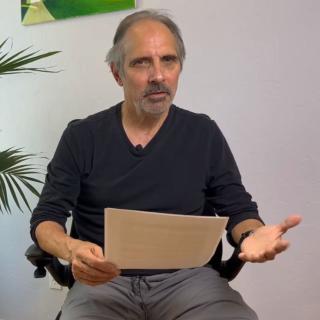
So there is a paradox at the core of tinnitus distress that You not only have to wrap your head around but resolve if.
.
.
You want to get to habituation.
I'm Dr.
Peter Bernese.
I'm a licensed psychotherapist and like you,
I have tinnitus.
So,
The paradox of tinnitus.
Technically the paradox of tinnitus distress.
What is a paradox?
Paradox is something that on the face of it seems illogical.
Goes against reason.
Against opinion.
DOXA means opinion.
PARA,
Against.
And so what's What's the paradox?
One of the famous paradoxes in the history of philosophy is Zeno's paradox.
For example,
He shows that If you give a tortoise And the famous warrior Achilles put him in a race and gave the tortoise a head start.
The Achilles will never catch the tortoise because Achilles By the time Achilles goes halfway to the tortoise,
The tortoise will have advanced to another point.
And every time Achilles hits a point,
The tortoise will have gone beyond that point.
So Achilles will never catch the tortoise.
That's a paradox.
And how do we resolve that?
Well,
We're not going to go into that here.
But the paradox with tinnitus distress is if you are going to habituate.
You have to lose.
The notion that you don't want tinnitus to be there.
And that seems as illogical as Achilles not catching the tortoise.
Who in their right mind would want Achilles to be there?
Who in their right mind would want the Tinnitus to be there?
But that's the attitude you have to get to because if you don't get to that place.
If you don't want tendencies to be there,
Your brain will always be on the lookout for it because you are essentially seeing it as a threat.
What happens when someone's threatened you?
Imagine you went to a ball game and someone threatened to beat you up there.
Well,
You would be looking around the whole game for that person and probably not enjoying the game.
Because this is how we respond,
Or our amygdala responds to a threat.
The amygdala being this almond-shaped part of the brain that is sometimes called a smoke detector and looks out for threats.
So if you see the Tantas as a threat,
Is something you don't want there.
Your brain is never going to let it go.
But who would want a tinnitus to be there?
How could you want this thing to be there?
Or want it not to be there.
That seems impossible.
So.
.
.
There is a way out.
A way to achieve a state of not wanting tinnitus not to be there.
But it's not the way that you're often told.
To avoid this situation.
As you're sometimes told by audiologists or friends,
Just don't see it as a threat.
Just stop seeing it as a problem,
As a threat.
And that's it.
You're given essentially a cognitive solution.
Tell yourself it's not a threat.
And convince yourself it's not a threat,
Because it's not a threat.
And if it's not a threat,
Then you can let it go and get on with your life.
The problem with that is the amygdala,
Coming back to our friend the amygdala,
It's not convinced by reason at all.
What it needs is an experience of the situation as non-threatening.
It's not something that you can talk the amygdala into.
Into not being threatened by tinnitus.
So,
How do you give the amygdala the experience of not being threatened by tinnitus,
Of wanting it not to be there?
Fortunately or unfortunately,
Tinnitus is not a unique experience.
There are a lot of things in life that we A lot of unpleasant things that we don't want and can't avoid.
Now,
There's a lot of unpleasant things we don't want and can avoid and those we want to avoid them,
Right?
We're not idiots.
But we have a lot of things in life that we don't want and can't avoid.
And so tinnitus is at the high end of that situation.
So just like if we were training to lift a heavy weight,
We would start with lighter ones.
Just so we want to start with smaller situations.
That we don't want but can't avoid.
And work at allowing those to be there.
Work at really accepting those.
Not fighting against these unpleasant situations.
And we do this by having a calm mind and a calm body in the face of these.
And starting small and building up.
Don't start right away with you know,
Not wanting your tinnitus to be there.
Let's start with the general experience of Again,
Unpleasant situations we can't avoid.
And it's actually,
The way to get into this is actually to start with some situations that are unpleasant.
But that you can.
Escape from,
But you want to see what it's like not to escape from them.
What do I mean?
Well,
If you drink coffee,
You've got an easy way to start this process.
If the first thing in the morning you drink coffee,
You're probably addicted to it and if you don't get it,
Your body is going to feel very unpleasant.
So what you do is not have a cup of coffee and notice this is an unpleasant experience.
And learn to sit with it.
It helps to be able to breathe and calm the body and you want to do all these calming practices and there's a lot of breathing practices on here,
But just breathing deeply in and out.
And feel the unpleasantness of not having a coffee.
And if you're addicted,
It's going to feel unpleasant.
But try to get to a point where you can observe.
What that's like.
Just notice it.
And You know,
After a while.
Yeah.
You can have your coffee,
But not before you try to get to a situation where You don't care if you have the coffee or not.
So see how long you can go,
Maybe a minute,
Maybe five minutes,
But start with an unpleasant situation like that,
One you can get out of.
And notice what it's like to move from,
You know,
I really need to get rid of this unpleasantness of not having caffeine to,
Yeah.
Caffeine or not,
It doesn't really matter.
That's actually a little tough one because the physiology is pretty intense,
But it's nice because it's something you can control.
Another way to work with unpleasant situations is if you don't like standing in line,
For example,
Or going slow.
In traffic.
What you do is.
.
.
Next time you're at the store,
Go into the longest line.
And notice what that's like.
If you don't like being in a line,
You're going to be very nervous and upset probably.
In an unpleasant situation and not wanting it to be there and see if you can go to not wanting it to be there to calming the body down,
Taking some breaths and not really care if you're there.
Just being interested in what's going on,
Just observing and noticing what's it like.
To transform a situation of one that,
An unpleasant situation you don't want to be in,
To an unpleasant situation that,
You know,
You're in and that's okay.
You don't mind it so much.
And then try pulling this out in.
.
.
Everyday life if you know driving and Try to,
When you're driving,
Notice what it's like first to want to pass cars or be upset when you're stuck behind someone slow.
Notice what's that like.
Observe it.
And then try to relax,
Breathe,
See if you can.
Come into a space where,
You know,
This isn't so bad.
This is an unpleasant situation.
On the one hand,
I didn't want to be there,
But there or not there,
It doesn't really matter.
And you can stretch this out to any unpleasant situation that you can't avoid.
Now if you can't avoid it,
Like I said,
If you're in a traffic jam and your GPS says go another way,
You go another way.
I've talked about this stuff on other videos,
But I kind of want to bring it all together here.
There's a world of difference between being in a situation that's unpleasant and really hating it and not wanting it to be there versus being in a situation that's unpleasant and,
You know,
It is what it is.
You're there.
You're not fighting it.
And that's what we want to get to.
More examples,
Being in the heat here in Arizona.
It's summer and it's hot.
You know,
There's a way to be in the heat and complain about it.
And that's just going to make it worse.
It's not pleasant.
Then there's a way to be in the heat and just be there with it.
It's what it is.
You're not going to fight against it.
So learn to accept it.
Try to see what it's like to go out in the heat and really not Care about it.
Train yourself to get to that space.
Being sick is another thing that provides a great opportunity.
No one wants to be sick,
Have a cold,
And we're not talking about anything serious here.
Again,
We're building up to small things,
But we want to get to a space where you can be sick and really resent being sick and hate it and complain about it and that does make it worse.
But there's a way to be sick and just to observe what's going on.
And this is where we begin to develop our mindfulness,
Which is going to really get you through this process where you can step back and observe what's happening.
Was a curiosity.
Oh,
That's interesting.
My throat is sore.
My nose is running.
And you can.
.
.
Observe it as almost in a third-person sort of way,
Stepping back and noticing it,
And not fighting against it.
So these are all attitudes that we can begin to develop towards unpleasant situations in life that are unavoidable.
The final end of the spectrum is age.
And here,
There's a lot of research showing that Those who are reluctant,
Irritated by their age,
Really hate being a certain age.
I.
.
.
Have worse health outcomes,
Physical and psychological,
Than those who just accept the age for what it is.
It's not that,
You know,
In an ideal world,
Yeah,
Who wouldn't want to be younger?
You're there.
It is what it is.
We can accept what is the case.
Or we can rail against and fight against and be depressed about it and ruin our lives essentially.
That choice is up to you.
All along the spectrum up to and including tinnitus.
We have the choice about what we're experiencing,
Whether we are going to rail against the inevitable.
Wish it were other than it were,
Which As in all these cases,
It's going to lead to a miserable outcome.
Or train ourselves to accept what is the situation.
And observe it,
Accept it,
It is what it is.
And just be able to be with it and really seriously we get to a point of not wanting it,
Not caring if it's anything else than it is,
Accepting that the situation is what it is.
Is not dominant here.
Reason can be a useful adjunct,
Some small mantras and just saying to yourself,
You know.
This is what is happening now,
Or it is what it is.
Right?
And accepting reality.
Rather than saying,
I wish this weren't there.
When you do that with your tinnitus or with anything that's unpleasant,
You make it worse.
And with your tinnitus,
You condemn yourself.
Because if again to go back to the reason that we started if you see it as a threat Your brain will never,
Ever let it go.
So,
The paradox is,
Again,
You have to get to a state where you don't want the tinnitus not to be there,
And that seems crazy,
Against reason,
Because who would want the tinnitus to be there?
But we can get to the space where it's essentially there or not there,
It doesn't matter,
It's there.
To say of something that It's there that I don't want it to be there.
With respect to age,
We can understand that wouldn't,
You know,
That attitude would just be delusional.
If you're just saying,
I don't want to be this age,
I don't want to be this age.
Well,
You're this age,
You know.
You can accept it or you can fight against it.
And most people with age understand the futility of tinnitus.
The stickler is that we can't give that up because it doesn't seem as inevitable as age because sometimes we get relief.
It goes up and down.
Drags us along to wishing it not to be there.
My friends.
The worst thing in the world you can do is wish it not to be there.
It's a paradox.
But it's one that we need to embrace and come to learn to live with.
And mindfulness training,
The sort that I give and you can find across numerous sources,
Is really the best way to get to this space.
And That's it.
So hopefully you will find that at least provocative.
Take care guys and I'll see you later.