Hello,
Dream travelers.
And welcome to the Story Nexus.
Tonight,
You'll be falling asleep.
To a story of artists.
Giovanni Simipiou.
Painter of Florence.
This bio was taken from the lives of the most eminent painters,
Sculptors,
And architects by Giorgio Vasari.
First published in 1912.
The language has been modernized and updated for current times.
It is narrated in a style which is conducive for sleep.
Let's begin.
The artist Giovanni Simepio.
Painter of Florence.
Amid the endless flood of disasters that had devastated Italy.
Not only had countless buildings been ruined,
But the entire tradition of skilled craftsmanship had nearly vanished.
By the will of God.
In the city of Florence.
In the year 1240.
Giovanni Simipio was born.
Giovanni was born into a noble family of the time.
And he would become the first to bring light.
To the art of painting.
That's a boy.
Some of you showed a sharp and lively intelligence.
His father sent him to study grammar at the convent of Santa Maria Novella under a relative who taught the novices.
However.
Instead of focusing on his lessons.
Simabu spent his days trying.
On books,
Papers.
And anywhere else he could.
He drew figures of men,
Horses,
Houses,
And all kinds of imagined scenes.
Nature had clearly drawn him to this path,
And fortune favored him.
At that time.
The city's rulers had summoned Greek painters to Florence to revive the nearly forgotten art of painting.
Among their projects was the Gandhi Chapel in Santa Maria Novella.
Time has badly worn its faults and walls.
Simipu often skips school.
To watch these masters at work.
His father and the painters soon recognized his exceptional talent.
And with his father's approval.
And apprenticed him to these painters.
Simabu applied himself relentlessly.
With nature as his guide.
Quickly surpassed his teachers in both drawing and coloring.
The Greeks worked in the crude style common to their era.
Not the refined ancient Greek manner.
The rough technique of their own time.
When Simabu learned from them,
He greatly improved upon their approach.
Shedding much of its roughness.
In doing so,
He brought honor to his country.
Through his name and his works.
Examples of his paintings can still be seen in Florence,
The front of the altar in Santa Cecilia.
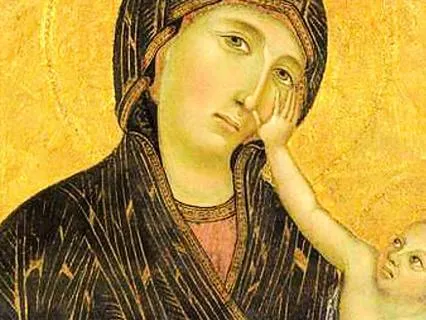
A large Madonna panel.
In Santa Cruz.
Placed against a pilaster.
The right side of the choir.
And a small panel of Saint Francis on a gold background.
For this last work,
He portrayed the saint from life.
A novelty at the time.
Surrounding the figure with 20 small scenes from his life.
Also on goal.
Simabu next created a large panel for the monks of Vallombrosa in the abbey of Santa Trinita in Florence.
Determined to live up to the growing reputation he had earned,
He worked with great care.
In one of his pieces.
He depicted the Madonna holding the Christ child in her arms.
Surrounded by many angels in adoration.
All on a gold background.
The finished work was placed above the high altar of the church.
Later,
When the monks replaced it with a panel by Alesso Baldovinetti.
Simabu's painting was moved to a smaller chapel in the left aisle.
He then worked in fresco on the façade of the Hospital of the Porcelana.
Corner where Via Nuova meets Borgo Agnesanti.
On one side of the main entrance,
He painted the Annunciation.
And on the other.
Christ with Cleophas and Luke.
Figures rendered at full scale.
In this work.
He broke away from the old Byzantine style.
He made the draperies,
Clothing,
And overall composition more lively,
Natural,
And softer than the stiff,
Linear Greek manner.
Full of harsh outlines and profiles that had been passed down unchanged for generations through both mosaic and painting.
With little thought given to improving draftsmanship,
Coloring,
Or invention.
After this,
The same prior.
Who had commissioned his earlier work in Santa Cruz.
Asked Simabu to paint a large crucifix on wood.
Which can still be seen in the church today.
Pleased with the result.
Briar then brought him to the convent of San Francesco in Pisa.
Some of you painted a panel of Saint Francis that was considered exceptional for its time.
It showed a clear advance over the Greek style in the expressiveness of the faces and the natural flow of the draperies.
Something no one had yet achieved in Pisa or anywhere else in Italy.
For the same church,
He also created a large panel of the Madonna and Child,
Surrounded by angels on a gold background.
This work was later moved from its original position to make way for a marble altar and placed inside the church beside the left-hand door.
The people of Pisa praised the painting highly and rewarded him well.
At the request of the Abbot of San Paolo in Ripa d'Arno.
He also painted a small panel of Saint Agnes,
Surrounded by scenes from her life in miniature.
This panel still hangs today above the altar of the virgins in that church.
Thanks to these works,
Simabu's fame spread widely.
And he was summoned to Assisi in Umbria.
Working alongside some Greek masters in the lower church of San Francesco,
He painted part of the vaulting and scenes from the lives of Jesus Christ and Saint Francis on the walls.
He far surpassed the Greek painters.
Emboldened by this,
He went on to paint the upper church entirely on his own.
In the main asp above the choir.
He painted four large scenes from the life of the Virgin.
Or death.
Her soul being carried to heaven by Christ on a cloud-born throne.
Her coronation amid a choir of angels.
And a large group of male and female saints below.
Time and dust have badly damaged these works.
He also decorated the five sections of the church's vaulted ceiling.
In the first section of the choir.
He painted the four evangelists larger than life.
These figures still show considerable quality today.
And the fresh coloring of the flesh demonstrates how much Simabiu advanced the art of fresco painting.
The second section he filled with golden stars on an ultramarine blue background.
In the third.
He painted medallions featuring Jesus Christ,
The Virgin Mary,
St.
John the Baptist,
And St.
Francis.
One figure per medallion.
Placed in each quarter of the vault.
The fourth section repeats the golden stars on Ultramarine.
While the fifth depicts the four doctors of the church.
Each accompanied by one of the four major religious orders.
This was an immense and meticulously executed undertaking.
Once the vaulting was complete.
He painted the upper walls along the entire left side of the church.
The windows and up to the vault.
He created eight seas from the Old Testament.
Beginning with Genesis.
And highlighting the most important events.
And the spaces around the windows down to the gallery level.
He added eight more Old Testament scenes.
On the opposite wall,
He painted 16 corresponding scenes from the lives of the Virgin Mary.
In Jesus Christ.
On the entrance wall,
Around the great rose window above the main door,
He depicted the ascension of the Virgin and the descent of the Holy Spirit upon the apostles.
This vast,
Rich,
And beautifully executed work must have astonished the world at the time.
Especially considering how long painting had remained in darkness.
Hundreds of years later,
In 1563.
It still strikes one as very beautiful.
It's remarkable how much light Zimabue was able to bring forth from such obscurity.
Of all those paintings,
Those on the ceiling have survived best.
Being less exposed to dust and other damage.
After finishing the upper sections.
Simabu began painting the lower walls.
On the windows downward.
However,
He was called back to Florence on personal business and left the work unfinished.
It was later completed by Giotto.
Many years afterwards.
As will be described in due course.
Giotto was Simabiu's protégé.
After returning to Florence,
Simabé painted three small arches in the cloister of Santo Spirito.
These depicted scenes from the life of Jesus and showed strong design.
Standing out against the Greek-style paintings by other masters.
Covered the side facing the church.
At the same time,
He sent several of his works to Impoli.
But they are still held in high regard today in the main church.
Piev.
Back in Florence,
He created a large panel of Madonna and Child for Santa Maria Novella.
It was placed high between the Rusellai Chapel and the Bardi-Divernia Chapel.
Larger than any figure painted up to that time.
The work included surrounding angels that revealed Zimabue moving beyond the strict Greek manner and beginning to adopt a more modern approach line and style.
This painting caused an enormous sensation.
Since nothing better had been seen before,
The people of Florence carried it in a grand procession from Simabu's house to the church.
Accompanied by great celebration,
Music,
And trumpets.
He was richly rewarded and honored for it.
It is said,
And recorded in some old painters' accounts,
That while Simabiu was working on this panel in gardens near the Porta San Pietro.
King Charles,
The elder of Anjou.
Pass through Florence.
The citizens eager to honor the king.
Took him to see the painting,
Which had not yet been viewed by the public.
Word spread quickly,
And crowds of men and women flocked to see it in a joyful procession.
Because of the delight this brought to the neighborhood.
The area became known as Bourgeois Allegory.
Joyful District.
Even after it was later enclosed within the city walls,
The name remained.
In the cloister of San Francesco in Pisa.
Near the door leading into the church.
Simabu painted a small distemper panel.
It shows Christ on the cross with weeping angels catch with their hands the words spoken by Christ.
And present them to the grieving virgin on the right.
And Saint John the Evangelist on the left.
Let the words read.
To the Virgin.
Woman,
Behold your son.
To John.
Behold your mother.
And on a scroll held by a separate angel.
From that hour,
The disciple took her into his own.
In this work.
Simabu began to bring new life to painting and to explore invention.
He used inscribed words to help express the emotional meaning of the scene.
And imaginative and original touch.
By now,
Thanks to these works,
Simabiu had gained great fame and considerable wealth.
He was appointed,
Together with Arnolfo Lapi.
An excellent architect of the time.
As one of the architects for the new cathedral of Santa Maria del Fiore.
In Florence.
Simabiu lived to the age of 60 and died in the year 1300.
Having almost single-handedly revived the art of painting in Italy.
He left behind many disciples.
The most outstanding of which was Giotto.
Who later lived in his master's former house in the Villa del Cocomero.
Simibiu was buried in Santa Maria del Fiore,
For him,
By one of the Nini family.
I should note that if Simabu's reputation had not been overshadowed by the greatness of his disciple Giotto,
His fame would have been even more celebrated.
Dante makes this clear in the eleventh canto of Purgatorio,
Where he alludes to the inscription on Simabiu's tomb.
Simabu was a painter from Florence in the time of the author.
Extremely noble,
And far beyond ordinary knowledge.
He was also so arrogant and proud.
That if anyone found a flaw in his work.
Or if he himself spotted any defects.
Even something as common as an error caused by faulty materials or imperfect tools he would immediately destroy the peace.
No matter how valuable it was.
Giotto was and remains the greatest painter of the same city of Florence.
Simabiu's works bear witness for him in Rome,
Naples,
Avignon,
Florence,
Padua,
And many other parts of the world.
Giotto truly eclipsed his master's fame in the way a bright light dims a lesser one.
Although Simabu was the first to spark the revival of painting.
It was Giotto.
Driven by noble ambition.
Aided by nature in heaven.
Who raised the art to far greater heights.
He opened the door to truth.
For those who later brought painting to the perfection and mastery we see in our own time.
Today,
People are so accustomed to seeing daily marvels,
Even near-miraculous achievements in this art,
That nothing men create even works that seem more divine than human,
Astonishes them any more.
It is a mixed blessing for those whose labors earn the highest praise.
Instead of receiving admiration,
They sometimes face criticism or even disgrace.
Portrait of Simabu.
Painted by Simone Martini of Siena,
Can still be seen in the chapter house of Santa Maria Novella.
It appears in the scene of the faith.
As a thin-faced figure in profile with a small reddish-pointed beard.
And turban-style caps.
Wrapped around the head and under the chin in the fashion of that period.
Beside him is Simone himself.
The artist of the work,
Who portrayed himself in profile by using two mirrors facing each other.
The armored soldier standing between them is said to be Count Guido Novello.
Then Lord of Puppy.
Many of Simabiu's work survives today.
Sleep well,
Dream traveler.
Let it be so.
You you you