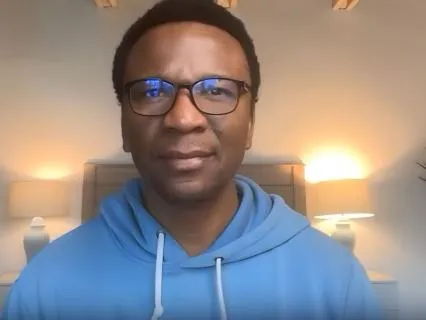
There's a version of generosity that is.
.
.
Slowly destroying.
Might be a heavy word.
But slowly eroding.
You mean us.
And It's not the giving that fills you,
It's the giving that hollows you out.
And the strange part is that most people doing it don't even call it a problem necessarily.
They call it being a good person.
But here is what.
We don't.
Often.
But out loud at least.
Is that not everyone you are keeping warm actually needs your fire.
Not everyone you're keeping warm actually needs your fire.
And some of them don't even notice that it's burning.
We'll start as we normally start by saying good morning.
Good evening,
Good afternoon.
Wherever you are,
Wherever you may be,
Whatever you may be doing.
I am Charu Raman Dawarada.
And today I want to sit inside a sentence.
That a lot of us have.
Quoted.
And it's that quote,
I will no longer set myself on fire to keep others warm.
And to be honest,
I'd never heard it before.
When I did hear it.
It spoke to me in such a profound way.
And it got me thinking that.
.
.
As we sit and think about that today.
And mull over it and say it.
And probably we mean it when we actually say it,
But then tomorrow or some point in time this week,
We hand someone else the matches.
Because from what I see.
.
.
The truth underneath that phrase.
The part that the quote doesn't tell you has nothing to do with the other person.
It has everything to do with something we learned long before we could name it.
About what love requires us.
About what safety demands,
About the deal we made quietly somewhere early in our lives.
And that deal is if I keep giving.
I stay needed.
And if I stay needed,
I stay close.
And if I stay close,
I stay safe.
And in there somewhere,
Sewed into all of those.
It's probably.
.
.
And then I won't get abandoned.
And that deal did make sense.
Once.
Betray and ask.
I want to ask you whether it still does.
There are four layers to this conversation today.
Most discussions about self-sacrifice only typically reach the first one.
Or usually reach the first one.
And that first one is the empty cup.
You can't pull from what is not there.
And the second,
The asymmetry.
Total destruction in exchange for minor.
The math is brutal.
When you actually look at it.
And the third,
The layer that stings the most probably.
You're sometimes giving everything to people who will not notice the toll it's taking on you.
And if we're lucky.
.
.
Does people actually care?
And the last one.
The permission.
We are allowed to say no,
Not as an apology,
But as a simple line in the sand as a boundary.
And hopefully today we can go a bit deeper than the quote on the mug.
Let me start with.
.
.
The empty cup.
Of people here.
Fill your cup first.
I've said it,
I'm sure you've heard it.
And we immediately think self-care.
We immediately think rest,
We immediately think putting ourselves first a weekend away.
And those things do matter.
But the emptiness I'm pointing to is not physical tiredness.
It's something more interior.
There's a coach and a thinker who.
.
.
I listen to.
And I spent a lot of time listening to him recently and he says something that stopped me cold.
He says that most people.
.
.
Who are managing themselves are not actually present.
They're managing.
And management is not connection.
Management is about distance.
You can be in a room.
Pouring into someone.
Technically generous,
Technically there,
And still be completely abandoned inside yourself.
The cup is not empty because you gave too much.
It's empty because somewhere a long time ago you learned that the way to stay loved was to focus entirely on love.
Solution salvation sits outside.
To watch the other person.
Read the room,
Anticipate the need.
Be useful.
Respond before they even ask.
And that's skill.
That skill saved you once.
And today you might even think.
.
.
And possibly say that it continues to save you.
It kept you connected to the people you needed most.
But now it runs on autopilot.
And it's costing you something you have not fully named yet.
And here's the question I want you to sit with.
I don't want you to answer it with your mind.
When you are giving.
Are you actually inside your body?
Or have you already left?
Are you actually inside your body or have you already left?
I want to come back to that question.
Because it's an important one.
All those times that you are giving of yourself to others,
Are you actually inside your body?
And notice what that question does to you.
Some part in your body,
In your stomach,
Your chest,
Your throat,
Your shoulders,
Your back.
And as I often say,
That noticing,
That noticing that right there is the beginning of the work.
Now let's talk about the maths.
Because there's something specific happening when we set ourselves on fire for other people.
The other person gets warmth.
Comfort,
Relief.
You get embers.
And yet the pattern continues.
Over and over and over again,
Maybe not as frequently as it perhaps used to.
But why does it continue?
And this is what I think at least is actually happening.
At some point.
.
.
Probably very early you learned something.
Your discomfort felt manageable.
Sorry,
Your discomfort felt more manageable.
Than someone else's disappointment.
I'll rephrase them.
And say it back after me.
In the first person.
And see if it lands.
My discomfort felt more manageable than someone else's disappointment.
That other person's disappointment felt dangerous.
Our discomfort felt like something we could handle.
Something we could carry.
Something that showed and proved that I was good.
So a deal was made.
Below the level of thought,
Below the level of decision,
And that deal was,
I will absorb this so they do not have to hold it.
I will observe this,
I will.
.
.
Absorb this so they do not have to hold it.
And here is where I want to.
.
.
To bring in something.
Honest to talk about impartiality.
At its core,
It means having no agenda for the outcome.
And as I normally do,
I'll just take a bit of a tangent here.
For a very long time I felt uncomfortable about coaching because I believe that I needed to have a methodology,
A framework that I could continually come back to.
So that I had an answer.
To somebody's problems.
When I learned about impartiality,
I realized that with true impartiality.
Is having no agenda.
Now we change the rule for an outcome.
That's real connection.
When there's no need for the other person to be different,
No need to manage how they feel,
No need to hold the room together.
That's impartiality.
But here is what that looks like turned inward.
Turned into ourselves.
The same words.
No agenda to fix.
My own feeling.
No urgency to move it along,
Nothing to do here,
Nowhere this needs to go.
And just reframing it like that really changes.
At least for me,
My outlook on it.
No agenda to fix my own feelings.
And no urgency to move it along.
Because the real burning.
.
.
That part in me that actually.
.
.
Overwhelms.
Not the giving.
It's the resistance.
The resistance to.
.
.
Your own experience.
The way you swallow what you actually feel,
What you actually want to do,
Your actual needs of the room or the other person.
Is comfortable.
The way you push past your own signals because someone else seems to need something more urgently than you do.
So again,
I ask you something.
Think of a situation now where you gave more than you had.
Any situation.
Time when you gave more than what you had.
Now you've thought of that situation,
I want you to ask yourself.
What were you afraid would happen if you said nothing?
And just.
.
.
Let's discomfort.
The silence.
Not fixing.
Are resolving.
Just being present.
Think of that situation.
And there's something that you really want.
And it's not necessarily fear.
Stops you from saying or doing.
It's wondering how the other person will respond.
But say the words and just sit with it.
What were you afraid would happen if you said nothing?
And just allow the discomfort.
Try that.
Try that today.
In an uncomfortable situation.
Just allow the silence.
And the answer to that question is not a problem to solve.
It's something to wonder about.
And now.
The third one.
And this is the one that.
A lot of people skipped,
Myself included.
Because it requires saying something out loud that feels good.
Unkind.
There are people in our lives who are not noticing what it costs you to hold them.
I'll say that again a little bit more clearly and closer to the mic.
There are people in your life.
Who are not noticing.
What it costs you.
To hold them.
Right there.
A face or a name came to mind.
It's not because they're bad people.
But because you've never let them see it.
You've been so good at making the warmth look effortless that they genuinely have no idea.
You are burning to produce it.
I want to bring in something.
That I've found.
Genuinely.
Powerful.
And it's the question.
Is this mine?
It's a question you ask yourself when you're holding a feeling,
Carrying a tension.
Running on low and you're not entirely sure where it came from.
Because some of what you are carrying right now,
Today,
Isn't yours.
It's not mine.
Some of the anxiety.
Sits in the room,
You took it on board.
Some of the tension in that relationship,
You took it on so no one else had to.
The fear you took it.
Some of the unspoken weight in your family.
Discomfort and work.
The unease in a relationship.
Your goodness in a friendship.
You became the container for it.
And it's been living in your body as if it were yours,
But it's not.
So I want to invite you into something small.
Think of a relationship.
Just think of a relationship where you consistently give more than you receive.
Bring it to mind.
If it helps,
You can close your eyes and just take on board.
And I want you to.
Think of that relationship not to build a case.
Against the person.
Not to make them wrong,
Just to notice.
And then ask yourself quietly,
How much of what I carry in this relationship actually belongs to me?
How much of it?
What have I been holding because no one else seemed willing to?
And then.
.
.
Even more gently.
Ask.
Is this mine?
And what is yours?
Let it be yours.
And you stay with it.
And those bits that are not yours.
You can begin slowly.
Without drama.
To sit them down.
You don't have to be confrontational.
It doesn't have to be explosive,
You don't even necessarily have to explain it.
Just by choosing today to not pick it up again is movement.
And then.
.
.
And this perhaps is.
The one that most conversations about self-sacrifice.
Don't even deal with.
I want to give us something here that.
I think you have been waiting for without knowing you were waiting for it.
What I'd like you to do is actually repeat what I'm about to say.
I am allowed to have a limit.
And allow that to land.
I am allowed to have a limit.
Because you are.
You are,
I am.
Partner is,
Your friend is,
Your parents are,
Everybody is allowed to have a limit.
We are all allowed to feel the weight of what is being asked of us and say,
Not this time.
Without a paragraph of explanation,
Without a weak guilt.
Without rewriting the story of yourself as cold,
Selfish,
Self-centered too much.
And this is probably what makes that so hard.
The word.
Boundary.
That word has been attached.
Somewhere along the way to the idea of building a wall.
Creating a barrier.
Keeping you in and others out.
Of being cold,
Of being dismissive.
The move that most resembles a boundary is actually vulnerability.
Because if you think about it,
Vulnerability is about speaking that's scary.
Boundaries aren't walls.
The boundary is the moment you say the thing that has been sitting quiet in your body for too long.
It sounds like.
.
.
I care about you.
And I'm running low.
I want to show up for this.
And I cannot do it like this right now.
I love you and I need you to hold some of this yourself.
That's isn't fire.
It's honest.
And honesty in the long run is more generous than burning.
Because when you burn out.
.
.
You disappear.
The warmth stops.
And you are left alone with embers.
And that person.
.
.
You were keeping warm wonders.
Where did you go?
Wonder where you went without ever knowing.
You were the one who built the heat.
You made it look so easy that no one saw the cost,
The toll.
And honestly guys,
It's time to stop hiding that closet.
Wonder is described as holding a question without needing to answer it.
It's curiosity without limit.
An outcome attached to it.
And there's something that we can't do.
We cannot hold both fear and wonder at the same time.
Let's think about that one.
We cannot hold fear.
And wonder at the same time.
So today I want to leave you.
There've been a number of questions in this one,
But I want to leave you with this question.
But I'm not going to give an answer or my opinion on it.
I'm going to leave you with a question that you can carry with you into the rest of the day,
The week.
And the question is.
.
.
What would change in your life if you stopped trying to manage someone else's experience of you?
I'll say it again,
What would change in your life if you stopped trying to manage?
Someone else's experience of you.
Let that sit in your body,
Not in the head.
Let's see it.
Will naturally move to somewhere now and wherever that natural move is allowed to go and sit there.
Because that place in your body is probably where that part.
That has been trying to protect you resides.
Notice what tightens when you ask it.
And also notice what softens.
Was that noticing?
That is the beginning of putting down the fire.
All at once,
Not today,
Not after you hear this,
Not after.
Just a little bit.
That's how we begin.
And with that.
.
.
I want us to just to.
.
.
Slow this down.
I just want you to feel right now.
Where it is.
That part in your body.
That responds to that question.
And with that.
Thank you for being here.
Thank you for your time.
Thank you for the continued support.
Deepest you all.
Remember that you are seen.
You are enough.
And you are home.