So right now,
We're just going to take a few minutes to slow down an anxious mind.
And what we need to understand is that the anxious mind is normal,
Especially when you've had something difficult happen to you recently,
Or some stress in your life,
Or maybe you read something or saw a video or heard something that was scary.
Harry.
Stress and anxiety are a normal response and oftentimes our mind grips on to these concepts and thoughts and begins circling and circling and we look for resolution,
But we can't find it.
So I'm welcoming you to attempt to listen to this meditation and participate in a way that brings you out of the circling circle of anxiety and stress and gets you back into your body and what I like to call the larger picture.
Now,
You don't need to do anything special.
You don't have to be a meditation guru or do anything except try to find a space right now that is away from other people or at least quiet enough for you to breathe.
And when you're in that space.
.
.
Just listen and breathe.
Remember,
Deep breathing doesn't necessarily quell anxiety,
But long breaths out can help reduce anxiety.
Because anxiety doesn't just live in our mind,
It goes to the body.
And the way our mind responds to threats in our mental state cause our body to feel things.
Even if we're dissociated from our body,
Reacting,
Your nervous system reacts without permission.
Let's try this body-based meditation.
So the first thing I want you to do.
.
.
Is not really worry about your breathing at all.
My only instruction to you about breathing is try to elongate your breath.
I don't need you to breathe deeply.
I don't need you to do anything about mouth or nose breathing.
Nothing special.
Just try to elongate the breath.
So when you breathe out,
Whether it's through your mouth or your nose,
Whichever is more comfortable,
Just try to make it a little bit longer.
That's it.
So let's just breathe.
Elongating the out breath,
That's all.
And as you breathe,
I'm going to just pretend that you're going to continue breathing.
I'm going to lead you through a few more instructions.
So the first instruction is I want you to try to place your feet on the ground or on a surface,
Whether you're in a bed or a couch,
That's fine as well.
I just want you to try to feel a little bit of pressure on your feet.
And I want you,
As you're breathing,
To just notice your feet.
And notice the pressure on your feet and notice the temperature of your feet and notice if you can the details of your foot whether your eyes are closed or open for instance moving your toes around you can feel those if you are able to move your toes and you have different toes whether they're or a large toe or a small toe or a medium-sized toe,
You can feel those.
And next,
Focusing on your heel.
And you can feel that,
Oftentimes,
Pressure that a heel has as it presses against an object.
Sometimes heat,
Depending on where you are right now.
And kind of like the bottom of your foot beneath your big toe often has a space to touch the ground or whatever your foot is resting on.
And just maybe if you've been focusing on your left foot then bring it to your right foot and if you've been focusing on your right foot then bring it your focus to your left foot and as you focus on this next foot and your toes and the bottom of your foot and the heel I want you to imagine for a moment that your foot is connected to something deep beneath you.
Which is sand or dirt or rock.
And I want you to imagine whatever comes to your mind,
Whether it be some type of dirt or sand or rock or anything else,
Maybe decaying leaves or branches or pebbles or different things that happen to be underneath the earth.
And while you imagine that,
I want you to imagine that all of those surfaces beneath the surface,
All of those objects,
All of that,
Is compressed all the way,
Thousands and thousands of feet and meters,
Down into the core of the Earth,
Which is a molten core that,
Of course,
Basically alive in some way if you if you could imagine that the earth is an organism and that continues to host life and our feet are connecting to the floor or a piece of furniture,
And underneath that is oftentimes a building.
If we're outside,
It's grass or something like that,
Or pavement,
Or moss,
Or whatever.
And underneath that is something that is more quiet,
More still,
Possibly ancient.
Depending on where you are right now,
Maybe 10 to 15 feet underground,
Perhaps,
Been disturbed in a long time by humans or animals.
Yes,
It absorbs water and water flows through it and goes into the aquifers and whatever else is beneath you And yes,
Perhaps the ground is Vibrates with vehicles or animals or people or wind or whatever and As you notice your feet are connected it is grounding you into the ground and what that means is we're just trying to focus on our feet and our connection to the larger earth and sometimes when we're overwhelmed we think that this will last forever and that we won't ever feel differently and As people we sometimes need help of you know Practitioners or doctors or people in our lives to help us?
Feel better,
But right now I'm just having you breathe elongated out and and focusing on the feet in the grounding the visualization of what is 5 10 15 30 feet or meters beneath the surface Resting beneath us is a planet that has been here for a very long time,
Almost incomprehensibly long for us humans to understand and thus hopefully starting to bring us out of whatever cycle of anxiety we're in and to focus on something else for a little while because oftentimes anxiety cannot be solved.
We want some sort of answer.
We want some sort of decree.
We want some sort of definition.
We want some resolution.
We want to know that things are going to be okay.
And the more we try to know that things are going to be okay,
Or things are going to be the way we want them to be,
Or the way somebody else wants them to be,
The more we try to control that We think at first maybe this will help us become less anxious or less stressed But it doesn't because we're not accepting life as it comes now Of course,
We can take actions towards any sort of outcome which we should do If we are able to or want to But let's just say right now There is nothing to do while you're listening to this meditation except to reset our mind and focus on elongating our breath and putting our feet on the ground.
And this is not a body scan.
This isn't anything special.
I'm just having you listening to my voice and imagining the earth,
Imagining the dirt,
The sand,
The pebbles,
The rocks,
The water.
Different iron deposits,
Mineral deposits.
Maybe there's even an ancient cave far beneath our feet full of those beautiful stalactites and stalagmites and different formations that take thousands if not longer to form of years and time.
And remembering that In our lives,
We've had times where we didn't feel this way,
And we felt connected and somewhat more carefree.
And the hard part about growing up is there's always more things to worry about.
There's always more things to be concerned about.
And all of those things are valid.
And yet,
Sometimes if we focus too much on them,
They can turn into chronic stress or anxiety.
And so this meditation,
This talk,
Or what have you,
Is about remembering to take breaks from whatever you're going through,
Whether it be some sort of conflict,
Or a work issue,
Or fear episode,
Or financial issue,
Or whatever it may be.
I don't want to name everything people are going through,
But If you have the autonomy to get away from other people and to find a quiet place to breathe,
It does take a while for the body to get into sync with that.
And it's not that we're trying to deny what's going on,
We're just giving it a rest.
It's almost as if you're putting something on a shelf or a table,
And that something is your anxiety.
And that something is your stress and we're just temporarily we know it'll be back it's not that you know there's some sort of thing we like to fool ourselves into thinking that if we if we are anxious and perseverate on something long enough that that we're in control or or it'll go away but it won't it'll just stay there so you can forget about it for a little while trust me our our nervous system will will bring it back into our awareness you're not going to forget what you're worried about it'll come back so just taking this time right now to elongate the breath and my next part of this activity is imagining,
Instead of the ground and the earth,
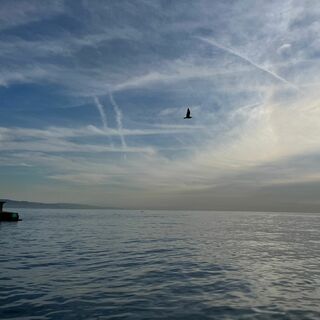
Imagining a bird flying above us,
Maybe 100 feet,
100 meters up.
And it's just soaring on the wind as its wings are creating a lift with the air molecules to glide and to flap their wings as they find out what they're going or hunting for something or looking for water or maybe hoping to come grab some breadcrumbs from you or some nice French fries The bird is up there and it is trusting the wind.
It is trusting gravity.
Maybe it's with some other friends flying around and it is in our minds in a enviable position sometimes because the bird can see things that we cannot see because we are earthbound unless we are in some type of vehicle.
We cannot just fly like a bird.
But the one thing we can do is when we imagine the bird or ourself,
Maybe imagining ourself as a bird or imagining ourself riding on a bird or something like that,
We can look down on what is going on in our life from a higher perspective.
And that higher perspective is sort of what I call a zoom out.
And that zoom out is difficult to get to when you're very stressed or anxious and trying to solve a problem.
But if you keep breathing and you imagine yourself soaring above these issues right now,
Remembering that all of the issues you're ever going through are temporary,
They will not last forever.
Nothing does.
And in that we are just trying to have some grace with our body right now and our mind and just sort of.
.
.
Loving.
The opportunity to imagine for a moment that we are above the earth and just Soaring and looking down and realizing there are,
When we're anxious and stressed,
Our minds naturally don't want to think of other solutions.
They can't withdraw.
And that is because of neuroscience.
We know that when we're stressed out,
It is very difficult to be creative and to feel the difference in our bodies.
But when you're thinking of this bird,
I want you to almost let your torso and your shoulders relax a little bit.
That is difficult to do.
It is not easy.
But I want you to imagine that you are actually temporarily letting go of that stress you're holding onto in your shoulders and your neck.
And you are flying like a bird.
And many of us have had flying dreams.
And in those dreams,
I remember when I'm in a flying dream,
I have some sort of skill where I can kind of push myself up and just like a swimming in a pool where I am weightless,
So to speak.
Or,
Um.
.
.
Not very heavy.
We float.
And I want you to imagine floating and it being safe and being able to float above our problems for a little while.
Um just noticing as you breathe out this imagination that the birds have given us and and as you know and maybe you don't know sometimes nature can be very recharging to us even if it's in a city even if it's in a zoo to see how animals go about their lives in very risky conditions without many sophisticated shelters,
Trusting for their next meal,
Trusting that no one or nothing is going to hurt them.
And yet,
If something does try to hurt them,
The animal has instincts and they instantly react.
And oftentimes as humans,
We think we've got to hold on to these thoughts of anxiety and stress or else we will not be safe.
And honestly,
That's a bit of a superstition because your body and your nervous system want to react.
They don't always react how we want,
But they want to react if they see a threat.
So just breathing out,
Just elongating that breath and remembering now,
Let's bring both into focus.
In our minds we are a bird flying above,
Or flying with the birds,
Above our problems.
And in our body we are also noticing our feet are on a surface and we are grounding deep into the earth and imagining the silence and the quiet that goes on.
Maybe only 30 meters or feet below us.
And the interesting juxtaposition with being above 100 to 300 feet or meters above the earth,
Flying around,
The sound is different up there.
Maybe you hear wind or distant noises,
But it's not as voluminous as being here on the surface where humans live.
So,
Just notice the juxtaposition.
One is high above you,
One is low below you.
And breathing out slowly.
And just noticing.
And appreciating the fact that you spent a few minutes doing this.
And as we close,
Feel free to just stay in whatever position you're in and continue this.
When we access our creative imagination,
Even if it's just imagining rocks and sand and dirt or a bird flying.
It can bring us into,
According to neuroscience,
A different part of our brain that's being utilized.
And that combined with physiologically noticing our body breathing and noticing our feet's contact with an earth or an object can help us.
Now,
I understand that a meditation isn't going to fix all the problems in your life.
And anyone who's telling you that,
I wouldn't listen to.
But I will tell you this the more that you do a meditation and relaxation exercise over time the brain science says it helps create more gray matter in our brains and as long as we're not spending you know,
15 hours on screens and.
.
.
Eating and drinking things that are unhealthy,
That gray matter can really expand and that helps us deal with stress and become creative about our problems and our stressors.
As much as I'd love to tell you that someday you'll get to a point where there won't be stressors or problems,
I cannot tell you that lie.
There will always be stressors and problems and really becoming wise and mature is about how we deal with them,
How we respond to them and not getting caught up in our states of mind where we wish it wasn't so,
Or we wish we had someone to help us,
Or we wish we had someone to do it for us,
Or we wish we weren't in this position.
Because all humans wish they weren't in a position.
We all wish somebody would save us.
We all wish that it wasn't so.
And that is difficult because life is the way it is,
And things happen that are out of our control.
So,
Thank yourself,
Appreciate the fact that you took this time,
And remember,
It's a process,
It's not a product.
And thank you for listening.
Working through this exercise with me.
And at the end,
Feel free to take your time and continue if you'd like.
Take care now.