Close your eyes.
Take some normal breaths for you in through the nose and then Allow that to sigh out.
Another more or one in through the nose.
And sigh out.
As you continue just with your regular breath to feel into where your system is right now.
Do a very brief body scan to know where you are holding tension right now,
In this moment.
So just feel through from top to toe,
Over your face,
Over your head,
Over your neck.
Check your shoulders.
Your arm.
Your entire bag.
Your front body,
Your hips.
Cross over your legs all the way into your feet and your toes.
And try to tune into your body as good as you can.
Not yet here to change anything.
It's just an observation of where your body is right now.
It helps you to land in this practice.
Leave behind your day,
Your weekend,
Whatever it was.
Be now here for yourself.
So notice what this one or two areas are that are really intense for you at the moment,
Maybe even uncomfortable or maybe even painful.
And then with your next inhale,
As you're opening your eyes,
I invite you to go back to your screen and.
.
.
Message in the chat on what is that one or those two areas that you have mentioned now in your body scan.
Where are you holding?
Tension in this very moment.
And depending on what I see in the chat.
These are the things that we are going to work on.
The more areas are named,
The same areas,
These are the areas we're going to start with.
It looks like we're starting on the back today and looking into the shoulder region to start with.
So for that,
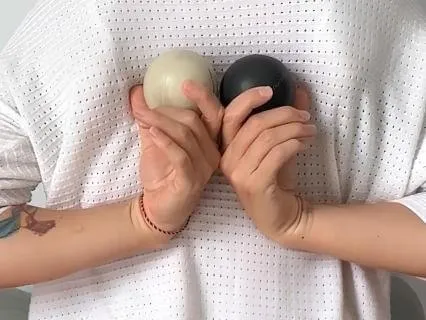
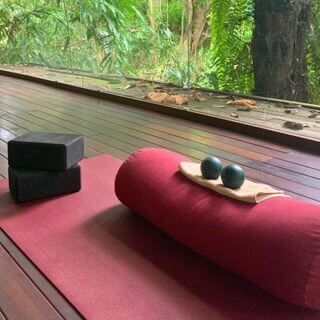
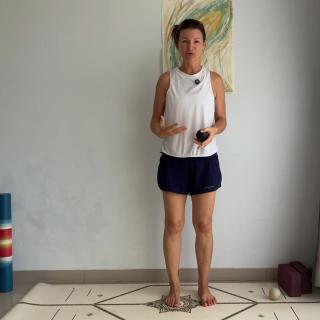
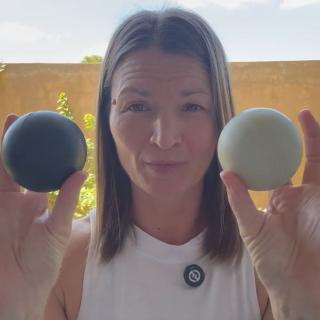
I invite you to grab two balls.
And then I just quickly turn around so I can show you where we start.
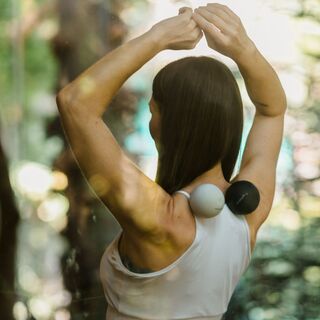
So with these two balls,
We are starting between our shoulder plates.
So if you are grabbing,
If your arms move behind your back,
You'll see your shoulder plates will be moving out.
These are your shoulder plates.
Orientation points and then we just place these balls in the center.
So that there's one on the right spinal muscle and one on the left spinal muscle so the poles are touching just around the spine itself and then you can either If you're by the wall,
You can lean back to a wall to press against that if it's very sensitive for you here or if you can't lay down at the moment.
But my recommendation is to.
.
.
To lay down and have those balls exactly in that position that I just described.
So you want to place them just between your shoulder plates to start with and then maybe hold yourself first on your elbows to see how that feels with these balls under.
But then allow your head Come down on the other side.
Allow to rest there.
There should be a bit of a comfort here.
And just feel in,
If you have balls that are really hard,
Like a cricket ball or a kook ball,
You may want to put a towel or something soft between a ball and your back so that it's not painful.
We want to stay away from pain.
As you're resting here initially,
I just want you to play with your weight.
If you feel just allowing your full body weight to rest on it is too much,
You can use your elbows a little bit to lift your chest off the balls so that you find the right level of intensity for yourself.
But ideally you can allow your upper body to rest off these balls,
It just depends on how sensitive you are here in this spot and really go with what is accessible for your body.
And to start with,
As you're laying here,
Just focus on your breath.
I invite you to inhale through the nose.
And always.
Exhale through the mouth make it an audible sigh possibly even so that your system recognizes okay We are here to release.
We are here to relax.
Everything is safe.
Your body does need to go in alert if you're pressing against some tension.
This is here to support your body,
So don't be forceful.
Be very kind,
Listening and very carefully.
And support your body,
Release practice.
With This breath ongoing,
Always in through the nose.
Mary Chanting.
Out through the mouth.
And then we want to,
If it's possible for you,
To bring your arms point towards the ceiling.
Add just a little bit of weight.
To those balls here.
Just very gentle.
You may want to rock a little bit from the left to the right.
Just to give the balls a little bit of a different look.
Focus.
Can do that very slowly.
Did you really feel the shift?
As you go from the left side to the right side with more weight.
Maybe with that you notice that one side holds more tension,
Is more sensitive to the pressure than the other side.
Which is really good information.
And in either way I wanted to just give it some focus time here and by that I mean don't constantly wriggle and rush around but.
.
.
Stay with the pines for long enough in water for your tissue to dry.
Understand the practice here,
Allow the pressure that you are applying to slowly open up the tension here.
And if you feel you want to have more pressure,
Many of you have mentioned the back and the shoulders,
So you might have enough pressure already,
But in case if not,
You can bring your knees to point towards the ceiling and then lift up your hips.
That will add way more weight to the pressure point under the shoulders.
I don't need that right now,
So I keep my hips down there.
I've tried it and just lifting up.
The hip is for me at the moment too much pressure.
So I don't want that and I keep my hips down.
But if it feels right for you to keep your hips up,
Feel free to do that.
And then what we want to do is we slowly make our way to words.
The upper shoulder reaches.
So you want to either roll down a little bit,
Glide downwards so the balls move just a little bit further up.
Or you just manually reposition the balls under you just a little bit at the upper ending of the shoulder plates.
But the balls stay together next to each other.
And then as we're moving to this new space,
Also just feel into.
How does this new spot feel?
Mind yourself over the breath.
It should be fluid in front of the nose.
Out through the mouth,
Come to a comfortable side.
Just feel into this new position,
The new weight.
On displays if it's okay or if you need to use your elbows to lift your upper body away a little bit.
You will feel here is a different tissue,
You are closer to the shoulder blades possibly if any.
Upper region of it.
So we haven't moved too far,
But just far enough to have a new focus point.
Points to work on and to rest on.
So just stay here for a little bit longer,
You might feel.
.
.
Pressure radiating already up into your upper shoulders,
Maybe out to the outer shoulders as well,
Depending on what muscle you are currently resting on.
And if it's radiating somewhere else,
That is also really good information for you.
Because that tells you how any tension points.
Is connected to other regions in your body?
Where are the lines of the tension?
Go Wayne.
And I can help you to work with the right areas.
So take that as information.
You might even feel that going up into your neck,
I wouldn't be surprised because there are muscles going straight up there.
It's always an individual.
Experience sensation and how the actual radiation works from a field.
Have pressure on one point,
Where else in your body do you feel it being impacted?
I feel my entire upper right shoulder playing with that one point at the moment and I'm not moving at all.
So that tells me that I'm in a really good center point that is really impacting my.
.
.
Complete upper trip area here.
And that there is a lot of tension that is already in place.
Embedded in the entire muscle,
Not just in the point that I'm working on.
And this is what I'm inviting you to explore and feel and notice in your body.
It's not just how does the one point feel that you have your pressure on,
But how does it impact you?
Neighboring regions.
And also here you could.
Just lift your arms into the air to change and add a little bit more weight.
And then maybe you want to create some circles as you're coming up here.
Doing some movements with your arms.
Maybe you want to draw circles towards your ceiling.
That is really interesting here on the back as well because that will move and mobilise your shoulder plate.
And it will activate.
Those lower trap muscles that we are working on at the moment.
So every movement,
Every circle might give you a different sensation.
And if you have one particular.
.
.
Spot in that movement that is really interesting to state and just hold that hand in that position.
And allow the gravity to do its job to loosen up that point.
So work very slowly,
Very gently.
Consciously.
Take a few more breaths here before we move on.
Maybe allow your arms to come back down to the floor for the last cycle of breath.
And then we're moving on,
So gliding your body a little bit down again so the balls can go.
Closer to the upper shoulder.
Just need to arrange.
My shirt here.
And You're not at the top region yet of those bulls.
Just very central.
But we are above the shoulder plate region,
So in a really meaty part of the upper shoulders here.
If it feels better,
You can also start to open up the balls a little bit more so that they are not touching in the center anymore,
But maybe go a bit more into the center as the trapezius muscles is opening up.
In a V-shaped position.
So they can be very interesting to be.
A bit further.
Maybe just have a centimeter or two between the balls.
And then it also gives you a different region.
Again to feel.
Here depending on how sensitive you are you might want to add a bit more body weight by lifting your hip up and then you have this angle that just projects a bit more body weight onto the the balls under your shoulders.
So only do that if that feels still releasing and relaxing.
If it feels like it's getting too much,
Just allow your hip to be down by the floor.
Or grab a block and allow your hip to move.
To sit at that height that can be quite comfortable as well and then your legs don't need to work.
So that can be a good option as well.
And again,
Just gentle movements with your shoulders.
Maybe you want to wriggle a bit left,
A little bit right,
So that you can find interesting spots for the upper shoulder region here.
And you can bring in movements in your arms.
In particular here I find an interesting start again.
Point towards the ceiling.
Make your arms as straight as you can and then allow slowly.
For those arms to come down above your head,
Down towards the floor.
And just if every.
.
.
Movement you take with your arms.
See how that feels in your shoulders if there's a particular point where you're like oof I can't move my arms any further That is perfectly fine.
In that case,
Just allow your arms to literally hang in that position for a little bit.
Be patient,
Work with your breath,
And then just allow the pressure that's applying.
To the ball at the moment to gently open up that restriction.
It might not go fully away in this first session,
But it will already open up something.
And then if it's changed,
You just allow your arms to come down.
Further and further towards the floor.
I only recommend to keep your arms as close to the head as possible because if you're opening up your arms you're taking away a little bit of that activation of the upper traps.
Sometimes that's what you need depending on where you want to work on,
But most times it's better to have the the arms closer by your ears.
So that you can have the full activation effect in your shoulders.
Right there to pause opposition.
And if you made your arms.
.
.
All the way down to the floor.
Just allow them to rest there above your head for a little bit.
Feel into.
Different angle compared to having your arms down by your side.
And if it feels you need to roll a little bit up and down,
You can do that here as well.
So that it might reach a little bit further up.
Just where your neck starts.
And slowly downward.
If you find one spot,
Which I just did,
Just really rest in there.
Lao.
The time that you're staying here.
Don't hold your breath ever.
If you're holding your breath and you find a sweet spot,
Then that means your body is experiencing pain.
It is protecting.
So if you notice your breath is not a comfortable inhale through the nose and a relaxed out through your mouth.
Then your body signals you too much pressure.
So in that case,
Please always reduce the intensity.
You can make any arm movements that you want to explore the upper shoulder here.
Any arm movement will change how your trap muscles are.
Being used and how they feel against the ball.
Just have our final minute here.
And bring your arms back down to your side again if you had a block under your hips Please lift your hips so you can remove that block safely.
Do that first before you're removing the balls from the shoulders,
Just to slowly reduce the intensity up there.
And then to complete,
Please remove the balls from it.
Under your shoulder.
And just allow yourself briefly to rest here,
Not doing anything,
Feeling into you.
Mid shoulder,
Upper shoulder region we've just worked on.
Give your tissue to time.
To integrate what we've just done.
With the pressure that we applied,
We compress the tissue,
You press out a lot of liquids.
And now with the pressure gone.
Your tissue is now going into the second part of this practice,
Which is where the shift occurs.
So your tissues at the moment.
Coming back to its regular volume again.
With that it can restructure any connections it had before it can rehydrate with all the liquids that are coming in in a new way so it's like You compress the sponge and then you're letting it loose again so it's opening up in a different way.
And our body's always trying to come back into the most optimal.
So anything you released in the compression.
Now has the chance to find its new structure.
So give that another minute,
Stay there very calmly,
Just breathe,
Observe how that region feels.
You might observe some warmth,
Some heat coming in.
Hopefully it feels relaxing overall in your system.
Stay with your breath.
To exhale through your mouth.
And then slowly maybe make some movements if that feels right.
Slowly find your way back into a seated position.
As you come seated.
Just also wanna feel back into,
As you see that,
How does your upper shoulder region feel.
Maybe it goes into your neck,
Maybe it goes into your outer shoulder plates.
Just really notice What is different?
And then as an aftercare for today,
Please drink some extra water.
That really helps the fascia tissue with the rehydration process.
It also helps to flush out any toxins that you may have just released with the pressure.
So really take care of your body,
Don't go immediately back into.
.
.
Activating those muscles.
Give them a few more minutes to really settle in and support your tissue.