The world’s largest free audio library for everyday wellbeing
Devotional & Prayer
Om Mani Padme Hum is the six-syllable mantra of Avalokiteshvara, known in Tibetan as Chenrezig, the bodhisattva of compassion, recited in slow, steady repetition as a devotional practice across Tibetan and Mahayana Buddhism (Cartei et al., 2025).
Last Updated
3 Jul 2026
We are still reviewing this page. Our research team checks every technique page for accuracy and evidence quality before final release. Details may change as that review completes. The evidence badge shows our current reading of the published research.
RECOMMENDED DOSE
No direct dose-response literature exists for this technique. These recommendations are based on general practice conventions for mantra meditation and should be treated as starting points only. No direct dose evidence; editorial synthesis.
Session length
Session length: 5–10 minutes
5
MIN
How long each individual practice session should last from start to finish.
Frequency
Frequency: 3–4 days
3
DAYS
The number of days per week to fit a session into your routine.
Session length
Session length: 10–20 minutes
10
MIN
How long each individual practice session should last from start to finish.
Frequency
Frequency: 5–6 days
5
DAYS
The number of days per week to fit a session into your routine.
Session length
Session length: 20–30 minutes
20
MIN
How long each individual practice session should last from start to finish.
Frequency
Frequency: 7 days
7
DAYS
The number of days per week to fit a session into your routine.
About this card. These recommendations are not a substitute for personalised guidance from a qualified practitioner. No direct dose-response literature exists for this technique, so all figures are conservative starting points based on general mantra-meditation conventions rather than tested doses.
Quick answers to what people most often ask. Each card links to the deeper section below.
evidence
Evidence is emerging and indirect, with no trials of Om Mani Padme Hum itself. A 2025 acoustic study of 242 chants from seven traditions found listeners rated slow, low, steady chant sounds as more relaxing than ordinary speech or song. No measured effect on the body or any clinical condition has been shown.
Read moregood for
Om Mani Padme Hum may suit adults who want a simple, portable way to settle a busy mind or an on-edge body, and it carries particular meaning within Tibetan and Mahayana Buddhist traditions. It is supportive self-practice, not a treatment for anxiety, depression, trauma, grief, or any diagnosed condition.
Read moresafety
Most healthy adults can recite Om Mani Padme Hum safely, with no known risk and no reported hazards. Sustained devotional focus can occasionally surface difficult emotions like grief or restlessness; if that happens, slow the pace and seek support. Anyone coping with recent trauma, acute distress, or an active health condition should keep recitation alongside professional care.
Read morehow it works
Om Mani Padme Hum appears to work mainly through sound: reciting six syllables in a slow, low, even voice gives the nervous system a steady rhythm to follow, which many people feel as the breath lengthening and the shoulders softening. This calming pathway is reasoned from chanting acoustics rather than measured for this mantra.
Read moreOm Mani Padme Hum is the six-syllable mantra of Avalokiteshvara (Chenrezig), the bodhisattva of compassion, recited in slow, steady repetition as a devotional practice in Tibetan and Mahayana Buddhism.
Practitioners recite the six syllables Om-Ma-Ni-Pad-Me-Hum aloud, in a whisper, or silently, usually in a slow, low, even cadence. A common form counts 108 repetitions on a mala, the beads adding a tactile pace, and recitation may be done seated, during walking meditation, or as continuous background practice through the day. It is often paired with visualization of Chenrezig radiating compassionate light to all beings.
Om Mani Padme Hum is a specific Buddhist devotional mantra, not a generic relaxation exercise or a secular breathing drill. It differs from mindfulness or open-awareness meditation: the practice centers on repeating a sacred phrase and, traditionally, on devotion to Avalokiteshvara rather than on watching thoughts arise and pass. Though it overlaps with sound-based mantra meditation, its meaning and lineage sit within Tibetan and Mahayana Buddhism. The evidence discussed on this page concerns chanting in general, not this mantra tested on its own.
Not to be confused with
Generic "Om" chanting
Om is a single sacred syllable chanted for its sustained resonance. Om Mani Padme Hum is the full six-syllable mantra of Avalokiteshvara, with its own pacing, meaning, and compassion focus, not just an extended Om.
Mala counting as a rosary-style prayer count
A mala's 108 beads pace and repeat the mantra, and though it resembles a rosary, it is not a set sequence of different prayers. The same phrase repeats, with the beads adding tactile rhythm rather than marking distinct devotions.
Mindfulness or open-monitoring meditation
Mindfulness practices watch whatever arises without a fixed object, whereas Om Mani Padme Hum concentrates attention on one repeated sacred phrase and its resonance. The mantra narrows and anchors attention rather than opening it to observe passing experience.
Sound bath or singing-bowl relaxation
A sound bath has you receive externally produced tones passively, while Om Mani Padme Hum is an active practice you voice or rehearse yourself. The vibration in the mantra comes from your own chanting, not an instrument played for you.
Om Mani Padme Hum appears to work mainly through its sound: reciting it in a slow, low, even voice gives the nervous system a steady rhythm to fall into, which many people feel as the breath lengthening and the shoulders softening. An analysis of chants from seven traditions found that this flatter, lower-pitched, unhurried voicing was rated as more relaxing by listeners, suggesting the acoustics themselves may help ease the body's alertness down toward rest (Cartei et al., 2025). This is indirect evidence drawn from chanting in general, not measurements of this mantra, so the calming pathway is reasoned rather than demonstrated.
The slow, low, steady sound of chanting seems to be part of what makes it feel calming: an analysis of chants across seven traditions found that flatter, lower-pitched, unhurried voicing was rated as more relaxing by listeners (Cartei et al., 2025). Reciting Om Mani Padme Hum this way may ease down arousal, the body's alertness and stress-response state, which practitioners often notice as breathing slowing, shoulders softening, and a sense of settling.
The mantra's slow, steady, low-pitched sound gives the mind a repeating pattern to settle into, which many people feel as attention gathering and the body easing. In a study of chants from seven traditions, listeners rated recordings with these flatter, slower, lower-pitched qualities as more relaxing (Cartei et al., 2025).
What can be said honestly is limited: the available research measured how relaxed people felt while listening to chant, not what happened inside their bodies, so there are no heart-rate, breathing, or hormone findings for this mantra (Cartei et al., 2025). In practice, people often describe the body easing as they recite, the exhale lengthening on each long syllable and a keyed-up feeling giving way to settling, though these are reported experiences rather than measured autonomic changes.
Emerging, indirect evidence supports one modest benefit: chanting like this may help people feel more relaxed, based on a cross-tradition acoustic study in which listeners rated slow, low, steady chant sounds as more relaxing (Cartei et al., 2025). That study examined chanting in general and momentary relaxation while listening, not Om Mani Padme Hum itself. What is not yet supported is any trial of this specific mantra, any measured effect on the body, or use as a treatment for anxiety, depression, PTSD, or any diagnosed condition.
Listeners in a 2025 acoustic study rated chanting as more relaxing, and the 242 chants gathered from seven traditions shared a slow, steady, low-pitched sound that set them apart from ordinary song and speech (Cartei et al., 2025). Separate acoustics research explores how sound frequency relates to felt emotion, but it tests isolated tones rather than mantra practice (Kumar et al., 2022), (Kumar et al., 2022). All of it studies chanting in general, not Om Mani Padme Hum specifically, and none of it reports the effect sizes or clinical outcomes that would let anyone call it a proven remedy.
0
Meta-analyses
0
RCTs
0
Systematic reviews
0
Observational
4
Pilot
Studied populations
Outcomes measured
Chants across seven traditions share acoustic traits that enhance subjective relaxation
2025
Finding: Comparing 242 chants from seven traditions against ordinary song and speech, this 2025 study found that chanting shares a distinctive sound worldwide: flat, slow-changing intonation, steady unbroken voicing, a comfortably low pitch, and relaxed, minimally articulated vowels. When listeners heard these chants, whether the original recordings (61 listeners), resynthesized versions (114), or fully synthetic ones (80), they consistently rated themselves as feeling more relaxed, and those same slow, low, steady qualities were the features driving the calming response. For someone drawn to mantra recitation like Om Mani Padme Hum, this hints that the soothing quality of chanting may come partly from its sound itself. Keep in mind, though, that the study looked at listening to chants in general rather than actively reciting this specific mantra, measured only how relaxed people said they felt, and did not track any clinical or physiological changes.
reported narratively
A Preliminary Investigation on Frequency Dependant Cues for Human Emotions
2022
Finding: In this preliminary online study, people listened to isolated tones and rated the emotions they heard, and their responses shifted with pitch: four basic emotions crossed over in the 417 to 440 Hz range, with that band coming across as roughly emotionally neutral, while happy-versus-sad and angry-versus-calm reactions tracked frequency in near-mirror-image patterns. For someone drawn to chanting, this hints that the pitch of a sound can colour how it feels emotionally, which may be part of why a steady vocal tone feels grounding. That said, this was early research on plain tones rather than mantra, so it can only loosely inform ideas about sound and emotion, and it does not show that Om Mani Padme Hum works through any specific "healing frequency."
Om Mani Padme Hum is the mantra of Avalokiteshvara, known in Tibetan as Chenrezig, the bodhisattva of compassion, and it is among the most widely recited mantras across Tibetan and Mahayana Buddhism. Each syllable is traditionally understood to purify one of the six realms of existence, and the Dalai Lama has described the phrase as holding the essence of the whole of the Buddha's teaching. These roots help explain the practice's form, its slow syllable-by-syllable recitation and devotional orientation to Chenrezig, not its clinical effects.
For most healthy adults, reciting Om Mani Padme Hum is a gentle, self-directed practice with no known risk, and the little research that exists points to chanting feeling relaxing rather than to any hazard (Cartei et al., 2025). No study has looked at the safety of this mantra specifically, so the cautions here are practice-informed rather than measured: long recitation cycles and sustained devotional focus can occasionally bring difficult emotions to the surface, which may feel like grief, restlessness, or a welling-up of unexpected feeling rather than calm. If that happens, take it as a signal to slow the pace and reach for support, and keep in mind that the practice is a support, not a treatment for any condition.
Anyone using recitation to cope with recent trauma, acute distress, or grief should practise with care, because quiet, sustained attention can let unprocessed feeling rise to the surface, sometimes felt as sadness or agitation moving through the body. This is a practice-informed caution, not a documented risk. People managing an active mental-health condition or a physical illness should also take care and keep recitation alongside professional care rather than in place of it. The practice is best framed as a low-intensity companion to treatment, not a replacement for it.
Long recitation cycles and sustained devotional focus can occasionally bring difficult feeling to the surface — grief, restlessness, or an unexpected welling-up rather than calm. No study has looked at emotional surfacing during this mantra, so this is a practice-informed caution, not a measured risk. If it happens, take it as a signal to slow the pace, shorten or pause the session, and reach for support (Cartei et al., 2025).
| Technique | Best for | Use with care | Evidence strength | Distinction |
|---|---|---|---|---|
| Transcendental Meditation (TM) | People wanting a private, silent, secular mantra practice with a structured format and no devotional content. | EVIDENCE | Both use a repeated mantra to gather attention, but TM is a silent, inward practice with a personally assigned sound and a secular, standardized format, taught for a fee. Om Mani Padme Hum is an openly shared, often chanted-aloud devotional phrase tied to Avalokiteshvara's compassion, so the felt experience of steady vocal resonance and its Buddhist meaning are central rather than incidental. | |
| Loving-Kindness (Metta) Meditation | Deliberately building warmth and goodwill toward yourself and others through directed phrases rather than a sacred syllable. | EVIDENCE | Both orient the practitioner toward compassion, but Metta cultivates warmth by silently repeating directed phrases of goodwill toward yourself and others, working through deliberate intention. Om Mani Padme Hum carries compassion through a fixed six-syllable sacred sound and devotional trust in a bodhisattva, so the vehicle is a repeated mantra and resonance rather than composed well-wishing phrases. |
Om Mani Padme Hum is the six-syllable compassion mantra of Avalokiteshvara (Chenrezig), traditionally glossed as "the jewel in the lotus." Each syllable is understood to purify one of the six realms of existence, and the Dalai Lama has described it as holding the essence of the whole of the Buddha's teaching.
+
Om Mani Padme Hum is the mantra of Avalokiteshvara (Chenrezig), the bodhisattva of compassion, and among the most widely recited phrases in Tibetan and Mahayana Buddhism. Traditionally rendered as "the jewel in the lotus," it points toward compassionate wisdom at the heart of experience, with each syllable understood to purify one of the six realms of existence. This is the devotional meaning carried within the tradition; it explains the practice's form and orientation rather than any clinical effect.
No. Om Mani Padme Hum is rooted in Tibetan and Mahayana Buddhism, where devotion to Avalokiteshvara (Chenrezig, the bodhisattva of compassion) is the traditional vehicle, but you can also recite it secularly for its steady sound and rhythm. Anyone can practice it.
+
No. For practitioners within Tibetan or Mahayana Buddhism, the devotional orientation to Avalokiteshvara is the primary vehicle, and that shared worldview can plausibly support engagement, adherence, and a felt sense of meaning during long recitation. A secular reframe can share the same processes, the repeating attentional anchor, the steady rhythm, and the chanted voicing, through a different vehicle. Belief alignment may help how well the practice fits you and how consistently you return to it, but it is not claimed to add any clinical or health benefit.
A word, syllable, or phrase repeated aloud or silently to steady attention and, in devotional traditions, to connect with a sacred meaning. Repeating it gives the mind something clear and rhythmic to rest on.
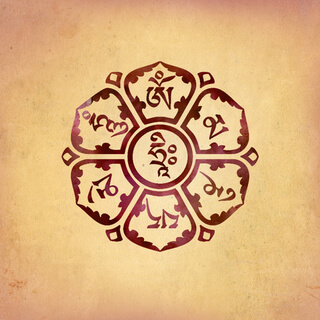
The six-syllable Sanskrit mantra of Avalokiteshvara, the bodhisattva of compassion, glossed as "the jewel in the lotus." It is one of the most widely recited phrases in Tibetan and Mahayana Buddhism.
The bodhisattva of compassion in Buddhism, known as Chenrezig in Tibetan. Reciting this mantra is understood as turning toward and entrusting oneself to that compassion.
In Mahayana Buddhism, a being devoted to awakening for the benefit of all others, embodying compassion and dedicating their practice to relieving suffering.
A string of 108 beads used to count mantra repetitions, moved one bead per recitation. The beads pace the practice and add a steady tactile rhythm you can feel under your fingers.
A major branch of Buddhism, encompassing Tibetan and other traditions, that emphasizes compassion and the bodhisattva path. It is the tradition in which this mantra is central.
Steadying attention on one clear target, here the repeating syllables, so the mind drifts less into worry or distraction. It tends to feel like sharper focus and fewer spiraling thoughts.
Stabilizing attention on a defined target (focused attention, attentional selection) to reduce mind-wandering and attentional shifting.
The way body and mind fall into step with a steady repeating sound, so the mantra's cadence begins to carry the practice on its own. It often feels like settling into a pattern without effort.
Synchronization of physiological rhythms (neural, cardiac, respiratory) to an external rhythmic stimulus such as chanting.
Valentina Cartei, Andrey Anikin, David Reby (2025). Chants across seven traditions share acoustic traits that enhance subjective relaxation. https://doi.org/10.1073/pnas.2506480122
Cited in: Benefits, How it works, Research, Use with care, What happens in the body, What it is
Manish Kumar, Thushara D. Abhayapala, Prasanga N. Samarasinghe (2022). A Preliminary Investigation on Frequency Dependant Cues for Human Emotions. https://doi.org/10.20944/preprints202205.0107.v2
The research is useful for setting expectations, but study methods and participant groups vary. Treat the findings as general guidance rather than a promise about any single session, and not a replacement for clinical care.
A Preliminary Investigation on Frequency Dependant Cues for Human Emotions
2022
Finding: In this early online listening study, people rated how single tones made them feel, and their responses flipped across a crossover zone around 417 to 440 Hz, with the 432 to 440 Hz band coming across as emotionally neutral and paired feelings like happy versus sad and angry versus calm shifting in roughly mirror-image ways as the pitch changed. That hints at a broad link between the pitch of a sound and the emotion we read into it, which loosely connects to why sound-based practices can feel calming. Keep in mind, though, that this looked only at isolated tones rated online, not at chanting or mantra, so it says nothing about a specific "healing frequency" in Om Mani Padme Hum and can only inform the general idea that sound and emotion are related.
See full citation in referencesA Preliminary Investigation on Frequency Dependant Cues for Human Emotions
2022
Finding: In this early online listening study, people rated the emotion they heard in single tones, and the ratings for four basic emotions crossed over in the 417–440 Hz range, pointing to that band sounding roughly emotionally neutral. The pattern also lined up in a mirror-like way, with happy and sad tones falling on opposite sides of the scale, as did angry and calm ones. For anyone drawn to Om Mani Padme Hum, this is worth taking lightly: it tested isolated tones, not chanting or mantra, so it hints at a general link between pitch and mood rather than showing that any specific frequency shapes how you feel while practising.
See full citation in referencesIf you are using recitation to cope with recent trauma, acute distress, or grief, practise with care: quiet, sustained attention can let unprocessed feeling rise, sometimes felt as sadness or agitation moving through the body. This is a practice-informed caution, not a documented risk. Shorten the session, open your eyes, and steady yourself in your surroundings, and keep the practice alongside qualified care rather than in place of it.
People managing an active mental-health condition or a physical illness should take care and keep recitation as a low-intensity companion to professional care, not a replacement for it. No research has tested this mantra as a treatment for any condition, so it is best framed as supportive self-practice rather than therapy.
Om Mani Padme Hum is most approachable as a brief, self-directed practice, sounded quietly and at a comfortable pace rather than as a full 108-bead cycle from the outset. A gentle low voicing, whether spoken aloud, whispered, or murmured, keeps the recitation easy and calming while you stay attentive to how you feel as you go. If you are working through trauma, grief, or a diagnosed condition, it is best held as a companion to professional care rather than a substitute for it.
Begin with a few minutes of slow, low, steady recitation rather than a full 108-bead cycle. Let the pace stay comfortable so the body can settle without strain, seated or while walking.
Chant in a relaxed, low-pitched, unhurried way, and avoid pushing the voice or over-extending the breath. This keeps recitation easy on the throat and calming rather than effortful, whether you sound the syllables aloud, whisper, or murmur them.
Check in with how you feel as you continue. If the practice brings a sense of settling, stay with it; if it stirs up grief, restlessness, or difficult memories, ease off rather than pressing through.
If difficult feeling surfaces, shorten the session, open your eyes, and return attention to simple contact with your surroundings until you feel steadier.
If you are working through trauma, grief, acute distress, or a diagnosed condition, use recitation as a companion to care from a qualified professional, not as a substitute for it.
This information is educational and is not medical advice. This practice is not a substitute for professional care and should not replace prescribed medication or treatment for any medical or mental-health condition. If you are managing a health condition or taking medication, talk with a qualified health professional before changing your practice. If you are in distress or crisis, seek professional support.
| Kirtan (call-and-response devotional chanting) | Group, musical, call-and-response singing where shared social and melodic energy carries the practice. | emerging EVIDENCE | Both are devotional chanting practices that share the vocal, rhythmic mechanism, but Kirtan is a Hindu bhakti tradition, typically musical, group-based, and call-and-response, where communal energy and melody carry the practice. Om Mani Padme Hum is a Buddhist mantra more often recited solo on a mala in a low, steady cadence, with attention drawn to felt vibration rather than musical arrangement. |
| Single-syllable Om chanting | A simpler single-syllable vocal practice focused on breath and resonance rather than devotional meaning. | emerging EVIDENCE | Both use chanted vocal resonance that may feel soothing, but Om chanting rests on one sustained syllable and its vibration, without the narrative meaning or devotional object of the longer mantra. Om Mani Padme Hum adds five further syllables, a discrete pacing structure for counting on a mala, and an explicit orientation toward Avalokiteshvara's compassion. |
| Focused-attention breath meditation | Building general concentration with the breath or a neutral anchor, with no vocal or devotional component. | EVIDENCE | Both stabilize attention on a repeating anchor, but focused-attention meditation usually rests attention on the breath or a neutral sensation, silently and without any vocal or devotional element. Om Mani Padme Hum uses a spoken or silently rehearsed sacred phrase, so it adds vocal resonance, rhythmic cadence, and a compassion-centered meaning that a plain breath anchor does not carry. |

Probably in a mild, momentary way, but the evidence is indirect. No trial has tested this mantra itself; the nearest support is a 2025 acoustic study where listeners rated slow, low, steady chant sounds as more relaxing (Cartei et al., 2025). People often report feeling calmer while reciting, though no heart-rate or hormone data confirm it.
+
Probably in a mild, momentary way, but the evidence for it is indirect. In a 2025 study, listeners rated slow, low-pitched, steady chant sounds as more relaxing, which is a plausible reason recitation can feel settling (Cartei et al., 2025). That research looked at chanting in general and at how relaxed people felt while listening, not at Om Mani Padme Hum specifically, and it measured no autonomic markers such as heart rate, breathing, or cortisol. So what can honestly be said is momentary, self-reported calm, not a demonstrated physiological or treatment effect.
Not directly. No trials or physiological studies have tested Om Mani Padme Hum itself. The only relevant evidence is indirect: a 2025 acoustic study found chanting across traditions shares a slow, low, steady sound that listeners rated as more relaxing (Cartei et al., 2025).
+
Not directly. No clinical trials or measured studies have tested this specific mantra, so any research applies to chanting in general rather than Om Mani Padme Hum. The closest evidence is a 2025 study of 242 chants from seven traditions, which found they share a slow, steady, low-pitched sound that listeners rated as more relaxing to hear (Cartei et al., 2025). That points toward gentle settling from chanting broadly, which stands as early signal rather than proof for this mantra or for any condition.
Likely because of the sound itself. A slow, low-pitched, even voice gives the nervous system a steady rhythm to settle into, and listeners in a cross-tradition acoustic study rated chant sounds with those qualities as more relaxing (Cartei et al., 2025). This is a plausible pathway, not a proven effect.
+
Likely because of its acoustic qualities. A 2025 analysis of 242 chants from seven traditions found that their slow, flat, low-pitched voicing set them apart from ordinary song and speech, and listeners rated these sounds as more relaxing (Cartei et al., 2025). The plausible reason is that this steady, unhurried sound gives attention and the body an easy rhythm to fall into, which many people feel as the breath lengthening and the shoulders softening. This evidence is indirect and drawn from chanting in general; it did not test Om Mani Padme Hum or measure any bodily change, so the calming pathway is suggestive rather than confirmed (Cartei et al., 2025).
Either works. Om Mani Padme Hum is traditionally recited aloud, murmured, or repeated silently, so silent practice is a legitimate option. Chanting aloud adds the slow, low, steady sound that acoustic research links to feeling more relaxed, so voicing it may add a settling effect that silent recitation won't (Cartei et al., 2025).
+
Either works. You can chant Om Mani Padme Hum aloud, whisper it, or say it silently in the mind, and all three are accepted forms of the practice. The one caveat is evidence-based: the only study here found that slow, low-pitched, steady chant sounds were rated as more relaxing by listeners, so the calming effect tied to voicing applies to audible chanting rather than silent repetition (Cartei et al., 2025). That is a reasoned inference from chanting in general, not a measured comparison of silent versus aloud, so choose whichever feels sustainable; silent recitation still steadies attention on the repeating syllables.
Traditionally 108 times per cycle, counted one repetition per bead on a mala. There is no measured or clinical "dose," so this is a tradition and practice convention: beginners can start with just a few minutes rather than a full 108-bead round.
+
Traditionally, Om Mani Padme Hum is counted in cycles of 108, moving one bead of a mala with each repetition, and it can also be recited during walking meditation or as quiet background practice through the day. This count comes from Tibetan and Mahayana tradition, not from research linking any number of repetitions to a measured effect, so treat it as a customary rhythm rather than a prescribed dose. If you are new to it, start with a few comfortable minutes and let the pace stay unforced rather than aiming for a full round.
Yes, it can. Sustained recitation and long cycles occasionally surface grief, restlessness, or unexpected feeling rather than calm. If that happens, slow the pace, shorten the session, open your eyes, and reach for support; this is a practice-informed caution, not a documented risk.
+
Yes, it can. Quiet, sustained attention during long recitation cycles can let unprocessed feeling rise to the surface, often felt as sadness or agitation moving through the body. This is a practice-informed caution rather than a measured risk, since no study has examined emotional-surfacing during this mantra. If difficult feeling comes up, treat it as a signal to slow down, shorten or pause the session, ground yourself in your surroundings, and keep professional care in place if you are working through trauma or grief.
Use care. No study has tested this mantra's safety in trauma, so there is no evidence-based answer; as a practice-informed caution, sustained recitation can surface grief or agitation, so slow or pause if that happens and keep it alongside professional trauma care, not instead of it (Cartei et al., 2025).
+
Use care. No safety-specific or trauma-population research exists on Om Mani Padme Hum, and the one cited study looked only at how relaxing chanting sounds to listeners, not at risk during trauma processing (Cartei et al., 2025). As a practice-informed caution rather than a documented finding, quiet, sustained recitation can let unprocessed feeling rise, felt as sadness, restlessness, or difficult memories. If that happens, shorten the session, open your eyes, and steady yourself, and treat the practice as a low-intensity companion to qualified trauma care, not a treatment for trauma or PTSD.
Both repeat a mantra to gather attention, but the vehicle and setting differ. Om Mani Padme Hum is a shared Buddhist compassion mantra, often chanted aloud in a slow, steady voice and tied to Avalokiteshvara; Transcendental Meditation is a silent, secular practice using a personally assigned sound, taught in a standardized paid course. No study directly compares them.
+
Both repeat a mantra to steady attention, but they differ in vehicle, tradition, and format rather than in any head-to-head evidence. Om Mani Padme Hum is an openly shared, devotional six-syllable phrase, frequently chanted aloud or on a mala in a slow, low, steady cadence within Tibetan and Mahayana Buddhism (Cartei et al., 2025). Transcendental Meditation is a silent, inward, secular technique using a personally assigned sound and a standardized format taught for a fee. No direct comparison exists, and neither is a treatment for any condition.
Using chanting and sustained voicing to engage the vagus nerve, which helps regulate calming, rest-and-recovery responses. Practitioners often notice it as grounding and a sense of the nervous system easing.
Vocalization engaging laryngeal vagal afferents through vocal-fold vibration and controlled exhalation, supporting parasympathetic regulation.
The body's alertness and stress response easing down toward rest, which shows up as slower breathing, softening shoulders, and a settling feeling. Chanting's slow, low, steady sound may support this shift.
A reduction in physiological arousal; here inferred from indirect acoustic evidence rather than measured autonomic markers.
Noticing internal body signals such as breath, vibration, or tension, which lets you catch early stress cues and feel more embodied. In this practice it centers on the felt resonance of the syllables and the mala beads.
The capacity to sense and interpret internal bodily signals (interoception, visceral afferent processing).
Stepping back from thoughts and feelings to observe them as passing events rather than being swept up in them. This creates a bit of breathing room and less automatic reactivity.
The shift from immersion in mental content to observing it as transient (decentering, cognitive defusion).
Deliberately releasing the grip of self-directed control and entrusting oneself to a sacred presence, here Avalokiteshvara's compassion. It is an active offering, not passive giving up, and often brings a felt sense of relief and connection.
Releasing self-referential control toward a perceived higher power through active trust and receptive openness (self-transcendence, surrender experience).
Cited in: Research
Manish Kumar, Thushara D. Abhayapala, Prasanga N. Samarasinghe (2022). A Preliminary Investigation on Frequency Dependant Cues for Human Emotions. https://doi.org/10.3390/acoustics4020028
Cited in: Research
Manish Kumar, Thushara D. Abhayapala, Prasanga N. Samarasinghe (2022). A Preliminary Investigation on Frequency Dependant Cues for Human Emotions. https://doi.org/10.20944/preprints202205.0107.v1
Cited in: Research
Beginner content for Om Mani Padme Hum

★ 4.8
·
Music
·
24 min
Zǒng Shì Qí (總是騎) - Khenpo Tsultrim ( མཁན་པོ་ ཚུལ་ཁྲིམས་ )
How hard is Om Mani Padme Hum?
Om Mani Padme Hum stays at 3 because it is more than a simple chant once the compassionate visualization and sustained repetition are honored.
3
Mental Effort
3 / 4
▾Emotional Depth
2 / 4
▾Physical Intensity
1 / 4
▾Prior Knowledge
2 / 4
▾Editorially curated. Tracks are not themselves clinically studied; evidence on the page applies to Om Mani Padme Hum as a technique.
Explore guided sessions to deepen your Om Mani Padme Hum technique.