Welcome to the mindfulness meditation podcast presented by the Rubin Museum of Art.
We are a museum in Chelsea,
New York City that connects visitors to the art and ideas of the Himalayas and serves as a space for reflection and personal transformation.
I'm your host,
Dawn Eshelman.
Every Monday we present a meditation session inspired by a different artwork from the Rubin Museum's collection and led by a prominent meditation teacher from the New York area.
This podcast is a recording of our weekly practice currently held virtually.
In the description for each episode,
You will find information about the theme for that week's session,
Including an image of the related artwork.
Our mindfulness meditation podcast is presented in partnership with Sharon Salzberg and teachers from the New York Insight Meditation Center,
The Interdependence Project,
And Parabola Magazine.
And now,
Please enjoy your practice.
Hi,
Everybody.
Welcome.
Great to have you here.
Welcome to mindfulness meditation online with the Rubin Museum of Art.
I'm Dawn Eshelman.
Great to be your host today.
We are a museum of Himalayan art and ideas in New York City,
And we're so glad to have you joining us.
Today,
This entire month,
We have been talking about healing and the people and elements in our lives that inspire not just healing,
But our health,
Our optimized well-being.
We will just give you the overview of what we'll do today.
So inspired from our collection,
We'll take a look at a work of art together from our collection.
We'll just hear a brief talk from our teacher today is the fantastic Tracy Cochran.
And then we will hear from Tracy.
Then we'll have a short sit 15 to 20 minutes for the meditation guided by Tracy.
Okay,
So we'll take a look at today's theme and artwork.
And this is really inspired by Healing Practices,
Which is an exhibition that we just opened last month.
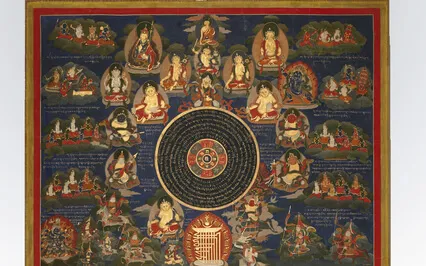
So we're looking at the protective astrological chart that is featured in that exhibition as a healing practice,
A tool for healing.
This is from Tibet,
18th or 19th century.
And astrology is very important in Buddhist healing sciences.
It's actually important in many different cultures.
And there's a strong tradition of astrological practices in a variety of cultures.
We actually did a series of programs on this a few years back and explored Vedic traditions,
Mayan traditions,
Other indigenous traditions as well.
So this astrology has its origins in the Tibetan shamanistic culture of Bon,
So the kind of precursor to Buddhism,
The indigenous religion of Tibet was Bon,
And can be used to construct medical calculations and protective guides for individuals and households.
So there are typically charts displayed in households that can be utilized by different family members and customized to the specific needs of families.
And the primary figure actually that's at the bottom,
So I'm going to go back to the main picture here and you can see there are these two main circles and the one at the bottom here is actually a tortoise,
A metaphor for creation.
So on the tortoise's belly are concentric circles that illustrate from the inside out the nine magic numbers,
The eight trigrams and the 12 animals of the zodiac,
Which combined all together with the five elements form the 60 year cycle of the Tibetan calendar.
Along the sides are rows of sigils,
Each representing a negative spirit and these symbols bind those spirits in a contract agreeing not to harm the displayer of the image.
Now I would love to bring on our fantastic teacher today.
This is Tracy Cochran.
She's been a student and teacher of meditation and spiritual practice for decades.
She is the founder of the Hudson River Sangha,
Which is virtual and open to all.
Can find more about this on TracyCochran.
Org.
And Tracy teaches not only at the Rubin,
But also mindfulness,
Meditation and mindful writing at New York Insight Meditation Center and many other places.
She's the writer and editorial director of Parabola,
An acclaimed and quite beautiful quarterly magazine that seeks to bring timeless spiritual wisdom to the burning questions of the day.
There's a new issue of Parabola out right now,
Right?
And that's about ancestors.
And I believe you also,
Tracy,
Have a piece in this,
So check it out.
You can get it at the Rubin shop or you can check out the magazine and much more at parabola.
Org.
Welcome Tracy.
Well,
Thank you,
Dawn.
I'm delighted to be back and especially under this beautiful and intricate illustration,
Which Tashi will describe and talk about later.
I wanted to talk to you just a bit before we meditate about what astrology can mean to us.
And most of the people here today are from a Western background.
And some of the people who are here and who listen to the podcasts are younger people,
Younger than I am.
And there has been a great resurgence of interest in astrology among that population in particular,
Which fascinates me.
So I've been reflecting on this and delving into it a little bit.
And what touches me is that what I've learned is that it is exactly what draws me and many of us to practice,
Namely to shift to an interest towards astrology is to open our view of who we are and what governs our life.
It's not so much a question of shifting to believe in something fanciful or something unreal versus the reality of data,
But to shift,
To open really our attitude towards ourselves and our lives.
It's not a matter of thinking that we're fixed,
That we have a certain star sign where Aquarius or Taurus,
But to open,
To consider that our lives move,
They change.
And this is what Buddhism teaches.
In other words,
It helps us,
It's a tool for healing.
Healing in the rude sense of the word in English means to make whole,
To begin to see that all parts of our lives inform us and potentially awaken us so that looking at our lives as something influenced by the movement of the planets shows us that a depression,
A hard time,
A time of conflict will eventually shift.
As Maya Angelou famously said,
Sooner or later every storm falls,
Runs out of rain,
Rain stops.
Another opportunity comes in.
So it's not simply opening our view to see that we're part of a larger world and it touches me,
The image of the tortoise because many of us here in America and indigenous Americans also saw the tortoise as an emblem for creation,
For the earth.
So opening to this notion that we're influenced by great forces.
First of all,
It's not fanciful.
We are literally made of star stuff.
We are literally part of world that gives us oxygen.
Our lungs are like trees.
Our circulatory system is like a river.
All of this is very real.
But it also invites us to consider a very different way that we can be free.
And that freedom consists not in forcing things to happen.
And this was the colonial way of doing this.
We will just force things.
But rather more like all these indigenous cultures that looked at the stars,
That studied them,
That understood our interconnection with nature.
So that on an individual basis as we come to practice now,
We begin to see that our freedom consists not in trying to always outrun sorrow or conflict or aging or loss or anything else we fear,
But to begin to discover a new way of relating to that fear.
As the great poet Rilke once said,
It may be the case that everything that frightens us inside is something helpless that needs our love.
And we begin to see that love,
Far from being something frightening or something remote from us,
Love in this practice is a way of seeing with kindness and with an openness to the reality that things change,
That things open and reveal other truths,
Other phases.
So as we begin to take our seat to meditate right now,
I invite you to consider that not only are we under the planets and the stars and sitting on the earth together,
But these bodies,
These hearts,
These minds,
These lives that we live that can seem so bewildering and overwhelming sometimes and fraught with uncertainty.
All of these things are also nature and all of these things can open and reveal unexpected joys and meanings under the touch of your own kind attention.
We begin to discover,
As Maya Angelou again said,
That we need joy like we need oxygen.
We need each other like we need the earth.
So we take a comfortable seat and just really take that suggestion,
Comfortable,
Seriously,
What is it like to welcome yourself to be here just like this without forcing yourself to be another way or a better way,
But to just notice that there is an attention present inside you.
Right now,
You don't have to strive for it.
Just close your eyes and see that there is a luminosity here,
A willingness to be with what happens to be present today and see that this attention can touch everything it finds,
Whether it's tension or sorrow or restlessness,
Whatever it is,
It can meet it with acceptance and with interest,
Not thinking about it,
Not fixing it,
But simply welcoming it home to presence,
Home to the present moment.
Notice that you can make this movement of coming home to the body,
To sensation,
To the rhythm of breathing,
No matter what else is going on.
Letting thinking happen,
Letting memories pop up if they pop up,
Letting all the senses appear,
Sound,
Touch,
And notice that you can come home to an attention that receives all of this with kindness and interest.
And notice how it feels to rest in the stillness of not striving.
And notice that when you get lost in thinking or dreaming or picturing,
You can gently,
Gently come back again to the experience of being present.
And notice that this doesn't close you but opens you,
Opens you to life.
We begin to remember mindfulness means to remember presence,
To remember that we are alive in a living world.
Notice how it feels to give yourself to life,
To practice.
To let yourself soften and open to all the influences known and unknown that are coming in and going out,
Hear impressions of all kinds and great forces of compassion and love.
Just let yourself rest in stillness,
In not resisting,
Not striving.
And notice how everything changes.
And notice that there is a presence here inside you and outside you that accompanies you,
That sees,
Receives what's happening with kindness,
With openness like the sky.
Notice that this simple movement of return,
Of returning to the body and the breath and the present moment opens you to the cosmos,
Not thinking about it but gently opening to sense that we are not alone,
That we belong to a larger life known and unknown.
Notice how this simple movement of return,
Of returning to the body and the present moment opens you to the cosmos,
Not thinking about it but thinking about it like the sky.
Just let yourself sink into sensation.
Opening to a presence that sees without comment,
Without thinking,
But with kindness and loving acceptance as boundless as the sky.
And notice how this simple movement of return,
Of returning to the body and the present moment opens you to the cosmos,
Not thinking about it but thinking about it like the sky.
Notice how it feels to be completely acceptable,
Alive,
Changing,
Not thinking about it like the sky,
Subject to storms and darkness and also joy.
Everything acceptable.
And notice that this stillness is not static,
It's not an absence but something alive,
Nourishing,
Touching us inside.
And notice how it feels to let yourself be completely accessible,
Not thinking about it but thinking about it as being completely vulnerable under the gate use of an attention that's completely accepting.
Notice how alive you are under the words of the sun.
And notice how it feels to be completely accessible,
Not thinking about it as being accessible,
Not thinking about it as being completely accessible,
Not thinking about it as being completely accessible.
There is something deep inside us that knows we're on the earth and under the stars.
And notice how it feels to be completely accessible,
Not thinking about it as being completely accessible,
Not thinking about it as being completely accessible,
Not thinking about it as being completely accessible,
Not thinking about it as being completely accessible,
Not thinking about it as being completely accessible.
That concludes this week's practice.
If you'd like to support The Rubin and this meditation series,
We invite you to become a member.
If you're looking for more inspiring content,
Please check out our new podcast Awaken,
Hosted by Laurie Anderson.
The 10-part series features personal stories that explore the dynamic path to enlightenment and what it means to wake up,
Now available wherever you listen to podcasts.
Thank you for listening,
And thank you for practicing with us.