Welcome to the Mindfulness Meditation Podcast.
I'm your host,
Dawn Eshelman.
Every Wednesday at the Rubin Museum of Art in Chelsea,
We present a meditation session led by a prominent meditation teacher from the New York area.
This podcast is a recording of our weekly practice.
If you would like to join us in person,
Please visit our website at rubinmuseum.
Org slash meditation.
We are proud to be partnering with Sharon Salzberg and teachers from the New York Insight Meditation Center.
The series is supported in part by the Hamera Foundation.
In the description for each episode,
You will find information about the theme for that week's session,
Including an image of a related artwork chosen from the Rubin Museum's permanent collection.
And now please enjoy your practice.
Good afternoon,
Everyone.
Welcome to the Rubin Museum of Art and to our weekly mindfulness meditation practice.
My name is Dawn Eshelman.
It's great to see you and great to be back.
And it's great to have you all here.
So we're talking about ritual this month.
And it's a concept that is central to Buddhism and Tibetan Buddhism and also very present in our galleries upstairs.
If you've had a chance to take a look throughout the exhibition on the sixth floor Padmasambhava,
The master of time,
You will see that there's lots of evidence of ritual and the importance of ritual in who he was and what he was able to do.
He's known to have brought Buddhism to Tibet.
And you'll see there's a special section on Bardo,
The Tibetan Book of the Dead,
The rituals around preparing for and going through death that are really interestingly linked to Padmasambhava.
So take a look at that if you can.
And certainly we're talking about ritual as a part of a spiritual or religious practice.
And also within this context here,
We're thinking about ritual as something that we do here once a week.
We gather.
This is our ritual.
And in fact,
As we structured this program,
We've been really dedicated to providing a kind of ritualized structure so that you're perhaps experiencing some similar elements when you come.
And then we can think even more broadly about rituals in our daily lives that are repeated,
But with intention and presence.
So maybe that morning cup of coffee or tea,
Or there may be other rituals that you can think of.
If you have a practice,
A meditation practice at home,
Perhaps you have built a little bit of ritual around that for yourself.
And maybe there's in fact some objects that ground you,
Even if it's just the couch cushion that you sit on or your cushion,
Meditation cushion,
Or feeling the floor beneath you,
Whatever it may be.
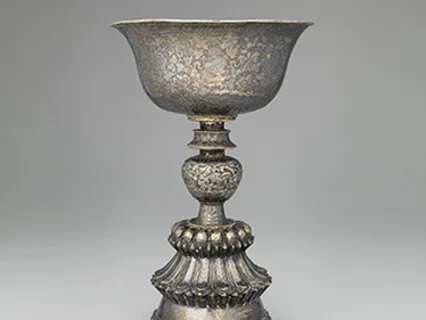
And we are looking here today at an object of ritual.
And if you were to put your hand over the top of it there,
You might guess that this were a candlestick.
And it is a candlestick of sorts.
This is a butter lamp.
And it is traditionally filled,
The top portion,
With yak butter and burned for light.
And that gives a really memorable scent to the room.
These days,
You're more likely to find ghee or vegetable oil as the oil that's burned.
But this is a really intricate,
Intricately engraved and created butter lamp here.
Some butter lamps that you'll see are very,
Very simple and just a simple bowl.
And some are quite intricate.
And here we see these kind of scalloped layers here.
Along the base of the butter lamp,
There are some clouds that have been engraved around the base there.
And then at the top,
If you were able to look closely at the detail,
When we were sitting here together,
You will have seen some lotus blossoms.
The lamp itself serves a few purposes.
One is the most kind of practical and literal,
Which is that it lights up a space.
And these are most traditionally found in monasteries,
In shrine rooms,
In shrines.
And they are certainly there to illuminate the space and to help us see the objects within the space,
So tankas,
Ritual objects.
But there is also an important quality to the light.
We're not talking about overhead fluorescence here.
This is a yellow flickering light.
And it traditionally comes from below most often.
And so you're getting kind of a very dark base of a room and then more light isolated in these certain areas directing upwards.
And the second purpose of these lamps is kind of harkening back to that flickering element.
It's to really galvanize a kind of focus for the meditator or the person who is in that room doing a practice.
And that flicker is a kind of presence of its own in a way,
And really does engage the viewer.
And the final kind of purpose of this lamp is symbolic one.
And that is simply to symbolize light,
Enlightenment,
The mind awakened.
And so perhaps you can think too about light that you find in your own sacred spaces and any connections you might find there.
Or light as you see it outside with the shifting a little bit as the season gets a little darker.
Light that's significant around us in other ways.
So delighted to have Sharon Salzberg here as always.
And I know you all have been engaged in an ongoing conversation about rituals.
So I'm excited to be part of that today.
Sharon is the co-founder of the Insight Meditation Society in Berry,
Massachusetts.
And she's been studying and teaching for a long time and is a beloved teacher and author many really useful,
Helpful,
Funny books.
Most of which you can find upstairs in the shop if you like.
And her most recent is Real Love.
Please welcome her back.
Sharon Salzberg.
Thank you for saying all that,
Dawn.
I just think my books aren't funny enough.
I think they're not.
But I'm still writing,
So there's hope.
So last week I talked a little bit,
Well really it's like Dawn was just talking about how intention and presence are at the core of appreciating ritual,
Rather than doing it mindlessly or as I think the Buddha sort of cast aspersions on it was sort of like paying someone else to do the work.
You do this ritual,
I'll just keep living the way I've been living and not really try to act from a place of greater good heartedness or more consciousness or make some shifts just to experiment,
You just,
You take care of it.
So that's the worst case scenario and it doesn't have to be that way.
I think any ritual can really serve as a powerful,
Powerful vehicle for us to connect,
To connect to others,
Maybe connect to those we haven't thought of in a while,
To connect to a sense of ancestry or even timelessness.
We're moved by ritual if we're actually present.
And something that intrigues me is that in my experience,
Many rituals,
Certainly within the early Buddhist traditions,
Come with a kind of belief system and that you may not feel in accord with that belief system at all,
But the actual experience of participating or observing if you do it with intention and presence,
If you're really open hearted,
Can be transforming.
So for example,
I went to Burma twice in the 80s for long periods of intensive meditation.
So first time was three months and that's where I did intensive loving kindness for the first time.
And the situation is pretty austere relatively speaking,
Although all your needs are met and that plays into something I'll talk about later.
All the meals that you eat are,
Which are two a day,
Breakfast and lunch,
Lunches,
Maybe 10.
30 in the morning.
That's what I mean by austere.
They're all offered to you.
They're all given.
You don't pay anything for being there.
So it's very intensive practice.
And for me,
I was doing loving kindness practice.
So it was kind of a newish practice for me,
Certainly in that intense immersive form.
And everything's about your experience.
You're encouraged not to read and there's nothing really to read unless you brought it.
Especially those of you who've been on intensive retreat know that you kind of get desperate to read and you read the bulletin board of the announcements again and again and again and again.
But Burmese script is not like Roman script.
It's round.
So you don't know what you're reading and you just kind of stare at it.
So everything's about your experience,
Which is a breathtaking view of human nature actually,
I think,
That you can do this.
You don't have to believe anything.
You don't have to tie your vision of what's real to someone else's.
It's about self-witnessed truth.
And you have the capacity as a human being to really understand your life and break through conditioning and all of that.
So it's very much that spirit.
And then it's also very restrictive in terms of where we're allowed to go.
And we have these special visas and all that.
So right at the end of the three months,
We were allowed to go to the Shwedagon Pagoda,
Which is this magnificent pagoda in the center of Rangoon.
And there were many rituals happening there.
And I remember leaving this kind of austere,
Extremely ardent practice.
And people sang like for 50 cents or the equivalent,
We'll give you a bucket of water and you can bathe this Buddha statue and all your wishes will come true.
I thought,
I could have saved three months.
Why did I go there first?
I could have gotten a tourist visa.
50 cents is not much.
But I don't really buy that.
But there's something about seeing what you want.
How is my aspiration?
It's like,
Really?
Am I going to waste my wish on that?
That's kind of illuminating.
And the main sort of vehicle for that understanding for me was in what I talked about last week as a promise to talk about this week as my favorite ritual,
Which is this concept called sharing merit.
So this may be a somewhat unfortunate translation,
But the idea within the teachings is that if you do something toward the good,
You're kind,
You're generous,
You're restrained,
Like it would be awfully easy to tell a lie,
But you don't.
You meditate,
Even if it feels like your concentration is totally crummy.
The fact that you sit down to do it or whatever form you're doing,
You do it.
You don't just think in the abstract about,
Wait,
That would be a good idea someday.
I say as a joke that often when I meet people,
If I'm introduced as a meditation teacher,
They will say,
Oh,
My partner should really meet you.
And somebody said that to me yesterday.
It's not just a joke.
So when you think,
OK,
What about me?
What about if I try?
What if I allow myself to step out of my comfort zone and really explore these other terrains?
All of those activities when we learn,
We question,
We want to understand something,
Are said to produce a powerful positive energy.
And that energy is what is being called merit.
So the idea is that we give a donation somewhere,
Or we sit down to meditate,
Or we do a retreat.
At the end of that,
Rather than going home and lying on the couch and thinking,
I made so much merit,
We dedicate it.
We offer it.
We give it over in various ways to those who've helped us,
Maybe to those we know who are hurting as a kind of affirmation that says your meditation that you're basing the sharing of the merit on.
It's an affirmation that our inner work could never just be for ourselves alone,
But is in this connection.
We offer the merit to all beings everywhere of the acts that we have done.
And one of the bases of that,
This is what I mean by a belief system,
Which you might or might not share,
Is the belief that merit is often shared in these cultures with those who've died.
Because first of all,
The belief system is embedded in a kind of cultural cosmology of rebirth.
So even if it said someone has died,
They're somewhere.
And none of which you need to believe.
I mean,
It's not the same as practice.
It's just the cultural context,
Which is the legacy of the centuries.
So very commonly,
One will do an act,
Generosity or so on,
And then dedicate the merit to someone who's died.
It's believed,
If you have that belief system,
That the strongest energy that can connect us beyond the body,
Beyond time,
Beyond space,
Is our own good heartedness.
So back to Burma as an example,
When I said you don't pay anything.
So every meal,
Which is two meals a day,
Is donated.
And the ethos is that if it's your birthday,
For example,
You go to the monastery and you offer as much money as you can possibly afford to feed as many people as you can.
And that's how you celebrate your birthday.
If your daughter's graduating from high school,
You do that.
If someone has died in your family,
You do that.
So every day,
Two meals a day was an offering.
And then there will be a ceremony at the end of the offering for the sharing of the merit.
Now you and many people don't,
Of course,
Have that kind of belief in rebirth.
But you can kind of honor the process.
It's like a remembrance.
Maybe someone was a strong figure in teaching us generosity,
For example.
And we are doing honor to their memory as we perform this act of generosity.
And then we share the merit with them.
It doesn't have to be literally the way that it is often described in those cultures.
And having participated in innumerable of these ceremonies,
It's very powerful just to feel that goodness,
It's almost like a reminder goodness is a potential for everybody.
And that good heartedness does connect us,
Whether you believe in the rebirth part or not.
I remember once,
Meals in Burma are also kind of in this monastery very formal,
Like sort of a processional as you go in and then you bow to the Buddha statue.
And then people are sitting maybe four to a table on the floor and the food is served family style.
So I went in and bowed to the Buddha and sat down and I looked at the food,
The different bowls of food on the table and I thought,
That looks like chicken soup.
That looks like white fish salad.
It was like an entire Jewish meal.
And I thought,
I'm hallucinating.
Like something has gone really off in my meditation.
But it turned out it was a Jewish meal that there was a minuscule Jewish community in Rangoon and someone had died.
Someone's father had died and so this family had come and didn't just offer the money,
They provided the recipes.
So it was like this entire Jewish meal.
And then we were there for the sharing of the merit ceremony.
And it was just a reminder,
You know,
Like we're not alone and we've never been alone.
And our lives are inextricably connected to those who've gone before and those who we are really indebted to and those who are struggling and ultimately all beings.
And so we often incorporate this sense of sharing merit.
I remember also once my Burmese meditation teacher,
Before I went to Burma,
Actually it was the year before,
He came to my center,
The Insight Meditation Society,
And he taught a three month retreat which I sat.
And someone I had been very close to died not long before he'd come.
And when I told him how much I was experiencing sadness and sorrow about my friend,
Upundit,
The teacher said to me,
Well now you have to do the retreat for both of you.
And every night when you end your day of practice,
I want you to share the merit.
You know,
So whether or not I take that to be literally true,
It was a tremendous sense of liberation in that kind of inclusion and so on.
So why don't we sit together and then I'll guide you through my version of sharing of the merit very briefly at the end of that.
So remember you're sitting as meritorious whether it feels concentrated or not.
Let your attention settle on the feeling of your breath.
You can have your eyes open or closed however you feel most comfortable.
Find the place where the breath is strongest for you or clearest for you.
The nostrils,
The chest or the abdomen,
You can bring your attention there and just rest.
And when you find your attention has wandered,
See if you can let go gently.
Just bring your attention back.
So I'm going to share the merit and the words that I use and you can just listen or use them silently or just put it on hold until you think of words that are more meaningful to you or just let it all go.
It's up to you.
So to begin with we actually feel that goodness,
We feel the power,
The positive energy,
No matter what your concentration was like or where your attention went.
It is a very positive act to sit,
To be still,
To look within.
And we have a lot of choices,
A lot of ways of spending an afternoon.
So we feel some joy at that,
Some upliftment at this possibility of choice.
And you can feel that in your body.
That is the so-called merit.
It's not the same as conceit or arrogance.
It's really delight in goodness.
And having gotten in touch with that,
We offer first to those who've helped you,
Whoever comes to mind.
Maybe they helped you be here right now or they helped you long ago or whatever it might be.
And again,
With the words that make sense to you,
If I say something like silently,
I offer the power of my practice to you or the merit of my practice to you.
May you be happy.
May you be peaceful.
And then assume you know or hurting or struggling.
I offer the merit of my practice to you.
May you be happy.
Be peaceful.
One another as we've co-created this experience.
And then all beings everywhere.
I share the merit of my practice with all beings.
May all beings be happy.
May all beings be peaceful.
So thank you.
That concludes this week's practice.
If you'd like to attend in person,
Please check out our website,
Rubinmuseum.
Org slash meditation to learn more.
Sessions are free to Rubin Museum members,
Just one of the many benefits of membership.
Thank you for listening.
Have a mindful day.