Welcome to the Mindfulness Meditation Podcast presented by the Rubin Museum of Art.
We are a museum in Chelsea,
New York City that connects visitors to the art and ideas of the Himalayas and serves as a space for reflection and personal transformation.
I'm your host,
Tashi Chodron.
Every Monday we present a meditation session inspired by a different artwork from the Rubin Museum's collection and led by a prominent meditation teacher from the New York area.
This podcast is a recording of our weekly practice currently held virtually.
In the description for each episode,
You will find information about the theme for that week's session,
Including an image of the related artwork.
Our Mindfulness Meditation Podcast is presented in partnership with Sharon Salzberg and teachers from the New York Insight Meditation Center,
The Interdependence Project,
And Parabola Magazine and supported by the Frederick Lance Foundation for American Buddhism.
And now,
Please enjoy your practice.
Hello,
Tashi Dalek.
So wonderful to see so many of you joining from all over.
Welcome.
Welcome to Mindfulness Meditation Online with the Rubin Museum of Art.
My name is Tashi Chodron,
And I am so happy to be your host today.
We are a museum of Himalayan art and ideas in New York City,
And we are so glad to have you all joining us for our weekly program where we combine art and meditation online.
Inspired from our collection,
We will take a look at a work of art from our collection.
We will hear a brief talk from our teacher,
And then we will have a short sit,
15 to 20 minutes for the meditation guided by our teacher.
And this month for October,
The theme is openness.
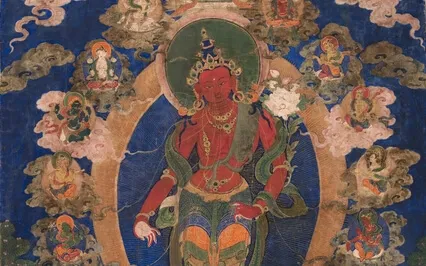
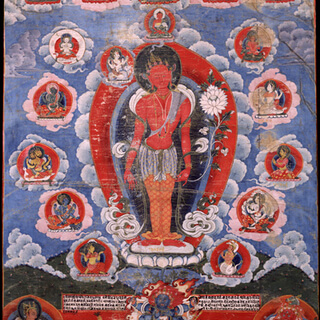
And the art connection for today is red Avalokiteshvara,
Origin from Tibet or Nepal from the period of 1871.
It's a thangka painting,
A scroll painting,
Mineral pigment on cloth,
About 48 and a half inch length into 28 and a half width.
The central figure here is the Avalokiteshvara,
The Bodhisattva of compassion.
One of the most recognizable mantras in the Buddhist world is Om Mani Padme Hum,
A jewel in lotus.
While many know the mantra,
Not all realizes that it is associated with the Bodhisattva Avalokiteshvara,
Who manifests in many forms.
Both peaceful and fierce wrathful,
In some of the local Teshwara also seems to appear in the female form as well,
The Kuan Yin in the Chinese Buddhism,
And often associated with white in color,
1000 arms,
Sometimes six arms and four arms.
And here you see two arms and red in color.
The two arms symbolizes the two truths,
Relative and absolute truth.
Also the four arms is associate or symbolizes the four immeasurable compassion.
So around his radiant body,
Tethered to his gaze by fine lines of gold are worldly gods,
Many originating in the Hindu tradition,
Such as Shiva,
Brahma,
Surya,
Varuna,
Ananta,
Chandra,
Agni,
All paying homage to the central figure,
The red Avalokiteshvara.
Painted in warm red hues,
He stands against a lapis background with his head at a charming angle with his right hand held in gesture of openness,
The palm open,
Fingers facing the earth symbolizes supreme generosity.
For us Tibetan,
His Holiness Dalai Lama is believed to be the emanation of Avalokiteshvara.
And how you can identify that this is the Bodhisattva figure is you look at the iconography,
You will find lots of jewels like our necklaces,
Armlets,
Bracelets,
Anklets,
Belt,
Crown,
Earring as you see here on this beautiful red Avalokiteshvara,
That's how you can identify that this is a Bodhisattva.
This particular painting is up in our gallery.
So if you come in person,
You can have an up close look at this beautiful thangka painting.
Now let's bring on our teacher for today,
Kyra Jualingo.
Kyra Jualingo is a Dharma teacher with a lifelong interest in blending spirituality with social justice.
Her name continues the engaged Buddhist movement developed by Thich Nhat Hanh and she draws inspiration from her parents stories and her dad's work with Martin Luther King Jr.
After living as an ordained nun for 15 years in Thich Nhat Hanh's monastic community,
Kyra Jual now teaching internationally in the Zen lineage and the Vipassana tradition as well as in secular mindfulness at the intersection of racial,
Climate and social justice with a focus on activists,
Black,
Indigenous,
People of color,
Artists,
Educators,
Families and youth.
Just in New York,
She offers spiritual mentoring to groups and is the author of We Were Made for These Times,
10 Lessons in Moving Through Change,
Loss and Disruption from Parallax Press.
Kyra Jual is leading a mindfulness practice in Prospect Park on Saturday,
October 22nd from 9.
30 to 11.
30.
Her teachings and writings can be found at her website www.
Kyrajual.
Com.
Kyra Jual,
Thank you so much for being here.
Thank you so much dear Tashi for your wonderful explanation of the piece of art,
The red Avalokitesvara and for your warm welcome.
And I just want to say I'm so grateful for you sharing the piece of art from your own shrine that was very beautiful.
Behind me is a face carved in the rock of a temple in Cambodia and I was told that it's also a representation of Avalokitesvara.
So we are surrounded by the wonderful energy of compassion.
And it's a very beautiful practice to contemplate art that if we ponder the artist that took the time to create this art,
It was such an act of compassion on the part of these amazing deep deeply practiced people who wanted to basically give a teaching through an image because every detail that Tashi was explaining is a teaching and we can ponder each thing and really receive a transmission,
Each element of the painting.
So just really grateful for the artist that created this work of art.
And so I want to offer a little bit of reflection today on the practice of openness as also a practice of compassion.
And then we'll do a meditation on how we might release limiting beliefs,
How we might practice openness with beliefs and mindsets that really hold us back.
And so I wanted to begin by offering the framework that my teacher Thich Nhat Hanh offers in his 14 mindfulness trainings of the order of interbeing.
So it's a set of practices,
Guidelines,
Principles that help us to really bring engaged mindfulness,
Engaged Buddhism into our lives,
Into the world.
And the very first one,
These were born out of the war in Vietnam when he was working for peace to end that war.
And so the very first training is openness.
And if you think of the context of a young monk seeing his country being destroyed by what he described as two warring parties who were both caught in ideologies,
His main wish was to transcend these ideologies,
The way we get caught in a certain perspective.
And then we're willing to kill others,
We're willing to die ourselves for an idea that often,
Even a few decades later,
That idea how a country should be run shifts greatly.
So is it worth all of that death and destruction for an idea that isn't very constant and that we may have a lot of misperceptions about?
So you can understand why the very first of this 14 trainings,
Thay wants to move away from being caught in ideas and dogmatism.
So let me read you this first of the 14 mindfulness trainings.
Aware of the suffering created by fanaticism and intolerance,
We are determined not to be idolatrous about or bound to any doctrine,
Theory or ideology,
Even Buddhist ones.
We are committed to seeing the Buddhist teachings as guiding means that help us learn to look deeply and develop understanding and compassion.
They are not doctrines to fight,
Kill or die for.
We understand that fanaticism in its many forms is the result of perceiving things in a dualistic and discriminative manner.
We will train ourselves to look at everything with openness and the insight of interbeing in order to transform dogmatism and violence in ourselves and in the world.
I'll put that in the chat and the whole,
All of the 14 mindfulness trainings,
You can find them on the internet,
The mindfulness trainings of the order of interbeing.
So that's a very,
It's very much a continuation of the Buddha as well,
Right?
The way the Buddha taught,
He said,
When people asked him,
How do we know what's true?
We have all these different teachers coming and one says this and one says something else.
And the Buddha gave a very profound answer and he said,
Don't believe what anybody says or don't believe things just because someone in a position of authority says it.
Don't believe things because they're written down in a sacred text.
Don't believe things because that's what everyone does,
Like rituals or certain sacred practices.
He said,
Try it out for yourself and if it works for you,
Then you should believe in it.
If you find that it helps you to suffer less,
Then you should believe in it.
Don't take my word for it.
He said,
Even the Buddha said,
Don't just believe me,
Try it out and if it works for you,
Then you can believe in it.
So that's a very radical teaching from someone who was awakened who said,
Just because I said it,
Even he was awakened,
That doesn't mean that you should just take my word for it.
Put it into practice.
So that's also a very deep teaching on openness,
On not getting caught in dogma,
In fanaticism,
In a very narrow way of perceiving reality.
He gave all of us practitioners a lot of freedom to explore for ourselves and find the truth that emerges for us in our own life.
It's a very compassionate thing that the Buddha did,
Not to force anyone to believe anything.
So another piece about openness is if we want to increase our understanding,
If we want to grow,
We actually have to let go of what we know in this moment in order to learn more.
And there's a wonderful image Thay,
Our teacher Thich Nhat Hanh,
Would often give of a ladder.
If you're wanting to go up a ladder,
You have to leave one rung of the ladder to advance to the next rung.
And so it's the same with what we know.
In order to increase,
To grow,
To expand our awareness,
We have to let go of the things that we stand on now.
And we see this in science over and over again,
Right?
There are certain ways of knowing,
Like Newtonian physics,
Very important for a certain way of understanding the world,
But then quantum physics was discovered and a lot of the Newtonian physics had to be left behind in order to go to a deeper understanding of reality,
Where the things that we rely on as being solid suddenly are just electrons that are spinning and not solid at all.
You can't find anything solid in the truest sense of reality.
So that's why Thay often asked us to put up on our wall a question.
He often wrote it as a calligraphy,
A beautiful calligraphy brush on rice paper that said,
Are you sure?
Question mark.
And he said we should all be reflecting on this many times throughout the day.
Are you sure?
So when we feel very,
Very strongly about something that we believe or that we think should happen,
Especially when there's a lot of intensity there,
It's a helpful question.
Are you sure?
Have we perceived the situation correctly?
So there's also a very beautiful sutra or discourse in the Mahayana tradition called the Eight Realizations of the Great Beings.
And this one,
The fifth realization,
I'll read it to you.
It's also about openness.
It says the fifth realization,
These are things that great beings,
Bodhisattvas who serve all beings like the red Avalokitesvara who has this hand extended in generosity,
Also a gesture of openness,
Right?
So great beings,
They are great because they practice beautiful qualities.
So this is one of these qualities,
These realizations that bodhisattvas have,
Including red Avalokitesvara.
So it says,
The fifth realization is the awareness that ignorance is the cause of the endless round of birth and death.
Bodhisattvas always listen to and learn from others so their understanding and skillful means can develop.
And so they can teach living beings and bring them great joy.
So even if they're very realized,
Bodhisattvas never think,
Oh,
I know everything.
I don't need to learn anything more.
They want to stay open and learn from others,
Understand others.
So I'll put that fifth realization in the chat as well.
So we are always open to learning and growing.
Our skillful means,
Our practice can always develop more.
So we should never think we come to the end of our understanding,
Right?
That when we practice that there is some final goal or that we never have to practice anymore because even the Buddha,
When he became awakened,
He didn't stop practicing.
He continued after his awakening to do walking meditation,
Sitting meditation,
Eating meditation,
Being aware of his body,
His breath.
So we can always continue to deepen our practice,
Continue to grow and his teaching continued to develop and respond and emerge in new ways in response to the people that he encountered.
So even the Buddha continued to change and grow.
So let's do a practice together now to explore how we might cultivate openness within our own lives in relation to particularly maybe some belief that we find to be constricting for us,
Somehow limiting that we feel somehow caught by.
So this is a practice from Tara Brach that I'll be sharing with you.
So inviting us to come into a position that supports our experience of dignity,
To sit comfortably and allow the body to settle into stillness.
Exhaling our attention,
Taking a few breaths together,
Inhaling deeply,
Filling the lungs,
And then slowing our out breath to really feel the sensations of the breath.
Singing to inhale deeply and exhale letting go,
Letting go of any tension,
Whatever holding that might want to be released.
And one more time,
Deep inhale,
Releasing the exhale and then allowing your breath to return to its natural rhythm.
And allowing your attention to rest in the body,
Just noticing if there are places of tension,
Maybe the breath can help to soften those areas,
Allowing the release of tension.
Now scan your awareness for any kind of limiting belief about yourself that might be asking for your attention.
Maybe there's a particular situation that has arisen or might arise where you find yourself caught or troubled in some way or fixated on some kind of perspective of what's right or what should be happening,
Maybe in your life or someone else's life or in society at large.
And so see if you can really bring this belief into as clear and immediate a sense as you can.
Maybe you put yourself in the situation in which this belief gets activated,
This maybe more closed down way of being arises.
And see yourself there in that situation,
Connecting with what you might be thinking or feeling,
What the limiting beliefs might be about yourself or about the situation,
That story you're telling yourself in that moment that causes a constriction,
Narrowing.
So we don't want to judge,
Although if judging is there,
We want to also be present with the judging.
But as much as possible,
We want to bring mindfulness and compassion to this experience of being caught.
And so we start with just recognizing what happens inside of you,
What happens in the situation where this limiting belief,
This closed down state gets activated.
So just connecting with that and asking yourself,
What's going on inside of me with this?
And as you do that,
Just to allow whatever you notice,
This opening to this perhaps painful experience,
Not pushing it away.
Just letting this reality be here as it is.
Realizing its space.
As we allow,
It enables a deepening of attention so that you can begin to investigate,
What is it that I'm believing?
And what's the core of what I'm believing about myself?
Sometimes these beliefs are kind of hiding beneath the surface,
But very much running our lives in a gently and in a curious,
Friendly way.
Just inquire.
You may also,
With whatever belief arises,
Just ask,
Is this belief really true?
Just notice what comes up.
Is it really accurate?
And continue to explore and investigate,
What is it like to live with this belief?
Maybe it's something that really influences you a lot.
Your thoughts confirm it.
You have a story,
A movie that really confirms your idea.
So what's that like when that story or belief that may bring about doubt,
That may make you self-critical,
Or maybe it brings up other emotions related to other people?
What's that like in your body,
In your heart?
What are the feelings or sensations that are strong when you're believing this?
When you're really holding on to that rung of the ladder that you're on.
Notice what emotions come along,
Like fear,
Embarrassment,
Self-hatred,
Irritation of yourself.
Just notice,
Just examine how it affects you.
And if you zoom out and allow your perspective to grow a little bit,
You could ask,
How is living with this belief or this family of beliefs,
How is it affecting my life?
How does it affect how I relate to others,
How I relate to myself,
My wish to help others or to be creative,
My sense of my own capability?
Just sense the landscape of how this belief impacts you and what it's like right in this moment to be living with that experience.
And then you can inquire,
What is the vulnerability?
What is the hurt or the fear that's under this belief?
And what does it need?
What does it most need right now?
What would be the message or reassurance,
The quality of kindness,
Compassion that would respond to it?
And if it feels right,
Maybe just offering a hand to your heart,
And that you can occupy the wisest,
Kindest place in your being and in some way offer what's needed to this part of you that is caught,
That is limited in some way.
Whether it's touch or an energetic offering or words,
Just giving yourself what it most needs in this moment,
And that you can begin more and more to rest in the presence,
The care,
The clarity and openness with who you really are beyond this belief.
You're more than this limited perspective.
So we'll take a deep breath together and we'll close this practice with the sound of the bell.
Doing the same thing again with the sound of the bell.
Thank you so much for your practice.
Thank you.
Thank you so much for that beautiful session,
Kaijua.
That concludes this week's practice.
If you would like to support the Rubin and this meditation series,
We invite you to become a member of the Rubin.
If you're looking for more inspiring content,
Please check out our other podcast,
Awaken,
A podcast that uses art to explore the dynamic paths to enlightenment and what it means to wake up,
Available wherever you listen to podcasts.
Thank you for listening.
Have a mindful day.