Welcome to the mindfulness meditation podcast.
I'm your host,
Dawn Eshelman.
Every Wednesday at the Rubin Museum of Art in Chelsea,
We present a meditation session led by a prominent meditation teacher from the New York area.
This podcast is a recording of our weekly practice.
If you would like to join us in person,
Please visit our website at rubinmuseum.
Org slash meditation.
We are proud to be partnering with Sharon Salzberg and teachers from the New York Insight Meditation Center.
In the description for each episode,
You will find information about the theme for that week's session,
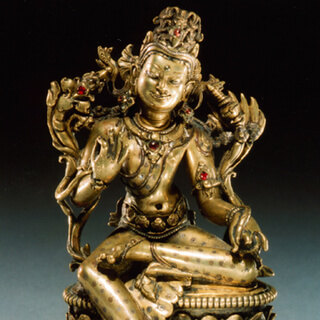
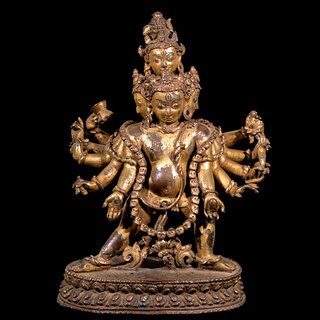
Including an image of a related artwork chosen from the Rubin Museum's permanent collection.
And now,
Please enjoy your practice.
Welcome to the Rubin Museum of Art.
My name is Dawn Eshelman.
Great to have you here for our mindfulness meditation practice.
And thanks for joining us on this kind of humid August afternoon.
It's nice to be in here with you.
We're talking this month about fear,
The juicy topic of fear,
Which is something that sometimes comes up when we're meditating,
That experience of the emotion that can be so overpowering.
But it is important,
I think,
To contextualize that we're having this conversation under this umbrella topic of power.
We're talking about power all year long at the Rubin and really trying to understand it,
The true nature of power.
And of course,
Fear is something that can really get in the way of our true inner power,
The power that's within and between us.
And fear,
In many cases,
Is an attempt to control things that may be out of our control,
A desire to control things for the sake of sometimes safety,
Sometimes emotional safety.
And it is something that we all grapple with from time to time.
It is something that can be a helpful kind of communication device to us.
If there's something going on that we really need to pay attention to,
That can be really useful to experience fear and to then decide what we would like to do about it and how we want to respond to it.
Of course,
It gets the best of us,
Just as any emotion does,
When it overtakes us and we become fearful.
Even the Buddha experienced some fear.
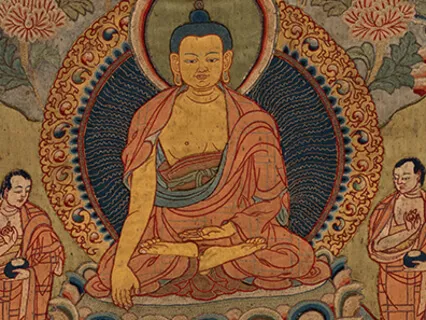
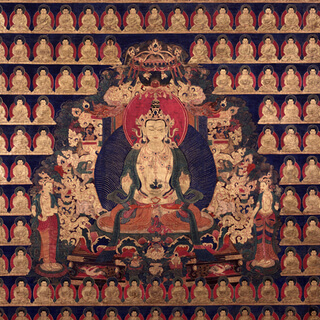
And we're looking at the Buddha here.
This is probably,
To those of you who come from time to time,
A very familiar image.
The iconography here is the Buddha sitting in his lotus posture with one hand in a gesture of meditation on his lap and the other hand touching down on the earth.
And this evokes,
This gesture of the earth touching evokes a very particular moment in the Buddha's life.
Is it ringing a bell?
So if we look a little bit further here at the Buddha,
We can see he has his beautiful robes on and his ears,
Which have large holes in them from where his princely jewelry used to be,
Right?
And so that reminds us that he was a prince.
And he did go through a very sheltered childhood,
Which was kind of shocked to bits when he ventured out of his surroundings,
His very sheltered surroundings,
And saw the first dying person that he ever saw and the first ill person that he ever saw.
And he realized with great shock and severity that suffering is this part of life.
And he then left everything behind and went on to seek kind of end to suffering.
And that was the kind of purpose behind his whole practice.
He went to one extreme and became an ascetic,
Decided to stop eating and drinking and just really focus on his practice.
And that was an important part of his journey.
But it was really once he accepted this bowl of,
I think,
Rice or rice milk,
There are a few stories of what that could have been,
From a generous stranger.
And he said,
Okay,
I will take this generosity and this nourishment and I will nourish my body.
That he took a step towards this middle path that he is known for encouraging people towards.
And it was at that moment that he then sat down and said,
All right,
This is it.
I am going to sit here until I get it,
Basically,
Right,
Until I can really understand what is beyond this life of suffering and really became enlightened.
Well,
He did that while sitting under the Bodhi tree.
And it wasn't quite as simple as that.
There was some fear going on.
In this story,
In this case,
This fear was embodied by the demon Mara,
Whose name means destruction and Mara would taunt the Buddha with all kinds of scary and interesting things.
And an entire army was sort of directed at the Buddha.
And then some gorgeous ladies trying to seduce him and all kinds of things.
Mara really worked hard,
Just like our fear does sometimes,
Really trying to get at us and get in there.
So this was the Buddha's big test.
And he saw what was going on and heard what Mara had to say.
And one of the last things that he said was that he,
Mara,
Said to the Buddha,
To Siddhartha,
He would never reach enlightenment because he had no one in the world who would bear witness to him.
And that moment was the moment that the Buddha reached down and touched the earth.
And he said,
The earth will bear witness to me.
And he became enlightened.
So as we work with our own Maras or our own sort of fears inside of ourselves during meditation or just in daily life,
We will take inspiration from this Buddha and also hear from our wonderful teacher today,
Rebecca Lee,
About some ways that we can engage with and have compassion for our fear.
So Rebecca Lee is a Dharma heir in the lineage of the Chan Master,
Xing Yin,
And started practicing meditation in 1995.
She trained with Master Xing Yin in 99 and then Simon Child to receive full Dharma transmission in 2016.
She's the founder and guiding teacher of Chan Dharma community and a sociology professor at the College of New Jersey,
Where she also serves as faculty director of the Alan Dolly Center for the Study of Social Justice.
Her talks and writings can be found at rebeccalee.
Org.
Please welcome her back,
Rebecca Lee.
Hello again.
It's wonderful to be back.
I hope you all had a lovely summer.
Thank you,
Dawn,
For this wonderful introduction of today's topic.
And when we think about the story of what Mara did in order to kind of get the Buddha off track,
Actually stop him from going for his awakening,
We can also see how he was trying to get at our fear that the Buddha as a human being shared with us.
So for example,
He was trying to tempt him with beautiful women to get at his fear of not being able to control his desires.
And we can all relate to it in one way or the other.
It may be sexual desire,
It may be desire for other things like food or even shopping,
Or things that we worry we're afraid of not having control over.
And that's very often why we are drawn to some form of asceticism,
To engaging in some depriving self deprivation,
Because of our fear of our losing control of our own desire.
And also the part about Mara threatening the Buddha with armies and fears looking warriors is really a kind of a threat to his bodily safety.
And of course,
That's another major source of fear for us,
Fear of what might happen to our body,
Right?
Fear of the body getting hurt,
Getting assaulted by others.
And of course,
Also fear of the body getting sick,
Deteriorating,
And dying.
And a number of books I've read about people talking about their fear of death,
They often talk about,
I'm not afraid of dying,
I'm just afraid of suffering when I die.
So like really,
So the fear of what might happen when this body begins to deteriorate.
And in a way,
Part of that fear is the fear of losing functions of our body that we have identified with being me,
Right?
So really,
It's also a fear of losing part of our body functions that challenges our sense of who we are.
So that is all part of that package.
And also,
The last bit when Mara said that,
You know,
You're going to do no one is going to be here to witness your enlightenment,
You're not going to make it.
And well,
Of course,
There's the fear of being unknown,
Being totally alone.
But also really part of it is like,
We might be able to relate to the fear of not being able to accomplish what we believe is really important for us in our life,
Besides our body,
Keeping our body safe.
We all have goals and missions,
Important,
Meaningful things that we would like to accomplish.
And fear of falling short,
Fear of disappointing ourselves,
And important people in our life,
Fear of being a failure.
Of course,
We fear losing people we love,
Our loved ones,
Things we love,
The life that we love as well.
And along with that is very often fear of having our life changed,
Like having a rug pulled under our feet,
Like things just suddenly change,
Maybe from death or from divorce or from sickness or many other possible things,
Losing things that we love.
And some of you might have heard this famous phrase,
There is nothing to fear but fear itself.
Because if you listen to what Dawn talked about in the introduction,
A lot of these different kind of fear really has to do with our fear of not being able to control that which really can't be controlled.
So we can,
Through our study and contemplation and reflection,
Begin to understand,
Oh yeah,
That's right,
I'm trying to control things that I can't control,
Right?
I can't control what's going to happen tomorrow,
Ten years from now,
And what's going to happen to this body.
So we can talk ourselves into,
Yeah,
I can't control this,
So there's no point in being afraid except that we're still afraid.
So we can be all rational and like,
Yes,
I understand this.
Despite all that,
Fear is still there,
And we are afraid of fear because it's paralyzing.
It's like when we experience fear,
It can completely overwhelm us.
And also,
Experiencing fear in itself challenges our sense of ourselves because we believe we are in control,
We are these rational,
Reasonable people,
And fear feels very irrational.
Even though I understand I can't control this or this and all that,
It still happens.
Or even I have prepared all these,
I still feel the fear.
And it's like,
What's going on?
I know all these things,
And it feels like you're not able to get everything under control.
So what I'd like to talk a little bit about is to practice with fear.
Now here is the fear that arises despite the fact that we have thought things through a gazillion times,
And we feel we're really prepared and we understand.
That's what I'm talking about after we do all that work.
And what we usually do with fear is that we kind of try to do everything we can to kind of avoid having to experience fear.
We avoid doing things that will get us fear.
Or when it shows up,
We pretend we're not afraid.
We deny it or in our own way resist it.
And all these actually,
All these in the way,
Actually give the fear more power by not having,
Not cultivating clear awareness of what is actually going on,
The fear that's arising.
And this summer,
I just told Dawn I lived out of the same suitcase for two months,
Going to seven different places.
And it's not as bad as it sounds,
Actually.
It's a really interesting experience.
One of the stops I made was in Alaska when I went with my husband to go see the glaciers.
And one of the days I was there when we did a hike on the glacier,
And this something that was one of those things I practice with is to go outside my comfort zone,
Way outside my comfort zone,
Because the guide who took us on this hike,
He's an avid ice climber.
So he talked us into trying ice climbing.
No,
I'm not athletic at all.
So when we were doing the ice climbing,
He's like,
Okay,
Well,
He showed us how all the equipment is very safe and all that stuff.
And I saw every knot he made.
It's like,
I knew there's no way I can fall down over this cliff.
So understanding,
Prepare.
And he told me if I just lose it,
He can pull me back up.
There's no way I will get to the bottom of this cliff.
And he told me exactly what to do.
And he told me also,
You will be very afraid.
So I knew I was going to be afraid.
Okay,
So I'm more prepared.
And I'm sure enough,
I have to walk backward over this cliff to climb on this vertical wall.
So sure enough,
I wasn't even really close to the edge.
My legs were not really moving backward.
And my entire body want me to move forward away from that cliff.
I was very glad that my instinct worked.
So like all those things about instinct or fear,
They all were in high gear functioning.
So what's interesting was I really,
The reason why I want to share this story was that it was a really wonderful experience to kind of practice with what happens when fear shows up anyway,
When you feel you're super prepared.
So with my practice in engaging in the Chan practice of silent illumination,
The really,
Really important thing is to remain anchored in the present moment.
So this is the wonderful thing that the Buddha did.
Like he's like,
You can,
You can just remember this by his gesture of touching the ground,
Like,
Stay grounded,
Stay grounded with the present moment by staying grounded,
Anchored with the body,
Staying with the bodily sensations of the moment.
So what that what was the really useful bodily sensation of the moment was to thankfully,
I was still breathing.
So I was breathing and I was really like breathing and I remember to feel my breathing fully in my body.
And that actually is very,
Very important to anchor ourselves to the present moment because fear has this power of taking us out of the present moment.
Like if you have,
If you remember what happens when you're afraid,
It's like,
It takes us away from the present moment reality and all the worst case scenario or the what if shows up and they almost never actually materialize,
But we are completely away from the present moment reality.
So a really important way to counteract that is to actually stay connected and grounded and anchor in the present moment using our body awareness.
And the other thing is when our body is grounded with the present moment is to,
Allows us to face our experience of fear as it is.
Instead of how we usually do it,
It's like,
You because we are so afraid of fear,
We don't want to experience it.
We don't want to feel it,
Anything but that.
It's like actually experience and face the fear as it is.
We might notice that the resistance is like,
I shouldn't be afraid because I'm all prepared.
I know this is supposed to happen.
Or when we feel like,
I know I'm going to be afraid,
But I didn't know I'm going to be this afraid.
It's like,
You have like some quota for how afraid you're supposed to be.
And it's like,
You're completely blindsided by how afraid you actually feel.
It's like,
No,
This is what it is.
This is how,
What is going on right now.
Face the fear as it is,
And it might be some kind of unpleasant mental and bodily sensations.
And one phrase that my student in silent elimination retreat finds very useful,
I share with you is stay with this just as this.
Stay with this just as this to remind ourselves to like,
Okay,
This,
This is,
This is how you,
I'm feeling this fear.
I don't want to move back.
Okay.
Yeah.
This say,
Stay with this just as this.
And this will allow us to being anchored in our body,
Leap sensations and allow us to face the fear as it is.
Then allow us to experience the present moment fully.
And this will do two things.
The first is to allow us to see this thing we call fear for what it is,
Because we will notice that it is just this moment after moment arising of physical sensations and thought.
You might feel the body freezing and like thoughts of like,
I don't want to move backward.
I don't want to do this.
What if this happened?
These are thoughts.
They are thoughts.
They are thoughts.
And that's all they are.
They are all,
That's all they are.
You if you allow yourself to be fully present in the,
In the moment,
We will notice that we will,
We are merely labeling these,
This bundle of sensations and thoughts as fear that I'm supposed to be afraid of.
And the other thing that being fully present in the moment is that it actually allows us to be open to other aspects of the present moment.
Being when we are afraid,
We are completely consumed by it.
We can't,
We blocked by it and we can't see other aspects of the present moment.
You might actually be able to connect with the sense of curiosity.
It's like,
Oh,
I wonder what's going to happen.
There's a reason why you're doing this,
Right?
I want to see how it's like to be climbing on climbing over the cliff.
It's like this curiosity can be experienced.
And also maybe allows us to experience some to recognize the positive aspects of the experience that we,
We have been blocked from seeing.
So learning something new that we are actually very intrigued by the,
These positive aspects of experience being blocked by our preoccupation with fear.
And so like the fear is still part of the present moment.
So we're not getting rid of it,
But it's our home awareness is much wider and broader that it can,
It's put in its right proportion.
It's not the whole experience anymore.
And the other aspect of the Buddha touching the ground is a very important part is trust,
Trusting our ability to connect with our heart mind.
We have a tendency to let our fear to take over.
And when that happens very often,
What we experience is this fabricated sense of isolation that like where I'm all alone,
I'm so afraid and no one cares about me and I'm on my own and all that,
All those ideas will come up.
And when we remember to connect with this sense of trust,
Or you can call,
You can use the word love as well,
Is that it allows ourselves to remember that we are actually loved and supported by all sentient beings in the universe.
That's actually what Shakyamuni Buddha did that like,
You know,
Mara,
You're wrong.
You know,
The entire universe is here,
Right here with me as I experience my awakening.
And even in the moment when we are experiencing great fear,
The entire universe is right here with me,
Supporting me.
You know,
Food being grown and people doing things that make our life possible.
And it definitely did a very useful thing for me because instead of being completely blocked by my fear,
I was able to hear the instructions by my guide and my husband very clearly in that moment exactly what to do so that I was able to walk over that cliff.
If I were allowing myself to be blocked by fear,
Then I would just start screaming and tell them,
Let me get back on this rope.
But you know,
I just listened to the instructions step by step.
And then it was a moment moment experience to be in that whole experience.
So we too,
In any moment of great fear can allow ourselves to be loved and supported by maybe strangers,
Maybe our loved one right around us who are there to help us through the most difficult moments in our life when we feel a great deal of fear.
And the practice of silent illumination in our meditation allows us to be able to remember to anchor to our present moment to the body,
To cultivate this clear awareness by being fully present.
So then this is what we are going to do.
And we're going to set our body up with the in a comfortable position,
Something that's putting pressure on our face,
Maybe glasses.
We might find it helpful to take it off during the meditation.
And we set up our body in a relaxed,
Comfortable posture.
Eyes downcast.
Make sure our head,
Our neck,
Our spine are in a straight line,
Facilitating by tucking in our chin slightly.
And we begin and feel the relaxation of the top of our head.
And feel the relaxation spread to the forehead.
I can see if we hold tension there by habit,
Maybe from worrying.
And allow the tension to melt away.
Feel the relaxation spread to the eyeballs and eye muscles,
Allowing the tension we hold in these muscles to melt away.
And feel the relaxation spread to the facial muscles.
Check and see if we tense up part of our face to hold a facial expression for the world to see.
And right here,
Right now,
You can give these muscles a vacation and allow the tension to melt away.
And feel the relaxation spread to the entire head.
Feel the relaxation spread to the neck muscles.
Directly experience these muscles softening.
Like melting butter,
Allowing the tension to melt away.
And feel the relaxation spread to the shoulder muscles.
And down the arms to the forearms and all the way to the fingertips.
And feel the relaxation spread to the chest area.
Check to see if we are holding tension in our chest by habit,
Perhaps from anxiety or fear.
And allow the tension to melt away.
And feel the relaxation spread down the body to the lower abdomen,
Trusting that the skeletal structure can hold up this body and allow the tension in these lower abdominal muscles to melt away.
And feel the relaxation spread to the upper back,
Allowing the tension we hold in the muscles between the shoulder blades to melt away,
Trusting the skeletal structure can hold up the body,
Allowing the tension to melt away.
And feeling this relaxation continuing to spread down the back to the lower back,
All the way to the buttocks where we feel the sensations of the body sitting on the chair.
And feel the relaxation spread to the thigh muscles and all the way down to the toes.
And feel the relaxation of the entire body sitting right here,
Right now,
Moment after moment.
We practice cultivating this clear awareness of this body and mind sitting right here.
And as we sit here moment after moment,
We notice subtle movements of the body as the body breathes.
We can make use of the changing sensations of the body sitting right here,
Breathing to anchor our mind to the present moment.
And if we notice the mind drifting out of this room,
Or thoughts coming up,
And you allow that to take you out of this room,
Not a problem,
All you need to do is to gently bring your attention back to the changing sensations of the body sitting right here,
Right now,
Breathing on its own,
Trusting your body to breathe on its own.
And all you need to do is to fully experience this emerging present moment.
When your thoughts come through,
No problem.
Allow it to be there,
And you will go away on its own.
One,
Two,
Three,
Four.
.
.
.
.
.
.