Hello my friend,
And welcome back to Drift Off.
I'm your host Joanne.
And tonight I'll be reading another enchanting tale by Henry Beston called The Man of the Wildwood.
This old-fashioned fairy tale will carry us into a mysterious woodland world filled with adventure,
Kindness,
A little bit of magic,
And the creatures who make their home beneath the trees.
So as we get ready to begin,
Make yourself as comfortable as you can.
Settle your head into your pillow.
All the covers around you.
And allow yourself to become still.
Take a slow,
Easy breath in.
.
.
And then gently breathe out.
Perhaps letting your shoulders drop just a little as you do.
Let your jaw soften.
Relax the muscles around your eyes.
And allow your hands and fingers to become loose and heavy.
The day can begin to fade quietly into the background now.
Any thoughts that happen to wander through your mind can simply pass on by.
And for the next little while,
You can simply rest here and listen,
Allowing the gentle rhythm of the words to carry you along.
And whether you remain awake for the whole story or drift off somewhere along the way.
I hope you enjoy spending this quiet time with me.
So snuggle in,
Get comfy and cozy,
And whenever you're ready.
Let's begin.
Once upon a time,
On a summer's morning after a night's rain,
A country squire's son stood within an arched doorway of his father's house,
Gazing upon the hedgerows and the fields.
The sun was shining after the storm.
A high wind was shaking the trees,
Scurrying gusts fled through the knotting grass,
And silvery white clouds sailed the arching sky.
And beholding the bright morning and the rain-washed land,
A great longing came into the heart of the squire's son to follow the clouds over hill,
Over dale,
And to see the world.
Presently with this prayer.
Presently,
With his parents' blessing locked in his heart's treasury and a purse of gold in his pocket,
He leaped to the saddle of his dappled steed.
Waved his plumed hat,
And galloped away.
Long he rode in afar.
And presently he found himself in the heart of the deepest and darkest wildwood that was ever to be seen.
Before him,
Behind him,
Around him,
All about,
Were the trunks of numberless trees,
Trees so tall that they hid the sky and made of it but patches of cloudy white or speckles of blue.
Trees,
Broad trees,
Slender trees,
Trees that were like men-at-arms,
Trees that were shy and aloof as maids,
Trees that were silent.
Trees that rustled.
Everywhere trees.
And deep was the wildwood's silence,
And unbroken save the soft pad of the horse's hoofs and the rare song of a hidden bird.
At the close of his third day,
The Squire's son found himself at the gates of a noble city,
Built of cedar green glass on an open hill in the heart of the Wildwood.
Now,
As it was late in the day when the youth arrived at the city,
It came to pass that he went to an inn for supper and the night.
Mistress of the tavern,
I must tell you,
Was a lonely orphan named Miranda.
Surely there was never a fairer or a kinder little maid.
Beneath her ancient roof,
The humble Wayfarer met with as friendly a greeting as his richer fellow.
And with her own hands she gave bread and milk to the unfortunate and poor.
Now it chanced that the youth had been given a chamber overlooking the court of the inn.
And presently,
He heard from below a confused din of voices,
Laughter,
And jeers.
In wonder as to what the cause of the hubbub might be,
The Squire's son drew open his lattice window and looked down.
A great green cage on wheels was to be seen there.
Surrounded by a throng of curious onlookers who poked fingers at something within it.
Shrieked cat calls,
Whistled,
And laughed to split their sides.
The youth descended to the court and made his way into the throng.
Within the cage,
Clawed in a gray wolf's skin,
Sat a creature like unto a man.
Strong of body was he,
And beautiful to behold.
His eyes were blue.
And they were the eyes of a wild thing.
And the long hair which fell about his neck was of the strangest tawny gold.
Aware of the stir made by a newcomer.
The prisoner turned.
And fix the youth with a glance in which lay pride mingled with despair.
Presently,
The proprietor of the cage,
Who had been baiting his horse at the stables of the inn,
Returned and lowered curtains about the cage and the prisoner.
Fearful lest they be summoned to pay the showman his penny,
The onlookers took to their heels,
And soon the youth found himself alone in the courtyard.
Now,
This prisoner,
I must tell you,
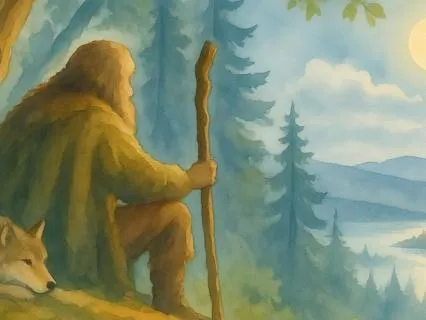
Was known as the Man of the Wildwood.
For some hunters had found him in a net which they had spread in the wildwood a year before.
To some,
An animal-like man.
To others,
A man-like animal.
The man of the Wildwood remained a mystery in the land.
As for the prisoner,
Never a word said he.
And none knew whether he would not or could not talk.
Securely locked in his cage.
The man of the Wildwood was shown to all at a penny a head.
And now.
.
.
As the youth mused alone in the silence,
The maid Miranda came forth to light the great lantern in the court.
A white apron she wore.
A great white cap.
And there were red ribbons on her gown.
The Squire's son thought he never beheld a maid so fair.
Catching sight of the squire's son,
Standing idly by,
Miranda said to him,
Pray,
Good sir.
What may there be in Yoncage?
The man of the wildwood,
Replied the youth.
And he told Miranda what he had overheard among the throng.
"'Alas,
Poor creature,
' said the gentle maiden.
How bitter must be such a cage to one who has known the freedom of the wildwood!
I surely must bring him some honey and bread.
And away she sped to the larder of the inn to fetch the good cheer.
The twilight deepened.
When Miranda returned again.
The youth and the maid walked to the green cage and offered the gift to the man of the wildwood.
For a little space,
The prisoner,
Crouched in a dark corner of the cage,
Made neither sign nor sound.
And slowly,
Very slowly,
He approached the gift of the kind maiden and ate of it hungrily.
And,
Because he had met with so little pity and compassion,
The man of the Wildwood was moved to his heart's deep and gazed upon the young folk with strange eyes.
All evening long the squire's son mused on the man of the wildwood.
Suddenly,
A great pity possessed him.
And going to the showman.
He purchased the prisoner for 50 golden crowns.
And now it was midnight,
And the green cage,
Drawn by the showman's horse,
Rolled down a deserted road to the edge of the wildwood.
A moon,
Almost at the full,
Sailed the high heavens,
Now vanishing under thin black clouds,
Now floating forth through silvery rifts and aisles.
Side by side,
Saying little to each other,
Sat the showman and the youth.
Suddenly,
A high wall of rustling darkness loomed before them at the verge of a moonlit field.
The cage had reached the gate of the forest.
With a key given him by the showman,
Who was a little afraid.
The squire's son unlocked the cage.
And freed the men of the Wildwood.
And even as he did so.
A summer breeze went singing through the wildwood with a great cry of joy.
Free at last.
The man of the wildwoods said not,
But lifted his head to the stars.
Then raising his right arm high above his head,
He made a stately sign of salutation to the youth.
And walked like a king into the darkness of the trees.
The next morning,
The youth rose early and set forth once more upon his travels.
Cities he saw,
And nations and kingdoms,
But no one in them who he thought fairer than Miranda.
As for Miranda,
Scarce had the Squire's son ridden away.
Then she began to hope for his return.
Little by little,
The tide of summer rose to its full,
And Ebbing left the gifts of golden autumns in the fields.
But now you must hear of the three merchants,
The Moonstone and the misfortunes of Miranda.
It was a harvest eve.
And presently Miranda.
Watching by the tavern door.
Beheld three men,
Habited as merchants,
Making their way along the city street to the inn.
Somewhat to her surprise,
They came afoot.
Two of these merchants,
I must tell you,
Were tall and lean,
Whilst the third was short and fat and had green eyes.
Unwilling to refuse,
Yet somewhat against your better judgment.
Miranda granted the request of these merchants for lodgement at the inn.
Now these three merchants,
Alas,
Were not merchants at all,
But three famous thieves who had come to the city to steal a certain celebrated gem belonging to the king.
This gem was a moonstone,
A moonstone of such rare loveliness that men fabled that it had tumbled to the earth from the moon.
And been found in a forest glade at the end of a ray of summer moonshine.
In all the world,
Nothing there was more fair.
And now it was another midnight.
And the three thieves,
Quitting their rooms to the inn,
Stole as quietly as three cats down the oaken stairway to the empty street.
Unknown to them,
However,
Miranda,
Wakened by their whispers,
Followed close behind.
Now retreating into shadowy doorways.
Now leaning against a wall lest she be seen.
Presently,
The rogues approached the huge darkened mass of the palace and made their way into the grounds through the Dreaming Gardens.
A little fountain splash somewhere in the night?
The moon had set,
And a thin layer of cloud dimmed the wheeling stars.
Chuckling softly at their success,
And having thus far eluded the palace watch,
The thieves now pressed open a little window and crawled into the Tower of Jewels.
Hurrying as fast as ever she could,
Miranda ran to wake the yeoman of the guard.
Suddenly,
There was a great outcry.
A light appeared in a window.
There were shouts and a clash of arms,
And the thieves came tumbling out of the window with the moonstone and vanished.
All three into the starry dark.
A moment later,
Flaming torches moved amid the trees,
A throng of men-at-arms poured into the gardens,
And Miranda found herself a prisoner.
Accused of having harbored the thieves and of having had a hand in the robbery,
The maiden of the inn was the next morning brought to trial.
Shake into the heart.
Yet protesting her innocence to the last.
The poor maiden made but a confused defense.
And presently was condemned to suffer the sternest judgment of the law.
When this was pronounced,
However,
The friends and neighbors who loved Miranda made such a tumult in the court that the judgment was altered,
And Miranda was sentenced to be carried into the jailer's cart into the very depths of the Great Wildwood,
And there abandoned to live or perish as she might.
And now it was twilight,
A golden harvest twilight,
And Miranda standing with her hands tied behind her by the wrists and her head bowed low.
Was drawn in a two-wheeled cart through the darkening streets of the glass city.
And carried far out into the pathless regions of the wildwood.
Once there.
The jailer who pitied her.
Loosened her from her bonds.
Gave her a crust of prison bread.
And drove away.
The night was moonless,
The stars were bright,
And a wild wind from some far west of the world was roaring through the trees,
Now dying away to a faint and vagrant murmur.
Now rising to a great wailing rustling cry that arose and broke and ebbed like a wave of the sea.
And the swaying branches tossed their clots of darkness against the stars,
Whilst underfoot so dark it lay that naught was to be seen.
For some moments,
The unhappy maiden,
Trembling with dread,
Stood motionless in the dark of the wildwood.
Strange sounds drifted to the ears.
The moan of rival branches.
The laughter of running water,
And the far cry of some hunter of the night.
Suddenly,
She felt herself grow icy cold,
And her eyes closing,
She sank to the earth and knew no more.
Meanwhile,
That very eve,
In the distant city,
The squire's son was riding joyously to the inn.
Presently he reached his long-awaited goal and,
To his great surprise,
Found the windows darkened and the doorway sealed and barred.
Seeing him thus wandering about.
A neighboring good wife came forth from her dwelling.
And told him,
With tears in her eyes,
The cruel fate of the good Miranda.
Oh,
Wicked judgment,
Cried the youth.
Tell me whither in the wildwood have they taken her,
For I must find her,
Come what may.
Alas,
Who can say?
" replied the good wife.
All that I can tell thee is that the cart vanished through the eastern gate and down the eastern way.
And now the youth cried to his dappled steed to press on as he had never done before.
And galloped through the night to the wildwood.
Darker it grew,
And darker still.
Arriving at length in a little clearing,
The Squire's son bade his horse stand halted,
And plunged into the wildwood.
Loudly calling and hallooing for the lost maiden.
On and on through briery thicket and stony mire He blundered forward in the gloom.
Suddenly,
An unseen ravine opened beneath him.
His feet trod forward into nothingness.
His hands caught at the air.
And with a cry he fell.
And now as you lay there stunned.
Strong arms caught him gently up and carried him away.
When he woke to life again,
He found himself lying on a bed of skins,
Piled near a fire on a cavern floor.
By his side,
The torment of his human prison fallen from him like an evil garment.
Noble and beautiful and strong,
Stood the man of the Wildwood.
Lifting himself up and turning toward his rescuer.
The youth poured forth his story and sought the eyes of the man of the Wildwood for a token that he had understood.
For a moment,
However.
The man of the Wildwood made no sign.
Then of a sudden,
With a gesture at once gentle and commanding,
He touched the youth by the hand.
And,
Going to the cave mouth,
Opened his arms to the dark wildwood and called upon it its secret speech.
And he bathed the things of the wild.
The brethren who go afoot.
Kindred of the air and the humble folk who crawl upon the earth to go forth through the wildwood and find the maiden and guard her well.
And he called upon them too,
To follow the thieves and make them prisoners of the wood.
And now,
A great murmur,
Even such a sound as Harold's,
The coming of a mighty rain,
Swept through the wood.
Forth from their dens creeping came the bears,
The gray wolves,
And the little foxes.
The shy deer started in their glens.
The birds awakened with a flutter in their nests and took wing into the starry dark.
Little wood mice came tumbling out of their warm beds,
And even the spotted snakes went forth to seek Almost in less time than it takes to tell of it,
The earth and the air seemed full of the people of the wild,
Questing here and there in search of the maids.
There passed a little time,
And suddenly a great brown owl,
Half blinded by the firelight,
Swooped down to the arch of the cave mouth with the news that he had found the maiden asleep beneath a sheltering pine.
And,
A moment later,
A nimble gray hare with upstanding ears came hopping in with the tidings that the thieves had been taken on a wildwood road.
Now this news was quite enough to cure the squire's son of his fall.
So,
Jumping to his feet,
He followed the staring owl and the man of the wildwood to the refuge of Miranda.
You may be sure that Miranda rejoiced to see the Squire's son.
As for the thieves,
They came upon them standing terror-stricken,
Huddled together in the heart of a wide circle of watching,
Silent,
Flame-eyed animals.
Creepers and vines had seized upon them as they fled,
And bound their arms behind with leafy fetters.
Suddenly,
A friendly whinny was heard,
And the dappled steed,
Guided by a benevolent badger,
Came trotting through the wildwood to his master.
To lift Miranda to the saddle was but a moment's task.
The thieves walking ahead.
Miranda Riding And the youth and the man of the Wadwood falling behind,
Even thus went the little company through the forest dark to the edge of the Wadwood.
Morning was at hand.
Only the brighter stars were left in the wide and cloudless sky.
Presently,
The dawn broke over the green horizon of the trees.
Arriving at the bound of the forest.
The man of the wildwood lifted his arm once more in token of farewell,
And with his animals clustered about him,
Watched his friends till they vanished down the road.
Presently,
The domes and towers of the City of Glass rose before the little company.
A swirling autumn mist lay over the fields between the wildwood and the city walls.
The sky was rosy overhead.
And hundreds of little bells were ringing.
Pausing at the eastern gate,
The squire's son delivered the thieves to the yeoman of the guard.
On the following morning,
The three rogues brought to trial,
Declared the innocence of Miranda,
Confessed their wickedness,
And restored the Moonstone.
A stern sentence was justly theirs,
But so pleased was the king at the return of his jewel,
That he merely condemned them to road-mending for a number of years.
To Miranda,
The king gave a rich reward.
To the squire's son,
A fair house whose windows looked forth on the treetops of the wildwood.
And thus it came to pass that the Squire's son married the good Miranda and lived happily with his dear wife and little ones many a long and pleasant year.
Sweet dreams my friend.
Sleep well.